Published on
What Is an AI Pricing Strategy for Wholesale?
An AI pricing strategy for wholesale is a data-driven system that continuously recommends optimal, contract-aware prices across SKUs, accounts, and channels. Unlike consumer AI pricing, which mostly reacts to shopping-cart behavior and competitor scraping, wholesale AI pricing has to respect negotiated contracts, account hierarchies, and tiered volume commitments before it touches a single price. Get the sequence wrong and you erode trust with the accounts that generate most of your revenue.
Three moves make this real instead of theoretical:
Run a readiness check. Confirm you have 6 to 12 months of order history, current cost data, and inventory feeds before evaluating any model.
Pick a pilot candidate carefully. Choose high-volume, transactional SKUs with no active contract, not your top negotiated accounts.
Set one governance guardrail immediately. Require that AI recommendations write to a separate pricing layer, never directly overwrite ERP-governed contract prices.
Key Takeaways
An effective AI pricing strategy for wholesale succeeds only when it treats contract prices as inviolable and layers market-responsive recommendations on top, never in place of them.
Point | Details |
|---|---|
Contract-aware architecture is non-negotiable | Keep ERP as the authoritative source for negotiated prices; AI writes to a separate recommendation layer. |
Data readiness comes before modeling | Gather 6 to 12 months of order history, cost data, and inventory feeds before evaluating vendors. |
Margin gains are real but vary widely | Vendor benchmarks range from roughly 3% average margin improvement to vendor-reported cases as high as 12%. |
Pilot narrow, measure fast | Test on non-contracted, high-volume SKUs for 60 to 90 days before scaling to adjacent categories. |
BRDGIT supports readiness through delivery | BRDGIT offers readiness assessments and fractional AI engineering to help wholesalers build and integrate pricing pilots. |
Table of Contents
What Is AI Pricing Strategy Wholesale Worth to Your Margins?
How Does an AI Pricing System Actually Work?
What’s the Implementation Roadmap for Wholesale AI Pricing?
What Data and Systems Does This Require?
Which Wholesale Pricing Tactics Does AI Actually Enable?
What Governance Prevents AI Pricing Mistakes?
How Do You Measure ROI and Timeline to Value?
How Do You Choose the Right Vendor or Partner?
How Will Agentic Procurement AI Change Wholesale Pricing?
Where Should Wholesalers Actually Start?
How BRDGIT Helps Wholesalers Build AI Pricing Systems
Frequently Asked Questions
Sources
What Is AI Pricing Strategy Wholesale Worth to Your Margins?
Wholesale margins get squeezed from three directions at once: catalog scale that makes manual pricing reviews impossible, contract complexity that buries pricing logic in spreadsheets and side letters, and procurement automation on the buyer’s side that finds your pricing gaps faster than your team can patch them. Buyers now run their own automated cost comparisons across suppliers, and a distributor still pricing off last quarter’s spreadsheet is negotiating blind.
The published numbers back up the urgency. Infor reports average margin improvements around 3% for distributors that adopt embedded AI pricing optimization, a conservative but repeatable figure across real implementations. Vendor case studies push higher: Aimondo reports revenue uplifts up to 38% and margin improvements up to 12% for some customers, though those figures come from vendor-selected success stories and should be read as a ceiling, not an average.
What actually changes day to day:
Pricing decisions that took a rep 10 minutes of spreadsheet-checking now take seconds.
New hires price with the same confidence as a 15-year veteran, because the logic lives in the system instead of someone’s head.
Margin leakage from stale price sheets gets caught before it compounds across a full sales cycle.
Wholesalers who treat it that way, per Eightx’s 2026 wholesale AI research, are the ones protecting margin while competitors still argue about whether AI belongs in a relationship-driven business.
How Does an AI Pricing System Actually Work?
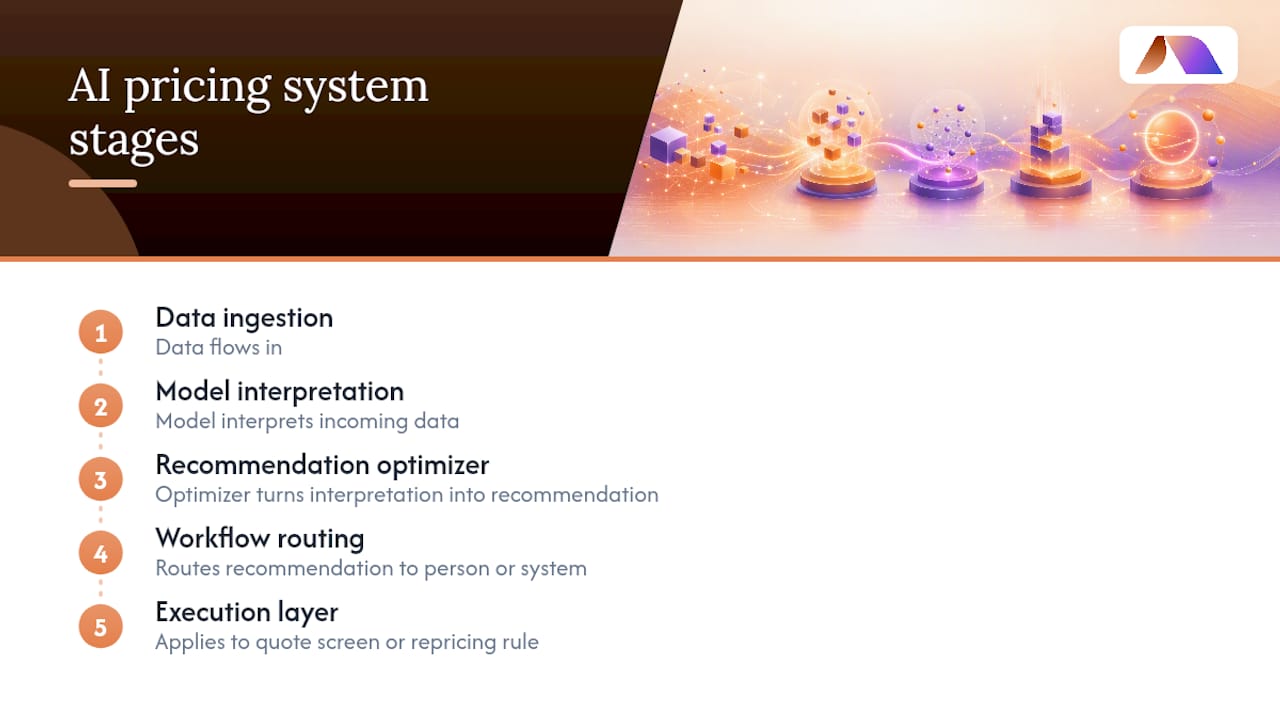
Picture the system as five stages in sequence: data flows in, a model interprets it, an optimizer turns interpretation into a recommendation, a workflow layer routes that recommendation to the right person or system, and an execution layer applies it, whether that’s a rep’s quote screen or an automated repricing rule. Break any link in that chain and you get either bad prices or prices nobody trusts enough to use.
Different model types handle different jobs. Elasticity models estimate how sensitive each account or SKU is to price changes. Demand forecasting predicts volume shifts before they hit your inventory. Price-sensitivity models segment customers by how much friction they’ll tolerate on quote adjustments. Reinforcement learning and band-optimization approaches continuously test small price movements within safe bands and learn what sticks, useful mainly for high-velocity, non-contract SKUs where testing carries low risk.
Contract encoding is where most implementations either succeed or quietly fail. Every negotiated rate, rebate structure, and volume tier has to be translated into machine-readable rules the AI respects as hard constraints, not suggestions it can override when the data looks tempting. Dynamic pricing AI should function as a recommendation layer that sits alongside your ERP, never underneath it or above it in authority.
Pro Tip: Keep your ERP as the single source of truth for contract prices at all times. Let the AI write market-responsive recommendations to a separate pricing layer, and require human or rules-based approval before anything touches a contracted account. This one architectural decision prevents the single most damaging mistake in wholesale AI pricing: an algorithm quietly renegotiating a customer’s contract without anyone noticing until the invoice dispute.
This layered architecture, covered in more depth in BRDGIT’s guide to AI tools for supply chain, is what separates a pricing engine wholesalers can trust from one that generates support tickets.
What’s the Implementation Roadmap for Wholesale AI Pricing?
Most successful rollouts follow several phases, with readiness work being crucial before piloting.
Step 1: Readiness and data collection. Before evaluating any tool, map who owns pricing data across ERP, CRM, and PIM systems, and confirm you have the minimum history a model needs to learn from.
Confirm 6 to 12 months of clean order history, cost data, and inventory positions.
Identify every integration point: ERP for contracts, CRM for account context, PIM for product attributes.
Assign a single data owner accountable for accuracy, not a committee.
Step 2: Pilot design. Pick a narrow, low-risk scope and define success before you start, not after.
Select 1 to 2 product categories with high transaction volume and no active contracts.
Define 2 to 3 success metrics upfront: margin delta, quote-to-order time, and price attainment rate.
Build explicit guardrails separating contract-locked SKUs (untouched by AI) from market-responsive SKUs (AI-adjustable within bounds).
Run the pilot for a full sales cycle, typically 60 to 90 days, before drawing conclusions.
Step 3: Scale and operate. Once the pilot proves out, the work shifts from proving value to maintaining it.
Establish a model retrain cadence, usually quarterly, tied to seasonal demand shifts.
Build an MLOps process for monitoring model drift and flagging anomalies before they reach a customer quote.
Assign clear roles: a pricing owner who approves band changes, an IT owner who maintains integrations, and a sales liaison who surfaces field feedback.
Embedding these recommendations directly into order-entry and CRM workflows, as Infor’s implementation cases show, is what actually drives adoption. A pricing engine that lives in a separate dashboard nobody opens delivers zero margin improvement, regardless of how good the model is. For broader context on why this urgency is accelerating across the sector, see BRDGIT’s analysis of why B2B firms need an AI strategy in 2026.
What Data and Systems Does This Require?
You need three things before an AI pricing model produces anything trustworthy: enough historical data, connected systems, and a clear rule for who wins when the AI and the ERP disagree.
On the data side, most implementations require 6 to 12 months of order history alongside current cost feeds and customer-segmentation data. Six months of history without cost data tells you almost nothing useful. Twelve months with clean costs, inventory positions, and customer hierarchies gives a model enough signal to distinguish a real demand shift from seasonal noise.
The integration pattern that works: read contract prices and customer terms from the ERP, since it remains the authoritative system of record, then write AI-generated, market-responsive price recommendations to a separate commerce or pricing layer. That separation is what keeps a negotiated rate from getting silently overwritten by an algorithm chasing a margin target.
Minimum system checklist:
ERP integration for contract terms, cost data, and order history.
PIM or catalog system for accurate product attributes and category structure.
CRM integration for customer hierarchy, account tier, and relationship context.
A competitor or market-price feed, even a manual one, for market-responsive categories.
MLOps tooling or a defined process for monitoring and retraining models.
Pro Tip: If your order history is thin, thinner than 6 months, don’t wait a year to start. Begin with a rules-based pricing layer informed by cost-plus logic and manual elasticity estimates, then layer in machine learning as history accumulates. A hybrid system beats a stalled project every time. For groundwork on the inventory visibility this depends on, review BRDGIT’s guide to AI-powered inventory control.
Which Wholesale Pricing Tactics Does AI Actually Enable?
The tactics that matter most protect margin on contract accounts while capturing volume opportunity everywhere else.
Contract-aware dynamic pricing: applies market-responsive adjustments only to non-contracted SKUs, leaving negotiated rates untouched. This is the safest entry point for most wholesalers.
Performance-based discounts: ties discount depth to actual purchase behavior, like consistent reorder cadence, rather than a flat negotiated rate. Monitor for accounts gaming the threshold near period-end.
Bundles and cross-sell pricing: prices a bundle below the sum of components to move slower-turning inventory alongside high-velocity SKUs. Watch total margin, not just the headline discount.
Subscription and replenishment pricing: rewards predictable reorder schedules with modest price breaks in exchange for demand-forecasting certainty on your side.
Minimum order enforcement: uses AI to flag orders below cost-to-serve thresholds and either suggest a minimum quantity or apply a small-order surcharge automatically.
Contract-aware pricing and minimum order enforcement protect margin directly. Bundles and performance-based discounts optimize volume, sometimes at the cost of a few margin points, so treat them as separate levers with separate success metrics rather than one blended “pricing AI” initiative.
AI also speeds up quote generation and RFQ triage. Instead of a rep manually checking price history and margin targets for a 40-line RFQ, the system pre-populates a recommended quote in seconds, flagging any line that falls outside acceptable bands for human review. That single change, more than any dynamic pricing rule, is often what convinces a skeptical sales team the system is worth using.
What Governance Prevents AI Pricing Mistakes?
The most damaging failure mode is an AI system overriding a negotiated contract price because the optimizer saw a margin opportunity it wasn’t authorized to act on. The second most common mistake: launching without cost-to-serve data in the model, which leads to recommendations that look great on unit margin but lose money once fulfillment and service costs are counted.
Common mistakes to guard against:
AI writing directly to contract-governed price fields instead of a separate recommendation layer.
Missing approval tiers, so a junior rep can accept an AI-suggested price with no second review on large accounts.
No audit log, making it impossible to explain to a customer why their price changed last quarter.
Cost-to-serve left out of the optimization, inflating apparent margin gains.
A workable governance checklist requires three things: tiered approval thresholds based on discount size or account value, a full audit log of every AI recommendation and who approved it, and explainability sufficient that a rep can tell a customer why a price moved. Build compliance and ethical review into this same governance layer, covering fair-pricing rules and data-privacy handling, rather than treating it as a separate legal exercise bolted on afterward.
How Do You Measure ROI and Timeline to Value?
Track five KPIs from day one of any pilot: margin delta versus your pre-AI baseline, net revenue retention on piloted accounts, quote-to-order time, price attainment rate against list, and the unprofitable order rate you’re catching before fulfillment.
Expect a realistic timeline of a 60 to 90 day pilot to reach statistically meaningful results, followed by incremental rollout to adjacent categories over the following two to three quarters. Rushing this window produces noisy data and false confidence in either direction.
Infor’s benchmark of roughly 3% average margin improvement gives a conservative floor for estimating breakeven: if your annual wholesale revenue on piloted categories is $10 million, a 3% margin lift is $300,000 in incremental margin, against which you weigh data engineering, integration, licensing, and ongoing operating costs.
Cost considerations to budget for:
Data engineering and integration work, often the largest upfront cost.
Software licensing, whether a standalone pricing platform or an embedded ERP module.
Ongoing model monitoring and retraining, typically a fractional resource rather than a full-time hire.
How Do You Choose the Right Vendor or Partner?
Evaluate any prospective vendor or partner against how well they handle the wholesale-specific problems generic pricing tools ignore.
Do they support native ERP integrations, or does contract data require manual export and reconciliation?
Is the architecture contract-aware by design, with a clear separation between negotiated and market-responsive pricing?
Can they explain any given recommendation in plain terms a sales rep can repeat to a customer?
Does the system embed into order-entry and CRM workflows, or does it live in a standalone dashboard?
Ask directly: how do you handle contract prices, what minimum data do you require to start, and what success metrics have your other wholesale customers actually hit? On the buy-versus-build question, most mid-sized wholesalers are better served buying or partnering for the model and optimizer layer while keeping data governance and ERP integration ownership in-house, since that’s where institutional knowledge about your contracts actually lives. For the integration and supplier-communication side of this evaluation, BRDGIT’s guide to streamlining supplier communication with AI covers the adjacent workflow questions worth asking.
How Will Agentic Procurement AI Change Wholesale Pricing?
Agentic procurement AI, systems that autonomously compare suppliers and negotiate on a buyer’s behalf, is about to make every SKU’s price more visible and more scrutinized than it’s ever been. When a buyer’s agent can scan ten suppliers in the time it takes your rep to open a quote template, unit price alone stops being a defensible position. Research on agentic AI in B2B pricing points to shifting value toward bundled services and relationship-based pricing as the practical defense.
Three moves to make now:
Bundle value into your pricing so a procurement agent comparing unit price alone misses your actual advantage: faster fulfillment, better fill rates, dedicated support.
Enforce minimum order and volume tiers explicitly, so agentic buyers can’t fragment orders to dodge them.
Instrument your data now so a procurement agent evaluating you can see total cost-to-serve, not just a line-item price.
Pro Tip: Simulate how a buyer’s procurement agent would evaluate your pricing today. If the only variable it can compare is unit price, you’ve already lost ground before the negotiation starts. This connects directly to the supplier-side shifts covered in BRDGIT’s piece on AI in supplier management.
Where Should Wholesalers Actually Start?
We keep seeing the same pattern: teams get excited about dynamic pricing’s upside and skip straight to the optimizer, before anyone has decided which SKUs are even safe to touch. Readiness work isn’t glamorous, but it’s the difference between a pilot that builds trust and one that damages it with a single mispriced contract account.
Start small. Pick a narrow, non-contracted category, measure hard for 90 days, and only then expand. If your team needs help translating that roadmap into an actual build, that’s a conversation worth having early rather than after a failed first attempt.
How BRDGIT Helps Wholesalers Build AI Pricing Systems
There are real technical decisions buried in every step of this roadmap, from contract encoding to ERP integration to model retraining cadence, and most wholesale teams don’t have a full-time AI engineer on staff to make them.
BRDGIT works with wholesale and distribution teams starting from an AI readiness assessment that maps your actual data, systems, and contract complexity before recommending anything. From there, our fractional engineering support gives you experienced AI talent for the pilot build and ERP integration work, without the cost or delay of a full-time hire you may not need past the rollout phase. That means you get someone who has done this integration before, not someone learning your ERP on your dollar. If you’re ready to find out what a realistic pilot looks like for your product catalog, start with a conversation about fractional AI engineering support built around your actual pricing structure.
Frequently Asked Questions
What is an AI pricing strategy for wholesale, in one sentence? It’s a system that continuously recommends contract-aware, data-driven prices across your SKUs and accounts, without overriding negotiated rates already locked into your ERP.
How is AI pricing for wholesale different from retail AI pricing? Wholesale pricing has to account for negotiated contracts, tiered volume commitments, and account hierarchies that don’t exist in most consumer pricing models.
How long does it take to see results from AI pricing? Most pilots need 60 to 90 days to produce statistically meaningful results, followed by incremental rollout over the following two to three quarters.
Can AI pricing override my negotiated contract prices? It shouldn’t. The safest architecture keeps your ERP authoritative for contract prices and routes AI recommendations to a separate, market-responsive pricing layer.
Do I need a full-time AI engineer to run this? Not necessarily. Many wholesalers use fractional AI engineering support for the initial build and integration work, scaling to in-house ownership once the system is stable.
Sources
Improve distribution margins with AI pricing optimization | Infor
Pricing Solutions For Wholesale & Distribution |Aimondo Predictive Analytics and Pricing Solutions