Published on
AI Use Cases in Retail Merchandising: 2026 Guide
TL;DR:
AI in retail merchandising boosts conversion rates through product content, chatbots, and personalized recommendations. Effective implementation requires clean data, cross-system integration, and measured pilots to build trust and scale successfully.
The highest-impact AI use cases in retail merchandising right now are GenAI product content generation, pre-sale chatbots, semantic search and query refinement, dynamic pricing, vision AI for shelf monitoring, demand forecasting, and personalized recommendations. Each one targets a different KPI:
GenAI product descriptions and titles: conversion lift of a few percentage points per large-scale field experiments
Pre-sale chatbots: conversion gains up to a significant double-digit percentage in tested deployments
Semantic search and query refinement: single-digit percentage conversion lift with measurable friction reduction
Dynamic pricing and promotion optimization: margin lift and improved promotional ROI
Vision AI for planograms and shelf monitoring: reduced shrink and improved fill rates
Demand forecasting with time-series ML: fewer stockouts, higher inventory turns
Personalized recommendations: average order value (AOV) uplift and repeat purchase gains
Those same experiments estimated annual incremental value at a few dollars per consumer in workflows that showed positive effects. BRDGIT helps merchandising teams move from that evidence to actual execution through readiness assessments, pilot design, and fractional AI engineering support.
Table of Contents
What are the most valuable AI use cases for merchandising teams?
How do you pilot and scale AI merchandising without overcommitting?
What data, technology, and team structure do you actually need?
How do you govern AI merchandising and measure its ongoing performance?
Why cross-functional integration matters more than isolated pilots
Key Takeaways
The gap between AI enthusiasm and AI execution in retail
BRDGIT helps you move from pilot to production
Useful sources
What are the most valuable AI use cases for merchandising teams?
The nine use cases below are ordered by implementation complexity, not impact. Start where your data is cleanest.
Assortment optimization and SKU rationalization. Feed sales velocity, gross margin, and price elasticity data into a ranking model. The workflow: score every SKU, run a controlled test on the bottom quartile, then reallocate shelf space and open-to-buy dollars to winners. Expected outcome: higher inventory turns and fewer end-of-season markdowns.
Demand forecasting and inventory allocation. Time-series ML models (gradient boosting, LSTM networks) trained on POS history, promotions, and external signals like weather or local events reduce stockouts and cut excess safety stock. Retrieval-augmented generation (RAG) can pull planning signals from unstructured sources, such as trend reports or supplier lead-time notes, directly into the forecast.
Dynamic pricing and promotion optimization. Elasticity estimation feeds a continuous pricing loop: set a price, measure the demand response, update. For promotions, AI models score which SKU-customer combinations respond best to a discount before you commit trade spend. The AI-driven retail pricing strategy that works is one that experiments continuously rather than repricing once a quarter.
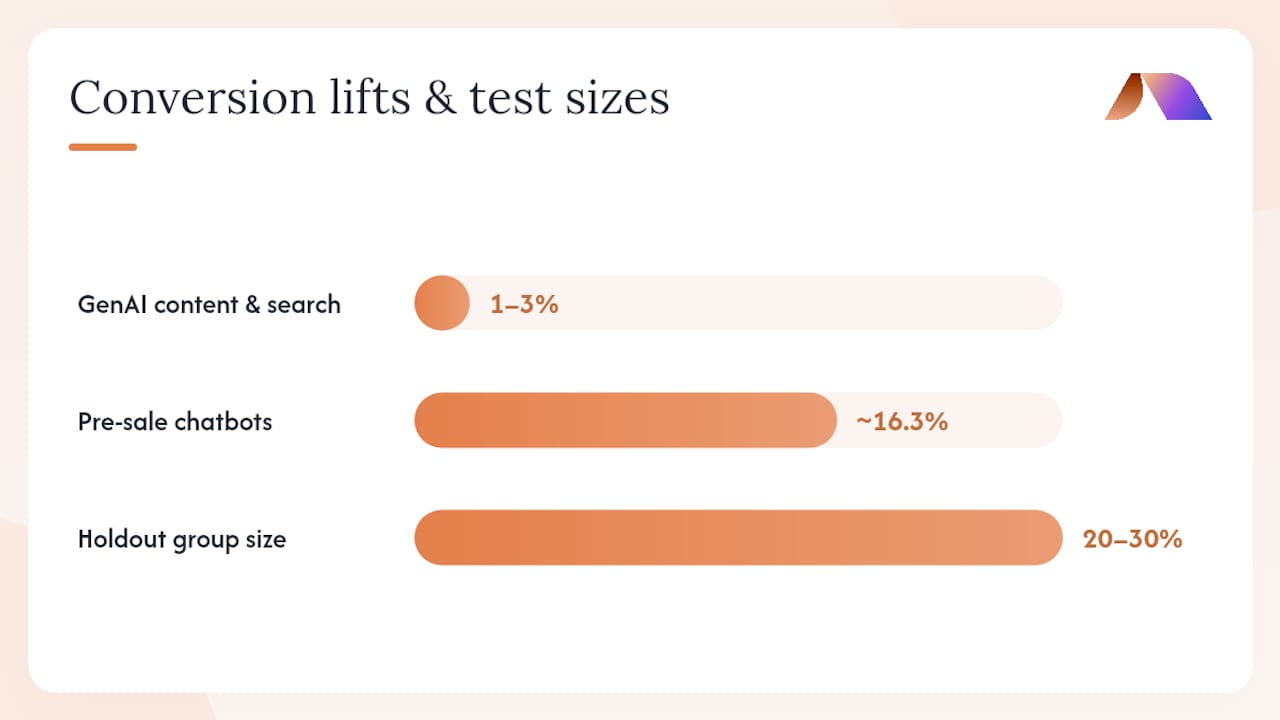
Semantic search and query refinement. Replacing keyword-matching with vector-based semantic search means a shopper who types “warm jacket for rainy commute” finds the right product even when no description contains those exact words. GenAI can also rewrite ambiguous queries before they hit the catalog. Field experiments show 1–3% conversion lifts from this workflow alone.
Product content generation with GenAI. LLMs generate titles, descriptions, and attribute tags at scale. Tools like Shopify Magic connect directly to store data without sharing it across stores, making A/B tests on product pages fast and low-risk. Expect 1–3% conversion improvement when copy is tested against a holdout.
Pre-sale chatbots and conversational agents. A chatbot positioned at the top of a high-traffic category page can answer sizing questions, compare products, and surface promotions before a shopper bounces. The GenAI field research found this workflow produced the largest treatment effects, up to ~16.3%, particularly for buyers who were undecided at the point of entry.
Vision AI for planograms, shelf monitoring, and replenishment. Cameras feed a vision model that detects out-of-stocks, misplaced SKUs, and planogram compliance gaps in real time. The inference loop triggers a staff alert or an automatic reorder, depending on your guardrails. NVIDIA’s Metropolis vision AI and similar platforms provide production-ready architectures for exactly this workflow. Shrink reduction and fill-rate improvement are the primary KPIs.
Personalized recommendations and bundling. Real-time scoring models rank products for each shopper based on browse history, purchase patterns, and session context. Front-end placement of those recommendations at cart or PDP level drives AOV uplift and repeat purchase frequency. AI personalization works best when the recommendation engine shares a data layer with your inventory system so it never surfaces out-of-stock items.
Returns prediction and loss prevention. Classifying orders by return probability before fulfillment lets you flag high-risk transactions for review, adjust free-return eligibility, or modify packaging. The AI returns management playbook also covers fraud signals that overlap with shrink reduction.
How do you pilot and scale AI merchandising without overcommitting?
Speed matters, but so does rigor. A six-to-eight-week pilot with a clean measurement design beats a six-month rollout with no holdout group.
Week 3–4: — Deploy one use case, either GenAI product descriptions via a tool like Shopify Magic or a semantic search pilot using your existing search infrastructure.
KPI | Measurement window | Scale threshold |
|---|---|---|
Conversion rate lift | 4–6 weeks | Statistically significant vs. holdout |
Inventory turns | 6–8 weeks | Improvement without stockout increase |
Stockout rate | Continuous | No degradation from baseline |
Margin impact | 6–8 weeks | Neutral or positive net of AI cost |
AOV | 4–6 weeks | Lift attributable to recommendation placement |
Change management is where most pilots stall. Assign a merchandising analyst to review AI-generated outputs weekly during the pilot. Build a rollback procedure before launch, not after the first anomaly.
What data, technology, and team structure do you actually need?
The data requirements are more important than the model choice.
Data checklist:
Order management system (OMS) and POS transaction history
Customer data platform (CDP) or equivalent for session and identity data
Product information management (PIM) system with clean attribute taxonomy
Clickstream and search query logs
Returns and refund data
Product imagery (for vision AI use cases)
External signals: weather, local events, competitor pricing feeds
Architecture notes: LLMs handle descriptions and chat. RAG connects those LLMs to your PIM and catalog without hallucinating product specs. Vision models run on edge hardware in stores for low-latency shelf monitoring. NVIDIA’s NeMo/NIM microservices and Omniverse digital twins represent one production-ready path for teams with the engineering capacity to operate them. AI-powered inventory control and supply chain AI tools cover the infrastructure layer in more detail.
Staffing model: A lean team of one merchandising analyst, one data engineer, and access to fractional ML engineering covers most pilots. BRDGIT’s fractional engineers slot into that model without a full-time hire commitment.
Pro Tip: Avoid seeking a single all-purpose AI vendor. Match each capability to a specific bottleneck: one tool for search, one for content generation, one for vision. A modular stack is easier to swap, measure, and govern than a monolithic platform.
How do you govern AI merchandising and measure its ongoing performance?
Production AI without governance is an operational risk, not a competitive advantage.
Risk checklist:
Privacy: confirm that customer data used for personalization complies with applicable state privacy laws (CCPA and state equivalents)
Bias: audit recommendation and pricing models for demographic or geographic skew before full rollout
Explainability: price changes driven by AI need a human-readable rationale for merchant review
Model drift: retrain demand forecasting models at least quarterly; monitor prediction error weekly
Agentic safety: any AI agent that executes pricing or reorder actions autonomously must operate within defined guardrails and dollar thresholds
Monitoring cadence:
Continuous A/B holdouts for conversion-rate-sensitive use cases
Weekly calibration checks on demand forecasting error (MAPE or WAPE)
Automated alerts when KPIs diverge more than a defined threshold from baseline
Monthly human audits of agent decisions, especially for pricing and inventory reorder
Salesforce’s agentic merchandising framework describes how autonomous execution under set objectives and guardrails works in practice, which is a useful reference when designing your own approval thresholds.
Why cross-functional integration matters more than isolated pilots
The single most common failure mode in AI merchandising is optimizing one channel while ignoring the others. A pricing model that lifts e-commerce margin can simultaneously create stockouts in stores if it is not connected to the inventory system. A recommendation engine that drives AOV can inflate return rates if it surfaces products with poor fit data.
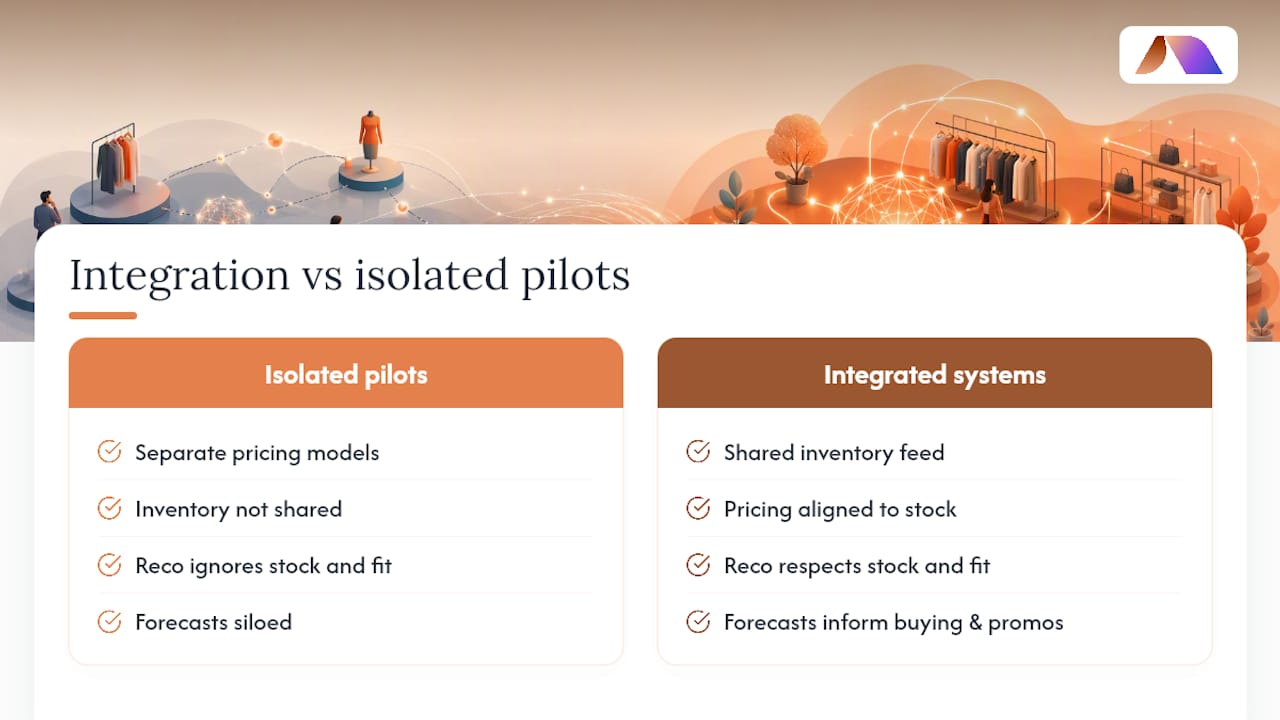
BizTech Magazine’s analysis of AI merchandising makes this point directly: AI merchandising delivers value when it connects inventory, pricing, and supply-chain decision systems rather than running as isolated pilots. That means your pricing model reads from the same inventory feed as your replenishment model. Your recommendation engine knows what is actually in stock. Your demand forecast informs both the buying plan and the promotional calendar.
NetSuite’s retail AI use case library includes heat-mapping for in-store behavior and agentic assistants for fulfillment, both of which require this kind of cross-system data flow to produce reliable outputs. Cross-functional integration is not a nice architectural detail. It is the condition under which AI merchandising actually works at scale.
Key Takeaways
GenAI-led merchandising use cases backed by 2023–24 field experiments deliver measurable conversion and productivity gains when paired with clean data, randomized measurement, and cross-functional system integration.
Point | Details |
|---|---|
Start with GenAI content and search | Product descriptions and semantic search pilots deliver 1–3% conversion lifts with low implementation risk. |
Pre-sale chatbots carry the highest ceiling | Field experiments show conversion gains up to ~16.3%, making chatbots the highest-priority use case for high-traffic categories. |
Connect inventory and pricing systems | Isolated pilots fail when pricing, inventory, and supply-chain models do not share a data layer. |
Measure with randomized holdouts | A 20–30% holdout group and a 4–6 week window are the minimum for reliable conversion attribution. |
BRDGIT accelerates pilot-to-scale | BRDGIT’s readiness assessments and fractional ML engineers shorten time-to-value without a full-time hire. |
The gap between AI enthusiasm and AI execution in retail
The merchandising teams that get the most out of AI are not the ones with the biggest budgets. They are the ones that resist the urge to deploy everything at once. The field evidence is clear: some workflows produce no detectable effect, and others produce a 16.3% lift. The difference is not the model. It is the workflow design, the data quality, and whether the team actually measured what changed.
What most articles understate is the organizational cost of a poorly scoped pilot. A chatbot deployed without a clear handoff protocol, or a pricing model running without a human review layer, does not just underperform. It creates distrust in AI across the whole merchandising function, and that distrust is hard to reverse. The safest path is a narrow, well-measured first use case that builds internal credibility before you expand scope.
BRDGIT’s approach is to assess what you actually have, design a pilot that can produce a defensible result in six to eight weeks, and then build the infrastructure for the next use case on top of what worked. That sequence is slower than buying a platform. It is also the one that produces results you can stand behind.
BRDGIT helps you move from pilot to production
Most merchandising teams know which AI use cases they want to try. The gap is execution: clean data pipelines, model selection, A/B test design, and the engineering capacity to ship something that actually runs in production.
BRDGIT’s fractional AI engineers embed in your team for the duration of a pilot or a full implementation, without a long-term headcount commitment. The engagement starts with an AI readiness assessment that maps your data assets, identifies the highest-value use case for your category mix, and produces a pilot plan with defined success metrics. If you are ready to run your first merchandising AI pilot, or ready to scale one that stalled, that assessment is the right starting point.
Useful sources
The sources below are worth reading directly if you are designing experiments, evaluating vendors, or building the business case internally.
What Is AI Merchandising and How Are Retailers Using It? | BizTech Magazine
Generative AI and Sales Productivity: Field Experiments in Online Retail
Retail | NVIDIA
AI Merchandising: Definition, Benefits, & Best Practices | Salesforce
AI Merchandising: How to Use AI Tools to Increase Sales (2026) — Shopify Malaysia
16 AI in Retail Use Cases & Examples | NetSuite