Published on
AI-Powered Order Fulfillment: What It Is and How It Works
TL;DR:
AI-powered fulfillment uses machine learning and analytics to automate each step of order processing, improving speed and accuracy with continuous adaptation. It enhances demand forecasting, inventory management, warehouse operations, and routing by learning from real-time data and resolving disruptions instantly, unlike static traditional systems. Successful adoption requires high-quality data, staged implementation, and seamless integration with existing systems to realize measurable operational benefits.
AI-powered order fulfillment is the use of artificial intelligence, machine learning, and predictive analytics to automate and optimize every step of the order lifecycle, from the moment a customer clicks “buy” through inventory allocation, warehouse execution, shipping, and returns. Unlike traditional order management systems that follow static, pre-programmed rules, AI-driven systems learn continuously from live data, adapting routing decisions, predicting demand shifts, and resolving exceptions before they reach the customer. The result is an operation that gets faster and more accurate with every order it processes.
The core capabilities that define this approach include:
Demand forecasting using machine learning models trained on historical order patterns, seasonal signals, and external data
Real-time inventory allocation across multiple warehouses and sales channels simultaneously
Automated warehouse execution including task planning, picking sequencing, and labor scheduling
Intelligent routing that weighs cost, carrier performance, delivery speed, and carbon footprint for every order line
Proactive exception handling when disruptions like weather events or stockouts require instant replanning
Continuous learning from every order, trend, and resolution to sharpen future decisions
The practical difference from legacy systems is not incremental. A traditional order management system breaks the moment conditions change. An AI system treats that disruption as new training data.
How AI transforms inventory management and demand forecasting
Inventory is where most fulfillment failures originate. Overstock ties up cash. Stockouts lose sales. And in omnichannel operations, the challenge compounds because the same SKU may need to serve a website, a retail store, and a marketplace simultaneously. AI addresses this by treating inventory as a dynamic, real-time signal rather than a periodic count.
Machine learning models analyze historical sales velocity, seasonal patterns, promotional calendars, and even external signals like weather or economic indicators to predict what stock will be needed, where, and when. That predictive layer feeds directly into replenishment triggers, so purchase orders go out before shelves run low rather than after. Real-time inventory management is rated highly relevant by 59% of omnichannel operations respondents, reflecting how central it has become to effective fulfillment routing.
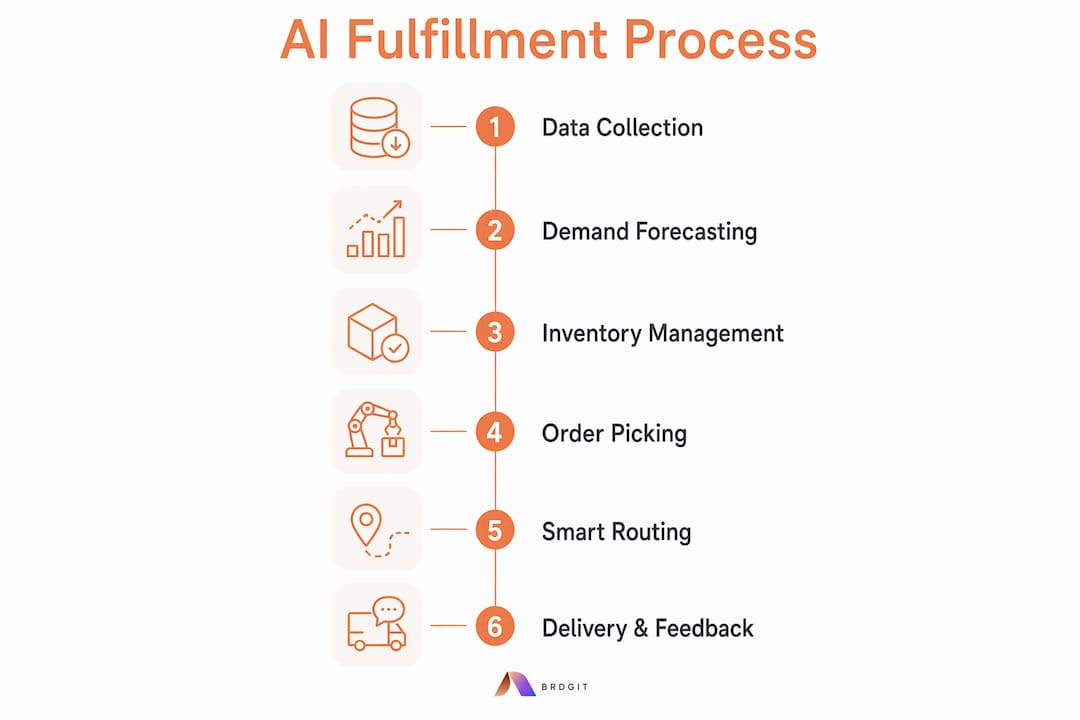
The synchronization challenge is real. Keeping inventory data consistent across every fulfillment node, from a distribution center in Ohio to a store in Austin, requires clean, harmonized data flowing continuously between systems. When that data is inconsistent, AI routing accuracy degrades fast.
Benefits of AI-driven inventory management at a glance:
Capability | Operational impact |
|---|---|
Demand forecasting | Reduces overstock and stockout frequency |
Real-time sync across channels | Prevents overselling and allocation conflicts |
Automated replenishment triggers | Cuts manual purchasing workload |
Carrying cost analysis | Identifies slow-moving SKUs before they become liabilities |
Multi-node visibility | Enables fulfillment from the most efficient location |
Pro Tip: Before deploying any AI forecasting model, audit your historical inventory data for gaps and inconsistencies. A model trained on dirty data will confidently produce wrong predictions.
For a deeper look at how AI manages stock at the operational level, the AI inventory control guide from BRDGIT covers the mechanics in detail.
How AI optimizes warehouse operations and workflows
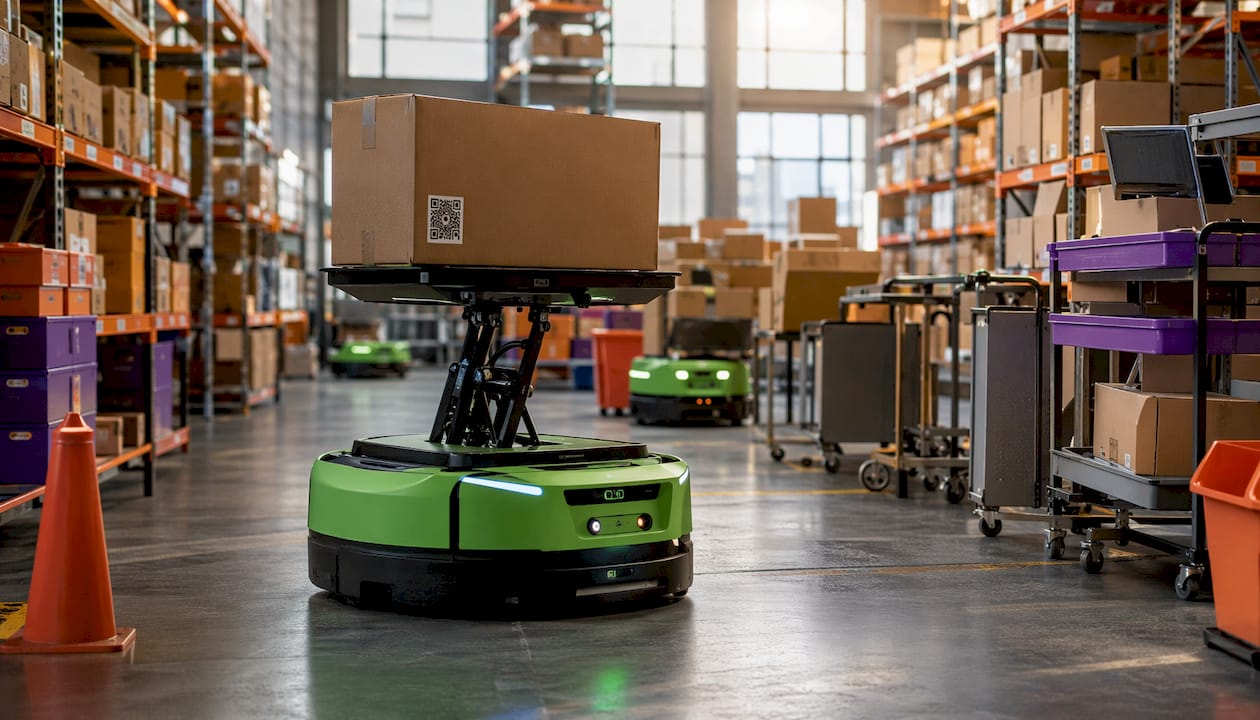
The warehouse is where AI’s impact becomes physical. Picking the wrong item, packing it inefficiently, or routing a task to the wrong worker are all errors that compound at scale. AI addresses each of these through predictive planning and, increasingly, through robotics and autonomous systems.
Oracle’s Warehouse Management Cloud uses machine learning models to predict order cycle time, processing time, and waiting time, giving operations managers the foresight to redistribute labor before bottlenecks form rather than reacting after delays occur. That shift from reactive to predictive is where the real efficiency gain lives. A high-volume distribution center preparing for a seasonal surge can use those predictions to staff correctly, sequence orders by priority, and avoid dock congestion before it happens.
Autonomous Mobile Robots (AMRs) have moved from pilot programs to standard infrastructure. AMRs are now considered highly relevant by 63% of omnichannel operations respondents, up from 50% the prior year, making them the most prominent technology supporting warehouse fulfillment today. They handle repetitive pick-and-carry tasks with consistency that human workers simply cannot sustain across a full shift.
Digital twins add another layer. By simulating warehouse workflows before committing to a layout change or a new process, operators can test automation strategies safely and identify failure points without disrupting live operations.
“Autonomous fulfillment goes beyond automation to orchestrate end-to-end execution. Unlike point automation, autonomous fulfillment integrates AI agents, robotics, and digital twins across order management, warehousing, transportation, trade compliance, and returns to make coordinated, real-time decisions with minimal manual intervention.” — Supply Chain Management Review
Key operational improvements AI delivers in warehouse settings:
Predictive labor scheduling aligned to actual order volume forecasts, not historical averages
Dynamic task prioritization that routes high-urgency orders to available workers first
Intelligent cycle counting that focuses physical counts on high-risk SKUs rather than blanket audits
Market basket analysis to co-locate frequently picked items and cut travel time per order
Integration with warehouse management systems (WMS) to close the loop between planning and execution
How AI selects smarter shipping routes and fulfillment sources
Routing an order to the right fulfillment location is not as simple as “ship from the nearest warehouse.” The nearest warehouse might be out of stock, might use a carrier with poor performance to that zip code, or might push the shipment’s carbon footprint above a threshold the business has committed to. AI holds all of those constraints simultaneously and resolves them in milliseconds.

Microsoft’s Intelligent Fulfillment Optimization service illustrates how this works in practice. It applies geocoding and distance calculations to compute both road and aerial distances between every available fulfillment source and the order’s shipping address, then applies business constraints to select the optimal source for each order line. The result is written back into the order orchestration flow automatically, with no manual dispatcher required.
Dynamic adjustment matters just as much as initial routing. When a disruption occurs, whether a carrier goes down, a warehouse runs short, or a weather event closes a distribution center, AI agents replan instantly rather than waiting for a human to notice the problem. That real-time exception handling is what separates intelligent order management from traditional systems.
Routing factor | Traditional OMS | AI-powered system |
|---|---|---|
Fulfillment source selection | Geography or carrier rank only | Cost, speed, carrier performance, carbon footprint |
Exception handling | Manual intervention required | Automatic replanning in real time |
Constraint modeling | Fixed rules | Dynamic, updated with every order |
Carbon footprint | Not considered | Factored into routing decisions |
The logistics research from MIT Sloan reinforces this. Uber Freight used machine learning for vehicle routing optimization and reduced empty truck miles from roughly 30% to between 10% and 15%, a concrete example of AI solving a routing problem that operations research and human judgment alone could not crack at scale.
How AI improves order accuracy and the post-purchase experience
Order accuracy is the metric customers feel most directly. A wrong item or a missed delivery window does not just create a return. It creates a customer who does not come back. AI attacks the accuracy problem at multiple points in the process.
Automating routine tasks like data entry, order processing, and fulfillment workflow triggers removes the human error that accumulates when workers handle thousands of repetitive actions per shift. Picking errors, mislabeled packages, and inventory discrepancies all decrease when AI handles the sequencing and verification steps. For more on the specific mechanisms, BRDGIT’s analysis of AI and order accuracy covers the operational detail.
The post-purchase experience is where AI’s customer-facing impact shows up. Generative AI agents integrated with order management systems can deliver proactive, personalized updates using natural language processing, predict delays before they happen, and resolve customer inquiries instantly without routing them to a human agent. That turns fulfillment from a backend operation into a visible competitive advantage.
Key accuracy and satisfaction improvements enabled by AI:
Automated order verification against inventory records before confirmation
Real-time exception detection that flags at-risk orders before they miss SLAs
Proactive delay notifications sent to customers before they contact support
NLP-powered agents handling complex order inquiries with accurate, real-time data
Personalized delivery updates that reduce inbound support volume
Industry trends, challenges, and where AI fulfillment is heading
The direction of travel is clear. Organizations are moving from isolated automation pilots toward autonomous fulfillment frameworks that combine agentic AI, robotics, and digital twins to coordinate decisions across the entire supply chain with minimal human oversight. At the highest level of maturity, this includes dark warehousing, where multi-agent systems analyze, decide, and act independently, coordinating resources and resolving disruptions without a human in the loop.
That trajectory is real, but the challenges are equally real. AI does not forgive organizational ignorance about data quality. Inconsistent inventory data across fulfillment nodes is the single most common bottleneck in omnichannel AI execution, and organizations routinely underestimate the effort required to synchronize it. Workforce impact is another honest conversation. AI handles repetitive tasks at scale, which changes what human workers do rather than simply eliminating roles, but that transition requires deliberate change management.
Current trends and near-term developments worth tracking:
Agentic AI adoption moving from single-task automation to multi-agent systems that coordinate across planning, sourcing, warehousing, and returns
Digital twin expansion enabling simulation of fulfillment scenarios before deployment, reducing implementation risk
Omnichannel AI integration connecting inventory, order, and transportation systems into a single real-time data fabric
Greener routing as carbon footprint becomes a standard constraint in fulfillment optimization models
Regulatory and ethical considerations around AI decision-making transparency, particularly for workforce scheduling and carrier selection
The DHL Logistics Trend Radar identifies advanced analytics and agentic AI as among the most consequential forces reshaping logistics over the next decade, with predictive capabilities extending to political disruptions, weather events, and demand signals drawn from sources traditional supply chain systems never accessed.
What BRDGIT recommends for adopting AI-powered fulfillment
Adoption is where most organizations stall. The technology exists. The business case is clear. What breaks down is execution: dirty data, misaligned systems, and teams that were never prepared for the change. BRDGIT works with businesses at exactly this inflection point, starting with an AI readiness assessment that identifies where the real gaps are before any technology is deployed.
The staged approach matters. Most organizations that succeed with AI fulfillment start with augmented decisioning, where AI surfaces recommendations and humans validate them, before moving to automated execution. That progression builds trust in the system, surfaces edge cases before they become operational failures, and gives the workforce time to adapt. Jumping straight to full automation without that foundation is where projects fail.
BRDGIT’s fractional AI support model is built for exactly this scenario. Rather than hiring a full-time AI team before the organization is ready to use one, businesses can access experienced AI talent for planning, implementation, and ongoing execution based on actual needs. That means the expertise scales with the project, not ahead of it.
Critical success factors for AI fulfillment adoption:
Clean, harmonized data across inventory, order, and transportation systems before any AI model goes live
Phased implementation starting with high-impact, lower-risk use cases like demand forecasting or routing optimization
Workforce readiness through training and clear communication about how roles will change, not just what technology will be deployed
Continuous monitoring of model performance against real outcomes, with feedback loops that keep predictions accurate as conditions shift
Technology integration between existing ERP, WMS, and ecommerce platforms to avoid creating new data silos
Pro Tip: Run a 30-day data audit before selecting any AI fulfillment vendor. The quality of your inventory and order history data will determine the ceiling of what any model can achieve, regardless of how sophisticated the platform is.
AI in returns management is another area where early investment pays off. BRDGIT’s returns management guide covers how AI orchestrates the reverse logistics process, which is often the last piece of the fulfillment puzzle to get attention and the first to create customer friction when it fails.
How AI integrates with existing ecommerce and ERP systems
One of the most practical questions operators ask is whether AI fulfillment requires replacing existing systems. The honest answer is: usually not, but integration is non-trivial. AI fulfillment capabilities are typically deployed as a layer on top of existing ERP and ecommerce platforms, reading data from those systems and writing decisions back into them.
The integration architecture matters more than the AI model itself. An AI routing engine that cannot access real-time inventory data from the ERP is making decisions in the dark. A demand forecasting model that cannot push replenishment signals back into the purchasing workflow produces insights that nobody acts on. The value of AI in fulfillment is almost entirely dependent on how tightly it connects to the systems that hold the operational data.
Modern platforms like Microsoft Dynamics 365 Intelligent Order Management and Oracle WMS Cloud are built with API-first architectures that make this integration more accessible than it was even three years ago. For businesses running Shopify, Magento, or custom ecommerce stacks, middleware layers and order management systems serve as the connective tissue between the storefront and the AI fulfillment logic. Inventory management platforms built for multi-channel stock optimization can serve as a practical starting point for teams that need real-time inventory visibility before layering in more complex AI routing.
The integration checklist for AI fulfillment deployment typically includes:
Bidirectional API connections between the AI layer and the ERP for inventory and order data
Real-time event streaming from the ecommerce platform to trigger fulfillment decisions at order placement
WMS integration for task execution and confirmation back to the order record
Carrier API connections for live rate shopping and shipment tracking
A unified data model that resolves SKU, location, and customer ID conflicts across systems
Real-world examples of AI-powered fulfillment in practice
The clearest proof of what AI fulfillment delivers comes from operations that have moved past the pilot stage. KION Group, a global material handling and supply chain technology company, is actively building out intelligent warehouse capabilities by integrating NVIDIA Omniverse into their fulfillment infrastructure. The goal is an adaptive system that predicts disruptions, continuously optimizes performance, and builds overall supply chain resilience through real-time digital twin simulation.
Uber Freight’s application of machine learning to carrier pricing and vehicle routing is another concrete example. By analyzing hundreds of parameters simultaneously, the company built an algorithmic pricing model that removed the friction of manual rate negotiation and, through routing optimization, cut empty truck miles from approximately 30% to between 10% and 15%. That is not a marginal improvement. It represents a structural change in how freight moves.
At the warehouse level, the Oracle WMS predictive fulfillment dashboard gives operations managers a live view of predicted order cycle times, processing times, and waiting times across different order types and warehouse zones. A high-volume distribution center using those predictions during a seasonal surge can preemptively redistribute labor, adjust load schedules, and sequence orders to avoid dock congestion, all before the problem materializes rather than after it costs money.
The pattern across these examples is consistent. AI fulfillment delivers the most measurable returns when it is connected to real operational data, deployed in stages, and given time to learn from the specific patterns of the business running it. The technology does not arrive fully calibrated. It earns its accuracy through continuous exposure to real orders, real disruptions, and real outcomes.
Key Takeaways
AI-powered order fulfillment delivers measurable gains in speed, accuracy, and cost efficiency by replacing static rule-based systems with machine learning models that adapt continuously to real operational data.
Point | Details |
|---|---|
Continuous learning is the core differentiator | AI systems improve with every order, trend, and exception, unlike traditional OMS platforms that follow fixed rules. |
Data quality determines AI performance | Inconsistent inventory data across fulfillment nodes is the most common bottleneck in omnichannel AI execution. |
AMRs are now mainstream | 63% of omnichannel operations respondents rate Autonomous Mobile Robots as highly relevant, up from 50% the prior year. |
Staged adoption reduces implementation risk | Starting with augmented decisioning before full automation builds trust and surfaces edge cases before they become failures. |
Integration architecture is as critical as the AI model | An AI routing engine without real-time ERP data makes decisions without the context needed to be accurate. |