Published on
Why AI Automation Improves Order Accuracy in 2026
TL;DR:
AI automation validates order data in real time, increasing accuracy from 70-85% manually to over 99.8%.
Implementing AI effectively depends on thorough data normalization, alias libraries, and integrated systems to ensure reliable results.
AI automation improves order accuracy by validating every order field against ERP master records in real time, eliminating the manual rekeying and SKU mismatches that drive most fulfillment errors. Manual order processing delivers accuracy rates of only 70–85%, while AI-powered systems reach up to 99.8% accuracy. That gap is not a marginal improvement. It represents the difference between a business that absorbs error costs quietly and one that turns order management into a competitive advantage. For manufacturers, wholesalers, and retailers, understanding why AI automation improves order accuracy is the first step toward fixing a problem that compounds daily.
Why AI automation improves order accuracy where manual processes fail
Manual order processing fails at predictable points. The three biggest culprits are re-keying data from customer purchase orders into internal systems, selecting the wrong SKU, and entering incorrect quantities. Wrong SKU errors account for 35–40% of all order mistakes and carry the highest downstream cost. A wrong SKU triggers a cascade: incorrect picking, wrong shipment, customer complaint, return, and restock. Wrong quantity errors add another 25–30% of total mistakes.
AI order management systems address these failure points directly. They capture order data from emails, EDI files, PDFs, and web portals, then validate each field against the ERP master catalog before the order is ever posted. This real-time validation step eliminates the manual translation layer where most errors originate. The result is 99.5%+ order-to-catalog match rates, compared to the 1–4% per-order error rate typical of manual entry.
Re-keying errors: AI captures data directly from source documents, removing the human transcription step entirely.
Wrong SKU selection: AI cross-references ERP master data before order acceptance, catching mismatches before they reach the warehouse floor.
Quantity mistakes: Automated validation flags quantities that fall outside historical norms for that customer or product.
Naming convention mismatches: Customers often use their own product descriptions. AI maps these to internal SKUs using customer-specific alias libraries.
Pro Tip: Build a customer alias library that maps every naming convention a buyer uses to your internal SKU. Customers often have 3–5 different ways of describing the same item. A well-maintained alias library is one of the highest-leverage investments in AI order accuracy you can make.
How AI learns continuously to keep accuracy high

Traditional order management runs on static rules. A rule either matches or it does not. When a new customer format appears or a product line changes, someone must manually update the ruleset. That lag creates error windows. AI order management works differently.
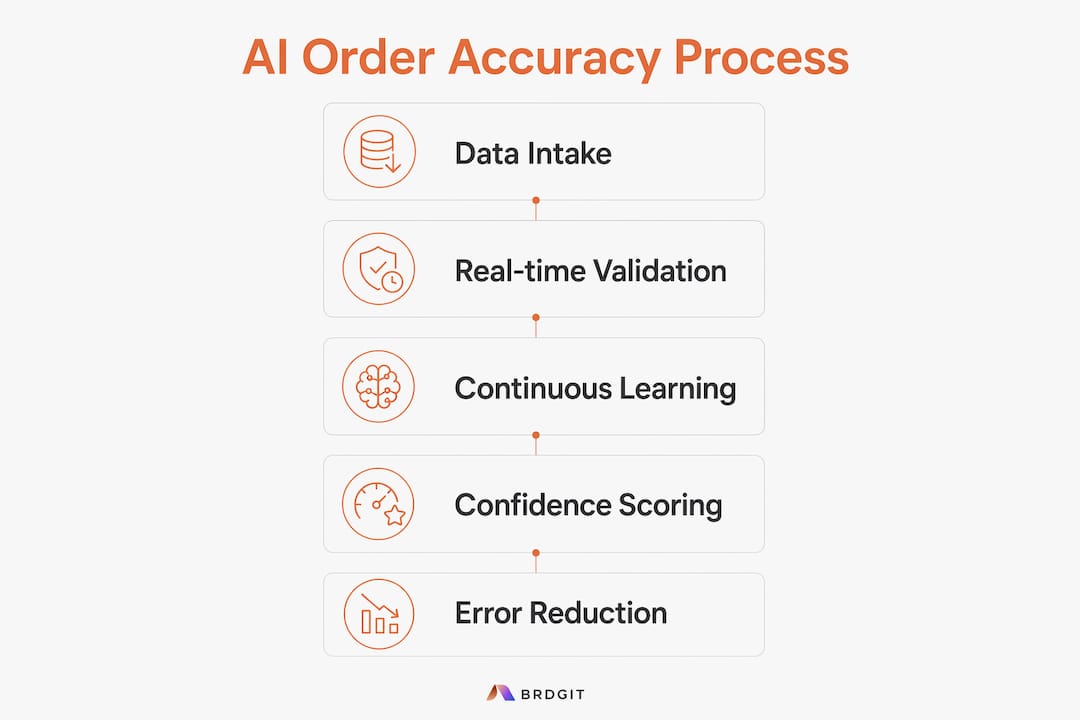
AI systems learn continuously from live data, refining routing decisions, demand predictions, and exception handling with every order processed. The system gets better as volume grows. This is the core structural advantage over static rule-based systems.
Capability | Traditional static rules | AI-driven learning systems |
|---|---|---|
Adapts to new formats | Manual update required | Learns automatically from new data |
Exception handling | Flags all exceptions equally | Routes only low-confidence fields to humans |
Accuracy over time | Degrades without maintenance | Improves with scale |
SKU validation | Fixed lookup tables | Dynamic ERP cross-referencing |
Confidence scoring is the mechanism that makes this practical. The AI assigns a confidence level to each field it processes. High-confidence fields post automatically. Low-confidence fields route to a human reviewer. This means your team spends time only on genuinely ambiguous cases, not on monitoring thousands of routine transactions. The workload drops. The accuracy stays high.
What are the financial benefits of AI-driven order accuracy?
Accuracy improvements translate directly into cost reductions. AI-driven order orchestration cuts per-order processing costs by 30–40% and reduces fulfillment errors by 91%. For businesses with $50M or more in annual revenue, that compounds into roughly $2.3 million in annual savings. These are not projections. They reflect what happens when manual touches drop and error-driven rework disappears.
The financial case extends beyond processing costs:
Returns and refunds: Fewer wrong orders mean fewer returns. Each return carries reverse logistics costs, restocking labor, and potential inventory write-offs.
Shipping costs: AI-optimized routing cuts shipping costs by 43% by selecting the most efficient carrier and route for each order.
Cycle time: High touchless order rates correlate directly with faster order cycle times and better customer satisfaction scores.
Staff reallocation: Teams freed from manual entry and error correction can focus on customer relationships and exception management.
Pro Tip: When building the business case for AI investment, calculate your current cost per error, not just your cost per order. Include picking labor, return shipping, customer service time, and lost reorder probability. The real cost of a wrong order is usually 3–5 times the face value of the correction.
The operational gains compound over time. AI does not forgive organizational ignorance, but it rewards organizations that feed it clean data and well-defined processes. The businesses seeing the largest returns are those that treated AI implementation as a process redesign project, not a software installation.
What steps should businesses take to implement AI for order accuracy?
Implementation quality determines outcomes. The technology works. The question is whether your data environment is ready to support it.
Integrate your core systems first. Connect your CRM, ERP, WMS, and fulfillment platforms so AI can access real-time inventory, pricing, and customer data. Siloed systems force AI to work with incomplete information. CRM and ERP integration with AI workflows is the foundation, not an optional add-on.
Build customer alias libraries before go-live. Map every naming convention your buyers use to your internal SKU catalog. This single step has more impact on straight-through processing rates than almost any other configuration decision.
Add an AI validation layer above your ERP. This layer captures incoming orders, validates fields, corrects known errors, and flags uncertain data before posting. Manual touches drop by roughly 85% when this layer is properly configured.
Standardize upstream data quality. AI amplifies what it receives. If your product master data is inconsistent or your customer records are fragmented, the AI will reflect that inconsistency. Clean data upstream produces clean orders downstream.
Avoid relying on OCR alone. Optical character recognition captures text. It does not validate meaning. An OCR system that reads a wrong SKU correctly has still produced a wrong order. True AI automation validates, corrects, and writes clean data into the ERP. That distinction matters.
AI-powered inventory control works best when order accuracy systems feed it reliable demand signals. The two capabilities reinforce each other.
Key Takeaways
AI automation improves order accuracy by replacing error-prone manual entry with real-time ERP validation, continuous learning, and confidence-based exception routing that reduces fulfillment errors by up to 91%.
Point | Details |
|---|---|
Manual accuracy gap | Manual order processing averages 70–85% accuracy; AI systems reach up to 99.8%. |
SKU errors are the costliest | Wrong SKU mistakes make up 35–40% of errors; AI validates against ERP before order posting. |
Continuous learning wins | AI improves routing and exception handling over time; static rule systems degrade without manual updates. |
Financial returns are measurable | AI cuts per-order processing costs by 30–40% and shipping costs by 43%. |
Implementation quality matters | Alias libraries, system integration, and upstream data quality determine how much accuracy improves. |
The part most businesses get wrong
We have worked with manufacturers and wholesalers who installed AI order tools and saw modest results. The technology was sound. The problem was always the same: they treated implementation as a configuration task rather than a data transformation project.
Order data normalization is genuinely hard. A single customer might submit orders using three different product descriptions, two unit-of-measure conventions, and inconsistent purchase order formats across departments. AI handles this well once it is trained on those patterns. But if no one built the alias library, if the ERP master data has duplicate SKUs, or if the CRM and WMS are not talking to each other, the AI is working with a broken foundation.
The businesses that see 90%+ error reduction within six months are the ones that did the unglamorous work first. They audited their product master data. They mapped customer naming conventions. They defined what a “clean order” actually looks like in their system before asking AI to produce one.
The future direction is clear. AI systems will handle more of the exception layer autonomously, reducing human review to a smaller and smaller fraction of total volume. But the organizations that will benefit most are those building clean data habits now. AI does not create order from chaos. It accelerates whatever order already exists.
— Team BRDGIT
How BRDGIT helps businesses get AI order accuracy right
Knowing what AI can do and knowing how to implement it inside your specific systems are two different problems. Most businesses have the motivation. What they lack is the technical depth to connect ERP, WMS, and CRM systems, build validation layers, and configure confidence scoring without a full-time AI engineering team on staff.
BRDGIT’s fractional engineering services give manufacturing, wholesale, and retail businesses access to experienced AI talent without the overhead of a permanent hire. BRDGIT works alongside your team to assess your current order workflows, identify the highest-impact automation opportunities, and build the data infrastructure that makes AI accuracy gains real and lasting. If you are ready to move from manual error management to AI-driven order precision, BRDGIT is the practical next step.
FAQ
What order accuracy rate does AI automation achieve?
AI-powered order systems reach up to 99.8% accuracy by validating data against ERP master records in real time. Manual processing typically delivers 70–85% accuracy.
How quickly do businesses see error reductions after AI adoption?
Industry benchmarks show 90–92% error reduction within six months of AI adoption. Results depend on data quality and how thoroughly systems are integrated before go-live.
Is OCR the same as AI order automation?
OCR reads text from documents but does not validate meaning. True AI order automation reduces manual touches by 85% by validating, correcting, and writing clean data into the ERP, which OCR alone cannot do.
What is confidence scoring in AI order processing?
Confidence scoring assigns a certainty level to each field the AI processes. High-confidence fields post automatically. Low-confidence fields route to human review, keeping accuracy high without creating bottlenecks.
What is the biggest implementation mistake businesses make?
Skipping the alias library and data normalization work before go-live. Customers often use 3–5 naming conventions per product, and AI cannot match what it has not been trained to recognize.