
Published on
What Is AI in Local Marketing Campaigns in 2026
TL;DR:
AI in local marketing involves machine learning, natural language processing, and autonomous decision-making that personalize and optimize campaigns in real time. It reshapes local search through AI-generated summaries and conversational interfaces, emphasizing data quality, localization, and human oversight to manage these new discovery channels effectively. Successful implementation requires feeding accurate data, understanding local context, and continuously refining AI-driven strategies to enhance visibility and engagement.
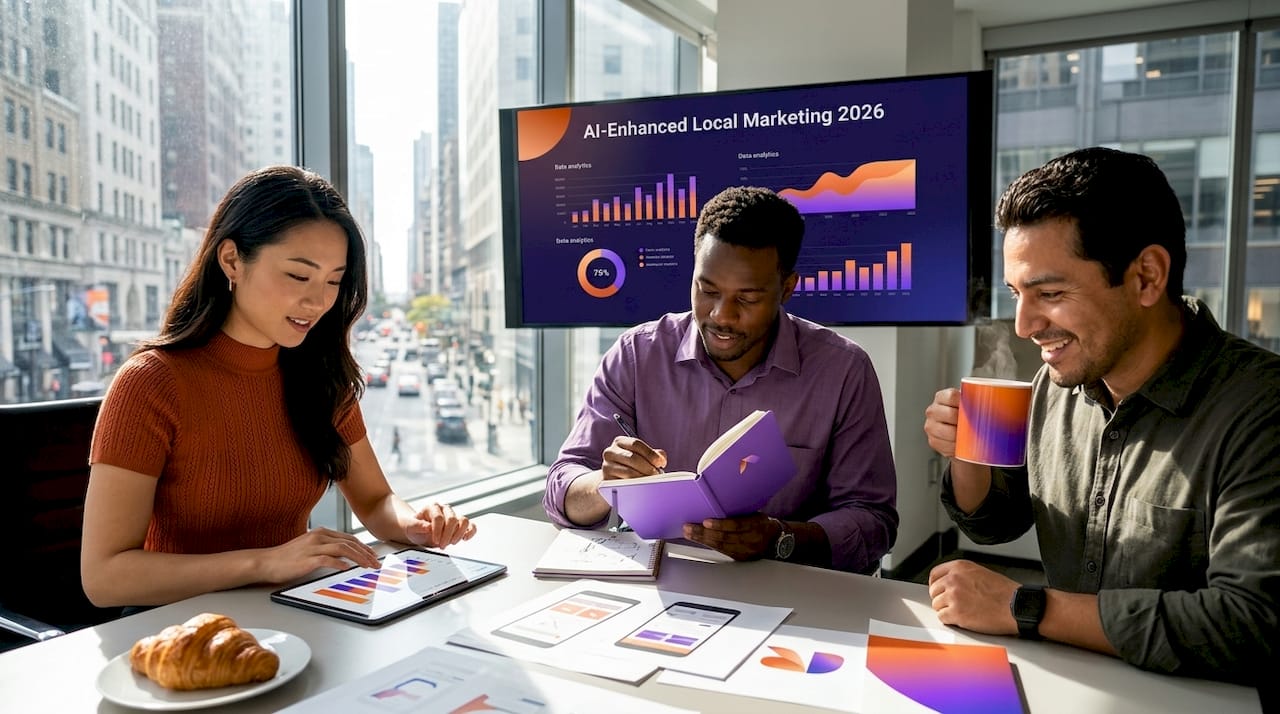
Most marketers treat AI as a smarter scheduling tool. That framing sells the technology short and, more importantly, leads to campaigns that underperform. What is AI in local marketing campaigns, really? It is a system of machine learning, natural language processing, and autonomous decision-making that adapts your messaging, bids, and customer touchpoints in real time based on signals no human analyst could process fast enough. The consumer behavior shift accelerating this is just as significant. Local search no longer means a map listing. It increasingly means a conversational AI interface serving personalized recommendations before your customer types a single word.
Table of Contents
Key Takeaways
What AI in local marketing campaigns actually means
How AI is rewriting local search and discovery
Benefits of AI in local advertising and content
Challenges and best practices for local AI marketing
My take on what most businesses get wrong
How Brdgit helps you move from AI curiosity to local execution
FAQ
Key Takeaways
Point | Details |
|---|---|
AI goes beyond automation | In local marketing, AI actively personalizes, optimizes bids, and adapts campaigns in real time without manual intervention. |
Local search is being reshaped | AI Overviews appear in 68% of local searches, making traditional local pack rankings less reliable indicators of visibility. |
Data quality is non-negotiable | Incomplete or inconsistent business data directly undermines AI-powered discovery and campaign performance. |
Localization beats translation | Effective AI-assisted content adapts tone, cultural context, and visuals, not just language, for local audiences. |
Human oversight still matters | AI does not forgive organizational ignorance. Monitoring, reviewing, and refining AI outputs remains a critical human responsibility. |
What AI in local marketing campaigns actually means
The industry term for this category is AI-driven marketing, and it covers a spectrum of technologies working together. At the foundation sits machine learning, which identifies patterns across your campaign data and adjusts targeting or creative delivery accordingly. Layered on top is natural language processing, which allows AI systems to understand how your customers search, speak, and phrase intent. Together, these two capabilities power everything from predictive audience segmentation to automated ad copy generation.
The third and most consequential layer is agentic AI. According to Salesforce, agentic AI takes multi-step actions autonomously, meaning it can evaluate campaign performance, adjust strategy, and execute changes without waiting for a human decision cycle. For local marketing, that translates to an AI system that can shift budget toward a neighborhood-level ad set on a Thursday afternoon because it detected higher foot traffic intent signals in that zip code. That is not automation. That is judgment at machine speed.
Real-time personalization is where this becomes tangible. A local home services company running campaigns across three cities no longer needs three separate campaign managers making gut-call adjustments. AI monitors which service pages drive conversions in each area, which ad formats perform by time of day, and which audience segments respond to urgency-based versus value-based messaging. It then applies that learning continuously.
Pro Tip: Do not confuse AI personalization with simple A/B testing. Testing gives you a winner after days. AI personalization adjusts continuously across dozens of variables simultaneously, often before you would have noticed a pattern.
How AI is rewriting local search and discovery
This is the section most local marketing guides skip, and it is arguably the most urgent thing you need to understand right now. Local search behavior has changed structurally, not incrementally.
AI Overviews appear in 68% of local searches, climbing to 92% for informational queries and 97% for hybrid intent queries. The traditional local pack, the three-business box that dominated local search results for a decade, now appears beneath or alongside AI-generated summaries. If your business is not referenced in those summaries, a significant portion of your potential customers may never see you at all.
Google Maps has made a parallel shift. The Gemini-powered Ask Maps conversational feature allows users to ask complex questions like “Where is a quiet coffee shop near me that’s good for working on a laptop?” and receive a curated map with personalized recommendations. This is not keyword matching. It is conversational retrieval based on structured business attributes.
Visibility strategy | Pre-AI era | AI search era |
|---|---|---|
Primary goal | Rank in local 3-pack | Appear in AI Overviews and conversational results |
Key signal | Citation volume and proximity | Structured data completeness and attribute richness |
Content format | Location landing pages | Conversational, question-answering descriptions |
Performance metric | Local pack ranking position | AI mention frequency and recommendation rate |
“Businesses that explicitly describe their services and attributes in language aligned with conversational queries are significantly more likely to be recommended by AI interfaces like Ask Maps.” — Google Maps
There is a real risk here that most businesses underestimate. 67% of consumers do not rigorously fact-check AI sources, which means AI hallucinations about your business hours, services, or location can circulate without correction. Active monitoring of what AI systems say about your business is no longer optional reputation management. It is operational risk management.
Traditional local pack rankings are becoming a less reliable proxy for actual visibility. Marketers who still measure success primarily through rank trackers are watching the wrong dashboard.
Benefits of AI in local advertising and content
The practical benefits of using AI for targeted marketing in local campaigns cluster into two areas: ad performance and content relevance. Both are worth examining concretely.
On the advertising side, AI-powered platforms perform thousands of bid micro-optimizations per day based on real-time conversion signals. Google Performance Max and Meta Advantage+ test dozens of creative and audience combinations automatically, rotating toward the highest-converting variations without manual intervention. For a local retailer running campaigns across multiple neighborhoods, this means the system is continuously learning which creative resonates with which audience segment at which time, compressing what used to take weeks of testing into days.
The ROI implications are real, particularly when advertising optimization is approached as a continuous process rather than a set-it-and-review-it monthly task. AI makes that continuous process feasible without adding headcount.
On the content side, the distinction between translation and localization matters more than most marketers appreciate. Translation changes words. Localization, as Typeface describes it, adapts tone, cultural references, imagery choices, and emotional register for a specific audience. AI tools now make genuine localization scalable across markets that would have previously required a team of regional copywriters.
Here is what AI-assisted localization actually looks like in practice:
A national retail chain adapts product descriptions for a Southern market to reflect seasonal buying patterns and regional preferences in word choice.
A healthcare network adjusts the urgency tone of its campaign messaging for different demographic segments across three metro areas.
A restaurant group generates location-specific social content that references neighborhood events, local landmarks, and community context rather than generic brand copy.
Pro Tip: When using AI for local content generation, build a detailed brief that includes the neighborhood’s demographics, cultural touchpoints, and the specific service context. Generic prompts produce generic output. Specificity is the multiplier.
AI also reduces the creative bottleneck that limits most small local marketing operations. Generating five ad variations per location used to mean five times the creative work. With AI, it means five targeted outputs from one well-structured brief, each adapted for context.
Challenges and best practices for local AI marketing
The benefits of AI in local campaigns are real. So are the failure modes. Understanding both is what separates professional execution from expensive experimentation.
The most common failure point is data quality. Incomplete or inconsistent business data directly undermines AI-powered discovery. If your business name, address, and phone number are inconsistent across data sources, AI systems will either ignore you or surface incorrect information. This is not a technical problem you fix once. It requires ongoing maintenance as platforms, directories, and structured data requirements evolve.
Several other challenges deserve direct attention:
Over-reliance on automation without human review creates campaigns that optimize toward the wrong metric. A system optimizing for clicks that do not convert is performing well by its own measure while failing yours.
Monitoring gaps allow AI-generated misinformation about your business to compound undetected. Check what AI surfaces about your business regularly, not quarterly.
Missing local context is the subtlest failure. AI does not inherently understand that a particular neighborhood has changed demographically, that a local competitor closed, or that a seasonal event shifts purchase intent. Human judgment feeds that context into the system.
Looking forward, the trends worth tracking are immersive navigation experiences that layer AR onto physical streets, voice-personalized local recommendations that adapt to individual user history, and AI-curated local ad formats that blend sponsored and organic recommendations in ways that are not yet clearly disclosed. Businesses that use AI for marketing effectively over the next two years will be the ones building organizational capability to monitor, feed, and interpret these systems, not just activate them.
My take on what most businesses get wrong
I have worked through enough AI-assisted campaign implementations to say this with some confidence: the technology is rarely the problem. The problem is that businesses treat AI as a replacement for local market understanding rather than a multiplier of it.
I have seen campaigns where the AI was performing beautifully by every platform metric, delivering hundreds of optimizations per day, generating localized content at scale. And the business was still struggling because no one had told the AI that its biggest conversion driver was foot traffic tied to a weekly farmers market two blocks away. That context never made it into the data. The model could not see it.
What I have learned is that the businesses getting the most from local AI marketing are not the ones with the most sophisticated tech stack. They are the ones that invest time upfront in feeding the AI the right inputs. Detailed location attributes. Accurate structured data. Audience briefs that reflect genuine local knowledge. Combined with human review cycles that catch what the algorithm cannot.
AI adoption is not a destination. It is an ongoing operational discipline. And in local marketing specifically, the irreplaceable ingredient is still someone who knows the market.
— Lars
How Brdgit helps you move from AI curiosity to local execution
Understanding what AI can do in local marketing is one thing. Building the systems, data infrastructure, and campaign workflows to actually capture those benefits is where most businesses stall. That is exactly the gap Brdgit was built to close.
Brdgit works with marketing teams and small business owners to identify the right AI opportunities, build clear execution roadmaps, and implement the automations and workflows that turn AI potential into measurable campaign results. For teams that need expertise without a full-time hire, Brdgit’s fractional AI engineers provide hands-on support for planning, execution, and ongoing optimization. Whether you are auditing your local data infrastructure or scaling localized content across markets, Brdgit brings the execution depth your campaigns need.
FAQ
What is AI in local marketing campaigns?
AI in local marketing campaigns refers to the use of machine learning, natural language processing, and agentic AI to automate, personalize, and optimize campaign performance at the local level. It includes bid optimization, real-time content adaptation, audience targeting, and AI-driven local discovery.
How does AI change local search visibility?
AI Overviews now appear in 68% of local searches, shifting visibility away from traditional local pack rankings toward AI-generated summaries and conversational results. Businesses need accurate, structured, and attribute-rich data to appear in these new AI-driven discovery formats.
What are the biggest risks of using AI in local marketing?
The primary risks include data inconsistency undermining AI discovery, AI hallucinations surfacing incorrect business information, and over-automating campaigns without human oversight to catch context gaps or misaligned optimization targets.
How does AI-powered localization differ from simple translation?
AI localization adapts tone, cultural references, visuals, and emotional framing for a specific audience rather than just converting language. It produces content that feels locally relevant rather than generically translated.
Do small businesses need a big budget to use AI in local marketing?
No. Many AI-powered local marketing tools are embedded in platforms small businesses already use, including Google Ads and Meta. The bigger investment is in data quality and strategic setup, not necessarily in software spend.
Recommended
What Is AI in Local Marketing Campaigns in 2026
TL;DR:
AI in local marketing involves machine learning, natural language processing, and autonomous decision-making that personalize and optimize campaigns in real time. It reshapes local search through AI-generated summaries and conversational interfaces, emphasizing data quality, localization, and human oversight to manage these new discovery channels effectively. Successful implementation requires feeding accurate data, understanding local context, and continuously refining AI-driven strategies to enhance visibility and engagement.
Most marketers treat AI as a smarter scheduling tool. That framing sells the technology short and, more importantly, leads to campaigns that underperform. What is AI in local marketing campaigns, really? It is a system of machine learning, natural language processing, and autonomous decision-making that adapts your messaging, bids, and customer touchpoints in real time based on signals no human analyst could process fast enough. The consumer behavior shift accelerating this is just as significant. Local search no longer means a map listing. It increasingly means a conversational AI interface serving personalized recommendations before your customer types a single word.
Table of Contents
Key Takeaways
What AI in local marketing campaigns actually means
How AI is rewriting local search and discovery
Benefits of AI in local advertising and content
Challenges and best practices for local AI marketing
My take on what most businesses get wrong
How Brdgit helps you move from AI curiosity to local execution
FAQ
Key Takeaways
Point | Details |
|---|---|
AI goes beyond automation | In local marketing, AI actively personalizes, optimizes bids, and adapts campaigns in real time without manual intervention. |
Local search is being reshaped | AI Overviews appear in 68% of local searches, making traditional local pack rankings less reliable indicators of visibility. |
Data quality is non-negotiable | Incomplete or inconsistent business data directly undermines AI-powered discovery and campaign performance. |
Localization beats translation | Effective AI-assisted content adapts tone, cultural context, and visuals, not just language, for local audiences. |
Human oversight still matters | AI does not forgive organizational ignorance. Monitoring, reviewing, and refining AI outputs remains a critical human responsibility. |
What AI in local marketing campaigns actually means
The industry term for this category is AI-driven marketing, and it covers a spectrum of technologies working together. At the foundation sits machine learning, which identifies patterns across your campaign data and adjusts targeting or creative delivery accordingly. Layered on top is natural language processing, which allows AI systems to understand how your customers search, speak, and phrase intent. Together, these two capabilities power everything from predictive audience segmentation to automated ad copy generation.
The third and most consequential layer is agentic AI. According to Salesforce, agentic AI takes multi-step actions autonomously, meaning it can evaluate campaign performance, adjust strategy, and execute changes without waiting for a human decision cycle. For local marketing, that translates to an AI system that can shift budget toward a neighborhood-level ad set on a Thursday afternoon because it detected higher foot traffic intent signals in that zip code. That is not automation. That is judgment at machine speed.
Real-time personalization is where this becomes tangible. A local home services company running campaigns across three cities no longer needs three separate campaign managers making gut-call adjustments. AI monitors which service pages drive conversions in each area, which ad formats perform by time of day, and which audience segments respond to urgency-based versus value-based messaging. It then applies that learning continuously.
Pro Tip: Do not confuse AI personalization with simple A/B testing. Testing gives you a winner after days. AI personalization adjusts continuously across dozens of variables simultaneously, often before you would have noticed a pattern.
How AI is rewriting local search and discovery
This is the section most local marketing guides skip, and it is arguably the most urgent thing you need to understand right now. Local search behavior has changed structurally, not incrementally.
AI Overviews appear in 68% of local searches, climbing to 92% for informational queries and 97% for hybrid intent queries. The traditional local pack, the three-business box that dominated local search results for a decade, now appears beneath or alongside AI-generated summaries. If your business is not referenced in those summaries, a significant portion of your potential customers may never see you at all.
Google Maps has made a parallel shift. The Gemini-powered Ask Maps conversational feature allows users to ask complex questions like “Where is a quiet coffee shop near me that’s good for working on a laptop?” and receive a curated map with personalized recommendations. This is not keyword matching. It is conversational retrieval based on structured business attributes.
Visibility strategy | Pre-AI era | AI search era |
|---|---|---|
Primary goal | Rank in local 3-pack | Appear in AI Overviews and conversational results |
Key signal | Citation volume and proximity | Structured data completeness and attribute richness |
Content format | Location landing pages | Conversational, question-answering descriptions |
Performance metric | Local pack ranking position | AI mention frequency and recommendation rate |
“Businesses that explicitly describe their services and attributes in language aligned with conversational queries are significantly more likely to be recommended by AI interfaces like Ask Maps.” — Google Maps
There is a real risk here that most businesses underestimate. 67% of consumers do not rigorously fact-check AI sources, which means AI hallucinations about your business hours, services, or location can circulate without correction. Active monitoring of what AI systems say about your business is no longer optional reputation management. It is operational risk management.
Traditional local pack rankings are becoming a less reliable proxy for actual visibility. Marketers who still measure success primarily through rank trackers are watching the wrong dashboard.
Benefits of AI in local advertising and content
The practical benefits of using AI for targeted marketing in local campaigns cluster into two areas: ad performance and content relevance. Both are worth examining concretely.
On the advertising side, AI-powered platforms perform thousands of bid micro-optimizations per day based on real-time conversion signals. Google Performance Max and Meta Advantage+ test dozens of creative and audience combinations automatically, rotating toward the highest-converting variations without manual intervention. For a local retailer running campaigns across multiple neighborhoods, this means the system is continuously learning which creative resonates with which audience segment at which time, compressing what used to take weeks of testing into days.
The ROI implications are real, particularly when advertising optimization is approached as a continuous process rather than a set-it-and-review-it monthly task. AI makes that continuous process feasible without adding headcount.
On the content side, the distinction between translation and localization matters more than most marketers appreciate. Translation changes words. Localization, as Typeface describes it, adapts tone, cultural references, imagery choices, and emotional register for a specific audience. AI tools now make genuine localization scalable across markets that would have previously required a team of regional copywriters.
Here is what AI-assisted localization actually looks like in practice:
A national retail chain adapts product descriptions for a Southern market to reflect seasonal buying patterns and regional preferences in word choice.
A healthcare network adjusts the urgency tone of its campaign messaging for different demographic segments across three metro areas.
A restaurant group generates location-specific social content that references neighborhood events, local landmarks, and community context rather than generic brand copy.
Pro Tip: When using AI for local content generation, build a detailed brief that includes the neighborhood’s demographics, cultural touchpoints, and the specific service context. Generic prompts produce generic output. Specificity is the multiplier.
AI also reduces the creative bottleneck that limits most small local marketing operations. Generating five ad variations per location used to mean five times the creative work. With AI, it means five targeted outputs from one well-structured brief, each adapted for context.
Challenges and best practices for local AI marketing
The benefits of AI in local campaigns are real. So are the failure modes. Understanding both is what separates professional execution from expensive experimentation.
The most common failure point is data quality. Incomplete or inconsistent business data directly undermines AI-powered discovery. If your business name, address, and phone number are inconsistent across data sources, AI systems will either ignore you or surface incorrect information. This is not a technical problem you fix once. It requires ongoing maintenance as platforms, directories, and structured data requirements evolve.
Several other challenges deserve direct attention:
Over-reliance on automation without human review creates campaigns that optimize toward the wrong metric. A system optimizing for clicks that do not convert is performing well by its own measure while failing yours.
Monitoring gaps allow AI-generated misinformation about your business to compound undetected. Check what AI surfaces about your business regularly, not quarterly.
Missing local context is the subtlest failure. AI does not inherently understand that a particular neighborhood has changed demographically, that a local competitor closed, or that a seasonal event shifts purchase intent. Human judgment feeds that context into the system.
Looking forward, the trends worth tracking are immersive navigation experiences that layer AR onto physical streets, voice-personalized local recommendations that adapt to individual user history, and AI-curated local ad formats that blend sponsored and organic recommendations in ways that are not yet clearly disclosed. Businesses that use AI for marketing effectively over the next two years will be the ones building organizational capability to monitor, feed, and interpret these systems, not just activate them.
My take on what most businesses get wrong
I have worked through enough AI-assisted campaign implementations to say this with some confidence: the technology is rarely the problem. The problem is that businesses treat AI as a replacement for local market understanding rather than a multiplier of it.
I have seen campaigns where the AI was performing beautifully by every platform metric, delivering hundreds of optimizations per day, generating localized content at scale. And the business was still struggling because no one had told the AI that its biggest conversion driver was foot traffic tied to a weekly farmers market two blocks away. That context never made it into the data. The model could not see it.
What I have learned is that the businesses getting the most from local AI marketing are not the ones with the most sophisticated tech stack. They are the ones that invest time upfront in feeding the AI the right inputs. Detailed location attributes. Accurate structured data. Audience briefs that reflect genuine local knowledge. Combined with human review cycles that catch what the algorithm cannot.
AI adoption is not a destination. It is an ongoing operational discipline. And in local marketing specifically, the irreplaceable ingredient is still someone who knows the market.
— Lars
How Brdgit helps you move from AI curiosity to local execution
Understanding what AI can do in local marketing is one thing. Building the systems, data infrastructure, and campaign workflows to actually capture those benefits is where most businesses stall. That is exactly the gap Brdgit was built to close.
Brdgit works with marketing teams and small business owners to identify the right AI opportunities, build clear execution roadmaps, and implement the automations and workflows that turn AI potential into measurable campaign results. For teams that need expertise without a full-time hire, Brdgit’s fractional AI engineers provide hands-on support for planning, execution, and ongoing optimization. Whether you are auditing your local data infrastructure or scaling localized content across markets, Brdgit brings the execution depth your campaigns need.
FAQ
What is AI in local marketing campaigns?
AI in local marketing campaigns refers to the use of machine learning, natural language processing, and agentic AI to automate, personalize, and optimize campaign performance at the local level. It includes bid optimization, real-time content adaptation, audience targeting, and AI-driven local discovery.
How does AI change local search visibility?
AI Overviews now appear in 68% of local searches, shifting visibility away from traditional local pack rankings toward AI-generated summaries and conversational results. Businesses need accurate, structured, and attribute-rich data to appear in these new AI-driven discovery formats.
What are the biggest risks of using AI in local marketing?
The primary risks include data inconsistency undermining AI discovery, AI hallucinations surfacing incorrect business information, and over-automating campaigns without human oversight to catch context gaps or misaligned optimization targets.
How does AI-powered localization differ from simple translation?
AI localization adapts tone, cultural references, visuals, and emotional framing for a specific audience rather than just converting language. It produces content that feels locally relevant rather than generically translated.
Do small businesses need a big budget to use AI in local marketing?
No. Many AI-powered local marketing tools are embedded in platforms small businesses already use, including Google Ads and Meta. The bigger investment is in data quality and strategic setup, not necessarily in software spend.

Recommended
More Articles

undefined
min read
how-to-train-factory-staff-on-ai-tools-effectively
Complexity

undefined
min read
the-role-of-ai-in-competitive-intelligence-in-2026
Complexity

undefined
min read
what-is-ai-in-local-marketing-campaigns-in-2026
Complexity
Built for all sizes of teams, our modular AI tools help you scale fast without the fluff. Real outcomes. No hype.
Legal
Terms & Conditions
© 2025. All rights reserved
Privacy Policy
Built for all sizes of teams, our modular AI tools help you scale fast without the fluff. Real outcomes. No hype.
Legal
Terms & Conditions
Privacy Policy
Terms & Conditions
Code of Conduct
© 2025. All rights reserved
