Published on
AI in Trade Promotion: A 2026 Guide for CPG Teams
TL;DR:
AI in trade promotion optimizes promotional planning and execution, significantly increasing profitability and speed. It replaces slow, backward-looking processes with real-time scenario modeling and autonomous adjustments, improving ROI and margin protection. Successful adoption depends on clean data, pilot programs, and retaining human judgment for negotiations and strategy.
AI in trade promotion is the application of artificial intelligence technologies to optimize promotional planning, pricing, and execution in retail and consumer goods sectors. The core promise is measurable: trade promotions consume 15–25% of gross revenue, yet only about 30% are profitable without optimization. AI can push that profitability rate to 65% while compressing planning cycles from 8 weeks to 2. That gap between current performance and what is achievable is the reason artificial intelligence trade marketing has moved from experiment to operational priority for leading CPG and FMCG teams.
What is AI in trade promotion and how does it change planning?

Traditional trade promotion management runs on spreadsheets, historical averages, and gut instinct. A category manager pulls last year’s numbers, adjusts for inflation, and submits a plan. The process is slow, backward-looking, and blind to real-time market shifts. AI replaces that static approach with predictive scenario modeling that accounts for demand elasticity, cannibalization between SKUs, and cross-category halo effects.
The scale difference is striking. AI can evaluate over 1 million scenarios at the store-group level before a single dollar of budget is committed. That means your team is no longer choosing between three hand-built options. It is selecting from a field of rigorously tested possibilities, each scored against margin, volume, and competitive context.
The operational results back this up. Teams applying AI to promotional planning report a 22% increase in promotional ROI and a 34% reduction in margin loss from over-discounting. Planning and execution speed improves by 2.7 times. Those are not incremental gains. They represent a structural shift in how trade investment decisions get made.
Key capabilities AI brings to trade promotion planning include:
Demand forecasting: Predicts volume lift at the SKU and store level before promotion launch
Cannibalization modeling: Identifies which promoted items pull sales from adjacent products in the same category
Halo effect analysis: Measures the sales lift on non-promoted items driven by a featured promotion
Scenario simulation: Tests promotional mechanics, timing, and depth across millions of combinations
Post-event analytics: Measures true incrementality after a promotion closes, not just total sales lift
Pro Tip: Before deploying any AI model, audit your data. Clean, unified POS, trade spend, and inventory data is the prerequisite. AI does not forgive organizational ignorance about data quality.
What types of AI are used in trade promotion?
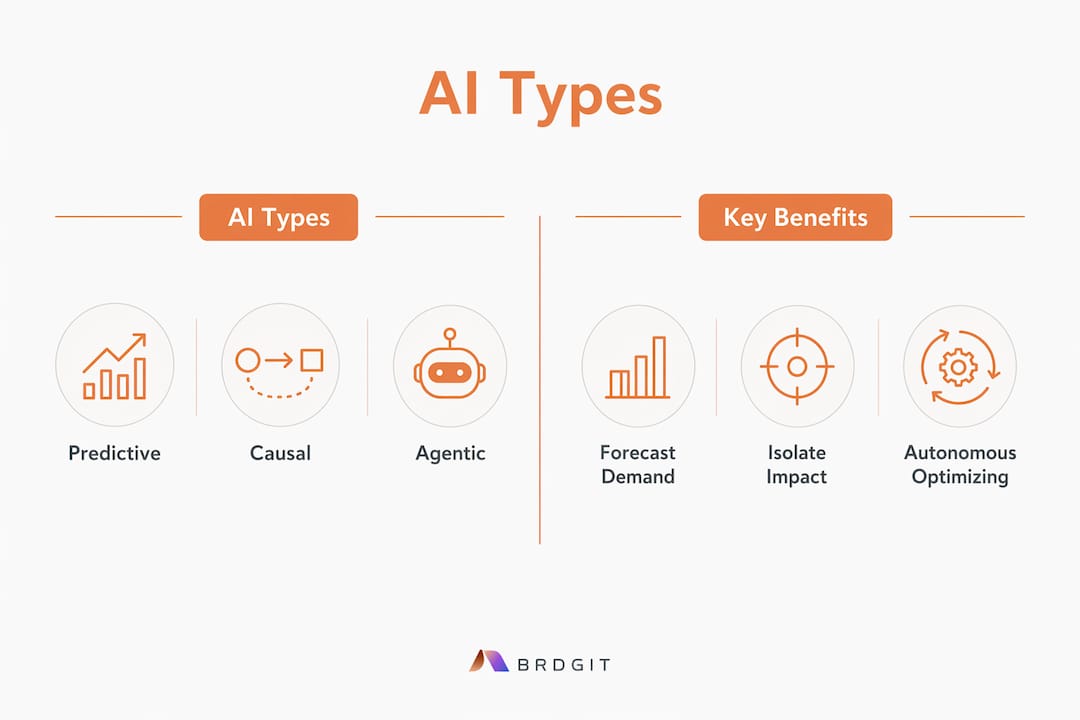
Three distinct AI approaches power modern trade promotion optimization, and each solves a different part of the problem.
Predictive AI uses machine learning models trained on historical sales, pricing, and promotional data to forecast demand and estimate uplift. These models reduce demand forecasting error by 30–40% compared to manual methods. That accuracy improvement directly reduces the risk of over-investing in promotions that underperform.
Causal AI goes further by isolating the true incremental impact of a promotion. Standard analytics often confuse baseline sales trends with promotional lift. Causal modeling separates the two, giving teams an honest read on what the promotion actually contributed. This is the foundation of credible ROI measurement in trade spend optimization.
Agentic AI is the most recent development. These are autonomous systems that monitor sales velocity, inventory levels, and competitor pricing in real time, then adjust live promotions within predefined guardrails. They do not wait for a weekly review meeting. They act.
AI Type | Primary Use Case | Key Benefit |
|---|---|---|
Predictive AI | Demand forecasting, uplift estimation | Reduces forecast error by 30–40% |
Causal AI | Incrementality measurement, impact decomposition | Separates true lift from baseline trends |
Agentic AI | Real-time promotion adjustment | Autonomous response to market signals |
Machine learning | SKU-level scenario simulation | Evaluates millions of options before budget commitment |
Integration with existing TPM and ERP systems is where these technologies become operational. AI tools for marketing efficiency deliver the most value when they connect directly to the systems your team already uses for execution and reporting.
How do you overcome the common challenges of AI adoption in trade promotion?
The biggest obstacle to AI success in trade promotion is not the technology. It is internal adoption friction. Teams that have built their careers around spreadsheet-based planning often resist tools that challenge their methods. The solution is not to force a full replacement. It is to design workflows where AI and human judgment each do what they do best.
Follow this sequence when introducing AI into your trade promotion process:
Unify your data first. Combine POS data, trade spend records, and inventory feeds into a single, audit-ready format before running any models. Many teams underestimate this step and pay for it later with unreliable outputs.
Pilot in one category with two retailers. Starting small reduces resistance and generates the proof cases needed to justify broader investment. Pick a category where you have clean data and a willing retail partner.
Build human-in-the-loop workflows. Let AI handle baseline forecasting and scenario generation. Keep humans in control of retailer negotiations and brand strategy. This division of labor minimizes friction and preserves the relationship skills that no model can replicate.
Establish a weekly operating rhythm. Leading CPG practitioners treat trade promotion as a weekly operating system, not a quarterly event. AI-driven reallocation of funds based on real-time data requires a cadence to match.
Invest in change management. Train your team on what the AI is doing and why. Teams that understand the model trust it more. Teams that trust it use it consistently.
Pro Tip: Frame AI to your team as a research analyst that never sleeps, not as a replacement for their expertise. That reframe reduces defensiveness and accelerates adoption.
How is agentic AI pushing trade promotion toward autonomous optimization?
The industry is moving toward what practitioners call the “agentic shift.” This is the transition from AI as a planning assistant to AI as an autonomous operator that governs promotions in real time. The difference matters enormously for how you think about AI applications in promotions going forward.
Agentic AI systems operate with goal-oriented autonomy. They are given objectives, constraints, and guardrails, then left to execute. In trade promotion, that means:
Monitoring live sales velocity against forecast and flagging underperforming promotions within hours, not weeks
Adjusting promotional depth or duration based on inventory levels and margin thresholds
Responding to competitor pricing moves without waiting for a human to notice them in a dashboard
Reallocating trade budget across retailers in real time based on sell-through performance
“The shift from static calendars to self-correcting decision flows is not a future state. It is happening now in leading CPG organizations.”
The business case for autonomous optimization is margin protection. Fixed promotional calendars lock in decisions months in advance. Markets do not cooperate with fixed calendars. Agentic systems close that gap by treating every promotion as a live variable, not a committed plan. Teams that understand demand forecasting with AI are already building the data infrastructure these systems require.
Key Takeaways
AI in trade promotion works because it replaces slow, backward-looking planning with real-time scenario modeling, causal measurement, and autonomous execution that protects margin and accelerates ROI.
Point | Details |
|---|---|
AI doubles promotion profitability | AI can increase the share of profitable promotions from 30% to 65% when applied to planning. |
Data readiness comes first | Clean, unified POS and trade spend data is required before any AI model can produce reliable outputs. |
Start with a pilot, not a full rollout | Piloting in one category with two retailers builds proof and reduces internal resistance before scaling. |
Human judgment stays in the loop | AI handles forecasting and scenario modeling; humans retain control of retailer negotiations and brand decisions. |
Agentic AI changes the operating model | Autonomous systems adjust live promotions in real time, replacing fixed calendars with continuous optimization. |
The uncomfortable truth about AI and trade promotion
We work with marketing and sales teams across retail and consumer goods, and the pattern is consistent. The organizations that struggle with AI adoption are not struggling because the technology failed. They are struggling because they expected the technology to solve a problem that was actually organizational.
AI does not fix a broken planning process. It accelerates it, for better or worse. Teams that had clean data, clear accountability, and disciplined post-event reviews got dramatically better results when they added AI. Teams that had fragmented data and siloed decision-making got faster versions of the same confusion.
The other thing we see consistently is an underestimation of what the human role becomes after AI takes over the analytical work. Retailer negotiations are not a spreadsheet problem. Brand positioning is not a forecasting problem. The teams that thrive are the ones that freed their best people from data stitching and pointed them at the conversations that actually move the needle. AI handles the analysis. Your team handles the relationship. That division of labor is not a compromise. It is the point.
— Team BRDGIT
How BRDGIT supports AI-driven trade promotion teams
Trade promotion optimization requires more than software. It requires people who understand both the AI and the business context it operates in.
BRDGIT provides fractional AI engineers who specialize in exactly this intersection. They assess your data readiness, design the integration between your TPM and AI systems, and build the workflows that keep humans in control of the decisions that matter. For teams that need AI expertise without a full-time hire, BRDGIT’s fractional model delivers experienced execution support from day one. If your team is ready to move from AI curiosity to real promotional ROI, BRDGIT is built for that transition.
FAQ
What is AI in trade promotion?
AI in trade promotion is the use of machine learning, predictive analytics, and agentic systems to plan, execute, and optimize promotional investments in retail and consumer goods. It replaces static spreadsheet planning with real-time scenario modeling and autonomous adjustment.
How much can AI improve trade promotion ROI?
AI-driven promotional planning delivers a 22% increase in promotional ROI and reduces margin loss from over-discounting by 34%, based on documented CPG implementations.
What data do you need before implementing AI in trade promotion?
You need clean, unified data combining point-of-sale records, trade spend history, and inventory feeds in an audit-ready format. Data preparation is the most commonly underestimated step in AI readiness for trade promotion.
What is agentic AI in trade promotion?
Agentic AI refers to autonomous systems that monitor live sales velocity, inventory, and competitor pricing, then adjust active promotions in real time within predefined guardrails, without waiting for human review.
Should AI replace human judgment in trade promotion decisions?
No. AI handles forecasting, scenario generation, and real-time adjustments. Human teams retain control of retailer negotiations, brand strategy, and decisions that require relationship context and judgment.