Published on
The Role of AI in Returns Management: 2026 Guide
TL;DR:
AI in returns management automates workflows, reduces costs by analyzing data points, and predicts high-risk returns. Successful implementation relies on integrating AI with enterprise systems and feeding return data back into product teams. Proper organizational setup and measurement of resolution, not just volume, drive true AI value in reverse logistics.
AI in returns management is defined as the application of predictive analytics, computer vision, and decision orchestration to automate and improve reverse logistics workflows. The role of AI in returns management has moved well beyond simple chatbot deflection. Predictive AI systems now analyze over 847 data points per transaction, achieving 89% accuracy in return prediction and cutting reverse logistics costs by an average of 74%. For supply chain managers and e-commerce professionals, that number reframes returns from an unavoidable cost center into a controllable, data-driven operation.
What is the role of AI in returns management?
AI in returns management works across three distinct layers: prediction, automation, and fraud detection. Each layer addresses a different failure point in the traditional returns process. Together, they form what industry analysts call a 3-layer AI architecture, and retailers using this approach achieve an 8–12% reduction in return dollar volume, improving overall return rates from 15% to 13%.

That improvement sounds modest until you apply it to a $50 million returns liability. The compounding effect across prediction accuracy, processing speed, and fraud prevention is where the real financial case lives.
How does predictive AI reduce returns before they happen?
Predictive AI addresses returns at the earliest possible point: before the item ships. Machine learning models ingest purchase history, product reviews, sizing data, customer behavior signals, and even weather patterns to flag high-risk orders. The goal is intervention before the return occurs, not just faster processing after the fact.
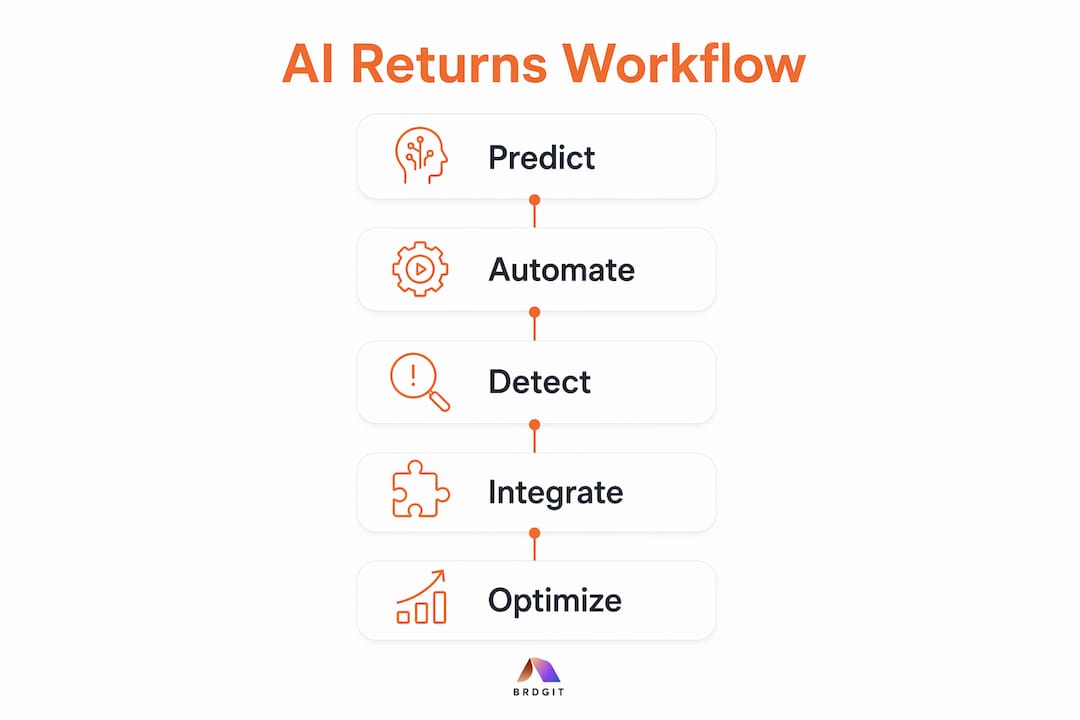
The financial impact is significant. Reverse logistics costs drop by an average of 74% for operations that deploy predictive AI at scale. That reduction comes from fewer items traveling back through the supply chain, lower labor costs at receiving docks, and reduced write-down losses on time-sensitive inventory.
Early adopters in direct-to-consumer apparel have integrated predictive models directly into their order management systems. When a transaction scores above a risk threshold, the system triggers proactive outreach, such as a sizing recommendation or a product substitution offer, before the order ships. That kind of early intervention is far cheaper than processing a physical return.
Predictive models analyze purchase history, fit data, and behavioral signals simultaneously.
High-risk transactions trigger automated pre-shipment interventions.
Reduction in return volume directly lowers warehouse receiving labor costs.
Fewer returns mean less inventory degradation and fewer markdown events.
Pro Tip: Start predictive AI with your top three return-driving SKUs. The model trains faster on concentrated data, and the ROI is visible within one quarter.
How does AI automate return processing and condition assessment?
Once a return is initiated, AI takes over the workflow decisions that previously required manual review. AI agents handle label generation, refund authorization, and routing decisions through API connections to order management systems and warehouse management systems. The result is faster cycle times and fewer human bottlenecks at the receiving dock.
The most significant capability here is computer vision for item condition grading. AI-powered computer vision assesses returned item condition with 94% accuracy compared to human inspectors. That accuracy level enables automated disposition routing: items go directly to resale, refurbishment, liquidation, or disposal without a human touching them first.
Here is how a typical AI-automated return flow works:
Customer initiates return through a self-service portal.
AI scores the return request and issues a prepaid label automatically.
Item arrives at the warehouse and is photographed by a computer vision system.
The model grades condition and routes the item to the appropriate disposition channel.
Refund or exchange is triggered automatically based on condition grade and policy rules.
Step | AI component | Outcome |
|---|---|---|
Return initiation | Decision AI agent | Label issued in seconds, no agent needed |
Condition grading | Computer vision model | 94% accuracy vs. human inspector |
Disposition routing | Rules engine + ML | Resale, refurb, or liquidation assigned automatically |
Financial reconciliation | ERP integration | Refund processed and inventory updated in real time |
Image recognition models require fine-tuning specific to retailer product categories to accurately grade item conditions. Out-of-the-box models underperform on nuanced defects like fabric pilling or subtle electronic damage.
Pro Tip: Budget for model retraining every six months. Product catalogs change, and a model trained on last season’s SKUs will drift in accuracy without updated data.
How does AI detect and prevent return fraud?
Return fraud is a structural problem in retail. Wardrobing, item swaps, and serial return abuse cost retailers billions annually. Machine learning models now score every return request before a label is issued, flagging patterns that human agents would never catch at volume.
85% of retailers deployed AI for return fraud detection by april 2026. Only 45% rate these tools as effective. That gap reveals an uncomfortable truth: deployment is not the same as performance.
Serial returner identification: models flag customers whose return frequency exceeds category norms.
Item swap detection: computer vision compares returned item photos against original order images.
Wardrobing signals: purchase-to-return timing patterns trigger automatic holds for review.
Policy abuse scoring: customers who exploit free return windows repeatedly receive friction-added flows.
“Current AI fraud detection tools often require human-in-the-loop escalation for complex return cases, with effectiveness still maturing in the industry.” — Industry case study analysis
The honest position is that AI fraud detection works well on high-volume, pattern-based abuse. It struggles with novel schemes and edge cases. Human review remains necessary for escalated cases, and the best implementations treat AI as a triage layer, not a final arbiter.
Pro Tip: Set your fraud model’s sensitivity threshold conservatively at launch. False positives that block legitimate customers cost more in lifetime value than the fraud you prevent.
Why does AI integration with OMS, WMS, and ERP determine success?
The key differentiator between successful and failed AI returns implementations is treating returns as an enterprise-wide data challenge rather than an isolated logistics task. AI tools that operate in isolation from warehouse management systems and financial reconciliation platforms create accuracy gaps that compound over time.
Real-time inventory updates depend on the returns AI communicating directly with the WMS. When a returned item is graded and routed, the inventory record needs to update immediately. Delays create phantom stock, which distorts demand forecasting and markdown timing. AI-powered reverse logistics systems reduce processing costs by 40% for direct-to-consumer brands and improve customer satisfaction scores by 23%. Those numbers assume full integration, not a standalone returns tool.
Closing the data loop with merchandising teams is equally important. Capturing structured return reason data and feeding it back into product and quality teams reduces preventable returns over time. A size inconsistency flagged in returns data should reach the product team within days, not quarters.
Connect returns AI to OMS for real-time order status and refund triggers.
Integrate with WMS for immediate inventory updates on received and graded items.
Feed structured return reasons into ERP and merchandising systems weekly.
Use return data to inform demand forecasting models and reduce overstock risk.
The primary value of AI in supply chain returns lies in orchestrating decisions across siloed systems, enabling cohesive automation rather than just labor reduction. That framing matters. If you buy an AI returns tool and bolt it onto an existing disconnected stack, you will get partial results at best.
Key Takeaways
AI in returns management delivers measurable cost reduction, fraud prevention, and customer satisfaction gains only when deployed as an integrated, enterprise-wide system rather than a point solution.
Point | Details |
|---|---|
Predictive AI cuts costs early | Analyzing 847+ data points per transaction reduces reverse logistics costs by up to 74%. |
Computer vision grades conditions accurately | AI assesses returned item condition at 94% accuracy, enabling automated disposition routing. |
Fraud detection needs human backup | 85% of retailers use AI for fraud detection, but only 45% rate it effective without human escalation. |
Integration determines ROI | Connecting returns AI to OMS, WMS, and ERP is what separates successful implementations from failed ones. |
Return data prevents future returns | Feeding structured return reasons back to product teams reduces preventable returns over time. |
The uncomfortable truth about AI returns projects
We work with supply chain teams who arrive with a clear mandate: reduce return costs with AI. The tools exist. The data is there. The business case writes itself on paper. What trips most implementations is not the technology. It is the organizational assumption that returns are a logistics problem.
Returns are a data problem that touches logistics, merchandising, product quality, customer experience, and finance simultaneously. When you treat them as a warehouse issue, you build a solution that optimizes one node in a broken chain. The AI does its job. The results disappoint. And the organization concludes that AI does not work for returns.
What we have seen work is starting with the data architecture before touching the AI layer. Map where return reason data lives, how it flows, and where it dies. Most companies discover that structured return reasons never reach the product team. That single gap is responsible for a significant share of repeat returns on the same SKUs.
Measuring success by completed resolution of automated interactions, meaning label generation, refunds, and status updates, is more meaningful than simple volume deflection metrics. That distinction matters because deflection can mean a frustrated customer who gave up. Resolution means the problem was actually solved. Build your KPIs around resolution, and your AI investment will reflect real business value rather than surface-level activity.
The AI tools for supply chain are mature enough to deliver. The organizational readiness to use them well is still the variable that determines outcomes.
— Team BRDGIT
How BRDGIT can help you build AI-powered returns workflows
Returns management automation is one of the highest-ROI applications of AI in supply chain operations. Getting it right requires more than selecting a tool. It requires integrating predictive models, computer vision, fraud detection, and enterprise data systems into a coherent workflow.
BRDGIT works with supply chain and e-commerce teams to design and implement exactly that kind of end-to-end AI architecture. From AI readiness assessments to fractional engineering support for ongoing model training and system integration, BRDGIT provides the technical depth that most internal teams need but rarely have on staff. If your returns process is costing more than it should, and your current tools are not connecting the dots, that is the problem BRDGIT is built to solve.
FAQ
What is the role of AI in returns management?
AI in returns management predicts high-risk returns before shipment, automates processing workflows, grades item conditions with computer vision, and detects fraud using machine learning. The goal is reducing costs and improving customer satisfaction across the full reverse logistics cycle.
How much can AI reduce returns processing costs?
Predictive AI systems reduce reverse logistics costs by an average of 74%, while AI-powered reverse logistics systems reduce processing costs by 40% for direct-to-consumer brands, according to 2026 industry data.
Does AI replace human workers in returns processing?
AI automates high-volume, pattern-based decisions like label issuance, condition grading, and refund triggers. Human review remains necessary for complex fraud cases and edge-case escalations where AI effectiveness is still maturing.
How does machine learning detect return fraud?
Machine learning models score every return request before a label is issued, flagging serial returners, item swap patterns, wardrobing behavior, and policy abuse signals. 85% of retailers had deployed these tools by april 2026.
Why does system integration matter for AI returns management?
AI returns tools that operate in isolation from OMS, WMS, and ERP systems create inventory inaccuracies and miss the data loops that prevent future returns. Full integration is what separates a 40% cost reduction from a marginal improvement.