Published on
Improve Retail Pricing Strategy with AI: A Playbook
The verdict is straightforward: AI can materially improve retail pricing by lifting gross margins, compressing repricing cycles from weeks to hours, and reducing end-of-season markdown loss through SKU-level elasticity modeling. Here are three immediate next steps your team can take today.
Run a data readiness check. Audit your POS sales history, inventory on-hand, promotions calendar, and competitor price feeds for completeness and SKU-level granularity.
Design a shadow-mode pilot on 1–2 categories. Pick categories with meaningful price variance, run AI recommendations in parallel with human decisions for 2–6 weeks, and capture every override.
Set three pilot KPIs before you start. Target a gross margin lift of 1–3 percentage points, keep override rates low, and aim to reduce repricing cycle times significantly.
BRDGIT’s fractional AI expertise helps teams execute exactly this sequence without hiring a full-time ML team. The approaches below draw on MIT Sloan Management Review guidance on when to use generative AI versus algorithmic models, and on agent-based markdown framing for end-of-season clearance.
Table of Contents
Why AI-driven retail pricing delivers measurable business results
What data and systems does an AI pricing pilot actually require?
Which AI pricing approach fits your retail use case?
How do you move from pilot to production? A phased roadmap
How does AI pricing output flow through your systems?
What governance guardrails do U.S. retailers need?
How do you measure whether the pilot is actually working?
What are the most common AI pricing mistakes, and how do you fix them?
Regulatory and compliance considerations for AI-driven pricing
Key Takeaways
What BRDGIT sees in the field
BRDGIT helps retailers move from pricing curiosity to margin results
Further reading and sources
Why AI-driven retail pricing delivers measurable business results
The business case is concrete. High-performing AI pricing setups typically realize gross margin lift of roughly 1–3 percentage points in categories with meaningful elasticity within two to three quarters of rollout. That lift comes from three places: tighter elasticity-based price setting, markdown simulation that clears inventory with minimized margin loss, and promotion optimization that separates genuine demand lift from baseline noise.
Speed matters just as much. AI can cut repricing cycle time from weeks to hours, enabling same-day responses to competitor moves. For pricing teams, that compression means fewer manual spreadsheet cycles and more time on strategic category decisions.
Markdown simulation reduces clearance discounts by modeling sell-through curves before committing to a price.
Promotion ROI improves when AI separates incremental lift from cannibalization across SKUs.
Inventory turn accelerates when pricing and replenishment signals share the same data layer.
Forbes coverage notes that many companies plan to raise prices to manage cost pressure — which makes AI-driven margin defense more urgent, not less.
What data and systems does an AI pricing pilot actually require?
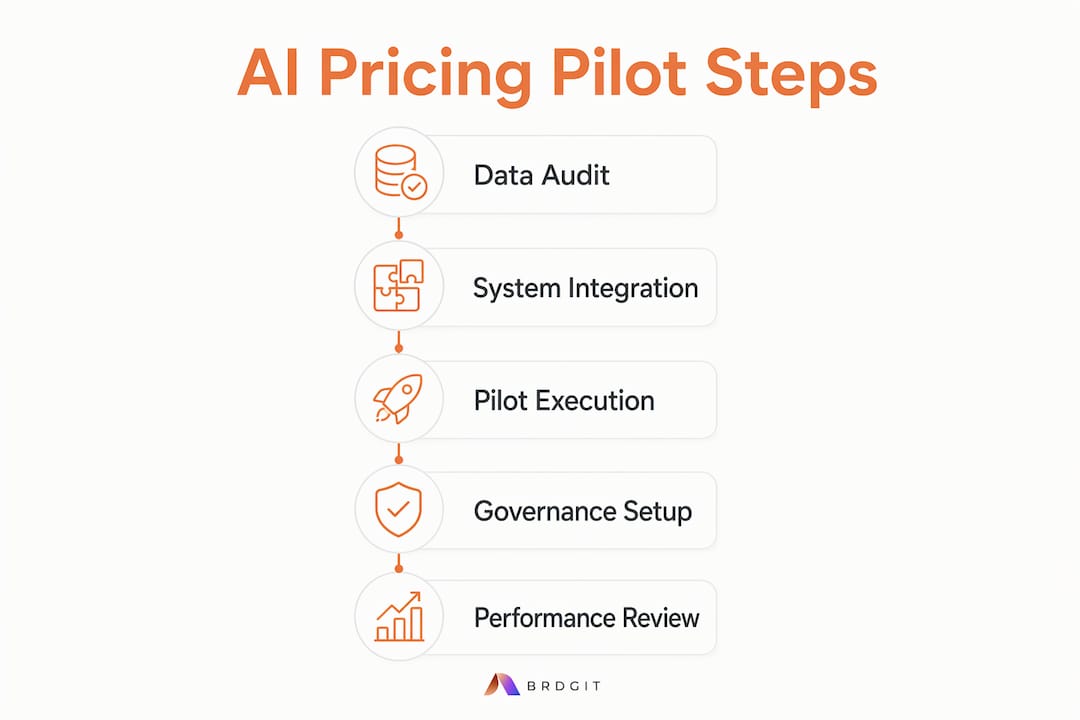
Data quality is where most pilots fail before they start. The table below maps each required source to its minimum quality bar.
Data source | Why it matters | Minimum quality requirement |
|---|---|---|
POS sales (SKU/day) | Elasticity and demand signal | 90+ days, no major gaps |
Inventory on-hand and cover | Markdown urgency signal | Daily refresh, UOM-aligned |
Cost and landed cost | Margin floor enforcement | Current, by SKU |
Promotions calendar | Demand attribution | Tagged by SKU and date range |
Competitor price feeds | Competitive positioning | Deduplicated, anomaly-checked |
Product master / attributes | SKU matching across catalogs | Canonical IDs, variant-mapped |
Customer signals | Personalization and segment elasticity | Optional for Phase 1 |
Advanced AI removes manual SKU-mapping grunt work by matching products across divergent catalogs using attributes and images — a critical pre-step before any elasticity model can run reliably.
On the systems side, you need integration points into your ERP, POS, e-commerce platform, promotions engine, and a pricing execution API. Siloed decisions cause negative cross-functional ripple effects, so a unified data layer connecting pricing to supply chain and promo planning is non-negotiable. Your team needs a pricing strategy owner, a data engineer, an ML engineer or fractional AI resource, and a category manager for human-in-the-loop decisions.

Which AI pricing approach fits your retail use case?
There is no single right model. The five practical approaches below cover most U.S. retail scenarios.
SKU-level elasticity modeling. Best for grocery, commodity, and electronics categories with high transaction volume. Accurate but data-hungry; requires 90+ days of clean sales history and careful promotion attribution.
Markdown-curve simulation. Purpose-built for apparel and seasonal goods. AI reasons about margin vs. volume vs. inventory risk to recommend clearance plans that minimize margin loss. Strong fit for end-of-season and overstock situations.
Dynamic repricing agents. Suited to omnichannel retailers competing on price in near real time. High governance complexity; requires anomaly detection on competitor feeds and strict guardrails.
LLM-assisted recommendations. Generative AI lowers the barrier to entry for pricing recommendations but requires careful prompt engineering and explainability controls. Use LLMs as an analyst-assist and explanation layer, not as the sole execution engine. They excel at surfacing rationale for category managers, not at replacing elasticity models where real-time variables matter.
Governed rules plus agents hybrid. The most sustainable production pattern. Rules enforce brand and margin constraints; agents handle optimization within those bounds. Fits retailers that need explainability for merchant sign-off.
For building and scaling AI agents in production, the hybrid approach consistently outperforms pure-agent or pure-rules setups in governance audits.
How do you move from pilot to production? A phased roadmap
Phase | Typical duration | Key deliverables |
|---|---|---|
Assess | 2–4 weeks | Data audit, integration map, KPI baseline |
Pilot / shadow mode | 2–6 weeks | Shadow recommendations, override log, A/B design |
Validate | 1–2 months | Margin lift measurement, guardrail tuning, stakeholder review |
Scale | 2–3 quarters | Full category rollout, governance cadence, retraining schedule |
Pilot checklist:
Pick 1–2 categories with SKU-level elasticity variance and sufficient transaction volume.
Set tight guardrails: maximum price change per cycle, cost-plus floor, category brand rules.
Run shadow mode for 2–4 weeks before any live execution.
Instrument every recommendation: log the rationale, the decision, and any human override.
Require explanation for every automated suggestion before merchant sign-off.
Pilot KPI targets: 1–3 percentage points of gross margin lift where elasticity exists, override rate below 20% in early weeks, repricing cycle time falling from weeks to hours, and measurable sell-through improvement in the pilot category.
A typical pilot resource mix is one fractional ML engineer, one data engineer, one category manager, and a part-time project manager. That structure keeps costs contained while maintaining the governance discipline a live experiment demands.
How does AI pricing output flow through your systems?
The runtime flow runs in one direction: canonical product master plus sales and inventory feeds feed the model or agent, which produces a pricing decision passed through a pricing execution API to your e-commerce platform and POS, with every decision logged for audit and analytics.
Mandatory feeds and APIs:
POS sales stream (near real time for dynamic repricing; daily batch acceptable for markdown planning)
Inventory on-hand and cover (daily minimum)
Cost and landed cost (updated on receipt)
Promotions calendar (forward-looking, SKU-tagged)
Competitor price feed (with anomaly detection layer)
Pricing execution API (idempotent, with rollback support)
Override and exception feed (captures every human intervention)
Reporting exports (margin outcomes, override rates, cycle times)
For teams managing inventory signals and integrations, connecting inventory cover directly to markdown urgency scoring is one of the highest-leverage integration decisions in the entire stack. Latency SLAs matter: dynamic repricing needs near-real-time feeds; markdown planning tolerates overnight batch. Every execution call should be idempotent so a retry does not double-apply a price change.
What governance guardrails do U.S. retailers need?
AI does not forgive organizational ignorance. Without explicit guardrails, a single bad competitor feed can trigger a margin-destroying race to the bottom across hundreds of SKUs.
Guardrail checklist:
Cost-plus floor: no price recommendation below landed cost plus minimum margin threshold.
Maximum percentage change per repricing cycle (typically 5–15% depending on category).
Category-level brand rules: luxury or private-label SKUs may require manual approval.
Human override authority with a defined SLA (e.g., merchant must review within four hours).
Automated anomaly detection on competitor feeds to flag and freeze on suspicious price blips.
For explainability, every price suggestion should carry a short rationale text, feature-level attribution (elasticity signal, inventory cover, competitor delta), and a confidence band. Monthly reporting should cover total price changes, override volume, and margin outcomes by category.
Pro Tip: Set your initial guardrails conservatively — a 5% max change cap feels restrictive but limits blast radius during the first live weeks. Widen the bounds only after two consecutive clean reporting cycles.
How do you measure whether the pilot is actually working?
Metric | Why it matters | Example target |
|---|---|---|
Gross margin lift | Primary financial return | 1–3 ppt in elastic categories |
Sell-through rate | Markdown efficiency | Improvement vs. prior season |
Inventory days on hand | Capital efficiency | Reduction vs. baseline |
Override rate | Model trust and governance health | Below 20% in pilot weeks |
Repricing cycle time | Operational speed | Weeks to hours |
Promotional ROI uplift | Promo-pricing interaction | Measurable vs. control group |
Evaluation steps:
Run shadow-mode comparisons for 2–4 weeks before any live pricing.
Where feasible, randomize A/B test groups at the store or region level.
Use uplift attribution to separate AI-driven margin changes from organic demand shifts.
Review a weekly dashboard during the pilot, monthly executive summaries post-launch, and a full quarterly post-rollout review.
Tracking AI ROI and governance failures rigorously from week one is what separates pilots that scale from pilots that stall.
What are the most common AI pricing mistakes, and how do you fix them?
Low SKU-level data quality is the leading cause of pilot failure. Gaps in promotion attribution, UOM mismatches, and missing cost data corrupt elasticity estimates before the model ever runs. Fix: run feed health checks as part of the readiness assessment, not after the pilot starts.
Treating LLM outputs as final prices is the second most common error. Generative AI excels at surfacing rationale and flagging anomalies; it is not a substitute for a calibrated elasticity model when real-time variables drive the decision.
A competitor feed blip — a single retailer’s erroneous price drop — triggered an automated repricing cascade across 200 SKUs in one category, compressing margin by nearly a full point before a human caught it. The fix: anomaly detection flagged the outlier feed as a statistical deviation, a temporary freeze halted further automated changes, and a human review confirmed the blip before any rollback. The entire episode took four hours instead of days — because the logging infrastructure captured every decision in sequence.
Fractured operating models that silo pricing from supply chain are the structural version of this problem. AI-driven pricing and supply chain planning must share a unified data layer or the margin gains in one function become costs in another.
Regulatory and compliance considerations for AI-driven pricing
U.S. retailers operating AI pricing systems face a growing set of legal and ethical obligations. Algorithmic pricing that coordinates with competitor data in ways that affect market prices can attract scrutiny under federal antitrust law, particularly the Sherman Act. The FTC has signaled active interest in AI-driven pricing practices, especially where pricing agents interact with shared data sources across competitors.
Price discrimination driven by customer-level signals must comply with the Robinson-Patman Act for like-grade and like-quality goods sold to competing buyers. Personalized pricing based on demographic proxies carries additional fair lending and consumer protection exposure under FTC Act Section 5.
Explainability is not just a governance preference — it is increasingly a legal defense. Maintaining audit trails of every automated price decision, the inputs that drove it, and any human override creates the documentation layer needed to respond to regulatory inquiries. State-level consumer protection laws in California, New York, and Illinois add requirements around price transparency and algorithmic accountability that federal law does not yet fully address.
This article is general information, not legal advice. Confirm current regulatory requirements with qualified legal counsel for your specific situation.
Key Takeaways
AI pricing delivers its strongest returns when data quality, governance, and operating-model alignment are treated as prerequisites, not afterthoughts.
Point | Details |
|---|---|
Start with data readiness | Audit POS, inventory, cost, and promotions data before building any model. |
Pilot on 1–2 categories | Shadow mode for 2–4 weeks with tight guardrails limits risk and generates clean measurement data. |
Target 1–3 ppt margin lift | Gross margin improvement of 1–3 percentage points is realistic in elastic categories within two to three quarters. |
Governance is non-optional | Cost-plus floors, anomaly detection, and override logging protect margin and regulatory standing. |
BRDGIT accelerates execution | BRDGIT’s fractional engineers cover the ML, data, and pilot design work without a full-time hire. |
What BRDGIT sees in the field
The readiness gap we encounter most often is not a technology problem. It is a data infrastructure problem dressed up as one. Teams arrive with enthusiasm for AI pricing agents and leave the readiness assessment realizing their POS data has 18 months of promotion-attribution gaps that will corrupt any elasticity model built on top of it. Fixing that gap is unglamorous work, but it is the work that determines whether the pilot produces a real margin signal or a noisy one.
Fractional BRDGIT engineers fill a specific role in this sequence: they run the data audit, design the shadow-mode experiment, instrument the logging layer, and hand off a governed, documented system to the in-house team. One category-level pilot we supported realized approximately 2 percentage points of gross margin lift within two quarters of scaling, after a six-week shadow phase that surfaced and corrected three data quality issues before any live pricing ran.
The question of when to bring in fractional resources versus building in-house comes down to timeline and governance maturity. If your team has never run a controlled pricing experiment, the cost of learning those lessons in production is higher than the cost of fractional support during the pilot.
BRDGIT helps retailers move from pricing curiosity to margin results
Retailers that want faster repricing cycles, measurable margin lift, and governed automation without building a full AI team from scratch have a direct path forward with BRDGIT.
BRDGIT’s services cover the full pilot-to-production arc: AI readiness assessments that surface data and integration gaps before they become pilot failures, fractional engineers who design and deliver shadow-mode experiments, production integration into your ERP and POS stack, and governance and training setup so your pricing team owns the system after handoff. The engagement starts where you are, not where a vendor wants you to be. Request a readiness assessment or pilot scoping session at brdgit.ai/fractional-engineers and leave with a concrete plan, not a slide deck.
Further reading and sources
How AI Is Changing Retail Pricing: 2026 C-Level Guide | Retailgrid — The most operationally grounded source in this piece. Covers agent-based markdown framing, repricing cycle compression, pilot best practices, and the adoption figures cited throughout.
How to Use Generative AI for Pricing | MIT Sloan Management Review — Authoritative guidance on where LLMs add value in pricing workflows and where they require guardrails. Essential reading before designing any LLM-assisted recommendation layer.
Retail pricing strategies: How AI keeps retailers profitable and popular | RELEX Solutions — Platform and unified-planning perspective; useful for understanding the integration requirements between pricing, supply chain, and promo planning.
How Does Advanced AI Price Intelligence Improve Pricing Decisions for Retailers? | Kathy McCraw — Practical breakdown of SKU-matching and product intelligence as a prerequisite for reliable competitive pricing signals.
How AI Is Transforming Pricing Management | Forbes — Executive framing on market pressure and the business case for AI pricing investment.
AI-powered inventory control | BRDGIT — Companion resource on how AI-driven markdown plans and inventory control reduce excess stock.
AI in trade promotion | BRDGIT — Covers how pricing interacts with promotional lift measurement, directly relevant to the KPI and integration sections above.