Published on
How to Streamline Supplier Communication with AI
TL;DR:
AI automates routine procurement tasks and supports multilingual communication without disrupting existing workflows.
This enables teams to focus on strategic supplier relationships while AI handles volume and language barriers effectively.
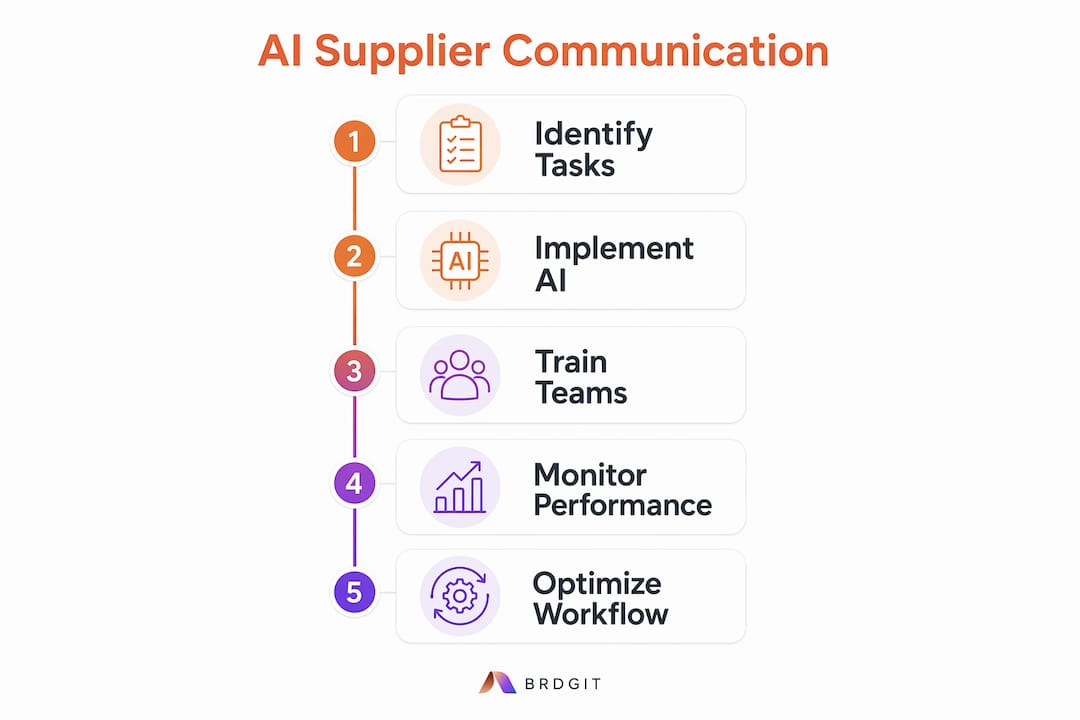
AI automates the repetitive, error-prone work that consumes procurement teams in manufacturing and distribution, and it does it without forcing suppliers to change how they operate. AI-powered procurement tools handle RFQs, order follow-ups, and exception handling automatically, freeing your team to focus on the supplier conversations that actually move the needle. The payoff is not just efficiency. Faster, clearer exchanges build the kind of trust that makes supply chains genuinely resilient.
Two capabilities define where AI creates the most immediate value in vendor communication. First, multilingual AI platforms support live, automated dialogue in Chinese, Spanish, Hindi, Vietnamese, and other major languages, eliminating the friction that slows global sourcing. Second, AI-powered supply chain planning tools enable two-way, real-time communication that sharpens forecast accuracy and accelerates how quickly critical updates reach suppliers. Together, these capabilities shift your team’s time from inbox management to partnership development.
AI automates RFQs, order follow-ups, and exception handling
Multilingual support removes language barriers with global suppliers
Real-time, two-way data sharing improves forecast accuracy and resilience
Procurement teams gain capacity for proactive, strategic supplier engagement
How to implement AI in your supplier communication workflows
The biggest misconception about deploying AI for supplier communication is that it requires a lengthy ERP overhaul. Modern AI platforms deploy rapidly without complex IT projects, wrapping around your existing workflows so your team keeps operating the way it already does, as explained in AI integration patterns. You can be running in days, not quarters.
The practical path looks like this:
Audit communication latency first. Before deploying anything, map where delays actually live. Auditing response times and prioritizing clarity is the foundation of trust-building with suppliers, and it gives you a baseline to measure against after AI goes live.
Use AI wrappers, not new portals. Successful deployments avoid forcing suppliers to create new logins or learn new systems. AI agents that work through email, Slack, and existing procurement channels see far higher supplier adoption.
Connect to your current stack. Platforms that integrate with email, Slack, and ERP workflows reduce change management burden and let AI interpret unstructured data from emails, PDFs, and scanned documents without manual re-entry.
Define expectations clearly. Set explicit rules for communication frequency, required data fields, and preferred channels before the AI goes live. Ambiguity at this stage creates noise the system cannot resolve on its own.
Let AI agents handle unstructured input. Most supplier communication arrives as free-form email or attached documents. AI agents trained to read and extract data from these formats eliminate the manual translation step that slows procurement cycles.
Pro Tip: Keep a human in the loop for any supplier conversation that involves pricing disputes, quality escalations, or relationship-sensitive decisions. AI handles volume; your team handles judgment.
AI does not replace the human element in supplier relationships
The concern comes up in nearly every conversation about AI in procurement: if machines handle the communication, do supplier relationships suffer? The short answer is no. The longer answer is that the premise gets the causality backward.
AI automation frees procurement teams from repetitive inquiries, creating capacity for the proactive, strategic conversations that actually strengthen partnerships. When your team is not buried in routine status requests, they can spend time on joint forecasting, risk planning, and the kind of collaborative problem-solving that suppliers remember. That is a fundamentally different relationship than one built on transactional email chains.
Speed and clarity matter here too. Suppliers who receive fast, consistent, accurate responses trust the buyer more, not less. AI delivers that consistency at scale, across time zones and languages, without the variability that comes from a team managing hundreds of threads manually. The role of AI in supplier management is not to replace the relationship. It is to remove the friction that prevents the relationship from deepening.
A few principles that keep the human element intact:
Reserve AI for high-volume, low-judgment tasks: status updates, confirmations, reminders, and data requests
Use the time AI creates for proactive outreach, not just reactive triage
Treat AI-generated communication as a floor for quality, not a ceiling
Train your team to recognize when a supplier interaction needs a human voice
How BRDGIT approaches AI-powered supplier communication
BRDGIT works with manufacturing and distribution companies that know AI can improve their supplier operations but are not sure where to start or how to do it without disrupting what already works. The approach begins with an AI readiness assessment that identifies where communication bottlenecks actually live, not where teams assume they live. That distinction matters more than most organizations expect.

From there, BRDGIT’s fractional AI experts build a roadmap tailored to the company’s existing systems, supplier base, and communication patterns. Implementation focuses on frictionless adoption: AI agents that plug into email and procurement workflows without requiring suppliers to change their behavior. The goal is measurable impact fast, not a multi-year transformation project.
BRDGIT also provides ongoing training so teams know how to work alongside AI rather than around it. That ongoing support is what separates a successful deployment from one that quietly gets abandoned six months in.
If your procurement team is spending more time managing communication than managing suppliers, BRDGIT can help you change that. Connect with a fractional AI specialist to assess where AI fits in your supplier workflows and what a realistic deployment looks like for your operation.
Key Takeaways
AI improves supplier communication by automating high-volume routine tasks, enabling multilingual real-time dialogue, and freeing procurement teams to focus on strategic supplier engagement rather than inbox management.
Point | Details |
|---|---|
Automate routine tasks | AI handles RFQs, order follow-ups, and exception handling without manual effort. |
Deploy without disruption | Modern AI platforms wrap around existing email and procurement workflows, requiring no ERP overhaul. |
Break language barriers | Live multilingual AI supports dialogue in Chinese, Spanish, Hindi, Vietnamese, and more. |
Protect human relationships | AI takes on repetitive volume so your team can focus on proactive, strategic supplier conversations. |
BRDGIT accelerates adoption | Fractional AI experts deliver readiness assessments, tailored roadmaps, and ongoing support for manufacturing and distribution teams. |