Published on
Automate Guest Communication with AI: 2026 Guide
TL;DR:
Automated guest communication with AI handles up to 70% of inquiries, increasing efficiency and consistency. Proper setup involves PMS integration, property-specific data, and confidence thresholds, with ongoing monitoring to prevent errors. Treat AI like a staff team member to improve guest satisfaction and operational performance.
Automated guest communication with AI is defined as the use of conversational AI systems to handle guest inquiries, send triggered messages, and manage multi-channel interactions without requiring staff to respond manually. Conversational AI can handle up to 70% of guest inquiries automatically. That figure means a front desk team spending most of its shift answering the same 20 questions can redirect that time toward in-person service. The real advantage is not just speed. It is consistency, coverage at 2 a.m., and a brand voice that never has a bad day.
What tools do you need to automate guest communication with AI?
The core technology stack for automated hospitality messaging has three layers: the AI engine, the messaging platform, and the property management system (PMS) integration. Each layer must work together. Without PMS integration, your AI is guessing at reservation details. Without a unified messaging platform, you are managing separate inboxes for SMS, WhatsApp, email, and OTA messages.

About 80% of hotel guest messages are predictable and repeatable. Pre-arrival instructions, check-in reminders, mid-stay check-ins, and post-stay surveys all follow a pattern. That predictability is what makes AI automation viable at scale.
The feature categories worth evaluating in any AI guest communication tool include:
Message automation: Triggered sends based on reservation events (booking confirmed, check-in day, checkout)
Sentiment analysis: Detecting frustration or urgency in guest messages to flag for human review
Task creation: Converting a guest request into a housekeeping or maintenance ticket automatically
Multi-channel unification: A single inbox pulling SMS, WhatsApp, Airbnb, Booking.com, and email into one view
Confidence thresholds: Controls that determine when AI replies autonomously versus when it routes to staff
Hotel messaging platforms unify communication across all these channels into one inbox tied directly to the PMS. That single-inbox model is what makes the system manageable for a small team.
Pro Tip: Train your AI on property-specific data, not generic hospitality content. Your cancellation policy, parking instructions, and local restaurant recommendations are what guests actually ask about. Generic training produces generic answers.
How do you set up AI automation for guest messaging?
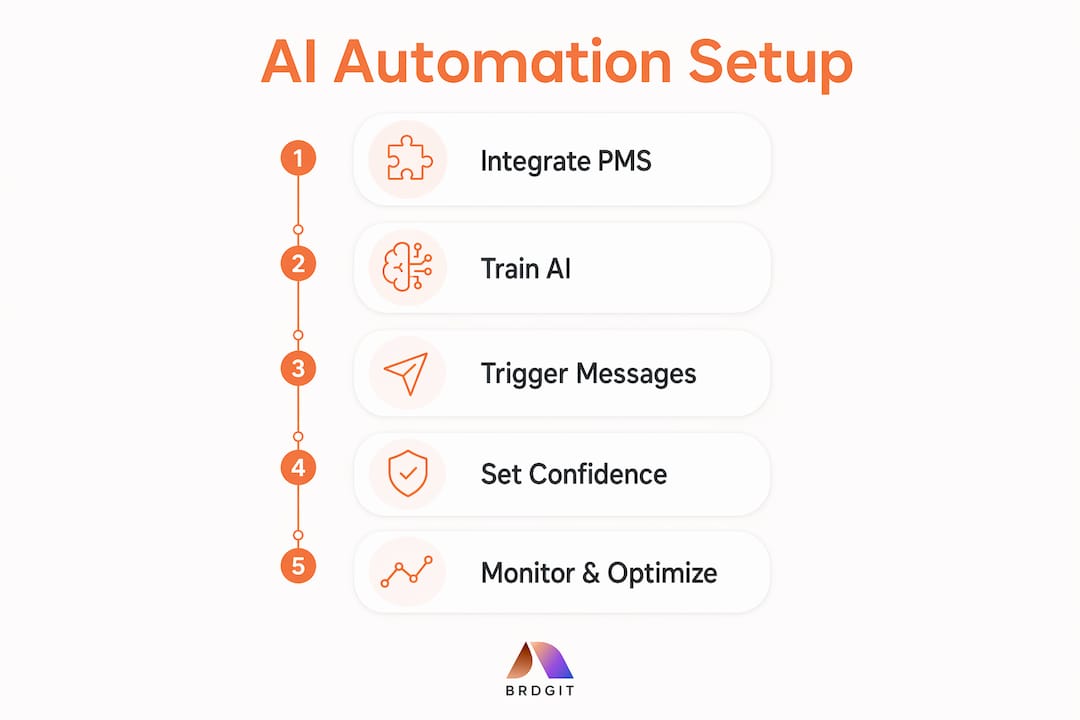
Setup is where most properties either get this right or create a maintenance problem they will deal with for years. The configuration process follows a clear sequence.
Connect your PMS. Live, bidirectional PMS integration is the foundation. Bidirectional PMS integration enables AI to not only respond to messages but also trigger operational actions like updating room statuses. Without this, your AI cannot confirm a late checkout or flag a room as ready.
Upload property-specific data. Feed the AI your policies, FAQs, listing descriptions, and local information. Clean and specific data training is critical for effective AI guest communication. Vague or outdated data produces vague or wrong answers.
Define response rules. Map out which message types the AI handles alone and which it escalates. Routine questions about check-in time, Wi-Fi passwords, and parking go to AI. Complaints, special requests, and anything involving a refund go to a human.
Set confidence thresholds. Successful implementations set AI to reply autonomously only when it is highly confident, routing uncertain cases to staff. This single setting prevents the most common AI failure mode: a confident wrong answer.
Configure multi-language support. If your property serves international guests, set the AI to detect and respond in the guest’s language. Most enterprise-grade platforms handle this natively.
Test with real scenarios. Run 30 to 50 real guest message examples through the system before going live. Look for gaps in your training data, not just errors in the AI logic.
Pro Tip: Use your PMS bidirectional integration to trigger messages based on operational events, not just time. A room marked “ready” at 11 a.m. can automatically trigger an early check-in offer to the guest waiting in the lobby.
What challenges come up when automating guest messaging?
The risks of AI guest communication are real, and most of them are preventable. The most common failure is not a technology problem. It is a data problem.
The most common pitfall is insufficient PMS integration. When AI lacks live access to reservation data, it fabricates answers or gives outdated information. A guest asking about their specific checkout time should get their actual checkout time, not a generic “our standard checkout is 11 a.m.” response.
The second risk is over-automation. Routing every message to AI, including complaints and emotionally charged requests, damages trust faster than slow response times ever would. The fix is a well-defined escalation rule, not a better AI model.
“Automation should be invisible to guests. Use existing communication channels and phone numbers so the experience feels personal, not like a chatbot interaction.” — automated guest messaging best practices
Three other challenges worth addressing directly:
Hallucinated responses: AI generating plausible but incorrect answers. Prevented by tight confidence thresholds and regular knowledge base audits.
Stale information: Policies change, local businesses close, seasonal hours shift. Build a quarterly review of your AI training data into your operations calendar.
Brand voice drift: AI trained on generic data sounds generic. Audit a sample of AI replies monthly and rewrite training examples that sound off-brand.
How does AI-driven communication improve guest satisfaction and efficiency?
The operational case for AI guest communication tools is straightforward. Conversational AI acts as a 24/7 virtual concierge, remembering guest preferences to personalize repeat stays. A guest who requested a foam pillow on their last visit should not have to ask again. That kind of memory is what separates a transactional stay from a loyalty-building experience.
The guest experience benefits extend across the full stay cycle. Pre-arrival, AI sends personalized check-in instructions and upsell offers. Mid-stay, it handles service requests and checks in proactively. Post-stay, AI communication collects feedback, offers loyalty discounts, and prompts repeat bookings. Each touchpoint is consistent and timely without adding to staff workload.
For a deeper look at how these tools fit into a broader hospitality tech stack, the AI guest experience tools overview from BRDGIT covers the 2026 landscape in detail.
Category | Operational benefit | Guest experience benefit |
|---|---|---|
Automated pre-arrival messages | Reduces check-in desk congestion | Guests arrive informed and prepared |
24/7 inquiry handling | Frees staff for complex tasks | Instant answers at any hour |
Sentiment analysis | Flags at-risk guests before escalation | Issues resolved before they become reviews |
Post-stay follow-up | Drives repeat bookings automatically | Guests feel remembered and valued |
The staff productivity gains are equally significant. When AI handles routine inquiries, your team focuses on the interactions that actually require human judgment. That is not a cost-cutting argument. It is a service quality argument.
Key takeaways
Automating guest communication with AI requires clean PMS integration, property-specific training data, and confidence thresholds that keep humans in the loop for complex situations.
Point | Details |
|---|---|
AI handles most inquiries | Up to 70% of guest questions can be automated, freeing staff for in-person service. |
PMS integration is non-negotiable | Bidirectional PMS access lets AI trigger real operational actions, not just send messages. |
Train on your own data | Generic training produces generic answers; use your actual policies and property details. |
Set confidence thresholds | Limit autonomous AI replies to high-confidence cases and route the rest to staff. |
Keep automation invisible | Use existing channels and phone numbers so guests experience service, not a chatbot. |
What we have learned from watching hotels get this wrong
The properties that struggle with AI guest communication share one pattern: they treat it as a software installation rather than an operational change. They connect the tool, turn on automation, and assume the work is done. It is not.
What actually works is treating your AI like a new team member. You would not hire someone and hand them a generic script. You would train them on your specific property, your guests’ expectations, and the situations where they should ask for help. The same logic applies here. The personalize customer experience with AI framework we use at BRDGIT starts with exactly that kind of property-specific onboarding.
The other thing most articles will not tell you: guests do not mind AI communication when it is accurate and fast. They mind it when it is wrong. One confident incorrect answer about a reservation detail does more damage than a 10-minute response delay. That is why confidence thresholds are not a technical detail. They are a guest trust decision.
Monitor your AI replies weekly in the first 90 days. Not to micromanage the system, but to catch the gaps in your training data before guests do. The properties that iterate on their AI knowledge base consistently outperform those that set it and forget it.
— Team BRDGIT
BRDGIT’s fractional engineers for AI guest communication
Deploying AI guest communication well requires more than picking a platform. It requires clean data architecture, PMS integration work, and workflow design that fits your specific operation.
BRDGIT’s fractional AI engineers work directly with hospitality teams to assess readiness, design automation workflows, and build the integrations that make AI communication actually function at the property level. For teams that need AI expertise without a full-time hire, this model provides experienced execution support from assessment through go-live and beyond. If your property is ready to move from curiosity to working AI, BRDGIT can build the path.
FAQ
What is AI guest communication automation?
AI guest communication automation uses conversational AI systems to handle guest inquiries, send triggered messages, and manage multi-channel interactions without manual staff responses. It typically integrates with a property management system to access live reservation data.
How much of guest communication can AI handle automatically?
Conversational AI can handle up to 70% of guest inquiries automatically, covering routine questions about check-in, checkout, Wi-Fi, and property policies.
What is a confidence threshold in AI messaging?
A confidence threshold is a setting that controls when AI replies autonomously versus when it routes a message to a human. Successful implementations set this threshold high, typically in the 95–99% confidence range, to prevent incorrect automated responses.
Why does PMS integration matter for AI guest messaging?
Without live PMS integration, AI cannot access real reservation data and will give generic or inaccurate answers. Bidirectional integration also lets AI trigger operational actions, like updating room status or sending an early check-in offer.
How do you keep AI communication from feeling impersonal?
Use existing communication channels and phone numbers rather than third-party chat apps. When automation uses the same touchpoints as your human staff, guests experience consistent service rather than a noticeable shift to a bot.