
Published on
AI Candidate Matching Explained for Hiring Teams
AI candidate matching is the automated process by which a machine learning system scores and ranks candidates against a job opening, using semantic analysis and skills inference rather than simple keyword overlap. For hiring teams, the practical payoff is faster shortlisting and better recall of qualified candidates who would otherwise be buried in an ATS. The caveat is real, though: match scores are a triage signal, not a hiring decision. Accuracy depends on data quality, bias mitigation requires deliberate effort, and a minority of job applicants trust AI to evaluate them fairly, according to a Gartner survey. That trust gap is your operational problem to solve, not the vendor’s.
Key Takeaways
AI candidate matching is a triage tool, not a decision engine. Its value is realized only when data is clean, feedback loops are active, and human oversight is structured and documented.
Point | Details |
|---|---|
Match scores are triage signals | Never auto-reject below a threshold without structured human review at every stage. |
Data quality determines output quality | Enrich profiles with transcripts and notes before running the model; sparse data produces unreliable rankings. |
Bias requires active mitigation | Run counterfactual tests and representation audits before going live; historical data bakes in historical bias. |
Measure outcome, not just match score | Track engagement rate, quality-of-hire proxies, and precision at top-10 to validate real-world accuracy. |
BRDGIT supports responsible adoption | BRDGIT’s readiness assessments and fractional AI support help teams design pilots, clean data, and build governance before scaling. |
Table of Contents
What does AI candidate matching actually mean for your pipeline?
How does a modern AI matching pipeline actually work?
Why AI matching changes the economics of hiring
AI matching vs. keyword matching: what actually changes for your team
How do you measure whether your matching system is actually accurate?
Bias, fairness, and U.S. regulatory considerations you cannot ignore
Common mistakes that sink AI matching projects before they start
How to run a responsible AI matching pilot from start to scale
What to ask vendors and which answers should give you pause
BRDGIT helps hiring teams adopt AI matching without the guesswork
Why responsible adoption matters more than fast adoption
Sources
What does AI candidate matching actually mean for your pipeline?
The industry term is automated candidate scoring, though “AI candidate matching” is how most practitioners and vendors describe it. At its core, the system reads a job and a candidate profile, converts both into a shared mathematical representation, and returns a ranked list with a fit score. What separates modern matching from the keyword filters of a decade ago is that the system infers meaning, not just presence. A candidate who lists “revenue operations” can surface for a “sales enablement” role because the model understands the conceptual overlap, not because the phrase appeared in the job description.
The candidate matching process runs in milliseconds at scale. A recruiter who once spent hours screening 400 resumes can instead review the top 30 ranked profiles, with the model’s reasoning surfaced alongside each score. That shift changes the recruiter’s job from triage to judgment, which is exactly where human expertise belongs.
How does a modern AI matching pipeline actually work?
Modern systems follow a staged pipeline. Understanding each stage helps you evaluate vendors honestly and set realistic expectations for your team.
Standardization via skills taxonomies. Raw text like “built dashboards in Tableau” gets mapped to a canonical skill node in a skills graph (e.g., “data visualization / Tableau”). This normalization step is what lets the system compare candidates across wildly different resume styles and job description formats.
Semantic embedding and meaning-to-meaning comparison. Both the job and the candidate profile are converted into high-dimensional vectors using large language model embeddings. As Spott describes, the system compares meaning to meaning, not word to word, which is why it can surface transferable skills that keyword filters miss entirely.
Hard-requirement filtering. Before scoring, the system enforces non-negotiable criteria: work authorization, required certifications, minimum years of experience. These gates run before ranking so that a high semantic similarity score cannot override a legal or operational requirement.
Scoring and ranking. The system produces a fit score, typically a composite of semantic similarity, skills coverage, and weighted role requirements. Noon’s technical breakdown shows that the current frontier combines embeddings with reinforcement learning from human feedback (RLHF), which means the model recalibrates based on which candidates recruiters actually advance.
Human feedback loops. When a recruiter advances, rejects, or flags a candidate, that signal feeds back into the model. This continuous learning loop is what separates a calibrated system from one that slowly drifts out of alignment with your actual hiring standards.
Pro Tip: The job brief matters more than the formal job description. A two-paragraph brief written by the hiring manager, describing the real problem the role solves, gives the model richer signal than a 20-bullet JD copied from a template. Feed both when you can.
Why AI matching changes the economics of hiring
The core benefit is recall at scale. A recruiter working manually can realistically review 50–100 resumes per role before fatigue sets in. A matching system processes thousands in seconds, which means qualified candidates who applied six months ago for a different role can resurface automatically when a new opening fits their profile. That rediscovery use case alone justifies the investment for high-volume teams.
SHRM’s 2025 talent-trends research documents measurable operational gains from AI in HR while flagging that governance and transparency are prerequisites for fair outcomes. The gains are real. Time-to-fill drops when recruiters spend less time on initial screening. Outreach quality improves when the system prioritizes candidates with genuine fit rather than those who simply used the right keywords. And AI tools for recruitment shift recruiter time toward relationship-building and assessment, which is where human judgment adds the most value.
“AI and cost pressures are two forces driving the top four trends for talent acquisition in 2026,” Gartner noted in its October 2025 talent-acquisition trends release, signaling that investment in applied AI for recruiting is accelerating across the market.
Those benefits are conditional, though. They materialize only when three preconditions are in place: clean, enriched candidate data; active feedback loops so the model learns from recruiter decisions; and two-way matching that scores role fit for the candidate as well as candidate fit for the role. Without these, you get a fast system that confidently surfaces the wrong people. Speed without accuracy is an operational liability, not an advantage. Teams serious about reducing time-to-fill need to address data hygiene before they touch the matching layer.
AI matching vs. keyword matching: what actually changes for your team
The practical difference is not just technical. It changes which candidates you see and which ones you miss.
Key differences hiring teams should test in vendor demos:
Recall vs. precision tradeoff. Keyword systems are precise but narrow: they find candidates who used the exact phrase. Semantic systems cast a wider net, surfacing candidates with equivalent skills described differently. Test this by searching for a role using only synonyms of the required skills and comparing result sets.
Transferable skill inference. A semantic model can infer that a “customer success manager” has skills relevant to a “client onboarding specialist” role. A keyword filter cannot, unless both phrases appear in the same document.
Non-standard language handling. Candidates from non-traditional backgrounds, career changers, and international applicants often describe skills in ways that keyword filters miss entirely. Semantic matching narrows that gap.
Explainability. A keyword system tells you why a candidate matched (the phrase appeared). A mature semantic system should surface which skills drove the score and which requirements were unmet. If a vendor cannot show you that reasoning, the score is a black box.
Dimension | Keyword / Boolean matching | Semantic / AI matching |
|---|---|---|
Matching basis | Exact phrase presence | Conceptual meaning and context |
Transferable skills | Not inferred | Inferred from embeddings |
Non-standard language | Often missed | Partially captured |
Explainability | High (phrase-level) | Varies by vendor maturity |
Bias risk | Lower (literal) | Higher without mitigation |
Continuous learning | None | Possible with RLHF |
Yena’s three-tier model frames this progression as keyword → semantic embeddings → predictive pipeline-level matching, with each tier requiring better data capture to deliver its full benefit. The data ceiling is real: a system that reads only an uploaded resume will always underperform one that also reads recruiter notes, call transcripts, and engagement history.
How do you measure whether your matching system is actually accurate?
Accuracy in matching is not a single number. It is a set of metrics that together tell you whether the system is surfacing the right candidates and learning from your team’s decisions.
Core metrics to track:
Metric | What it measures | How to calculate it |
|---|---|---|
Precision at top-K | Of the top K ranked candidates, how many were genuinely qualified? | Recruiter labels a sample; count qualified in top 10 or 20 |
Recall | Of all qualified candidates in the pool, what share did the system surface? | Requires a labeled ground-truth set; compare to manual review |
Engagement rate post-outreach | Of candidates contacted from the ranked list, what share responded positively? | Track in ATS or CRM |
Quality-of-hire proxy | Do candidates advanced by the system perform well and stay? | Correlate match score with performance and retention metrics |
Feedback loop velocity | How quickly does recruiter signal reach the model? | Measure lag between recruiter action and model update |
Validation requires more than running the system and checking whether it feels right. A proper validation workflow includes: labeling a sample of 50–100 candidates per role as qualified or not (blind to the model’s scores), running a blind review where a second recruiter assesses the same sample, and then comparing both sets to the model’s rankings. A/B testing, where one team uses the AI shortlist and another uses a manual process, gives you the cleanest outcome correlation data.
Monitoring matters just as much as initial validation. Skills taxonomies drift as job markets evolve. A model calibrated on 2023 hiring decisions may score 2026 candidates against outdated skill weights. Build a quarterly review cadence into your implementation plan, and treat any sudden drop in engagement rate or quality-of-hire proxy as a signal that the model needs recalibration.
Bias, fairness, and U.S. regulatory considerations you cannot ignore
Bias in AI matching is not hypothetical. A University of Washington analysis demonstrated that AI resume-screening systems reproduce racial and gender biases present in historical hiring data unless explicit mitigation steps are applied. The mechanism is straightforward: if your past hires skewed toward candidates from certain schools or employers, the model learns that pattern and amplifies it.

A follow-up University of Washington study found that people tend to mirror AI system biases in their own decisions, meaning unstructured human review does not correct the problem. It compounds it.
Bias mitigation checklist for hiring teams:
Remove or de-weight proxy signals: school prestige, employer brand, zip code, and graduation year are common proxies for protected characteristics.
Run counterfactual testing: submit identical profiles with names associated with different demographic groups and compare scores.
Conduct representation audits at each pipeline stage: if a protected group is disproportionately filtered out at the matching stage, that is a compliance signal.
Require structured human review rules: define in advance which score thresholds trigger mandatory human review, and document those thresholds.
Log all model decisions with explainability data so you can reconstruct why a candidate was ranked where they were.
On the regulatory side, the EEOC’s guidance on employment selection procedures applies to AI-assisted screening. The SHRM governance framework recommends documenting the human oversight layer explicitly, including who reviews AI outputs, at what stage, and under what criteria. Several U.S. states and localities have enacted or are considering AI hiring transparency laws, so staying current on workforce compliance requirements is not optional for teams operating at scale.
Pro Tip: Before deploying any matching system, run a disparate impact analysis on a historical sample. Calculate the selection rate for each demographic group at the matching stage and compare it to the overall rate. A ratio below 0.8 (the four-fifths rule) is a legal and ethical flag that requires investigation before you go live.
The ethical implications of AI in hiring extend beyond legal compliance. Candidates who receive no explanation for a rejection made partly by an algorithm are less likely to reapply or recommend your company. Explainability is both a fairness mechanism and a brand asset.
Common mistakes that sink AI matching projects before they start
Most early-stage matching failures trace back to a small set of predictable errors, not to the technology itself.
Mistakes hiring teams make repeatedly:
Treating the match score as a hiring decision. A score of 87% does not mean hire. It means this candidate is worth a closer look. The moment a team starts auto-rejecting below a threshold without human review, the system is making hiring decisions, not supporting them.
Relying on sparse legacy data. If your ATS has 10,000 candidate records but most profiles are just a name, email, and an uploaded PDF from 2019, the matching system has almost nothing to work with. Garbage in, garbage out applies here with unusual force.
Ignoring hard-requirement enforcement. A high semantic similarity score can mask a missing certification or work authorization status. Always configure hard filters before the ranking layer runs.
Failing to test on real workflows. Vendor demos use curated data. Run a parallel test on your actual open roles with your actual candidate pool before committing to a platform.
Misconceptions worth correcting:
AI replaces recruiters. It does not. It changes what recruiters spend their time on. The relationship, assessment, and negotiation work still requires a human.
A higher match percentage always means a better hire. Match scores reflect fit to a job description, not fit to a team, culture, or growth trajectory. Those dimensions require human judgment.
One taxonomy fits all roles. A skills graph calibrated for software engineering roles will perform poorly on creative, operations, or clinical roles. Taxonomy coverage must match your actual hiring mix.
Pro Tip: Run your first pilot on a role you have already filled. Score the historical applicant pool against the role that was filled, then check whether the system would have surfaced the person you actually hired in the top 10. If not, that is a calibration conversation to have with the vendor before you go live on open roles.
How to run a responsible AI matching pilot from start to scale
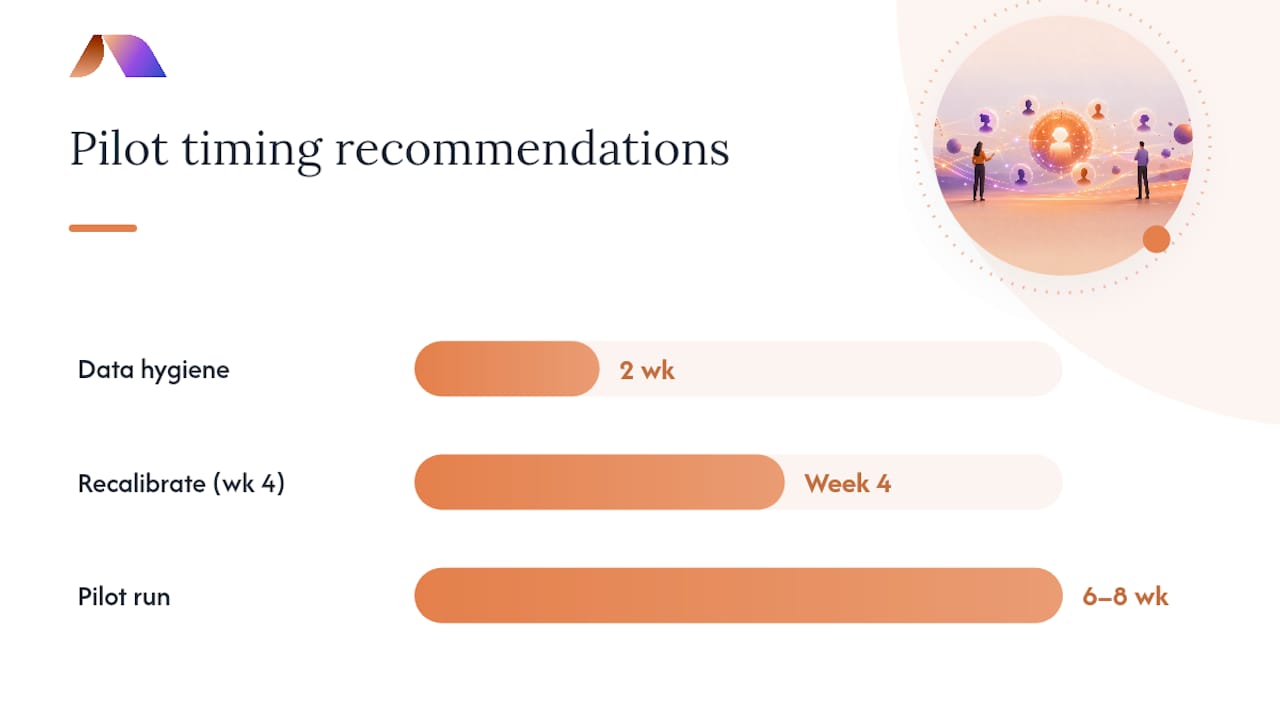
A pilot that is too broad teaches you nothing. A pilot that is too narrow cannot generate enough feedback signal to calibrate the model. The right scope is two to four roles with similar skill profiles, run over six to eight weeks, with a target of at least 50 recruiter feedback signals per role.
Define success metrics before you start. Precision at top-10, engagement rate, and time-to-first-screen are the three metrics most teams can measure without a data science team. Write them down and agree on thresholds before the pilot begins.
Enrich your data before you run the model. Profile enrichment with call transcripts, recruiter notes, and engagement history materially improves match quality. Spend two weeks on data hygiene before you touch the matching layer.
Configure integration points. The system needs to read from and write to your ATS, and ideally connect to your email and calendar for outreach tracking. Incomplete integration means incomplete feedback loops.
Run a parallel blind review. Have one recruiter use the AI shortlist and another review the same pool manually. Compare results after two weeks. Disagreements are your most valuable calibration data.
Capture feedback systematically. Every advance, reject, and flag is a training signal. Build the habit into your team’s workflow from day one, not as an afterthought.
Review and recalibrate at week four. Check precision at top-10 against your baseline. If the system is not outperforming manual review on recall, investigate the data quality and taxonomy coverage before extending the pilot.
Document human oversight at every stage. Who reviewed AI outputs? Under what criteria? These records matter for compliance and for your own institutional learning.
When internal ML expertise is limited, legacy data is messy, or compliance requirements are complex, that is the moment to bring in fractional AI support. BRDGIT’s AI in talent sourcing work is built around exactly this kind of structured pilot, where the goal is a system your team can trust and explain, not just one that runs.
Pro Tip: Set a minimum feedback volume target before you let the model’s weights update. Fewer than 30 recruiter signals per role is not enough to recalibrate meaningfully. Premature weight updates based on thin data can make the model worse, not better.
What to ask vendors and which answers should give you pause
Vendor demos are optimized to impress. Your job is to ask the questions that reveal what happens when the system meets your actual data and your actual workflows.
Questions every hiring team should ask:
How does your system explain a match score to a recruiter? Can you show me a live example with a real candidate profile?
What skills taxonomy do you use, and how often is it updated? Can we add custom skill nodes for our industry?
How does recruiter feedback feed back into the model, and how long does it take for a signal to affect rankings?
Does your system support two-way matching, scoring role fit for the candidate as well as candidate fit for the role?
How are hard requirements enforced? Can a high semantic score override a missing certification?
What audit logs do you provide, and in what format? Can we export them for compliance review?
What data do you use to train the base model, and what de-biasing steps have been applied?
Red flags that should slow or stop a procurement:
Match scores with no explanation of which skills or requirements drove them.
No path for recruiter feedback to influence future rankings.
Training data sourced entirely from historical hires with no de-biasing audit.
Inability to enforce hard requirements before the ranking layer.
Vague answers about data residency, privacy practices, or third-party data sharing.
Gartner’s finding that only 26% of applicants trust AI to evaluate them fairly is a vendor accountability question as much as a candidate experience one. Ask vendors directly: what do you do to earn candidate trust, and how do you measure it? A vendor who has not thought about that question is not ready for enterprise deployment.
For a deeper look at the tool landscape, the types of AI matching tools for staffing overview covers the major categories and what distinguishes them in production.
BRDGIT helps hiring teams adopt AI matching without the guesswork
Most teams that struggle with AI matching share the same three problems: their candidate data is too sparse to feed a model reliably, they have no structured pilot protocol, and they lack the internal expertise to evaluate vendor claims critically. Those are solvable problems, and solving them before you sign a contract is far cheaper than discovering them six months into a deployment.
BRDGIT’s engagement model is built for exactly this stage. A readiness assessment identifies where your data, workflows, and governance gaps are before any vendor conversation begins. From there, a six-to-eight-week structured pilot gives your team real performance data on your actual roles and your actual candidate pool, with explainability logging and bias checks built in from day one. For teams that need ongoing support without a full-time AI hire, BRDGIT’s fractional AI engineers provide experienced technical talent that can manage the matching layer, monitor for drift, and recalibrate the system as your hiring mix evolves. If you are ready to move from curiosity to a working pilot, that is the conversation to start.
Why responsible adoption matters more than fast adoption
Three lessons stand out from working with HR teams navigating AI matching for the first time.
The first is that teams consistently measure the wrong thing. Match percentage gets tracked obsessively while quality-of-hire and engagement rate go unmeasured for months. A system that produces high match scores but low offer-acceptance rates is not working. Measure outcome, not just output.
The second lesson is that explainability is not a nice feature. It is the mechanism by which your team catches errors, builds trust with candidates, and defends decisions under scrutiny. A matching system that cannot tell a recruiter why a candidate ranked where they did is a liability, not an asset. Require it in your vendor contract, not as a future roadmap item.
The third lesson is the one most teams resist: feedback loops require investment. Recruiters are busy. Asking them to flag every advance and reject feels like overhead. But without that signal, the model cannot learn, and a static model in a dynamic job market is a model that drifts toward irrelevance. The teams that get the most from AI matching are the ones that treat recruiter feedback as a product, not a chore.
The technology is genuinely useful. AI does not forgive organizational ignorance, though. A small, instrumented pilot with clear metrics and honest evaluation will teach you more in eight weeks than a year of passive deployment. Start there.
This article is general information, not a substitute for advice from a qualified lawyer. Consult a qualified legal professional about your own circumstances before acting on anything here.
Sources
The claims in this article draw on the following U.S.-focused research and practitioner resources. Reading vendor transparency reports and audit documentation before procurement is strongly recommended.