Published on
Reduce Time-to-Fill Using AI Tools: 2026 Hiring Guide
AI recruiting tools cut time-to-fill by up to 33% and compress time-to-first-interview by up to 90%, collapsing hiring cycles that once stretched 42 days down to under five. That’s not a projection. Organizations deploying AI interviewing platforms are reporting it now. The shift is structural: AI automates the repetitive coordination work that has always been the silent killer of hiring speed, freeing recruiters to focus on judgment calls that actually require a human.
Here’s what that looks like in practice:
Automated candidate engagement keeps applicants moving through the funnel 24/7, without a recruiter manually sending follow-ups.
AI-driven interview scheduling eliminates the back-and-forth that typically adds days to every hiring stage.
Structured AI screening replaces inconsistent manual reviews with scored, comparable evaluations at scale.
End-to-end process automation connects requisition to offer without manual handoffs between stages.
Platforms like Picked.ai deliver three ranked finalists within 48 hours of a role being posted, with a median end-to-end hiring time around two days. That kind of speed used to require a full sourcing team. Now it requires a well-configured AI workflow and a recruiter who knows where to apply human judgment.
Where traditional hiring processes actually break down
Most hiring delays don’t live in one place. They accumulate across every stage, compounding quietly until a 10-day process becomes a 6-week one. Understanding where the friction originates is the first step toward knowing where AI can actually help.
The stages where time gets lost
Job requisition and description alignment: Writing and approving job descriptions manually, often with multiple stakeholders, creates delays before a single candidate is even contacted.
High-volume application management: When hundreds of resumes arrive for a single role, manual review becomes a bottleneck that scales poorly and introduces inconsistency.
Interview scheduling: Coordinating calendars across candidates, hiring managers, and panel members is one of the most time-consuming and error-prone tasks in the entire process.
Candidate communication: Manual follow-up emails, status updates, and rejection notices pile up quickly, and delayed responses push candidates toward other offers.
Evaluation and feedback loops: Waiting for hiring managers to submit structured feedback after interviews can stall a pipeline for days.
The deeper problem is that these delays don’t just slow hiring. They compound. A two-day lag at the screening stage, followed by a three-day scheduling delay, followed by a week of waiting for feedback, produces a candidate experience that drives top applicants to accept competing offers before you’ve finished your process. Traditional hiring workflows were designed for a world where application volumes were manageable and candidates waited. Neither of those conditions holds anymore.
How AI recruiting tools address and alleviate hiring delays
AI doesn’t just speed up individual tasks. When deployed correctly, it removes the manual handoffs between stages that cause most of the delay. The distinction matters: automating a single step is useful, but automating the connection between steps is what actually compresses time-to-fill.
Candidate communication and engagement
Conversational AI agents engage job seekers continuously across multiple channels, guiding candidates from first contact through application without requiring a recruiter to manage each interaction. These systems operate in 24 or more languages, respond instantly, and never drop a follow-up. A candidate who applies at 11 PM on a Friday gets a response that night, not Monday morning.

Interview scheduling automation
AI scheduling tools sync directly with recruiter and hiring manager calendars, auto-suggest available slots, and confirm interviews without human coordination. What used to require three or four email exchanges now happens in minutes. The candidate selects a time, the system confirms it, and the recruiter sees a booked calendar without touching the process.

Reducing error and rework
Manual coordination produces errors: double-booked interviews, missed follow-ups, inconsistent evaluation criteria. AI removes most of those failure points by standardizing the process. Structured scoring rubrics applied consistently across every candidate mean fewer re-screens and less rework downstream.
Pro Tip: When evaluating AI tools, ask whether the platform connects screening to scheduling automatically. If a recruiter still has to manually move a candidate from one stage to the next, you’ve automated a task, not a process.
Key categories of AI recruiting tools that reduce time-to-fill
Not all AI recruitment tools do the same thing. The ones that genuinely accelerate hiring fall into distinct categories, each targeting a specific bottleneck in the workflow.
Candidate engagement agents: Conversational AI that handles inbound candidate inquiries, collects application information, and keeps applicants informed throughout the process. These tools prevent drop-off by maintaining contact at every stage without recruiter involvement.
Automated interview schedulers: Tools that integrate with calendar systems to propose, confirm, and reschedule interviews without email coordination. The best platforms handle multi-panel scheduling and time zone management automatically.
AI screening platforms: Systems that evaluate candidates against defined criteria, scoring responses to structured questions and surfacing ranked shortlists. The most effective platforms go beyond keyword matching to assess actual candidate work and portfolio evidence, reducing false positives from generic resume filters.
Resume parsing tools: AI that extracts structured data from unstructured resumes, normalizes it, and populates applicant tracking system (ATS) fields automatically. This eliminates manual data entry and accelerates the early stages of candidate review. For a detailed breakdown of what’s available, BRDGIT’s guide to AI resume parsing tools covers the current landscape.
Predictive analytics tools: Platforms that analyze historical hiring data to forecast time-to-fill, identify pipeline risks, and recommend sourcing channels with the highest conversion rates for specific roles.
Each category addresses a different layer of the hiring process. Deploying them in isolation produces incremental gains. Connecting them within a unified workflow is where the compounding acceleration happens.
How evolving hiring workflows demand a more strategic AI approach
The volume problem alone justifies the shift. Application volume has roughly tripled since 2021, and most talent acquisition teams have not grown proportionally. The result is a structural mismatch: more candidates, same number of recruiters, and a process that was never designed to scale. AI doesn’t just help teams work faster. It changes what’s possible at a given headcount.
Mapping the end-to-end hiring workflow from job requisition through onboarding is the foundational step before any AI deployment. Without that map, teams tend to automate the tasks they find most annoying rather than the ones causing the most delay. Those two things are rarely the same. IBM and Greenhouse both emphasize this point: workflow mapping surfaces the actual bottlenecks, which is where AI investment produces the highest return.
The strategic principle is straightforward. Apply AI to high-volume, repetitive tasks where consistency matters and human judgment adds little value. Preserve human involvement for the decisions that genuinely require it: final candidate evaluation, offer negotiation, and culture-fit assessment. The mistake most teams make is deploying AI as a speed tool without thinking about where human judgment is actually irreplaceable.
End-to-end process automation that moves candidates and requisitions forward independently creates capacity that doesn’t scale linearly with headcount. A team of five recruiters running a well-automated workflow can handle the volume that previously required fifteen. That’s not an efficiency gain. It’s a structural change in what the team can accomplish.
Stat to know: Organizations using AI interviewing tools report up to 33% reduction in time-to-fill and hiring cycles shortened from 42 days to under five.
Pro Tip: Don’t evaluate AI tools by the tasks they automate. Evaluate them by the handoffs they eliminate. Every manual handoff between stages is a delay waiting to happen.
For a broader view of where AI creates leverage in talent acquisition, BRDGIT’s piece on AI in talent sourcing covers the data and strategic framing HR leaders need.
A step-by-step approach to cutting time-to-hire with AI
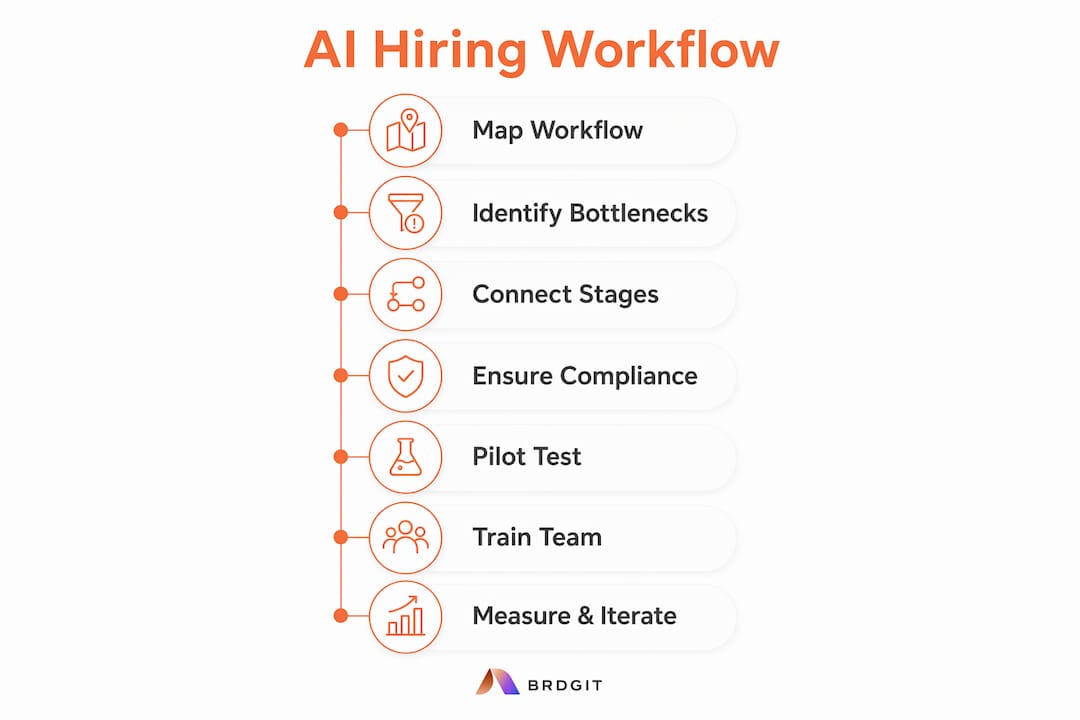
Deploying AI in hiring without a clear implementation sequence produces fragmented results. The steps below reflect what actually works in practice, not just in theory.
Step 1: Map your current hiring workflow
Document every stage from requisition approval to offer acceptance. Identify where candidates wait, where recruiters spend the most time, and where errors or rework occur most frequently. This map becomes the basis for every AI deployment decision that follows.
Step 2: Identify your highest-impact bottlenecks
Not every delay is worth automating. Prioritize the stages with the highest time cost and the lowest requirement for human judgment. Interview scheduling and initial candidate communication are almost always at the top of that list.
Step 3: Select AI tools that connect stages, not just automate them
Choose platforms that integrate with your existing ATS and pass candidate data automatically between stages. A scheduling tool that doesn’t connect to your screening platform creates a new manual handoff. Eightfold AI Interviewer, for example, is designed to work alongside existing ATS systems with minimal IT overhead, and carries compliance certifications including SOC 2, ISO 27001, and ISO 42001.
Step 4: Address compliance and ethical considerations
AI in hiring carries legal obligations under US employment law. The Equal Employment Opportunity Commission (EEOC) has issued guidance on algorithmic hiring tools and their potential for disparate impact. Before deploying any AI screening tool, audit its evaluation criteria for bias, document the decision logic, and confirm the vendor’s compliance posture. Skills-based evaluation frameworks reduce the risk of discriminatory screening compared to keyword filters.
Step 5: Run a pilot before full deployment
Test your chosen tools on a single role type or department before rolling out organization-wide. Measure time-to-fill, time-to-first-interview, and candidate drop-off rates against your pre-AI baseline. A pilot surfaces integration issues and adoption gaps before they affect your entire pipeline.
Step 6: Train recruiters and hiring managers
AI tools fail when the people using them don’t understand what the tools are doing or why. Training should cover:
How the AI scores and ranks candidates
Where human review is required before a candidate advances
How to interpret AI-generated evaluations without over-relying on them
What to do when the AI produces an unexpected result
The BRDGIT article on why teams don’t use AI tools addresses the adoption gap directly. The technology is rarely the obstacle. Change management is.
Step 7: Measure and iterate
Track time-to-fill, time-to-interview, offer acceptance rate, and candidate satisfaction scores on an ongoing basis. AI tools should be recalibrated as role requirements change and as you accumulate data on which evaluation criteria actually predict performance. The teams seeing the biggest gains treat AI deployment as a continuous process, not a one-time implementation.
For guidance on reducing placement time specifically in tech roles, the PluckTalent guide on IT recruiter placement time offers a practical breakdown of the tools and tactics that work in high-demand technical hiring.
Key Takeaways
AI tools that connect hiring stages end-to-end, rather than automating isolated tasks, produce the greatest reductions in time-to-fill and free recruiters to focus on the decisions that require genuine human judgment.
Point | Details |
|---|---|
AI compresses hiring cycles measurably | Organizations report up to 33% reduction in time-to-fill and hiring cycles shortened from 42 days to under five. |
Workflow mapping comes before tool selection | Identifying manual bottlenecks first ensures AI is deployed where it creates the most time savings. |
Process automation beats task automation | Connecting stages end-to-end eliminates manual handoffs, which is where most hiring delays actually accumulate. |
Compliance is non-negotiable | AI screening tools must be audited for bias and aligned with EEOC guidance before deployment in US hiring. |
Training drives adoption | Recruiters who understand how AI evaluates candidates use the tools more effectively and catch errors before they affect hiring decisions. |
The honest reality of AI in recruitment: what the data doesn’t tell you
The 33% reduction in time-to-fill and the 90% faster time-to-first-interview figures are real. They’re also the ceiling, not the floor. Teams that hit those numbers have done the workflow mapping, connected their tools properly, and trained their people. Teams that deploy AI as a point solution on top of a broken process get incremental gains at best and new failure modes at worst.
The concept of the “human scale ceiling” is the most honest framing of why AI matters in hiring right now. There is a hard limit to how many candidates a recruiter can meaningfully engage in a given week. AI doesn’t make recruiters faster. It removes the ceiling entirely, allowing a lean team to maintain quality engagement across a pipeline that would have been unmanageable manually.
What the data also doesn’t capture is the quality problem that comes with scale. When application volume triples and AI screens every applicant, the pipeline fills faster. But if the screening criteria are shallow, the pipeline fills with noise. The teams getting the most value from AI are the ones using it to evaluate actual candidate work, not just resume keywords. That requires more upfront configuration and a willingness to revisit the evaluation rubric regularly.
The other thing worth saying plainly: AI does not fix a hiring process that lacks clarity about what a good candidate looks like. If your hiring managers can’t agree on the three must-haves for a role, no AI tool will resolve that disagreement. It will just automate the confusion at scale.
BRDGIT works with organizations that are past the curiosity stage and ready to execute. If your talent acquisition team is dealing with volume pressure, slow cycles, or fragmented tooling, the fractional AI support model gives you experienced AI practitioners who can map your workflow, configure the right tools, and train your team without the overhead of a full-time hire.