Published on
AI in Workforce Compliance: What Leaders Need to Know
TL;DR:
AI in workforce compliance automates monitoring and flags issues without making final employment decisions. Regulatory laws require audits, disclosures, and human oversight to mitigate legal risks for employers. Proper governance involves cross-functional teams conducting regular bias audits and managing vendor contracts proactively.
AI in workforce compliance is defined as the use of intelligent software systems that automate monitoring, enforcement, and documentation of workforce rules across HR and legal functions. With over $2.8 billion invested in HR tech in Q1 2026 alone, compliance technology has become a strategic priority, not a back-office afterthought. Regulatory pressure from frameworks like the EU AI Act, NYC Local Law 144, and a growing patchwork of U.S. state laws is forcing business leaders and compliance officers to rethink how they govern AI in HR. Understanding what AI in workforce compliance actually does, and what it requires of your organization, is no longer optional.
What is AI in workforce compliance and how does it work?
AI in workforce compliance refers to automated systems that monitor HR processes, flag regulatory violations, and support human decision-making across the employee lifecycle. These systems apply machine learning and natural language processing to track multi-jurisdictional rules in real time, reducing the lag between regulatory change and organizational response.
Core functions include:
Automated bias audits: AI scans hiring algorithms and performance scoring models for patterns that could indicate discriminatory outcomes before and after deployment.
Document review and tracking: Systems extract obligations from employment contracts, policy updates, and regulatory filings, then alert HR teams to gaps.
Compliance chatbots: Jurisdiction-aware tools answer HR questions with guidance specific to the employee’s location and role, replacing static policy manuals.
Workflow automation: AI flags scheduling conflicts, missed certifications, and wage violations for human review rather than acting autonomously.
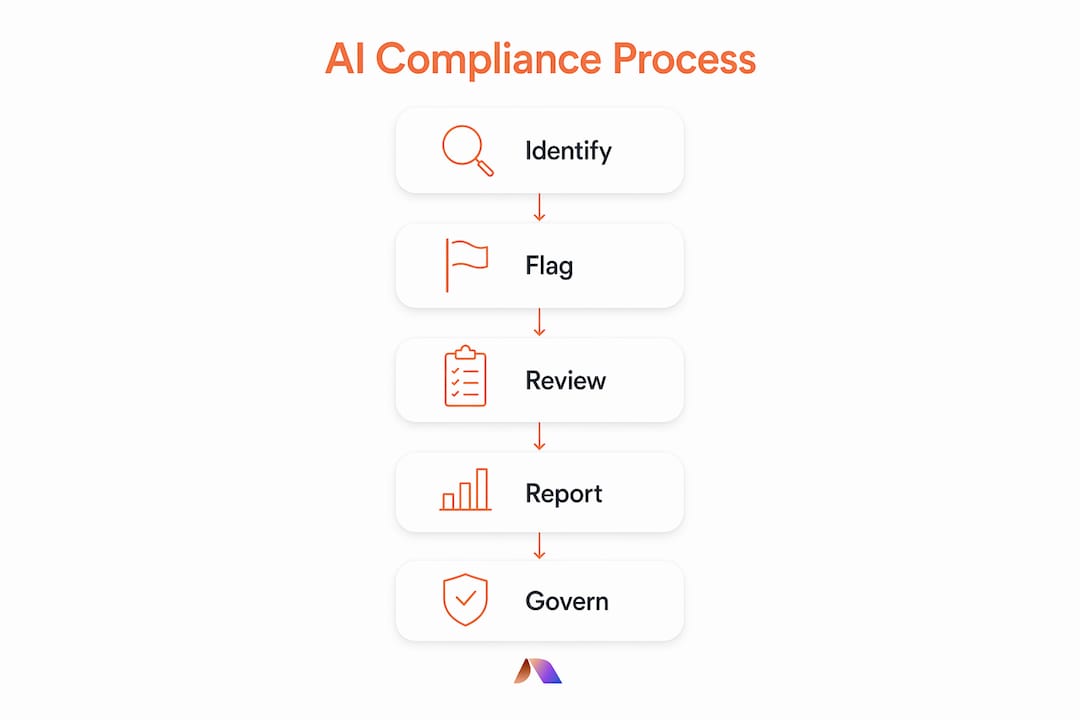
The governing principle here is “flag, don’t decide.” Human-in-the-loop workflows, where AI surfaces issues for human review but does not make sole employment decisions, are legally preferred under both the EU AI Act and NYC Local Law 144. That distinction matters enormously when a termination or hiring decision ends up in court.
Real-world applications span hiring screening, performance monitoring, workplace safety alerts, and AI-driven recruitment compliance. Each use case carries its own regulatory exposure, which is why governance cannot be an afterthought.

Pro Tip: Map every AI tool your organization uses against the specific HR decision it influences. If a tool touches hiring, promotion, or termination, treat it as high-risk from day one.
How is the regulatory landscape shaping AI in HR compliance?
The regulatory environment governing artificial intelligence workforce rules is fragmented and accelerating. No single federal law governs AI in employment decisions in the United States, but the state-level activity is substantial and moving fast.
Jurisdiction | Law / Framework | Key Requirement |
|---|---|---|
New York City | Local Law 144 | Annual independent bias audits; candidate notification required |
European Union | EU AI Act | High-risk classification for recruitment AI; fines up to €35M or 7% of global revenue |
Connecticut | AI Responsibility and Transparency Act | Effective october 2026; bias audits and disclosure mandates |
Colorado, Illinois, Texas | State AI employment laws | Varying bias audit and transparency requirements |
U.S. Federal (proposed) | AI-WARN Act proposal | Mandatory AI disclosure for mass layoffs where AI is a substantial factor |
The EU AI Act classifies AI used in recruitment and performance monitoring as “high risk,” with incident reporting required within 15 days of a compliance failure. That 15-day window is unforgiving for organizations without automated monitoring already in place.
The fragmented U.S. state AI laws create a compliance burden that grows with every new jurisdiction where you employ people. Connecticut’s law takes effect in october 2026. More states are drafting similar legislation now. Waiting for federal clarity is not a viable strategy.
One critical legal point: employer liability for discriminatory outcomes remains with the employer, even when a third-party vendor built the AI tool. Vendor contracts that disclaim compliance responsibility do not transfer your legal exposure. They just leave you holding the bill.
How should organizations govern AI tools for workforce compliance?
Governance is where most organizations fail. They deploy AI tools quickly and build oversight structures slowly. That sequence institutionalizes the problem.
A sound governance framework starts with a cross-functional team that includes HR, Legal, IT, and Payroll. Each function sees a different slice of AI risk. No single team sees all of it.
Build a complete AI tool inventory. Catalog every AI system that touches the employee lifecycle, from applicant tracking to performance reviews to scheduling. You cannot govern what you have not mapped.
Conduct pre-deployment bias audits. NYC Local Law 144 mandates annual independent bias audits and candidate notification. Treat that standard as a floor, not a ceiling.
Evaluate vendor contracts carefully. Require transparency provisions, audit rights, and change control clauses. Review AI vendor management tools that support ongoing vendor oversight.
Define human-in-the-loop controls. Document which decisions AI can flag and which require human sign-off. Codify this in policy, not just practice.
Train HR teams on AI literacy. The U.S. Department of Labor’s AI Literacy Framework provides a structured starting point for building team competency without requiring technical expertise.
Run post-deployment audits on a schedule. Bias can emerge after deployment as workforce data shifts. Periodic audits catch drift before it becomes a lawsuit.
Pro Tip: Retrofitting compliance after a complaint is filed costs significantly more than proactive governance. Build your AI compliance audit process before you need it, not after.
What are the real benefits and risks of AI in employee management?
The operational case for AI in workforce compliance is strong. Automated monitoring catches regulatory changes faster than any manual process. Workflow automation reduces human error in documentation, audit trails, and deadline tracking. AI-powered compliance platforms now serve mainstream organizations at scale, with some platforms supporting millions of employees across thousands of businesses.
The risks are equally real and deserve direct attention:
Regulatory fragmentation: Operating across multiple U.S. states means managing overlapping and sometimes conflicting requirements simultaneously.
Vendor liability gaps: Most vendor contracts disclaim compliance responsibility. Your legal team needs to close those gaps before signing.
Transparency obligations: Employees and candidates have a right to know when AI influences decisions about them. Failing to disclose this creates both legal and reputational exposure.
Autonomous decision risk: Fully automated employment decisions, with no human review, violate the spirit and often the letter of current regulations.
The organizations that get this right treat AI as decision support infrastructure. They use it to surface issues faster and document decisions better. They do not use it to replace the human judgment that regulators and courts still expect.
Key Takeaways
AI in workforce compliance requires treating intelligent software as regulated decision infrastructure, not just an efficiency tool, with human oversight built into every employment decision it touches.
Point | Details |
|---|---|
Define AI’s role clearly | AI in workforce compliance automates monitoring and flags issues; it does not make final employment decisions. |
Regulatory exposure is real | Laws like NYC Local Law 144 and the EU AI Act impose audits, disclosures, and fines on employers using AI in HR. |
Employer liability stays with you | Vendor contracts do not transfer legal responsibility for discriminatory AI outcomes. |
Governance requires cross-functional ownership | HR, Legal, IT, and Payroll must all participate in AI tool oversight and bias audit programs. |
Proactive audits prevent costly remediation | Pre-deployment and periodic bias audits cost far less than responding to complaints or litigation after the fact. |
The uncomfortable truth about AI and compliance readiness
From where we sit at BRDGIT, the conversation around AI in workforce compliance has a consistent blind spot. Organizations focus on what AI can do and underinvest in what AI requires. The technology is not the hard part. The governance is.
We see teams deploy AI hiring tools without a bias audit protocol. We see vendor contracts signed without audit rights. We see HR teams trained on how to use a platform but not on what legal obligations that platform creates. AI does not forgive organizational ignorance. The regulatory frameworks being built right now, from Connecticut’s 2026 law to the EU AI Act’s enforcement timeline, assume that employers know exactly what their AI systems are doing and why.
The organizations that will navigate this well are the ones that start small, validate outcomes at each step, and build human oversight into the process before regulators require it. That is not caution. That is the only approach that holds up under scrutiny.
— Team BRDGIT
BRDGIT’s fractional engineering support for AI compliance systems
Building a governed, compliant AI system for workforce management is not a one-time project. It requires ongoing engineering expertise that most HR and compliance teams do not have in-house.
BRDGIT provides fractional engineering teams that help organizations design, deploy, and govern AI-powered compliance platforms without the cost of full-time hires. Whether you need to build a bias audit workflow, integrate real-time regulatory tracking, or establish human-in-the-loop controls across your HR systems, BRDGIT brings experienced AI talent to the work. You get the expertise when you need it, scoped to your actual compliance requirements.
FAQ
What is AI in workforce compliance?
AI in workforce compliance is automated software that monitors HR processes, tracks regulatory requirements, and flags potential violations for human review. It supports compliance across hiring, performance management, payroll, and safety functions.
Which laws govern AI use in HR decisions?
Key frameworks include NYC Local Law 144, the EU AI Act, and state laws in Connecticut, Colorado, Illinois, and Texas. A federal AI-WARN Act proposal would also require disclosure when AI drives mass layoff decisions.
Who is legally liable when an AI tool discriminates?
The employer retains legal liability for discriminatory outcomes, even when a third-party vendor built the AI tool. Vendor contracts that disclaim compliance responsibility do not eliminate employer exposure.
What is a human-in-the-loop approach in HR AI?
A human-in-the-loop approach means AI flags compliance issues or candidate concerns for human review but does not make the final employment decision alone. This model aligns with EU AI Act and NYC Local Law 144 requirements.
How often should organizations audit their HR AI tools?
Bias audits should occur before deployment, after deployment, and on a periodic schedule. NYC Local Law 144 requires annual independent audits for automated employment decision tools used in New York City.