Published on
AI in Financial Advisory: What Advisors Must Know in 2026
TL;DR:
AI in financial advisory uses machine learning and automation to support decision-making and client services, with most firms adopting it for operational tasks like communication and data collection. It enhances investment strategies by identifying market trends and providing real-time insights, but professional responsibility remains with human advisors. Early AI adoption offers a competitive edge, while neglecting proper governance increases risk and compliance challenges.
Artificial intelligence in financial advisory is the use of machine learning, predictive analytics, and automation to enhance data-driven decision-making, automate routine tasks, and improve client service within financial planning and investment management. This is not a future trend. 81% of financial firms have adopted AI, with 40% reaching advanced maturity linked to stronger profitability. For financial professionals, understanding what AI in financial advisory actually does, and what it demands of you, is now a baseline professional requirement.
What is AI in financial advisory, and how is it used today?
AI in financial advisory refers to technology systems that process large volumes of client and market data to support advisor decisions, automate communications, and generate financial insights at scale. The CFP global standards identify the top three AI use cases in advisory practices: client communications at 41%, data collection at 33%, and risk profiling at 30%. These numbers tell a clear story. AI is already embedded in the most frequent, high-volume tasks advisors perform every day.
Client communication is where AI delivers the most immediate efficiency. Automated follow-up messages, meeting summaries, and personalized outreach can be generated and sent without advisor involvement. That frees up hours per week for relationship work that actually requires human judgment.
Data collection and risk profiling are where AI’s analytical depth becomes most visible. AI tools can pull data from multiple sources, identify patterns in client behavior, and flag risk exposures that a manual review would likely miss. The role of AI in advisory is not to replace the advisor’s judgment. It is to give that judgment better raw material to work with.
Client communications: AI drafts and sends personalized messages, meeting recaps, and follow-up sequences
Data collection: AI aggregates financial data across accounts, markets, and client profiles automatically
Risk profiling: AI identifies risk tolerance signals from client behavior and portfolio history
Compliance support: AI flags regulatory gaps and generates audit-ready documentation
Pro Tip: Before deploying any AI tool for client communication, map every touchpoint where AI output reaches a client directly. Each one requires a disclosure protocol and a human review checkpoint.
How does AI improve decision-making and investment strategy?
AI improves financial decision-making by processing data at a speed and scale no human team can match, then surfacing insights that inform better advice. AI tools enable real-time portfolio updates, multi-portfolio optimization, and deeper client data insights that increase both advisor efficiency and decision accuracy. That last point matters most. Better decisions come from better information, and AI changes the information baseline entirely.

Machine learning models identify market trends by analyzing historical price data, macroeconomic indicators, and client portfolio behavior simultaneously. Predictive analytics can flag when a client’s portfolio is drifting from their stated risk tolerance before the client notices. That kind of proactive insight shifts the advisor’s role from reactive to genuinely anticipatory.
The table below shows how AI capabilities map to specific advisory functions.
AI capability | Advisory function | Practical outcome |
|---|---|---|
Predictive analytics | Market trend identification | Earlier positioning on client portfolios |
Real-time data processing | Portfolio rebalancing | Faster response to market shifts |
Natural language processing | Client communication | Consistent, personalized outreach at scale |
Machine learning models | Risk profiling | More accurate client risk assessment |
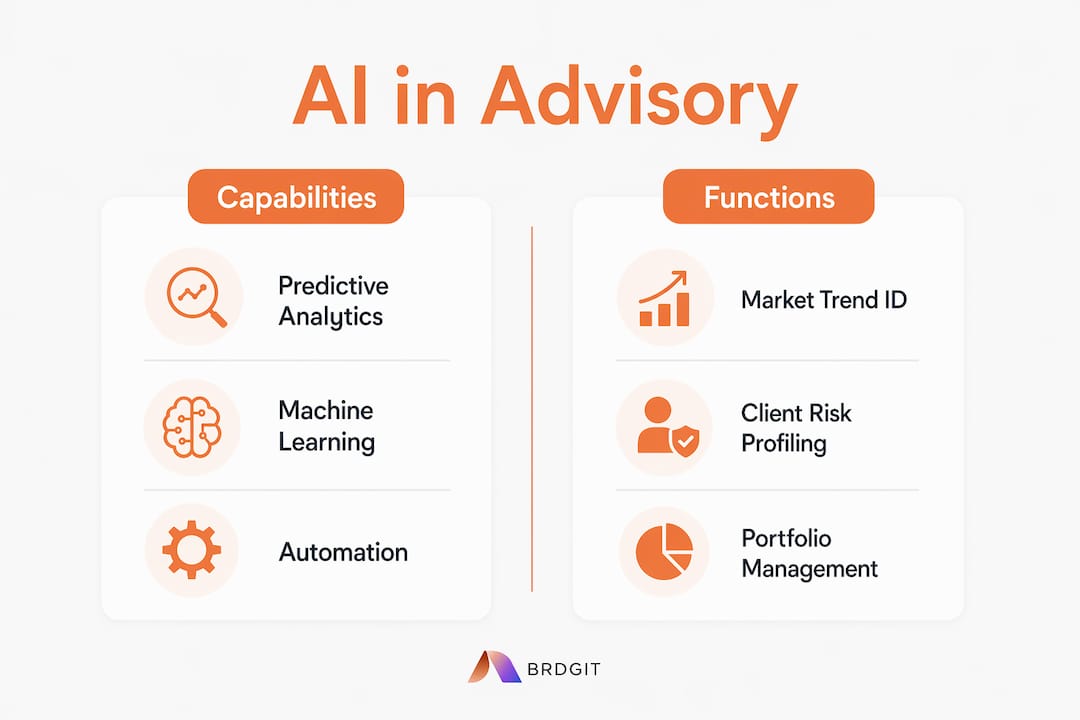
Human-AI hybrid systems are now reshaping credit allocation, liquidity management, and the data used to inform future decisions. This creates what researchers call a sociotechnical decision system. The implication is direct: AI does not just support decisions. It becomes part of the decision architecture itself, which raises the bar for explainability and auditability across every advisory firm.
Pro Tip: When evaluating AI tools for financial planning, prioritize systems that generate explainable outputs. If you cannot trace how the AI reached a recommendation, you cannot defend it to a client or a regulator.
What ethical responsibilities come with AI use in advisory?
Advisors retain full professional and fiduciary responsibility for every recommendation, regardless of whether AI generated the underlying analysis. The global CFP body is explicit on this point: using AI does not change your responsibility to clients. That is not a soft guideline. It is a professional standard with real liability implications.
AI systems carry risks that advisors must actively manage. Hallucinations, where an AI generates plausible but factually incorrect outputs, are a documented failure mode. Bias in training data can produce skewed risk profiles or systematically disadvantaged recommendations for certain client segments. Neither failure is the AI’s legal problem. It is yours.
Disclosure: Clients must be informed when AI tools contribute to their financial advice or planning outputs
Data privacy: Client data used to train or inform AI systems must comply with applicable privacy regulations
Audit trails: Every AI-assisted recommendation requires documentation that supports regulatory review
Oversight: Advisors must understand the assumptions embedded in any AI tool they use
Successful AI governance requires transitioning from simply generating AI outputs to maintaining full audit trails and verified data permissions. That transition is harder than most firms expect. It requires process redesign, not just tool adoption. For advisors serious about AI governance in financial services, the compliance infrastructure must be built before the AI tools go live, not after.
What does AI adoption mean for the future role of financial advisors?
AI adoption does not eliminate the financial advisor. It eliminates the version of the advisor who spends most of their time on tasks a machine can do faster. AI shifts the advisor’s role toward behavioral coaching, complex life-event problem-solving, and deep client relationship management. Portfolio management, as a standalone skill, becomes commoditized. The advisor’s core value moves to the areas AI cannot replicate.
The firms that pull ahead will be those that treat AI adoption as a culture shift, not a software purchase. Early adopters gain competitive advantage through data readiness, staff upskilling, and integrated workflows. Firms that delay accumulate what practitioners call readiness debt. That debt compounds. The longer you wait, the more ground you lose and the harder it becomes to catch up.
Here is what the shift looks like in practice for advisors building an AI-ready practice:
Audit your current workflows. Identify every task that is repetitive, data-heavy, or rule-based. Those are your first AI candidates.
Invest in data infrastructure. AI is only as good as the data it runs on. Clean, structured client data is the foundation.
Upskill your team. Staff who understand AI outputs, and their limits, make better decisions than those who treat AI as a black box.
Reposition your value proposition. Lead with behavioral coaching, life planning, and complex financial problem-solving. Let AI handle the volume work.
Build compliance into the process. Disclosure protocols, audit trails, and data permissions must be part of the AI workflow from day one.
AI-driven marketing tools also enhance client acquisition by targeting prospects and scaling engagement after client meetings. That operational efficiency compounds over time. Firms that automate their client communication workflows free advisors to take on more clients without proportionally increasing overhead. For a deeper look at how AI connects to firm profitability, the AI and project profitability guide from BRDGIT covers the financial mechanics in detail.
Key takeaways
AI in financial advisory augments advisor judgment through automation and predictive analytics, but professional responsibility, client disclosure, and ethical oversight remain entirely with the human advisor.
Point | Details |
|---|---|
AI is already mainstream | 81% of financial firms have adopted AI, with 40% at advanced maturity tied to stronger profitability. |
Top use cases are operational | Client communications, data collection, and risk profiling lead AI adoption in advisory practices. |
Advisors keep full liability | Professional standards require advisors to understand AI assumptions and maintain oversight of all outputs. |
Early adoption creates advantage | Firms that delay AI integration accumulate readiness debt that compounds over time. |
Advisor value shifts to coaching | AI commoditizes portfolio management, making behavioral coaching and complex problem-solving the advisor’s core differentiator. |
The uncomfortable truth about AI in financial advisory
We have worked with enough professional services firms to say this plainly: most advisors are adopting AI tools without adopting AI discipline. They run a client communication through a language model, paste the output into an email, and call it efficiency. That is not AI adoption. That is risk creation with a productivity label on it.
The firms getting real value from AI are the ones that treated the first six months as infrastructure work. Data cleanup. Permission mapping. Staff training. Compliance review. None of it is visible to clients. All of it is what makes the visible AI outputs defensible. AI does not forgive organizational ignorance. When a hallucinated output reaches a client, the advisor owns it completely.
The optimistic read, and I do hold this view, is that AI genuinely frees advisors to do the work that matters most. Behavioral coaching during a market downturn. Complex estate planning conversations. Helping a client think through a career change that affects their entire financial picture. Those conversations cannot be automated. They are also the conversations clients remember and pay for. The advisors who get AI right will have more time for exactly that kind of work. The ones who get it wrong will spend that time managing compliance problems instead.
For financial professionals thinking through responsible AI use standards, the professional development implications are significant and worth planning for now.
— Team BRDGIT
How BRDGIT supports financial firms adopting AI
Financial firms moving from AI curiosity to real AI execution face a specific set of challenges: data readiness, compliance integration, staff capability, and workflow design. BRDGIT works directly with professional services firms to address all four.
BRDGIT’s fractional AI engineers give financial firms access to experienced AI talent without the cost of a full-time hire. That means you get the expertise to build compliant, explainable AI systems, train your team to use them confidently, and create workflows that actually hold up under regulatory scrutiny. For firms ready to move from planning to execution, the AI readiness assessment is the right starting point.
FAQ
What is AI in financial advisory?
AI in financial advisory is the use of machine learning, predictive analytics, and automation to support financial planning, client communication, and investment decision-making. It augments advisor judgment rather than replacing it.
Does using AI change an advisor’s responsibility to clients?
No. The global CFP body states clearly that using AI does not reduce an advisor’s professional or fiduciary responsibility. Advisors must understand AI assumptions and maintain full oversight of all outputs.
What are the most common AI use cases for financial advisors?
Client communications lead at 41%, followed by data collection at 33% and risk profiling at 30%, according to CFP global standards research on AI adoption in advisory practices.
How does AI improve investment strategy for advisors?
AI applies predictive analytics and real-time data processing to identify market trends, flag portfolio drift, and support faster rebalancing decisions, giving advisors better information to work with.
Will AI replace financial advisors?
AI will not replace advisors, but it will separate those who adapt from those who do not. Behavioral coaching, complex life-event planning, and deep client relationships are areas AI cannot replicate effectively.