Published on
Role of AI in Recruiter Productivity: 2026 Guide
TL;DR:
AI in recruitment enhances recruiter productivity by automating tasks like sourcing, screening, and scheduling. Teams that adopt centralized, calibrated AI workflows conduct significantly more candidate screens and reduce hiring time and costs. Proper training, calibration, and oversight are essential to maximize AI benefits and avoid biases.
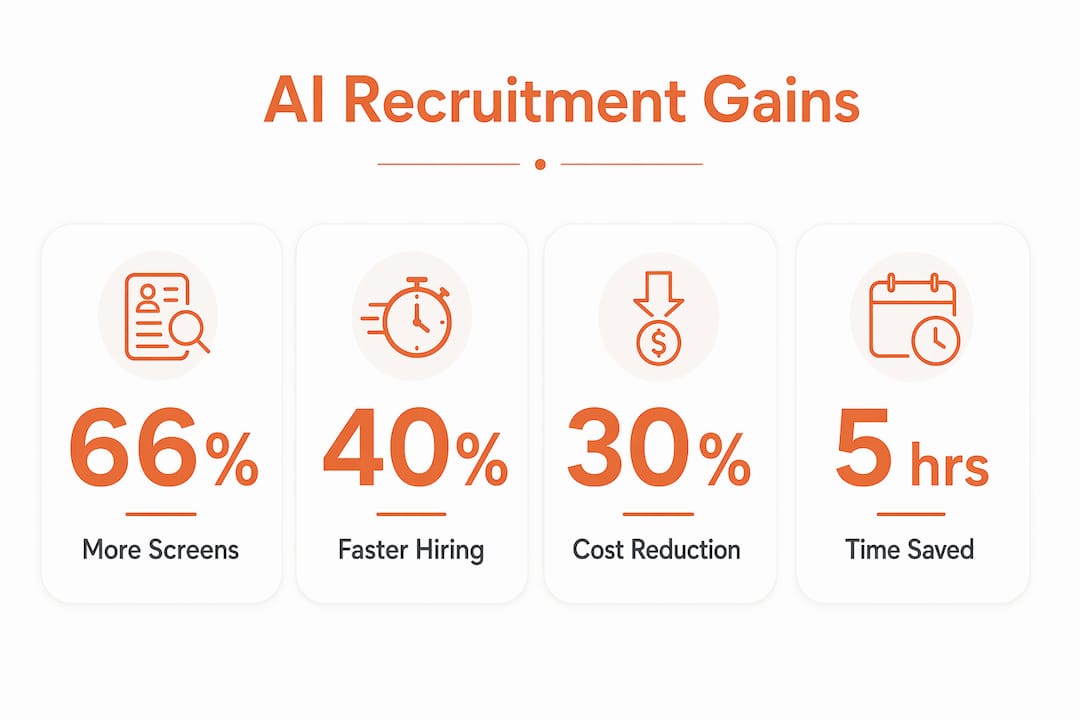
AI in recruitment is defined as the application of machine learning, natural language processing, and automation to sourcing, screening, scheduling, and managing candidates at scale. The role of AI in recruiter productivity is not marginal. AI-enabled recruiters contact 25% more candidates weekly and cut administrative work by 41%. That translates to roughly five hours saved per week for a recruiter screening 20 candidates. The gains compound when AI is adopted across an entire team rather than by individual contributors working in isolation.
How does AI improve specific recruitment tasks?
AI changes the mechanics of sourcing, screening, and scheduling in ways that are measurable and immediate.

Candidate sourcing is the first area where AI earns its place. AI tools generate longlists automatically by scanning job boards, LinkedIn profiles, and internal databases against a defined role brief. They also construct and refine Boolean search strings faster and more accurately than most recruiters can manually. The result is a broader, better-filtered candidate pool in a fraction of the time.
Resume screening is where the speed gains become striking. AI-assisted CV screening shortens shortlist time by 75% with 89–94% accuracy. That accuracy figure matters because it means fewer qualified candidates fall through the cracks, not just faster processing.
Interview scheduling is the administrative task recruiters most consistently describe as a time drain. AI scheduling tools eliminate the back-and-forth by syncing calendars, sending invitations, and handling rescheduling automatically. Recruiters who use these tools report reclaiming hours each week for higher-judgment work.
Automatic longlist generation from multi-source candidate databases
Boolean string construction and refinement
Resume parsing and ranked shortlist creation
Calendar-synced interview scheduling with automated follow-ups
Candidate status tracking and pipeline reporting
Pro Tip: Configure your AI screening criteria at the role-family level, not just the individual job level. A generic setup produces generic shortlists. Tuning the model to the specific competencies of an engineering role versus a sales role produces shortlists that actually match what your hiring managers want.
What are the best practices for integrating AI into recruiter workflows?
Successful AI adoption in recruitment does not happen through a one-time tool rollout. It requires a phased approach that builds recruiter confidence and calibrates the AI to your specific hiring context.
The most effective training model combines formal instruction with on-the-job pairing over 8–10 weeks. Junior recruiters co-run AI workflows alongside senior team members, which accelerates real-world skill transfer faster than classroom training alone.
A practical phased onboarding sequence looks like this:
Orient (weeks 1–2): Introduce the AI tools, explain their function, and set expectations about what AI can and cannot do.
Pair (weeks 3–4): Junior recruiters shadow seniors running live AI-assisted workflows on real requisitions.
Calibrate (weeks 5–6): Teams tune role-family rubrics together, adjusting AI scoring criteria to match actual hiring manager feedback.
Retro (week 7): Review shortlist quality, identify gaps, and adjust configurations based on outcomes.
Deepen (weeks 8–10): Recruiters take ownership of their AI workflows and begin contributing to team-wide calibration sessions.
Managing resistance is a real part of this process. Recruiters who distrust AI often come around when they see data from their own requisitions. Showing a recruiter that their AI-assisted shortlist produced a higher hiring manager acceptance rate than their manual shortlist is more persuasive than any training slide.
Pro Tip: Never skip the calibration phase. Out-of-box AI settings are built for average roles. Your roles are not average. Calibration is where the productivity gains actually materialize.
You can find a deeper framework for training teams on AI tools that applies directly to recruitment contexts.
What are measurable productivity gains from AI in recruitment?
The productivity data on AI in recruitment is specific enough to be useful for building a business case.
Teams with centralized AI workflows conduct 66% more candidate screens weekly compared to teams where individuals use AI tools independently. That gap reveals something important: coordination multiplies the productivity benefit. A recruiter using AI alone gets a lift. A team using AI together gets a structural advantage.
The cost and speed metrics are equally concrete. AI reduces time-to-fill by 40% and cuts cost per hire by 30%. For high-volume hiring teams, those numbers represent significant budget and capacity recovery.
Metric | AI-Driven Improvement |
|---|---|
Candidates contacted weekly | +25% per recruiter |
Administrative time | 41% reduction |
Shortlist creation time | 75% faster |
Time-to-fill | 40% reduction |
Cost per hire | 30% reduction |
Weekly candidate screens (team) | 66% more vs. individual AI use |
One of the less-discussed productivity gains comes from onboarding. Internal AI assistants trained on company playbooks and standard operating procedures have cut recruiter onboarding time from 13 weeks to 2 weeks at organizations that have deployed them. That is not a marginal improvement. It changes how quickly a new hire contributes.
“AI is best used to clear the administrative burden so recruiters can focus on the human judgment elements that actually determine hiring quality.” — The evolving role of AI in recruitment, Financial Times
For HR leaders evaluating AI in talent acquisition, the efficiency gains for tech startups documented in recent case studies show these numbers hold across company sizes, not just enterprise environments.
What are the risks of using AI in recruiter productivity?
AI in recruitment carries real risks. Ignoring them does not make them smaller. It makes them more expensive to fix later.
Bias from historical data: AI trained on past hiring decisions inherits the biases embedded in those decisions. If your historical data favored certain demographics, your AI will too. Training AI on competency-based frameworks defined by HR leaders, rather than on legacy hiring patterns, is the primary defense against this.
Compliance exposure: The EU AI Act and emerging U.S. state-level regulations treat automated hiring decisions as high-risk applications. Human-in-the-loop workflows with manual override capability and audit trails are not optional. They are the compliance baseline.
Over-reliance on AI outputs: Recruiters who stop questioning AI shortlists stop catching AI errors. The tool is only as good as the oversight applied to it.
One-size-fits-all configurations: Generic AI setups produce generic results. Role-specific calibration is not a nice-to-have. It is what separates useful AI from noise.
Pro Tip: Build a quarterly calibration review into your team calendar. AI tools drift as job markets shift. What worked in Q1 may not reflect the candidate pool or role requirements in Q4. Continuous governance is what keeps the productivity gains from eroding.
Key Takeaways
AI in recruitment delivers its largest productivity gains when teams adopt centralized, calibrated workflows rather than leaving individual recruiters to use tools in isolation.
Point | Details |
|---|---|
Centralized AI workflows win | Teams using coordinated AI conduct 66% more screens weekly than individual adopters. |
Calibrate for every role family | Generic AI settings produce generic shortlists; tuning rubrics to specific roles drives shortlist quality. |
Phase your training over 8–10 weeks | Orient, pair, calibrate, retro, and deepen — skipping steps stalls adoption and reduces output. |
Manage bias at the source | Train AI on competency frameworks, not historical hiring data, to avoid perpetuating discriminatory patterns. |
Human oversight is non-negotiable | Audit trails and manual override capability are the compliance baseline under current and emerging AI regulations. |
What I’ve learned about AI and recruiter productivity
The productivity numbers are real. I have seen them hold across different team sizes and industries. But the number that surprises most people is the 66% increase in weekly screens when teams adopt AI together versus individually. That gap does not come from better tools. It comes from shared calibration, shared rubrics, and shared accountability for output quality.
What I have also seen is the failure mode: a team that deploys AI, skips calibration, and then blames the tool when shortlists are poor. AI does not forgive organizational shortcuts. If you hand it a vague job description and a legacy dataset, it will return a vague, biased shortlist with confidence. The tool reflects the quality of the inputs and the governance around it.
The recruiters who get the most from AI are not the ones who trust it most. They are the ones who question it most productively. They review shortlists critically, flag anomalies, and feed that feedback back into calibration. That loop is what makes AI a genuine productivity amplifier rather than an expensive shortcut that creates new problems.
One more thing: do not underestimate the onboarding acceleration. Cutting new recruiter ramp time from 13 weeks to 2 weeks is not just a training win. It is a capacity win. It means your team can absorb growth without the usual lag.
— Team BRDGIT
BRDGIT’s approach to AI-driven recruiter productivity
Knowing AI can improve recruiter output is one thing. Building the workflows, training the team, and maintaining governance over time is another problem entirely.
BRDGIT works with HR and talent acquisition teams to move from AI curiosity to real execution. That means conducting AI readiness assessments, building role-specific automation workflows, and providing fractional AI engineers who embed with your team to handle implementation and ongoing calibration. You get experienced AI talent without the overhead of a full-time hire. For teams that need to close the gap between knowing AI works and making it work inside their specific hiring process, BRDGIT provides the practical path to get there.
FAQ
What is the role of AI in recruiter productivity?
AI automates administrative and repetitive tasks in recruitment, including resume screening, candidate sourcing, and interview scheduling. This frees recruiters to focus on relationship-building and hiring decisions that require human judgment.
How much time can AI save recruiters each week?
AI-enabled recruiters reduce administrative work by 41%, saving approximately five hours per week for a recruiter screening 20 candidates. They also contact 25% more candidates weekly compared to non-AI-assisted peers.
What are the biggest risks of AI in recruitment?
Bias from historical training data and compliance exposure under regulations like the EU AI Act are the primary risks. Human-in-the-loop workflows with audit trails and competency-based AI training are the standard mitigation approach.
How long does it take to train a recruitment team on AI tools?
Effective AI training for recruitment teams takes 8–10 weeks using a phased model that combines formal instruction with on-the-job pairing and role-family rubric calibration.
Does team-wide AI adoption outperform individual use?
Teams with centralized, coordinated AI workflows conduct 66% more candidate screens weekly than teams where individuals use AI tools independently. Coordination is the multiplier.