Published on
How to Automate Candidate Sourcing with AI in 2026
TL;DR:
Automating candidate sourcing with AI improves efficiency by reducing time-to-hire and automating most manual tasks. It requires structured intake, semantic search, and ATS integration to produce relevant shortlists and trustworthy results. Success depends on proper process discipline, skill development, and continuous calibration of AI models.
AI candidate sourcing automation is the practice of using machine learning and agentic AI workflows to find, rank, and engage job candidates without manual searching. When you automate candidate sourcing with AI, you replace hours of Boolean searching and spreadsheet tracking with a system that works continuously, at scale, and with far greater accuracy than any recruiter working alone. AI recruitment automation reduces time-to-hire by 33% and automates up to 80–90% of manual recruiter tasks. That is not a marginal efficiency gain. It is a fundamental shift in how recruiting teams spend their time and where they add value.
What does it take to automate candidate sourcing with AI?
Before any AI tool produces useful results, you need the right inputs and infrastructure in place. Garbage in, garbage out is not a cliché here. It is an operational risk.

The first requirement is a structured intake process. A structured intake call that separates must-have qualifications from nice-to-haves gives the AI the context it needs to operate beyond keyword matching. Without that clarity, the AI will surface technically qualified candidates who miss the mark on team fit, seniority level, or domain focus.
The second requirement is semantic search capability. Keyword searches fail to capture relevant candidates because they match exact terms rather than intent. Semantic AI understands that “revenue operations manager” and “RevOps lead” describe the same role. That distinction alone eliminates a significant blind spot in traditional sourcing.
The third requirement is native ATS integration. Tools lacking ATS write-back functionality create a new manual burden: copying candidate data from one system into another. That overhead erases much of the time savings AI delivers.
Core feature categories to evaluate in any AI sourcing platform:
Feature category | Why it matters |
|---|---|
Semantic search engine | Matches candidates by skills context, not just job title keywords |
Profile database breadth | Wider reach reduces sourcing blind spots across passive talent |
ATS write-back integration | Eliminates manual data entry and keeps records current |
Ranked shortlist with reasoning | Helps recruiters assess fit quickly and calibrate the AI model |
Outreach personalization | Increases candidate response rates without manual drafting |
Pro Tip: Before selecting any AI sourcing platform, confirm it integrates natively with your existing ATS. A tool that requires manual exports will cost your team more time than it saves within the first month.
How to implement an AI-driven candidate sourcing process
A clear sequence separates teams that see real results from those that buy a tool and wonder why nothing changed.
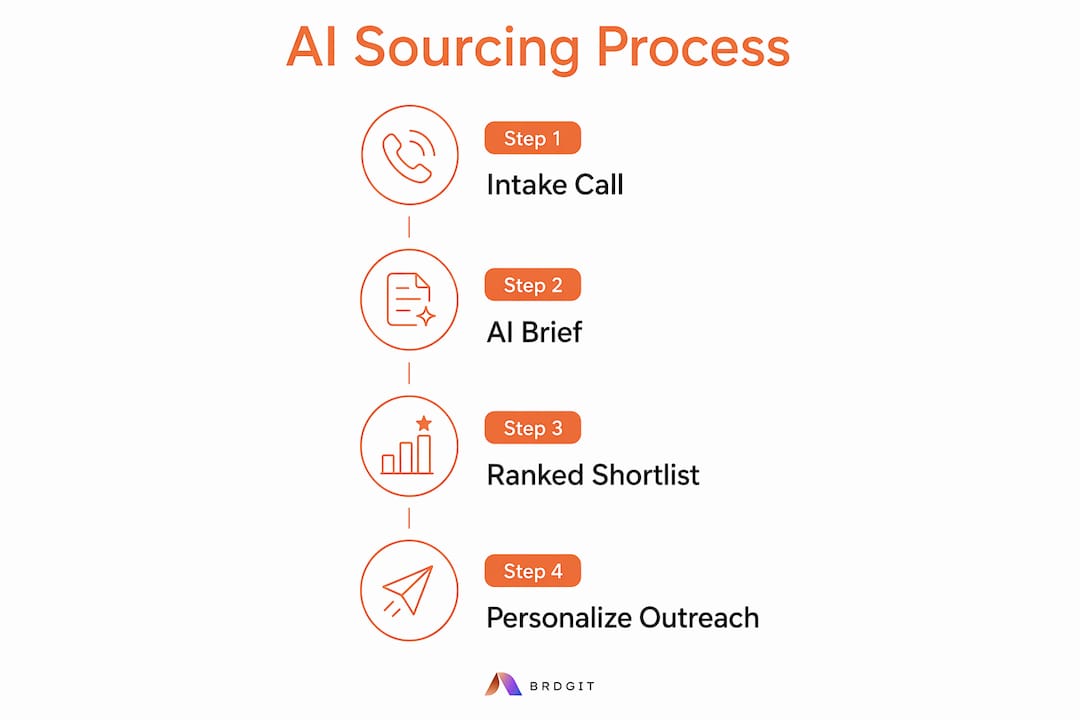
Step 1: Run a structured intake call. Sit down with the hiring manager before touching any sourcing tool. Capture the role’s must-have skills, preferred background, team context, and deal-breakers. This brief becomes the input that drives everything downstream.
Step 2: Feed the brief into your AI sourcing agent. Paste or upload the structured brief directly into the AI platform. The more specific the input, the more relevant the output. Vague briefs produce vague shortlists.
Step 3: Review the ranked shortlist with reasoning. AI-ranked shortlists with reasoning help recruiters trust and speed up decision-making by explaining each candidate’s fit score. Do not skip this step. Reading the reasoning tells you whether the AI understood your brief correctly, and it gives you the data to recalibrate if it did not.
Step 4: Personalize outreach with AI assistance. Use the AI’s candidate summary to write a short, specific outreach message. Reference the candidate’s actual background. Generic messages get ignored. Specific ones get replies.
Step 5: Push candidate data into your ATS automatically. Native write-back means the candidate record, fit score, and sourcing notes land in your ATS without any manual entry. Your pipeline stays clean and auditable.
Step 6: Track timelines and recalibrate. AI sourcing platforms scan 800M+ candidate profiles across 40+ sites and complete sourcing 70% faster than manual methods. That speed means you can run multiple sourcing cycles quickly, compare shortlist quality, and adjust your brief parameters based on what the data shows.
First shortlist typically arrives within hours, not days
Recruiter review time drops significantly when reasoning is included
Outreach response rates improve when messages reference specific candidate details
ATS records stay current without a separate data entry step
Pro Tip: Treat the first two sourcing cycles as calibration runs. Review the AI’s reasoning on every shortlisted candidate, not just the top three. Patterns in the misses reveal exactly where your brief needs more specificity.
Common mistakes when automating candidate sourcing with AI
51% of organizations use AI recruitment, yet 90% of recruiters still find attracting quality talent challenging. That gap exists because most teams adopt the tool without changing the process around it.
The most common mistakes include:
Writing generic briefs. An AI sourcing agent is only as good as the criteria you give it. “Strong communicator with 5 years of experience” produces noise. “B2B SaaS account executive with enterprise deal cycles over $100K” produces signal.
Skipping skill development. AI investment without team skill development results in adoption gaps and suboptimal return on automation tools. Recruiters need to learn how to read AI analytics, not just receive a shortlist.
Ignoring ATS integration. Teams that accept manual export workflows underestimate the compounding cost. One extra step per candidate becomes hundreds of hours per quarter.
Accepting shortlists without reading the reasoning. A fit score without an explanation is a black box. Recruiters who skip the reasoning cannot identify when the AI is wrong, and they cannot improve it.
“AI does not forgive organizational ignorance. If your intake process is broken, your AI sourcing will surface the wrong candidates faster and at greater scale than any human recruiter ever could.”
Continuous calibration is the fix for most of these problems. After each hiring cycle, compare the shortlisted candidates against the ones who actually advanced to interviews. Feed that signal back into your brief parameters. The AI improves with every cycle, but only if you close the feedback loop.
How AI shifts recruiters from administrators to talent advisors
The shift from administrative operators to strategic talent advisors is the most significant career change AI brings to recruiting. It is also the most misunderstood.
AI handles signal surfacing and repetitive task execution. Humans handle judgment calls. That division is not a threat to recruiters. It is a promotion, if they are ready for it.
“The recruiter’s value no longer lives in their ability to search LinkedIn for three hours. It lives in their ability to interpret what the AI surfaces, ask better questions in interviews, and advise hiring managers on market realities.”
The skills that matter most in an AI-assisted recruiting environment include:
Interpreting AI analytics and fit score reasoning
Calibrating sourcing models based on hiring outcomes
Advising hiring managers on candidate market conditions
Leading complex negotiations and closing senior candidates
Assessing culture fit and team dynamics in final stages
For a deeper look at how this shift plays out across HR functions, the role of AI in corporate hiring is reshaping recruiter responsibilities in ways that reward analytical thinking over manual execution.
Best practices for scaling AI-driven sourcing across industries
Scaling an AI-driven talent acquisition program requires more than adding more job requisitions to the queue. It requires building the feedback infrastructure that makes the AI smarter over time.
Build continuous feedback loops. After each hire, record which shortlisted candidates advanced and which did not. Feed that data back into your sourcing parameters.
Train your recruiting team on AI analytics. Reading a fit score is a skill. Teams that invest in that training see compounding returns as the AI and the recruiter improve together.
Tune for quality, not volume. A shortlist of 10 highly relevant candidates outperforms a list of 50 marginal ones. Adjust AI parameters to tighten relevance before expanding reach.
Evaluate ROI with clear KPIs. Track time-to-fill, shortlist-to-interview conversion rate, and offer acceptance rate. These three metrics reveal whether your AI sourcing program is working or just busy.
KPI | What it measures |
|---|---|
Time-to-fill | Speed improvement from AI sourcing versus manual baseline |
Shortlist-to-interview rate | Relevance quality of AI-generated candidate lists |
Offer acceptance rate | Downstream quality of candidates sourced by AI |
For teams building out AI in talent sourcing, the KPI framework matters as much as the tool selection. Without measurement, you cannot distinguish a working program from a well-marketed one.
Key takeaways
Automating candidate sourcing with AI delivers real results only when structured intake, semantic search, ATS integration, and continuous calibration work together as a system.
Point | Details |
|---|---|
Structured intake is non-negotiable | A detailed brief with must-haves versus nice-to-haves is the single biggest driver of AI shortlist quality. |
Semantic search beats keyword matching | AI that understands intent surfaces candidates that Boolean queries consistently miss. |
ATS integration prevents manual overhead | Native write-back keeps pipeline data clean and eliminates a compounding time cost. |
Reasoning explains the ranking | Shortlists with fit score explanations let recruiters calibrate the AI and trust its output. |
Skill development drives adoption | Teams that learn to read AI analytics see far better returns than those that just receive shortlists. |
What I’ve learned about AI sourcing after watching teams get it wrong
The teams that struggle with AI candidate sourcing share one pattern: they treat the tool as the solution. They buy the platform, connect it to their job descriptions, and wait for magic. It does not come.
The teams that succeed treat the intake call as the product. They spend 45 minutes with the hiring manager before touching the AI, and that conversation does more for shortlist quality than any feature the platform offers. The AI is only as good as the brief you feed it. That is not a limitation of the technology. It is the nature of intelligence, artificial or otherwise.
I also think the industry underestimates how fast agentic AI will change this space. By the late 2020s, AI agents will not just surface candidates. They will schedule outreach, track responses, and flag when a pipeline is stalling, without a recruiter initiating each step. The teams building AI adoption habits now will be positioned to absorb that shift. The teams waiting for a perfect tool will be perpetually behind.
Human judgment is not going away. Culture fit, complex negotiation, and final hiring decisions require a person. But the administrative layer underneath those decisions is already automated for teams willing to build the process correctly. The question is not whether to adopt AI sourcing. The question is whether your team has the skills and the process discipline to make it work.
— Team BRDGIT
BRDGIT’s fractional engineers for AI-driven talent acquisition
Building an AI-driven hiring program takes more than a software subscription. It takes people who understand how AI systems actually work inside recruiting workflows.
BRDGIT’s fractional engineers give your team experienced AI talent without the overhead of a full-time hire. They help you assess your current sourcing process, identify where AI automation creates the most value, and build the integrations that make your ATS and AI tools work together. Whether you need help designing your intake framework, connecting your sourcing platform to your ATS, or training your recruiting team to read AI analytics, BRDGIT provides the execution capacity to move from planning to results. No long-term commitment required.
FAQ
What is AI candidate sourcing automation?
AI candidate sourcing automation uses machine learning and agentic AI workflows to find, rank, and engage job candidates without manual searching. It replaces Boolean queries and spreadsheet tracking with systems that scan millions of profiles and surface ranked shortlists with fit explanations.
How much faster is AI sourcing compared to manual methods?
AI sourcing platforms complete candidate searches 70% faster than manual methods by scanning hundreds of millions of profiles simultaneously. Some enterprises report reducing time-to-fill from 42 days to 5.
Why do AI sourcing tools need ATS integration?
Without native ATS write-back, recruiters must manually copy candidate data between systems. That manual step erases a significant portion of the time savings AI delivers and introduces data entry errors.
What is the biggest mistake teams make with AI candidate sourcing?
The most common mistake is writing a vague job brief before running the AI. Generic criteria produce irrelevant shortlists. A structured intake call that defines must-haves versus nice-to-haves is the single most important step before using any AI sourcing tool.
How does semantic search improve candidate matching?
Semantic search understands the intent and context behind job requirements rather than matching exact keywords. It recognizes that different job titles and skill descriptions can describe the same qualified candidate, which significantly reduces sourcing blind spots.