


Published on
4–6 Hour AI Literacy Program for Business Teams Mapped to Roles
A workplace AI literacy program has to deliver measurable competence, not just completed modules. It maps five core skills across individual contributors, managers, and executives, ties each to observable behavior, and gets most staff to working competence within four to six hours of instruction plus guided practice. BRDGIT builds these programs to run alongside workflow redesign, since training that skips that step rarely survives contact with real work.
TL;DR:
Effective AI literacy programs require role-specific training in prompt engineering, output verification, escalation judgment, policy awareness, and workflow redesign; skipping any creates future gaps.
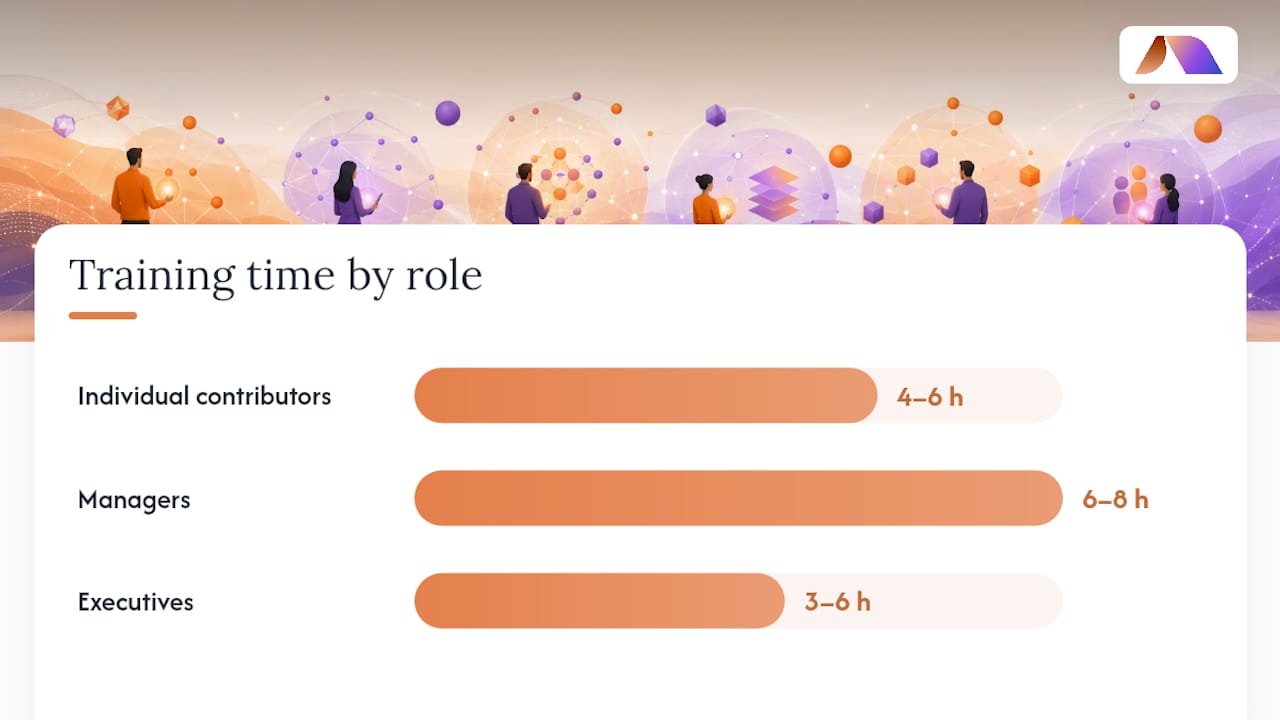
Training duration varies by role, with individual contributors needing four to six hours, managers six to eight hours, and executives three to six hours, depending on depth and content.
Cohort-based training significantly outperforms self-paced formats, especially when layered with tool onboarding, policy integration, and on-the-job reinforcement via sandboxes and prompt libraries.
Ongoing support and integration with existing LMS systems are crucial; budgets should account for continuous maintenance, policy updates, and technical support beyond initial delivery.
Vendors should offer role-based curricula, workflow redesign support, clear measurement metrics, and ongoing support, with flexible engagement models like pilots, retainer support, or dedicated fractional expertise.
Table of Contents
What Are the Core Competencies in an AI Literacy Program?
How Long Does It Take to Train Each Role?
Should Training Be Cohort-Based, Self-Paced, or Both?
Which Metrics Prove an AI Literacy Program Is Working?
What Does a 4-Week AI Literacy Pilot Look Like?
What Does an AI Literacy Program Cost?
How Do You Manage Data Privacy and Ethical AI Risks in Training?
How Do You Integrate Training With Your Existing LMS?
What Should You Look for in an AI Literacy Program Vendor?
What Do Vendor Engagement Models Typically Look Like?
Team BRDGIT perspective: integrating training with workflow redesign and fractional expertise
If You Want Help: BRDGIT Fractional Engineers and Custom Training
Sources
What Are the Core Competencies in an AI Literacy Program?
Every credible AI literacy program teaches five things, and skipping any one of them creates a gap that shows up later as a compliance incident or a stalled adoption curve. AI literacy is layered and role-dependent, according to research on workplace AI skills, which means the five competencies below apply differently depending on who is sitting in the room.
Prompt engineering. Writing instructions that get usable output on the first or second try, not the fifth. Observable behavior: an employee can restructure a vague request into a specific one without help.
Output verification. Checking AI-generated work against a known standard before it moves downstream. Observable behavior: staff flag a factual error or hallucination in a sample output during a training exercise.
Escalation judgment. Knowing when a task is too sensitive, too ambiguous, or too high-stakes for AI assistance alone. Observable behavior: an employee routes a borderline case to a supervisor instead of guessing.
Policy awareness. Understanding what data can go into a tool, which tools are approved, and why. Observable behavior: no one pastes client records into an unapproved chatbot.
Workflow redesign. Recognizing where a process should change shape now that AI handles part of it, rather than bolting AI onto an unchanged process. Observable behavior: a team rewrites a step-by-step procedure instead of just inserting a new tool at the old step.
Statistic: Organizations that run formal AI training programs see adoption move 2.3 times faster and ROI run 67% higher than organizations that leave employees to figure AI out on their own. That gap is the entire business case for a structured program over ad hoc tool rollout.
How Long Does It Take to Train Each Role?
Time-to-competence varies sharply by role, and pretending otherwise is how programs waste budget training executives on prompt syntax they’ll never use, or leaving managers without the workflow skills their teams need. Role tiers require different competencies and time investments, and a smart staff AI training plan reflects that from the start.
Individual contributors: 4 to 6 hours. Foundational instruction on approved tools and prompt basics, followed by applied practice inside their actual workflow. Learning objective: complete a real task using AI assistance and correctly verify the output before submitting it.
Managers: 6 to 8 hours. Everything ICs get, plus a workflow redesign project where the manager maps a process their team owns and identifies where AI changes the sequence. Managers also need train-the-trainer elements, since they become the people coaching correct use on the floor.
Executives: 3 to 6 hours. Strategic briefings focused on governance, risk tolerance, and how to evaluate vendor claims rather than hands-on tool mechanics. Executive AI training works best as a condensed, discussion-driven format rather than a scaled-down IC course.
Pro Tip: Don’t schedule manager training after individual contributor training finishes. Managers need the workflow redesign skills in place before their teams start applying prompt and verification skills on the job, or nobody’s coaching the new behavior.
Accessibility matters here too. Microlearning modules, protected training time blocked on calendars (not “whenever you get to it”), and multiple formats for people who learn differently all raise completion, according to UK government guidance on AI upskilling.
Should Training Be Cohort-Based, Self-Paced, or Both?
Cohort-based delivery wins by a wide margin. Cohort programs post completion rates between 85% and 96%, compared to 3% to 15% for self-paced course formats. That gap alone should settle most vendor debates about format.
The right program layers three things rather than picking one:
Cohort-based sessions for the core five competencies, run in small groups so people practice on real examples together and hold each other accountable to finish.
Vendor tool onboarding for the specific platforms your team actually uses, combined immediately with your own policy rules and escalation procedures. Vendor resources like Grow with Google’s SMB programs teach tool mechanics well but say nothing about your data policy, which is why they can’t stand alone.
Embedded, on-the-job reinforcement through an AI sandbox for safe practice, a shared prompt library so people aren’t reinventing instructions from scratch, and in-app guidance at the moment someone opens the tool.
An LMS can host the cohort content and track completion, but the sandbox and prompt library are what turn a training event into a habit. Managers act as coaches once training ends, and a small group of AI champions in each department fields day-to-day questions so the training desk isn’t the bottleneck. For most small and mid-sized teams, this is where fractional AI engineers earn their keep. They can build the sandbox, stock the prompt library with role-specific examples, and troubleshoot integration issues that would otherwise stall the whole rollout.
Which Metrics Prove an AI Literacy Program Is Working?
Five numbers tell you whether training is sticking or just checking a box.
Adoption rate. Percentage of trained staff actively using approved AI tools in their real workflow, not just during the training session.
90-day retention. Whether usage still holds three months after the cohort finishes, since a spike followed by a drop-off signals the training didn’t survive contact with daily pressure.
Competence assessments. Short, scenario-based checks that verify someone can actually spot a bad output or escalate correctly, not just recall a definition.
Incident and error rate. How often AI-assisted work produces a compliance issue, a factual error that reaches a customer, or an unapproved tool use.
Task time and ROI proxies. Whether AI-assisted tasks are genuinely faster or higher quality, and whether that gain shows up anywhere near the program’s cost.
Statistic: Programs built around a clear roadmap of assess, design, launch, reinforce, and measure quarterly consistently outperform ones built around a single training event, according to enterprise AI literacy guidance. Governance controls, including documented data governance policies, belong in the same dashboard as the skills metrics, not in a separate compliance binder nobody reads.
Assign a single accountable owner for this dashboard, usually the operations lead who commissioned the training, and report it monthly for the first quarter, then quarterly after that.
What Does a 4-Week AI Literacy Pilot Look Like?
A focused pilot with one team beats a company-wide rollout on day one, because it surfaces problems with your policy, your tools, or your workflow before you’ve spent the budget to scale it.
Week 1: Foundations and policy. Cover approved tools, data rules, and why they exist. This is also when policy awareness gets tested for the first time, before anyone touches a live task.
Week 2: Prompt engineering practice. Role-specific examples, drawn from the team’s actual work, not generic samples. People leave this week able to write a usable prompt on the first try more often than not.
Week 3: Output verification. Real workflow examples, including at least one deliberately flawed output, so staff practice catching errors instead of just discussing the concept.
Week 4: Escalation and workflow redesign. Scenario exercises on when to escalate, paired with a manager-led session redesigning one team process around the new capability.
After the pilot, run quarterly refreshers to catch tool updates, policy changes, and skill drift, and use the pilot team’s dashboard numbers to build the case for expanding to the rest of the organization within six months.
What Does an AI Literacy Program Cost?
Budget breaks into three buckets, and leaders who only plan for the first one usually get surprised by the other two.
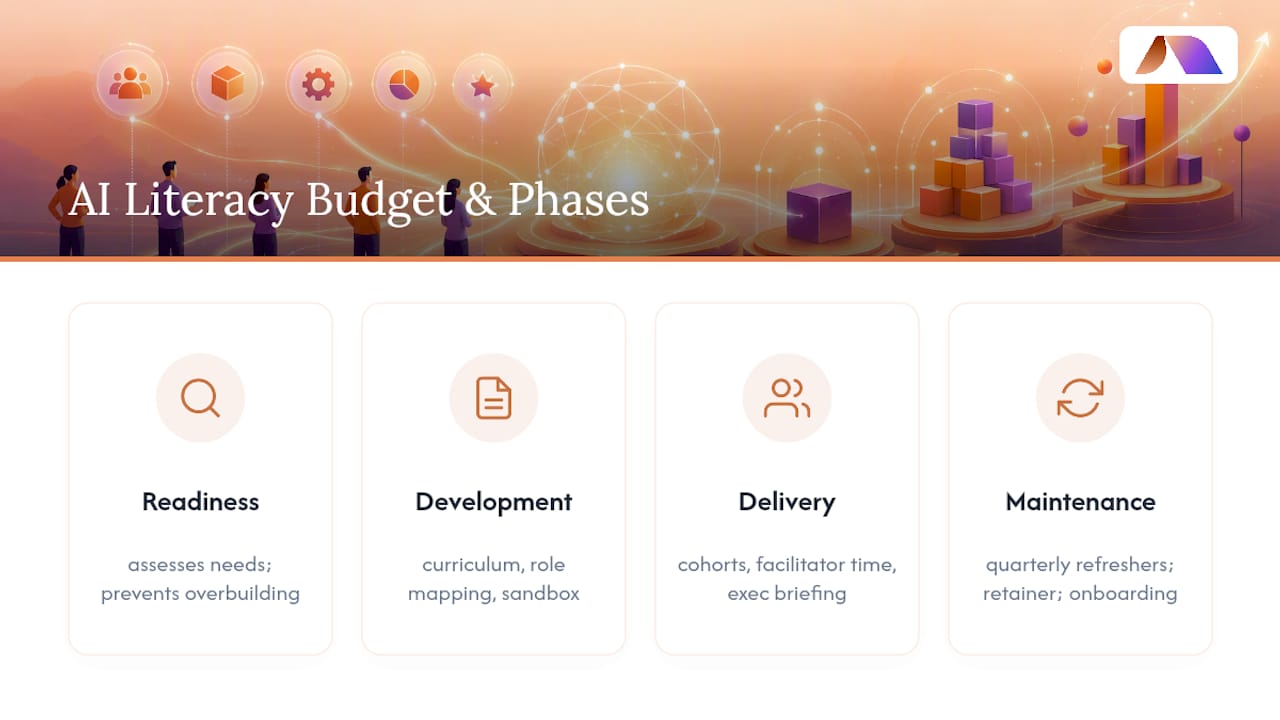
Program development covers curriculum design, role-based path mapping, and building the sandbox and prompt library. For a small or mid-sized team, this is typically a fixed-scope consulting engagement rather than an off-the-shelf purchase, since generic courses rarely map cleanly to your actual workflows or your approved tool stack.
Delivery covers the cohort sessions themselves: facilitator time, manager train-the-trainer sessions, and the executive briefing. This cost scales with headcount and the number of role tracks you’re running, but cohort delivery for a single department pilot is a modest line item compared to company-wide rollout.
Ongoing maintenance is the bucket most budgets miss. Tools change, policies get updated, new hires need onboarding, and quarterly refreshers require facilitator time every quarter, not just once. Treat this as a retainer line item, not a one-time cost, or the program quietly decays within a year.
The biggest budgeting mistake we see is treating training as a single line item instead of a phased investment. A readiness assessment up front, before you commit to full program development, tells you exactly where the money needs to go and prevents you from overbuilding curriculum for a workflow that needs redesigning first.
How Do You Manage Data Privacy and Ethical AI Risks in Training?
Data privacy and ethical use don’t belong in a standalone compliance module that gets skimmed once and forgotten. Responsible AI use, meaning data protection, ethical judgment, and human oversight, functions best as an everyday operational skill woven into the same exercises that teach prompt engineering and verification, not as a separate lecture bolted onto the end of week one.
Practical risk management starts with a clear, short policy: what data categories can never go into an AI tool, which tools are approved, and who to ask when a use case isn’t covered. That policy needs to show up inside the training itself, tested with realistic scenarios, not just distributed as a document employees sign without reading.
Escalation rules are the other half of risk management. Staff need a clear, low-friction path to flag an output that seems wrong, biased, or based on questionable data, without fear that raising a concern makes them look incompetent. Programs that treat escalation as a sign of good judgment, rather than a failure, catch problems before they reach a customer or an auditor. Building a governance-first approach to AI data handling into training from day one is far cheaper than retrofitting policy after an incident.
Manager training carries extra weight here, since managers are the ones who’ll field the judgment calls their teams can’t resolve alone. A manager who can’t explain why a certain data type is off-limits will struggle to enforce that rule consistently.
How Do You Integrate Training With Your Existing LMS?
Most small and mid-sized businesses already have some kind of learning management system, and the mistake is either ignoring it and running AI training as a disconnected side project, or trying to force AI literacy into an LMS built for compliance checkboxes and generic soft-skills content.
The better approach treats your existing LMS as the tracking and scheduling layer, while the applied practice happens in tools purpose-built for it: an AI sandbox for safe experimentation, a shared prompt library staff can browse and contribute to, and in-app guidance inside the actual tools people use daily. Completion records, quiz scores, and role-track assignments live in the LMS where HR and compliance already look for them. The muscle memory work happens elsewhere.
Integration also means connecting AI literacy milestones to whatever professional development pathways your company already runs, so AI competence isn’t treated as a one-off event disconnected from career growth or performance review. If your LMS supports API connections or single sign-on with a sandbox tool, use it. If it doesn’t, don’t force a clumsy technical fix. Running the sandbox as a separate, well-labeled resource works fine as long as completion still gets logged somewhere leadership can see it.
What Should You Look for in an AI Literacy Program Vendor?
Vendor selection comes down to a handful of hard questions, and vague marketing language about being “AI-powered” or “comprehensive” should disqualify a vendor rather than reassure you.
First, ask whether the curriculum is genuinely role-based or a single course relabeled for different audiences. A real program has distinct content for individual contributors, managers, and executives, not a shared deck with different intro slides.
Second, ask how the vendor handles your specific tool stack and data policy. Generic AI fundamentals training that never touches your approved tools or your actual escalation rules leaves the hardest part of adoption unaddressed.
Third, check whether the engagement includes workflow redesign support, or just instruction. Training that never touches how work actually gets restructured tends to fade within a few months, since AI reshapes workflows in ways that generic courses can’t anticipate for your business specifically.
Fourth, ask about measurement. A vendor who can’t describe how they’ll help you track adoption rate, incident rate, and competence over time is selling a training event, not a program.
Finally, weigh whether the vendor offers ongoing support, such as fractional AI expertise, or disappears after the last training session. Programs that end at graduation day rarely survive the first quarter of real-world friction.
What Do Vendor Engagement Models Typically Look Like?
Engagement shapes vary, but three models cover most of what small and mid-sized businesses actually need.
A fixed-scope pilot covers a readiness assessment, curriculum design for one or two role tracks, and delivery to a single department. This model works well for leaders who want to prove value before committing budget company-wide, and it typically runs on a defined project fee rather than an open-ended retainer.
A pilot-plus-retainer model adds ongoing fractional support after the initial rollout: ongoing curriculum updates, quarterly refresher sessions, and technical maintenance of the sandbox and prompt library. This suits teams that know AI adoption isn’t a one-time event and want expertise on call without hiring a full-time AI specialist.
Standalone fractional support fits organizations that already have training built or partially built but need technical execution, workflow automation, or custom system development to make the training stick. This is closer to ongoing staffing than a training project, and it scales up or down based on what the quarter actually requires.
Service levels should specify response time for policy questions, a defined cadence for dashboard reporting, and clear ownership of what happens when a tool or policy changes mid-quarter. Contract terms worth negotiating include the ability to scale hours up during a rollout month and down during quieter periods, since AI training for managers and executive briefings rarely need the same weekly attention as an active pilot.
Team BRDGIT perspective: integrating training with workflow redesign and fractional expertise
Training that skips workflow redesign is the most common way this money gets wasted. Employees leave a well-run session able to write a good prompt, then return to a process that was never rebuilt to use that skill, and the training evaporates within weeks. That’s not a training failure. It’s a sequencing failure, and it’s the reason we start every engagement with a readiness assessment before curriculum, not after.
BRDGIT builds role-based curricula alongside the workflow changes that give the training somewhere to land, then brings in fractional AI engineers to handle the technical build: the sandbox, the automation, the integration work managers shouldn’t have to do themselves. The programs that hold up six months later are the ones where training and workflow redesign happened together, not in sequence.
— Team BRDGIT
If You Want Help: BRDGIT Fractional Engineers and Custom Training
BRDGIT is built for exactly the gap most vendors leave open: a program that pairs role-based training with the technical work of actually changing how your team operates. That starts with a readiness assessment to find where your workflows and your data policies need attention before a single training session runs, continues through curriculum built for your individual contributors, managers, and executives specifically, and extends into implementation support so the sandbox, prompt library, and automations actually get built rather than left as a slide in a deck.

Typical engagements start as a focused pilot, similar to the four-week structure covered earlier, then move into either a project-based implementation phase or an ongoing retainer for fractional support once the pilot proves out. Leaders should expect a working pilot team within a month and a scaling decision backed by real adoption and incident data within a quarter, not a vague promise of transformation six months down the road.
If your team needs staff trained to use AI safely and your current plan stops at “buy a course,” talk to BRDGIT’s fractional engineers about what a role-based pilot would look like for your organization.
Sources
AI Literacy: The New Workplace Skill Every Organization Needs
AI Literacy: A Practical Enterprise Guide to Building Skills, Governance, and Business Value
How AI is reshaping workflows and redefining jobs — MIT Sloan



