
Published on
AI Knowledge Management Tools for Professional Services
Professional services firms that require AI knowledge management tools should prioritize four capabilities above all others: a grounding or fact layer that links every claim to a source file, bi-directional connectors to existing content stores like SharePoint and Microsoft Teams, agent orchestration with enforceable policies and escalation rules, and fine-grained access controls that preserve source-level permissions. Get those four right, and you have a foundation worth building on. Skip any one of them, and you have an expensive experiment.
What to require from any AI KM solution:
A grounding or fact layer with source lineage and human verification checkpoints
Native connectors to SharePoint, Teams, Google Drive, and your document management system
Agent orchestration with configurable policies, guardrails, and escalation paths
Role-based and source-level access controls that mirror your existing permissions
Immediate next step: Scope a pilot over several weeks around one high-volume, low-risk knowledge workflow, such as proposal drafting or precedent retrieval. Assign an engagement lead and a data owner before you touch a single vendor demo. If your firm lacks an internal AI engineer to design that pilot, engage BRDGIT fractional support before the scoping conversation, not after.
Table of Contents
What do AI knowledge management tools actually do for professional services?
How do you move from pilot to production without losing momentum?
How do you measure success and what does it cost?
What security and compliance controls are non-negotiable?
Is your organization actually ready to adopt AI KM?
What questions should you ask vendors, and when do you need a partner?
How do multi-lingual knowledge bases change the picture?
What does a data governance framework look like for AI-enabled KM?
Key Takeaways
The gap most firms miss when they start
BRDGIT helps you move from pilot to production faster
What do AI knowledge management tools actually do for professional services?
AI knowledge management, or AI KM, is the practice of turning a firm’s scattered documents, decisions, and expert judgment into an active organizational memory that agents and people can query, verify, and build on. That is a fundamentally different proposition from passive document storage or basic enterprise search, which retrieve files but cannot reason across them, surface relationships, or explain why a particular answer is correct.
The distinction that matters most for professional services is grounding. Plain retrieval-augmented generation (RAG) pulls relevant chunks from a document store and feeds them to a language model. Grounded RAG goes further: it enforces a fact or provenance layer that links every claim back to an authoritative source file and flags when no source supports the answer. Wellknown’s provenance workspace illustrates this well, extracting lineage-traced facts from documents and requiring human validation before outputs reach a client deliverable.
A second distinction is the separation of a knowledge base from agent memory. A knowledge base is a governed, shared library of firm truths, updated by designated stewards. Agent memory is personalized, session-specific context. Arahi AI’s knowledge base architecture preserves source-level permissions and manages both layers so agents retrieve only what a given user is authorized to see. High-performing firms pair both from day one rather than treating them as the same thing.
How do you move from pilot to production without losing momentum?
Phased timeline
Phase | Duration | Key milestone |
|---|---|---|
Pilot | Several weeks | Accuracy threshold met, escalation behavior verified, user satisfaction baseline set |
Expand | 2–3 months | Two additional use cases connected, governance policies documented |
Production | A few months | Full rollout to target user group, audit logs active, KPIs tracked |
Continuous improvement | Ongoing | Monthly grader reviews, policy updates, knowledge steward cycle |
Roles and responsibilities
Role | Responsibility |
|---|---|
Executive sponsor | Budget, escalation authority, go/no-go decisions |
Engagement lead | Day-to-day coordination, vendor liaison |
Data owner | Source authorization, ACL governance |
Legal/compliance | Data residency, BAA review, audit requirements |
BRDGIT fractional engineer | Pilot design, connector setup, agent configuration, testing |
Knowledge steward | Ongoing curation, accuracy review, content lifecycle |
Enterprise agent deployments need policies, simulations, graders, and continuous improvement processes to stay reliable as firm content, client requirements, and user behavior change. Build that improvement loop into the pilot contract, not as an afterthought.
Pilot acceptance criteria before scaling:
Answer accuracy meets or exceeds the threshold set in the pilot brief (typically 85% or above on a graded test set).
Every answer carries a verifiable source citation.
Escalation rules fire correctly on out-of-scope or low-confidence queries.
No unauthorized content surfaces for any test user persona.
User satisfaction score meets the baseline agreed with the executive sponsor.
How do you measure success and what does it cost?
Sample KPI table
KPI | What it measures | Target signal |
|---|---|---|
Answer accuracy | Graded correctness vs. verified source | 85%+ at pilot close |
Mean time to insight | Minutes from query to verified answer | Reduction vs. manual baseline |
Revision rate | Percentage of AI drafts requiring substantive edits | Declining trend over several weeks |
Escalation rate | Queries routed to human review | Stable or declining after tuning |
User adoption | Active users as a share of licensed seats | Growing week-over-week |
A simple ROI frame: estimate the hours saved per week on research, drafting, and revision, multiply by fully loaded staff cost, and compare against total program cost including integration work, data engineering, licensing, and fractional talent. Pilots typically run several weeks. Production rollout adds a few months depending on the number of source systems and the complexity of governance requirements.
Cost drivers include the number of source connectors, the volume of documents requiring chunking and tagging, the level of custom agent configuration, and whether you need isolated workspaces or a shared multi-tenant environment. Fractional AI engineering support is often the most cost-effective way to compress that timeline without hiring a full-time team. See how to elevate AI performance for business leaders for a practical measurement framework.
What security and compliance controls are non-negotiable?
Client confidentiality is not a feature. It is the baseline. Professional services firms must enforce these controls before any AI KM system touches production data.
Security checklist:
Source-level ACL preservation: permissions from the origin system must carry through to the AI layer.
Encryption in transit (TLS 1.3) and at rest (AES-256).
Data residency options that satisfy your client contracts and any applicable regulatory requirements.
Business Associate Agreements or equivalent contractual protections with every vendor that processes client data.
Immutable audit logs covering every query, every answer, and every source retrieved.
Retention and deletion controls that honor client data agreements.
On the architecture question: multi-tenant SaaS is acceptable for internal knowledge that carries no client confidentiality obligation. For anything touching client-specific data, demand project-ring-fenced workspaces at minimum, and evaluate VPC or on-premises deployment for regulated industries. Compliance-specific AI guidance for workforce contexts covers the regulatory framing in more detail.
Is your organization actually ready to adopt AI KM?
Most firms underestimate the people side. The technology is the easier problem.
Recommended staffing mix for a production AI KM program:
Fractional AI engineer (pilot design, connector setup, agent tuning)
Knowledge steward (content governance, accuracy review, lifecycle management)
Data owner (source authorization, ACL governance)
Domain reviewer (subject-matter expert who grades outputs and flags errors)
Product owner (roadmap, user feedback, vendor relationship)
Training priorities follow a clear sequence: first, verification training so every user knows how to check a source citation before acting on an answer. Second, decision-rule coding so the system knows which queries to escalate rather than answer. Third, partner-review workflows that integrate AI-drafted content into existing quality gates rather than bypassing them.
The Adecco Group’s workforce redesign research is direct on this point: firms that reskill and redesign workflows build lasting advantage. Those that hand staff a new tool without changing the surrounding process capture little of the potential value.
For the change-management path, identify two or three early adopters in the pilot group who become internal champions. Tie productivity KPIs to AI KM usage so adoption is measured, not assumed. Communicate the governance model clearly so staff trust that the system will not expose client data inappropriately.
What questions should you ask vendors, and when do you need a partner?
Essential vendor questions:
Which source connectors are native versus custom-built, and what is the maintenance model for each?
How does your grounding layer behave when no source supports a query?
What explainability tools do you provide for retrieval and reasoning paths?
What are your SLAs for accuracy, uptime, and support escalation?
How do you handle model fallback when the primary model is unavailable?
What observability and monitoring tools are included in production?
When to engage an implementation partner:
Your firm has no internal AI engineer with production agent experience.
Your client data carries confidentiality obligations that require custom governance design.
You need a pilot scoped and running within 60 days.
You want a readiness assessment before committing to a vendor.
BRDGIT’s AI strategy guide for professional services firms outlines the readiness criteria in detail.
How do multi-lingual knowledge bases change the picture?
Firms operating across multiple languages face a specific retrieval problem: semantic search that works well in English often degrades in other languages, particularly for technical or domain-specific terminology. The practical fix is to index content in its source language rather than translating everything to a single canonical language, then use a multilingual embedding model that preserves semantic meaning across languages.
Localization challenges go beyond translation. Legal terms, regulatory references, and professional standards vary by jurisdiction. A knowledge base that treats a French regulatory citation as equivalent to a U.S. one will produce answers that are technically fluent but jurisdictionally wrong. The governance response is to tag content by jurisdiction and language at ingestion, and to configure retrieval filters that scope answers to the relevant jurisdiction when the query context requires it.
What does a data governance framework look like for AI-enabled KM?
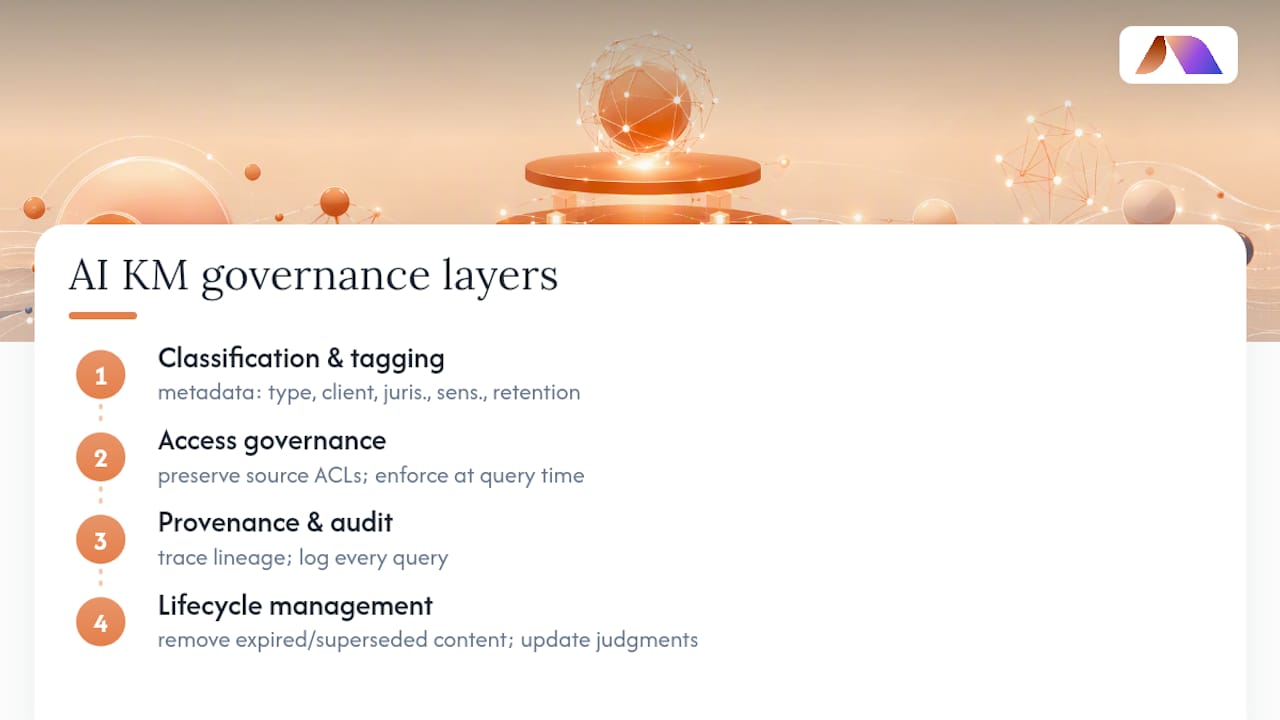
Data governance for AI KM in professional services has four layers that must be designed together, not bolted on after deployment.
The first layer is classification and tagging: every document entering the knowledge base must carry metadata for content type, jurisdiction, client matter, sensitivity level, and retention period. Without this, access controls and deletion rules cannot function correctly.
The second layer is access governance: source-level ACLs must be preserved and enforced at query time, not just at ingestion. Arahi AI’s architecture demonstrates this pattern, syncing permission changes from source systems so the knowledge base never drifts out of alignment with the original access rules.
The third layer is provenance and audit: every answer the system produces must carry a traceable lineage back to a source document, and every query must be logged. This is the foundation of client-facing auditability.
The fourth layer is lifecycle management: content that expires, is superseded, or is subject to a deletion request must be removed from the knowledge base and from any vector stores derived from it. Firms that codify partner judgment into structured systems also need a process for updating that judgment when methodology evolves, so the knowledge base reflects current firm standards rather than archived ones.
Key Takeaways
Grounding, source connectors, agent governance, and fine-grained access controls are the four capabilities that determine whether an AI KM deployment produces consulting-grade outputs or expensive hallucinations.
Point | Details |
|---|---|
Require a grounding layer | Every answer must cite its source; systems that generate unsupported answers are not production-ready. |
Pilot before you scale | A pilot with defined acceptance criteria including accuracy thresholds and verified escalation behavior is the right entry point. |
Governance is not optional | Source-level ACLs, audit logs, and data classification must be designed before deployment, not retrofitted. |
People and process drive adoption | Reskilling, knowledge stewards, and workflow redesign determine whether the tool delivers value or sits unused. |
BRDGIT accelerates the path | BRDGIT’s fractional engineers and readiness assessments compress pilot timelines and close the internal expertise gap. |
The gap most firms miss when they start
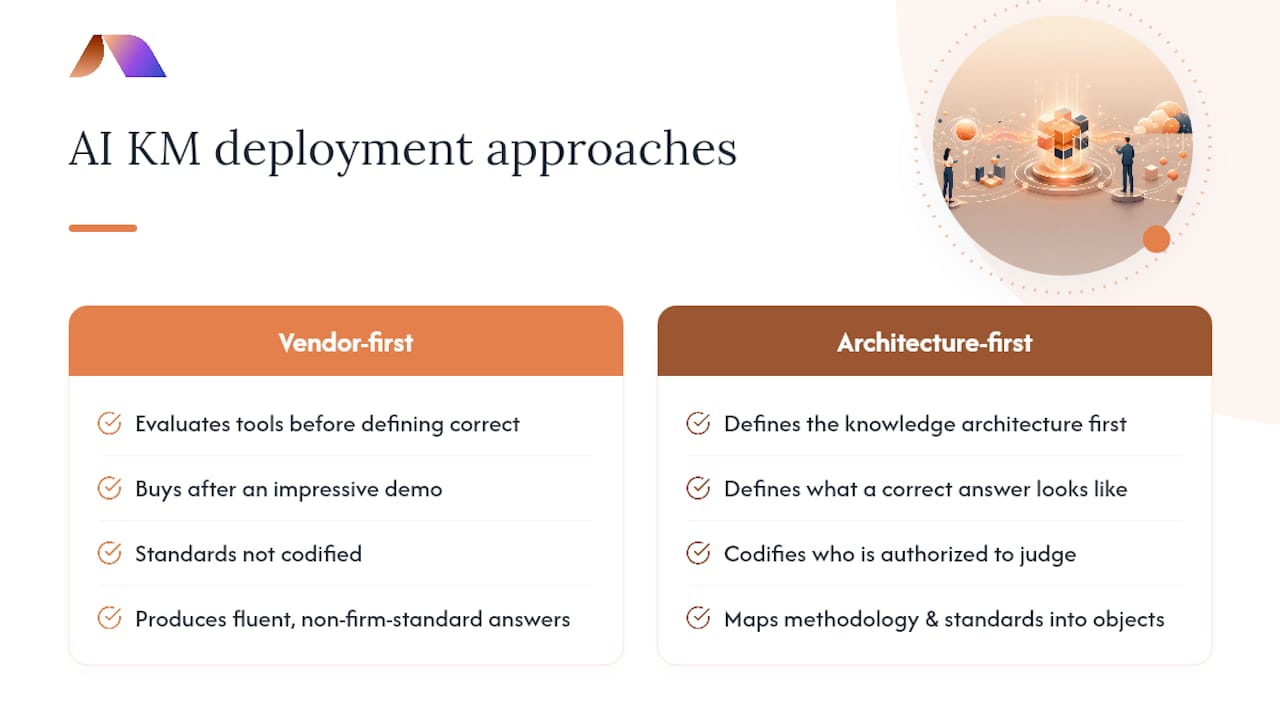
The firms that stall on AI KM deployments almost always make the same mistake: they evaluate tools before they have defined what “correct” looks like for their own work. They run a demo, the output looks impressive, and they move to procurement. Six months later, the system is producing answers that are fluent but not firm-standard, and nobody knows how to fix it because nobody codified the standard in the first place.
The most durable deployments we observe start with the knowledge architecture, not the vendor selection. What does a correct answer look like in your practice? Who is authorized to say so? Where does that judgment currently live, and in what form? Those questions are harder than picking a platform, and they are the ones that determine whether the system scales firm judgment or just scales firm noise.
Penumbra’s approach to scaling judgment without dilution captures this well: the goal is to map methodology, review standards, and prior work into structured objects that agents and people start from, rather than leaving every engagement to rediscover what “good” means. That is the difference between a knowledge system and a document search tool.
AI does not forgive organizational ignorance. The firms that treat AI KM as a technology purchase rather than an organizational design problem will spend real money and see marginal results. The ones that redesign the workflow first, codify the judgment, and then deploy the technology will build something that compounds in value over time.
BRDGIT helps you move from pilot to production faster
Firms that know they need AI knowledge management but lack the internal expertise to design a production-grade deployment face a real cost: every month of delay is a month competitors are compounding their advantage. BRDGIT’s fractional AI engineers close that gap without the overhead of a full-time hire.
BRDGIT designs and runs pilots from scoping through acceptance testing, configures source connectors and governance frameworks, and stays engaged through production rollout on a retainer model that scales with your actual needs. The starting point is a readiness assessment that maps your current knowledge infrastructure, identifies the highest-value pilot use case, and produces a scoped implementation plan before you commit to any vendor. No guesswork about where to start. No six-month vendor evaluation that delays execution.
Engage BRDGIT’s fractional engineers to scope your first AI KM pilot and get a readiness assessment within two weeks.