Published on
AI Workforce Augmentation: A 2026 Guide for Leaders
TL;DR:
AI workforce augmentation enhances human capabilities by pairing AI with workers to handle routine tasks, allowing humans to focus on judgment-based work. Leaders who redesign workflows, involve employees early, and maintain quality control can realize significant productivity gains and reduce risks. Failure to do so risks low-quality outputs and talent pipeline degradation, making thoughtful implementation essential.
AI workforce augmentation is defined as the strategic integration of artificial intelligence to enhance human workers’ capabilities, not replace them. The industry term for this practice is “human-AI collaboration,” and understanding the distinction matters. 65% of employees in AI-adopting organizations report improved individual productivity and efficiency. That number signals a shift in how work gets done, and business leaders who ignore it are accepting a real competitive disadvantage. This guide explains what AI workforce augmentation is, how it works, and what it takes to implement it well.
What is AI workforce augmentation and how does it work?
AI workforce augmentation works by pairing AI systems with human workers to handle specific tasks, freeing people to focus on judgment-intensive work. The key distinction from pure automation is intent. Automation replaces a human step entirely. Augmentation keeps the human in the loop but makes that human significantly more capable.
The mechanism involves three layers. First, AI handles repetitive, rules-based tasks such as data entry, scheduling, or document summarization. Second, workflows get redesigned around AI’s strengths. Task chaining sequences multiple steps end-to-end, reducing coordination costs even when AI is slightly less accurate on any single step. Third, humans apply judgment to AI outputs, catching errors and making decisions that require context.
The productivity gains are measurable. Enterprise users report daily productivity gains of 40–60 minutes from AI, with high-frequency users saving at least 4 hours weekly. That is not a marginal improvement. It is the equivalent of adding a half-day of capacity per worker, per week.
Pro Tip: Start augmentation pilots with tasks that have clear inputs and outputs, such as drafting reports or summarizing meeting notes. These yield fast, visible wins that build organizational confidence.
Anthropic Claude usage data shows 53% of enterprise AI usage is augmentation versus 44% automation. Augmentation is already the dominant mode. Leaders who design for it intentionally will outperform those who let it happen by accident.
What are the key benefits and challenges of AI workforce augmentation?
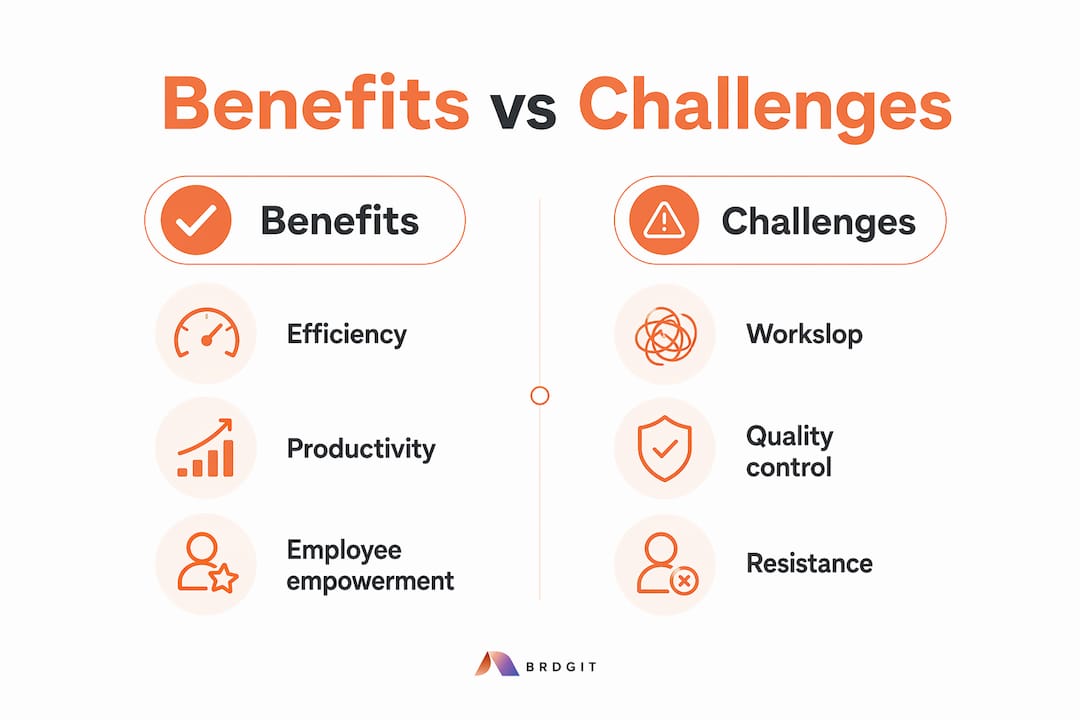
The benefits of AI in workforce settings are real, but they are not automatic. Efficiency gains come when AI handles volume work and humans handle complexity. Expanded human capacity means one skilled employee can produce what previously required a team. Innovation potential increases when people are freed from routine tasks and can focus on creative problem-solving.
The challenges are equally real. The most underreported risk is “workslop.” 40% of employees reported receiving low-quality AI-generated content in the prior month. Poor AI outputs that go unreviewed reduce productivity rather than increase it. Quality control is not optional.
A second risk is skill degradation. Entry-level employment in highly AI-exposed roles declined by 16%. Fewer junior roles means fewer opportunities for workers to build foundational skills. Organizations that automate away their talent pipeline will pay for it in three to five years.
Salesforce’s “4Rs” framework offers a practical structure for addressing both benefits and risks:
Redesign work around what AI does well and what humans do better.
Reskill employees with AI skills so they can work alongside these systems confidently.
Redeploy talent into roles that create higher value with AI support.
Rebalance tasks continuously as AI capabilities evolve.
“Pro-worker AI extends human judgment and creates new tasks that increase the value of human skills rather than replacing jobs.” — MIT economists Acemoglu, Autor, and Johnson, February 2026
This framing matters. The goal is not to cut headcount. The goal is to make every person on your team more capable than they were before.
How can business leaders integrate AI augmentation effectively?
Leadership is the single biggest variable in whether AI augmentation succeeds or stalls. Organizational success with AI depends on treating AI as a collaborative partner, building a culture of experimentation, and focusing on workflow transformation rather than isolated task automation. That is a leadership problem, not a technology problem.

The first step is workflow mapping. Leaders need to identify which tasks consume the most time, which require the least judgment, and which would benefit most from AI handling. MIT research on workflow restructuring shows that clustering and sequencing tasks for AI execution reduces handoffs and coordination costs significantly. This is where most organizations leave value on the table.
The second step is involving employees early. Top-down AI mandates generate resistance and surface-level compliance. Employees who help design their own augmented workflows adopt them faster and use them more effectively. This is not a soft consideration. It is a practical one.
Integration approach | What it achieves |
|---|---|
Workflow mapping before deployment | Identifies highest-value augmentation opportunities |
Employee co-design of AI workflows | Increases adoption rates and reduces resistance |
Iterative pilots with defined metrics | Builds evidence for scaling decisions |
Ongoing quality review processes | Prevents workslop from eroding productivity gains |
Pro Tip: Assign a designated “AI quality reviewer” role within each team during early augmentation phases. This person catches poor outputs before they spread and builds institutional knowledge about where AI fails.
For leaders who want a deeper read on AI adoption readiness, the gap between curiosity and execution is almost always a strategy problem, not a technology problem.
What industries and job roles benefit most from AI augmentation?
Knowledge work sees the highest immediate returns from AI workforce enhancement. Coding, content generation, legal research, and financial analysis all involve high-volume, structured tasks that AI handles well. Generative AI is reshaping jobs most visibly in coding and sales coaching, where AI can draft, suggest, and analyze at a speed no human matches.
Operational roles benefit differently. In logistics, AI augments route planning and inventory forecasting. In HR, it accelerates candidate screening and onboarding documentation. In customer service, it handles tier-one queries and routes complex cases to human agents. The pattern is consistent: AI takes volume, humans take complexity.
AI adoption leads to mixed workforce patterns across company sizes, with some firms expanding headcount and others reducing it. The difference is strategy. Companies that redesign workflows around augmentation tend to grow. Companies that use AI purely to cut costs tend to shrink their capabilities along with their headcount.
Criteria for identifying strong augmentation opportunities in your organization:
Tasks with high volume and low variability respond best to AI handling.
Roles where speed matters more than nuance are strong candidates.
Functions with measurable outputs make it easy to track augmentation ROI.
Teams with existing digital workflows integrate AI faster than analog-heavy operations.
For a practical look at AI in talent sourcing, HR leaders will find that augmentation changes the recruiter’s job rather than eliminating it.
Key Takeaways
AI workforce augmentation delivers measurable productivity gains when leaders redesign workflows, involve employees, and maintain rigorous quality control over AI outputs.
Point | Details |
|---|---|
Augmentation vs. automation | Augmentation keeps humans in the loop; automation removes them. Design for the former. |
Productivity gains are real | High-frequency AI users save at least 4 hours weekly, per St. Louis Fed research. |
Workslop is a genuine risk | 40% of employees received poor AI outputs last month; quality review is non-negotiable. |
The 4Rs framework works | Redesign, reskill, redeploy, and rebalance tasks to capture AI’s full value. |
Entry-level roles need protection | A 16% decline in junior AI-exposed roles signals a talent pipeline risk leaders must address. |
The uncomfortable truth about AI augmentation most leaders miss
We work with business leaders who are genuinely excited about AI. That excitement is warranted. But the ones who struggle share a common pattern: they deploy AI on top of broken workflows and expect the technology to fix the underlying problem. It does not. AI does not forgive organizational ignorance.
The leaders who succeed treat augmentation as a redesign project, not a software purchase. They ask hard questions about how work actually flows through their organization before they introduce AI into it. They involve the people doing the work. They build feedback loops that catch bad outputs before those outputs become bad decisions.
The other thing I have seen consistently: the quality problem is underestimated. Workslop is not a minor inconvenience. When 40% of employees are receiving low-quality AI outputs and acting on them, you have a systemic accuracy problem dressed up as a productivity gain. The fix is not less AI. The fix is better review processes and clearer accountability for AI outputs.
AI augmentation done well is one of the most powerful tools available to business leaders right now. Done carelessly, it creates a new category of organizational risk. The difference is almost entirely in how seriously leadership takes the implementation.
— Team BRDGIT
How BRDGIT helps leaders move from AI interest to AI execution
Business leaders who understand AI workforce augmentation conceptually often hit a wall when it comes to execution. Knowing what to do and knowing how to do it inside your specific organization are two different things.
BRDGIT works with organizations at exactly that gap. Our fractional AI engineers bring hands-on implementation experience without the cost of a full-time hire. We help teams map workflows, identify augmentation opportunities, build custom AI systems, and train employees to use them confidently. For leaders who need AI expertise applied to real problems, BRDGIT provides the experience and the execution capacity to make it happen.
FAQ
What is AI workforce augmentation in simple terms?
AI workforce augmentation is the use of AI tools to make human workers more capable, not to replace them. Workers handle judgment and complexity while AI handles volume and repetition.
How does AI augmentation differ from automation?
Automation removes a human from a task entirely. Augmentation keeps the human involved but uses AI to handle parts of the task faster or at greater scale.
What productivity gains can businesses expect from AI augmentation?
Enterprise users report daily gains of 40–60 minutes, with high-frequency users saving at least 4 hours weekly, according to Microsoft and St. Louis Fed research.
What is the biggest risk of AI workforce augmentation?
The “workslop” problem is the most underreported risk. 40% of employees received low-quality AI-generated content in the prior month, which can reduce productivity if outputs go unreviewed.
Which roles benefit most from AI workforce augmentation?
Knowledge workers in coding, sales, legal research, and content generation see the highest immediate gains. Operational roles in logistics, HR, and customer service also benefit significantly.