


Published on
Ship 1–2 AI Pilots Fast: AI Center of Excellence for Leaders
An AI Center of Excellence is a cross-functional unit that centralizes AI governance, builds reusable assets, and clears the path for high-value pilots to reach production. The right way to launch one is to start small: pick one or two mission-aligned use cases, staff them with fractional talent if needed, and align controls to the NIST AI Risk Management Framework and CSET’s operational guidance from day one. Scale only after that pilot proves value.
TL;DR:
Most organizations encounter shadow AI and tool sprawl when they lack a structured CoE with decision rights, leading to inefficiencies and unmanaged risks.
A CoE is most effective when it starts small with one or two use cases, using governance frameworks like NIST and scaling only after proven value.
Staffing should focus on critical roles such as a lead, product owners, engineers, and security specialists, often leveraging fractional talent initially to manage costs.
AI governance must span the entire lifecycle, with tiered controls based on risk levels, and integrate seamlessly with existing IT and data systems to prevent siloed infrastructure.
Success depends on disciplined pilot evaluation, thorough documentation, and fostering organizational skills while avoiding premature full-scale deployment.
BRDGITMove From AI Plans to ExecutionBRDGIT helps teams assess AI opportunities, build roadmaps, implement practical systems, and access fractional expertise for ongoing execution.Explore BRDGIT
Table of Contents
What Is an AI Center of Excellence, and What Does It Actually Do?
Why Does an AI Center of Excellence Matter for Your Bottom Line?
Who Should Staff Your AI Center of Excellence?
How Do You Govern AI Risk Across the Full Lifecycle?
How Do You Pick and Launch the Right Pilot First?
What Technical Foundations Does a CoE Need to Build First?
How Does a Centralized CoE Evolve Into a Distributed Model?
What Does BRDGIT Bring to Standing Up Your CoE?
Why Do Most AI Adoption Efforts Stall Inside the Organization?
How Should You Fund and Budget Your AI Center of Excellence?
How Does the CoE Fit Into Your Existing IT and Data Systems?
How Do You Build Long-Term AI Skills Across the Organization?
What Do Successful AI CoEs Actually Do Differently?
What Leaders Get Wrong About Building an AI Center of Excellence
Ready to Move From AI Strategy to AI Execution?
Sources
FAQ
What Is an AI Center of Excellence, and What Does It Actually Do?
Most executives who ask “what is an AI Center of Excellence” already sense the answer: it is not a lab, and it is not a committee that meets quarterly to talk about the future. It is an operating unit with real authority over how AI gets evaluated, built, and governed across the company. IBM defines it around a consistent set of jobs: prioritizing use cases, setting governance policy, improving data quality, standing up shared infrastructure, and writing the delivery playbooks that let one team’s win become everyone’s template.
Scope matters as much as function. A CoE with no decision rights is a newsletter. A CoE with too much authority becomes the single point of failure every team routes around. The functions that consistently show up in a well-run unit include:
Strategy and prioritization — deciding which use cases get funded and in what order.
Governance — setting the risk, compliance, and approval gates every project must clear.
Platform and reusable assets — maintaining shared infrastructure, prompt catalogs, and model registries.
Skills development — training staff outside the CoE to use AI tools competently and safely.
Use-case pipeline management — a running intake and evaluation process, not a one-time project list.
Operating models vary across organizations. A centralized model consolidates build and governance under one team, suitable for early stages when consistency is key. A federated model delegates delivery to business units while maintaining centralized standards and review, better suited for organizations with mature AI capabilities. A hybrid model, commonly adopted, centralizes governance and platforms but allows business units to manage delivery for their use cases.
Why Does an AI Center of Excellence Matter for Your Bottom Line?
The business case is straightforward: organizations with a CoE tend to move from pilot to production faster, spend less on redundant tooling, and manage risk consistently instead of department by department. The absence of one produces a familiar pattern. Marketing licenses one AI writing tool, finance quietly adopts another, and operations builds a spreadsheet macro nobody in IT knows exists. That is shadow AI, and it is how companies end up with a dozen unmanaged AI touchpoints and no idea which ones touch sensitive data.
Five signs tell you it is time to stand one up:
More than one department is experimenting with AI tools without a shared review process.
Pilots keep stalling because nobody owns the decision to move them to production.
Legal or security has flagged AI usage they were not consulted on.
Leadership cannot answer “which AI initiatives are we funding and why” in one sentence.
Vendor sprawl is driving up cost without a clear owner tracking return.
If two or more of those sound familiar, the gap is not tooling. It is structure.
Who Should Staff Your AI Center of Excellence?
Staffing an AI CoE is less about headcount and more about covering a fixed set of responsibilities, some of which can be part-time, shared, or fractional in the early stages. The roles that matter most:
CoE lead — owns the roadmap, reports to an executive sponsor, and makes the final call on prioritization.
Product owner(s) — translate business problems into scoped use cases with measurable outcomes.
ML/AI engineers — build and maintain models, pipelines, and integrations.
Data engineers — own the pipelines and data quality that every model depends on.
Security and privacy lead — reviews data handling, access controls, and third-party model risk.
Responsible AI specialist — maps projects against governance frameworks and flags high-risk deployments.
Change manager — handles training, communication, and adoption across the business units the CoE serves.
A simple RACI pattern avoids the most common failure: the CoE lead is Accountable for prioritization, the product owner is Responsible for use-case definition, security is Consulted before any deployment gate, and business unit leaders are Informed at every milestone. Ambiguity on that chart is where pilots quietly die.
For small and mid-size enterprises, hiring seven full-time specialists before proving a single use case works is backwards. This is where fractional staffing earns its place: bringing in experienced fractional engineers to fill the ML engineering or security review gap for the first two or three pilots, then converting to permanent hires once the pipeline justifies it. A talent gap analysis before you post a single job listing tells you exactly which roles are truly missing versus which ones you already have covered under a different title.
Pro Tip: Do not staff for the CoE you’ll need in eighteen months. Staff for the two pilots in front of you, and let the roadmap tell you when to add headcount.
How Do You Govern AI Risk Across the Full Lifecycle?
AI introduces risk categories that traditional IT governance was never built to catch. Data poisoning corrupts training inputs before a model ever ships. Indirect prompt injection manipulates a deployed model’s behavior through content it processes, not through its code. Model drift erodes accuracy silently as real-world data diverges from training data. Supply-chain risk arrives the moment you depend on a third-party foundation model or fine-tuned checkpoint you did not build and cannot fully audit.
Governance has to run the length of the lifecycle, not sit at the end as a final review:
Design — risk-tier the use case before writing a line of code; a low-risk internal productivity tool does not need the same scrutiny as a customer-facing decision system.
Development — validate training data provenance and test for injection and manipulation before integration.
Deployment — enforce least-privilege access and require sign-off from security and the responsible AI specialist for anything above the lowest risk tier.
Maintenance — monitor for drift and log model behavior against baseline performance.
End-of-life — decommission models and data access cleanly, with an audit trail showing what was retired and why.
NIST’s AI Risk Management Framework is the most cited reference point for mapping these controls to lifecycle stages, and it works because it does not assume every deployment carries the same risk. A useful discipline borrowed directly from NIST’s own guidance is to tie your risk tiering to deployment gates. Low-risk tools get a lighter review path. High-risk, customer-facing, or safety-critical systems require full framework mapping and independent review before launch. CSET’s operationalizing guide synthesizes more than 1,200 government and industry sources into concrete steps across planning, development, deployment, and operation, which is worth consulting when NIST’s framework feels too abstract to act on directly. OWASP’s machine learning and large language model security projects round out the technical side, covering the injection and adversarial-input risks that general IT security checklists tend to miss entirely.
How Do You Pick and Launch the Right Pilot First?
Picking the wrong first pilot is the single most common way a new CoE loses executive confidence before it gets a second chance. Evaluate every candidate use case on four criteria: business value (does it move a number leadership already tracks), complexity (can it ship in weeks, not quarters), data readiness (does the data already exist in usable form), and regulatory or risk profile (does it touch regulated data or customer-facing decisions).
KPMG’s executive guidance frames the path from idea to scaled deployment as a five-step flow:
Assess — score candidate use cases against the four criteria above.
Design — scope the pilot narrowly enough to finish in one funding cycle.
Pilot — build and deploy with a fixed group of users and a defined success threshold.
Measure — compare results against the baseline you set before the pilot started.
Scale — only after the metrics clear the bar, expand to additional teams or use cases.
Each step needs a decision gate, not a soft handoff. Funding tends to work best in stages too: a small discovery budget to assess and design, a slightly larger pilot budget with a hard time box, and a separate scale budget that only unlocks once measured results justify it.
Pilot stage | Primary metric | Typical decision gate |
|---|---|---|
Assess | Use-case score (value, complexity, data, risk) | Go/no-go to design |
Design | Time-to-pilot estimate | Scope approval |
Pilot | Adoption rate, error rate, time saved | Scale or kill |
Measure | ROI against baseline | Funding release |
Scale | Cost per unit at volume | Expand to next use case |
The teams that get this wrong almost always skip the measure step and jump straight from pilot to scale on enthusiasm alone. The teams that get it right treat the measure gate as non-negotiable, even when the pilot feels obviously successful.
What Technical Foundations Does a CoE Need to Build First?
The technical stack a CoE needs at the start is smaller than most vendors want you to believe. A minimal reference architecture covers three things: an MLOps pipeline for versioning and deploying models, API governance that controls who can call which model and with what data, and least-privilege access baked in from the first deployment rather than retrofitted later.
Beyond infrastructure, the assets that actually get reused are simple documents and templates, not platforms:
A prompt catalog documenting what works for common tasks, so teams stop reinventing prompts from scratch.
A model catalog listing which models are approved for which use cases and data sensitivity levels.
Deployment playbooks that turn a successful pilot into a repeatable checklist for the next team.
Monitoring templates that define what “healthy” looks like for a deployed model before something breaks.
GSA’s AI CoE guidance is explicit that these artifacts should be among the first deliverables, not an afterthought once pilots succeed, because they become the basis for training, audits, and every future deployment’s head start. On the build versus buy question: managed components make sense for commodity capability like model hosting, while the CoE should own governance, the asset catalog, and integration logic in-house to avoid vendor lock-in. Teams evaluating infrastructure for AI-heavy workloads often find it useful to review how storage and search infrastructure decisions shape what a reference architecture can actually support at scale. For a deeper look at how these reusable practices get built and scaled across teams, see how organizations approach creating and scaling AI agents.
How Does a Centralized CoE Evolve Into a Distributed Model?
The typical evolution path runs centralize, then enable, then distribute. Early on, centralizing build and governance under one team is what gets consistent standards off the ground. Once that team has proven a handful of use cases and written the playbooks, the next phase is enabling business units to build with those standards rather than waiting in a central queue. Microsoft’s guidance on establishing an AI CoE frames this directly: treat the CoE as an operational evolution, not a permanent department, or it becomes the bottleneck it was created to eliminate.
The signal that you are ready to decentralize is not a calendar date. It is operational: business units are consistently clearing governance review on their own submissions, reuse of shared assets is already happening without central prompting, and the CoE’s queue is backed up with requests it does not have capacity to build itself. At that point, governance shifts from “the CoE builds and reviews” to “the CoE sets standards and audits,” and KPIs shift from delivery volume to compliance rate and asset reuse across the distributed teams.
Pro Tip: If your CoE’s backlog is growing faster than its output, that is not a staffing problem to solve by hiring more engineers. It is the signal to start distributing delivery and keep the CoE focused on standards.
What Does BRDGIT Bring to Standing Up Your CoE?
Most companies do not fail at AI because the technology does not work. They fail because nobody scoped the first pilot correctly or governed it once it shipped. BRDGIT’s AI Readiness Assessment and AI Blueprint exist specifically to close that gap before a single dollar goes into engineering.
Where teams need hands rather than strategy, BRDGIT’s Fractional Engineer Services let you staff a pilot with experienced AI engineering talent without committing to a full-time hire before you know the use case will scale. That reduces the single biggest risk in early-stage CoE work: over-hiring against unproven demand.
Why Do Most AI Adoption Efforts Stall Inside the Organization?
Technology rarely kills an AI initiative. Adoption does. A model that works perfectly in a demo dies the moment the people expected to use it daily do not trust it, do not understand it, or were never asked what they actually needed it to do.
Change management for an AI CoE looks different from a typical software rollout because the tool’s behavior can shift over time, and staff need to understand that a model’s output is probabilistic, not a fixed feature list. Three practices consistently separate CoEs whose pilots get adopted from ones whose pilots get quietly abandoned.
First, involve the people who will use the tool in defining what success looks like before the pilot starts, not after it ships. Second, train for judgment, not just clicks: staff need to know when to trust an AI-generated output and when to escalate it, which is a different skill than knowing which button to press. Third, communicate what the CoE is doing broadly and often, because workforce compliance and adoption research consistently shows that silence during a rollout gets filled with assumptions, usually the wrong ones, about job security and surveillance.
The change manager role on your CoE team exists precisely because these are ongoing jobs, not launch-week tasks. Budget for them the same way you budget for engineering time.
How Should You Fund and Budget Your AI Center of Excellence?
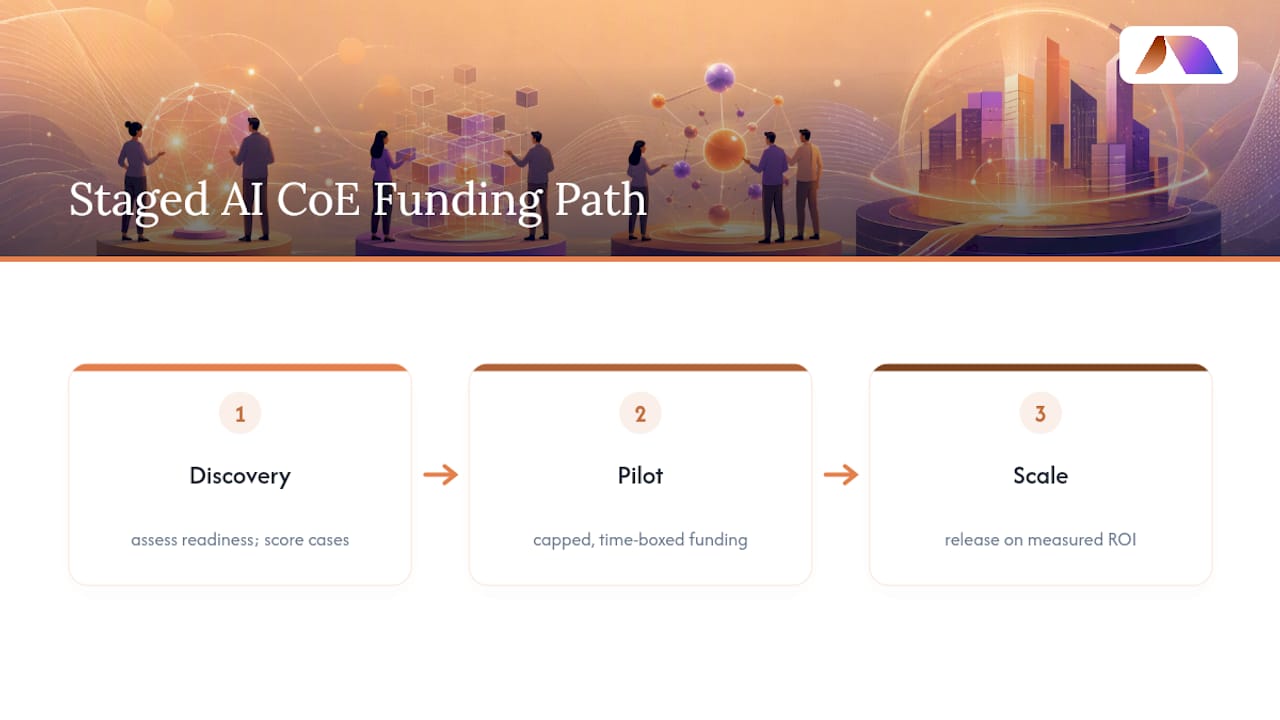
Funding an AI CoE works best as a staged commitment rather than a single annual line item, because the first few months are discovery, not delivery. A small discovery budget covers the readiness assessment and use-case scoring. A pilot budget, deliberately capped and time-boxed, funds the one or two use cases that clear your prioritization criteria. A scale budget only unlocks once a pilot’s measured results justify the expansion, which keeps you from pouring money into something that looked good in a slide deck but never actually moved a real metric.
Three funding models show up most often in practice. A central IT budget model funds the CoE entirely from a corporate technology line, which keeps governance clean but can starve the CoE of business-unit buy-in. A chargeback model has business units pay for CoE services per project, which forces prioritization discipline but can slow adoption if units treat every request as a cost to minimize. A hybrid model funds the core governance and platform team centrally while charging business units for delivery work, which tends to balance both concerns reasonably well.
Whichever model you choose, tie budget releases to the decision gates in your pilot process rather than to the fiscal calendar. Releasing scale funding because a use case cleared its measured ROI threshold is a fundamentally different conversation than releasing it because the quarter ended and there was money left. Fractional staffing also changes the budgeting math meaningfully: paying for experienced fractional engineers on a pilot-by-pilot basis avoids the fixed-cost commitment of full-time hires before the CoE has proven which roles need to be permanent.
How Does the CoE Fit Into Your Existing IT and Data Systems?
An AI CoE that ignores your existing IT and data infrastructure will spend its first year rebuilding pipelines that already exist somewhere in the organization, usually under a different owner. The integration questions that matter most are unglamorous: where does the data actually live, who currently owns access control, and which existing systems does a new AI deployment need to read from or write into safely.
Most mid-size organizations already have identity and access management, data warehouses, and some form of API gateway in place before the CoE ever forms. The CoE’s job is not to replace those systems. It is to extend their governance model to cover AI-specific risks those systems were never designed to catch, like a model quietly pulling from a data source nobody flagged as sensitive. Least-privilege access, applied consistently between existing IT systems and new AI deployments, closes most of that gap without a rebuild.
A common mistake is standing up AI infrastructure in a silo that IT does not know about, which recreates the shadow AI problem at the infrastructure layer instead of the tool layer. The fix is procedural: the CoE’s platform lead and the existing IT/data leadership need a standing integration review before any new pipeline goes live, not after a security audit finds it. Vendor-agnostic integration, where the CoE avoids hard-coding a single provider’s proprietary format into core pipelines, keeps that review process from becoming a repeated fire drill every time a new model provider enters the picture.
How Do You Build Long-Term AI Skills Across the Organization?
A CoE that hoards all the AI expertise on one team has built a bottleneck, not a capability. The organizations that get durable value from AI treat skills development as a parallel track to pilot delivery, not something that happens after the technology matures.
That starts with tiered training. Frontline staff need practical fluency: how to write a usable prompt, how to spot when a model’s output looks wrong, and when to escalate rather than trust the answer. Product owners and business analysts need a step further: how to scope a use case so it is technically feasible and how to read the metrics a pilot produces. Engineers embedded in business units need deeper technical training on the CoE’s reference architecture and governance requirements, so they are not learning the rules for the first time on their first project.
Continuous learning matters more in AI than in most other technology domains because the tools themselves change quickly. A training program built once and never revisited will teach staff to use a version of a tool that no longer exists within a year. Building a lightweight internal knowledge base, capturing what worked, what failed, and why, gives the CoE a living resource instead of a static onboarding deck. Tools built for AI knowledge management in professional services illustrate one way organizations are keeping that knowledge current instead of letting it calcify into outdated documentation.
What Do Successful AI CoEs Actually Do Differently?
The pattern across organizations that get real return from an AI CoE has less to do with budget size and more to do with restraint. They resist the urge to launch five pilots simultaneously and instead prove one or two decisively before asking for more funding. They document what worked in a form the next team can actually reuse, rather than trusting institutional memory to carry the lesson forward.
Governance failures tend to follow a specific pattern: a system gets deployed without the review it should have had, the gap surfaces publicly, and the resulting cleanup costs far more than the review would have. Enterprise cases involving AI governance failures and their cost show how expensive it gets to retrofit governance after a system is already in production versus building it in from the pilot stage.
Sector-specific execution also matters more than generic playbooks suggest. Risk-heavy industries approach CoE governance differently than lower-risk ones. Guidance for AI in risk consulting and AI in financial advisory both illustrate how the same CoE structure gets tuned for regulatory exposure, client trust, and audit requirements that a manufacturing or logistics pilot simply does not face. The best CoEs adapt the framework to their sector’s actual risk profile instead of importing someone else’s checklist wholesale.
What Leaders Get Wrong About Building an AI Center of Excellence
The conventional advice on AI CoEs leans heavily toward maturity models, capability matrices, and phased multi-year rollouts. That advice is not wrong, exactly. It is just built for organizations with the patience and budget to spend a year planning before they ship anything real. Most mid-size companies do not have that runway, and pretending otherwise is how CoE initiatives quietly die in the planning phase.
What the evidence actually supports is narrower and more useful: pick one or two pilots that map to a business outcome leadership already cares about, staff the gaps with fractional talent instead of waiting on a hiring cycle, and build governance into the pilot from day one using NIST or CSET’s frameworks as your map, not your finish line. The organizations that stall are usually the ones trying to build the full operating model before they have proven a single use case works.
The overrated piece is the org chart. Endless debate over centralized versus federated versus hybrid structure rarely determines success. What determines it is whether the first pilot ships, gets measured honestly, and gets documented well enough that the second team does not start from zero. Get that right, and the structure question answers itself within two quarters.
— Team BRDGIT
Ready to Move From AI Strategy to AI Execution?
BRDGIT is the alternative to hiring a full AI team before you have proven a single use case works. Rather than committing to permanent headcount against unproven demand, you get an AI Readiness Assessment that scopes your first pilot correctly, followed by fractional engineering talent that staffs the build without the risk of a bad full-time hire.

If your organization is still debating org charts instead of shipping a pilot, that is the actual signal to start smaller and faster. BRDGIT’s AI Blueprint service maps your highest-value use case and the governance it needs before a line of code gets written, and the Fractional Engineer Services page outlines how experienced AI engineers can staff that first build without a long-term commitment. Book a readiness assessment and get a concrete roadmap instead of another planning deck.
Sources
FAQ
What Is an AI Center of Excellence?
An AI Center of Excellence is a cross-functional team that centralizes AI strategy, governance, and reusable infrastructure so pilots move to production faster and more safely. Its core functions typically include use-case prioritization, risk governance, shared platform ownership, and skills development, as IBM outlines.
What Does an AI CoE Actually Do Day to Day?
An AI CoE evaluates and prioritizes candidate use cases, sets the governance gates each project must clear, and maintains reusable assets like prompt catalogs and deployment playbooks. It also trains staff outside the unit and manages the ongoing pipeline of AI requests, rather than treating AI as a one-time project.
What Is a Center of Excellence, in General Terms?
A Center of Excellence is an organizational unit that concentrates expertise, standards, and shared resources around a specific discipline to raise consistency and quality across the company. An AI CoE applies that same model specifically to artificial intelligence governance, delivery, and skills.
How Big Should a CoE Team Be When You’re Starting Out?
There is no fixed headcount that fits every organization; sizing depends on how many pilots you are running and which roles you can fill fractionally versus permanently. Many small and mid-size teams start with a lead, one or two engineers, and fractional support for security and responsible AI review, scaling headcount only once pilots prove out. BRDGIT’s Fractional Engineer Services are built for exactly that early-stage gap.
Should a Small Company Build a Full CoE or Start Smaller?
Smaller organizations generally get better results starting with one or two high-impact use cases rather than staffing a full enterprise CoE structure upfront. Fractional AI talent can cover the specialized roles you need for those first pilots without the cost and risk of full-time hires before demand is proven.



