
Published on
The Role of AI in Risk Consulting: A 2026 Guide
TL;DR:
AI enhances risk consulting by increasing productivity and output quality through automation and advanced data synthesis. Firms need to focus on governance, data confidentiality, and organizational change to successfully adopt AI and achieve long-term competitive advantage.
AI in risk consulting is defined as the use of machine learning, agentic AI systems, and natural language processing to augment consultant capabilities in data synthesis, risk assessment, and decision-making. The role of AI in risk consulting is not to replace the trusted advisor. It is to make that advisor dramatically more capable. Research from Harvard Business School and BCG shows consultants who integrated AI completed 12.2% more tasks, worked 25.1% faster, and delivered outputs rated over 40% higher in quality than non-users. Those numbers are not incremental gains. They represent a structural shift in what a consulting engagement can deliver.
How does AI improve productivity and quality in risk consulting workflows?
AI’s most immediate impact on risk consulting is time reclaimed from low-value work. Agentic AI systems layered over curated knowledge bases reclaim about 30% of research time and redeploy consultant labor worth $12 million monthly toward higher-value client work. That is not a rounding error. That is a meaningful reallocation of expert capacity.
The specific tasks AI handles well in risk consulting include:
Document synthesis: AI reads and summarizes regulatory filings, audit reports, and prior risk assessments in minutes rather than hours.
RFP response automation: AI drafts first-pass responses using firm knowledge libraries, which consultants then refine and personalize.
First-draft report generation: AI produces structured risk reports from raw data inputs, cutting initial drafting time by a significant margin.
Scenario modeling: Machine learning in risk assessment enables faster stress testing across multiple risk variables simultaneously.
The quality improvement is as significant as the speed gain. AI-assisted outputs scored over 40% higher in quality ratings, which means clients receive better analysis, not just faster analysis. That distinction matters when you are advising on operational risk or regulatory compliance.
Pro Tip: Identify the three most time-consuming non-expert tasks your team repeats every engagement, then build AI workflows around those first. The productivity gains compound quickly and free senior consultants for the judgment-intensive work clients actually pay premium fees for.

What are the challenges and organizational considerations in integrating AI into risk consulting?
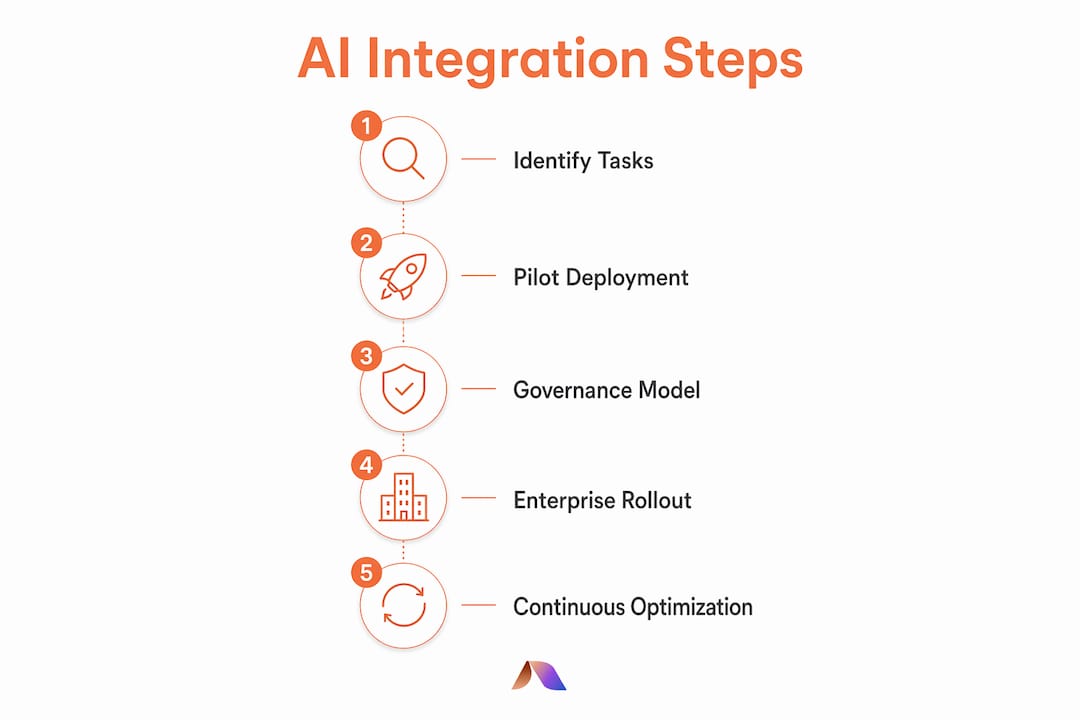
Technology readiness is not the bottleneck. Organizational readiness is. Up to 50% of junior consultants’ billable hours are spent re-creating analyses that already exist somewhere in the firm. AI solves this through instant retrieval and synthesis. But firms must first build the knowledge infrastructure that makes retrieval possible.
The organizational challenges risk consulting firms face when adopting AI fall into three categories:
Governance gaps: Most firms lack accountability frameworks that define who owns AI outputs and how errors are caught before client delivery.
Confidentiality risk: Client data cannot flow freely through general-purpose AI systems. Firms must implement enterprise-grade RAG architectures and multi-agent designs that enforce strict document-level access controls.
Cultural resistance: Senior consultants who built careers on proprietary knowledge often view AI as a threat rather than a tool. This slows adoption at the exact level where it would have the most impact.
Firms that treat AI only as a productivity tool see limited returns. True transformation requires a 3–5 year horizon for redesigning operating models, governance structures, and measurement frameworks. That timeline is uncomfortable for firms used to quarterly performance cycles. But it is the realistic path to sustained competitive advantage.
The confidentiality paradox deserves particular attention in risk consulting. Clients share sensitive financial, operational, and regulatory data. Feeding that data into poorly designed AI systems creates liability. Sophisticated data siloing through purpose-built agentic architectures is not optional. It is a baseline requirement for any firm serious about AI adoption.
Pro Tip: Before deploying any AI tool that touches client data, map your information barriers explicitly. Define which data sets can interact, which must remain isolated, and who has authority to change those boundaries. Build that map before you build the system.
How does AI impact consulting business models and client expectations in risk consulting?
AI compresses timelines. Compressed timelines challenge effort-based billing. This is the economic tension at the center of how AI transforms risk consulting business models. If a risk assessment that once took 200 hours now takes 80, billing for 200 hours becomes indefensible. Firms must shift toward outcome-based pricing, retainer models, and proprietary system delivery.
The economics of early adoption are compelling. Early AI adopters in consulting reported a 15.8% revenue increase and a 15.2% operational cost reduction, largely driven by faster client turnaround. Those firms are not just more profitable. They are pulling ahead in client acquisition because they deliver results faster.
Client expectations are also rising. AI has commoditized surface-level analysis. Any client with access to a general-purpose AI tool can generate a basic risk summary. Premium consulting fees are now awarded for deep strategic judgment, sector-specific expertise, and the kind of trusted advisor relationship that no AI system replicates. As Michael Zipursky of Consulting Success has noted, AI raises the bar for consulting services but does not replace deep strategic judgment or trusted human relationships.
“Competitive advantage in the AI era is derived from organizational change linking AI efficiencies with business model innovation.” — Will Barnes, Ajuno
The future of AI in risk advisory belongs to firms that treat AI as infrastructure, not a feature. The firms winning today are not the ones with the most AI tools. They are the ones that have redesigned their delivery model around AI capabilities.
What practical steps can risk consultants take to successfully implement AI?
Implementation works best when it starts narrow and expands deliberately. Broad AI rollouts without clear use cases produce confusion and wasted spend. Focused pilots with measurable outcomes build the internal credibility needed to scale.
Identify routine, non-expert tasks first. Research synthesis, regulatory update monitoring, and first-draft report generation are ideal starting points. These tasks consume significant time and carry low risk if an AI output requires revision.
Build reusable prompt libraries. Standardized prompts for common risk consulting tasks, such as gap analysis frameworks or control assessment templates, improve AI output quality over time and reduce variance between team members.
Establish a governance structure before scaling. Define who reviews AI outputs, how errors are flagged, and what accountability looks like when AI-assisted work reaches a client. Governance models that address accountability and measurement frameworks are the foundation of sustained AI value.
Set client communication standards. Clients should understand that AI augments your team’s expertise. Every AI-assisted deliverable must reflect your firm’s voice, judgment, and professional standards. Transparency builds trust. Opacity creates risk.
The shift AI enables is from “find and reformat” to “evaluate and synthesize.” That shift is where consulting productivity gains become durable rather than temporary. Consultants who make that shift early will be significantly harder to compete against in 18 months.
Pro Tip: Run a 30-day pilot on one repeatable deliverable, such as a monthly risk summary or a vendor due diligence report. Measure time saved, output quality, and client feedback. Use that data to build the internal case for broader adoption.
Key takeaways
AI augments risk consultants most effectively when paired with governance structures, clear use cases, and a firm-wide commitment to operating model change.
Point | Details |
|---|---|
Productivity gains are measurable | AI-assisted consultants complete 12.2% more tasks and deliver outputs rated 40%+ higher in quality. |
Organizational change drives real value | Firms need a 3–5 year transformation horizon to realize AI’s full potential beyond surface productivity. |
Confidentiality requires architecture | Enterprise-grade RAG and data siloing are baseline requirements for AI use with sensitive client data. |
Business models must shift | AI compresses timelines, making outcome-based pricing more defensible than effort-based billing. |
Start narrow, then scale | Pilot AI on one repeatable task, measure results, and use evidence to build internal adoption momentum. |
The uncomfortable truth about AI and risk consulting
We have worked with enough consulting teams to say this plainly: the firms struggling most with AI adoption are not struggling because of the technology. They are struggling because AI exposes organizational problems that were already there. When AI surfaces the fact that 50% of junior hours go to re-creating existing work, that is not an AI problem. That is a knowledge management problem that AI just made visible.
The consultants who thrive in this environment are the ones who treat AI as a forcing function for better practice, not just a faster tool. They use it to ask harder questions of their own workflows. They build governance before they build systems. And they stay relentlessly focused on what clients actually value: judgment, trust, and the ability to navigate ambiguity that no model can fully resolve.
AI does not forgive organizational ignorance. Firms that deploy it without governance frameworks will produce inconsistent outputs, create confidentiality exposure, and erode the client trust they spent years building. The technology is ready. The question is whether your organization is.
The good news is that the path is clear. Start with a specific problem. Build a measurable pilot. Govern it properly. Then scale what works. That is not a complicated strategy. It is just a disciplined one.
— Team BRDGIT
BRDGIT’s approach to AI adoption for risk consulting firms
Risk consulting firms that want to move from AI curiosity to real AI execution need more than a tool recommendation. They need experienced support that understands both the technology and the consulting context.
BRDGIT works with consulting teams to identify the right AI opportunities, build clear implementation roadmaps, and deploy AI systems that fit their actual workflows. For firms that need AI expertise without a full-time hire, BRDGIT’s fractional engineers provide experienced AI talent for planning, delivery, and ongoing execution. Whether you are building your first AI pilot or scaling an existing program, BRDGIT brings the structure and accountability that turns AI potential into measurable client value. Learn more about building an AI strategy designed specifically for consulting firms.
FAQ
What is the role of AI in risk consulting?
AI in risk consulting augments consultant capabilities by automating research synthesis, accelerating data analysis, and improving decision-making quality. It does not replace human judgment but enables consultants to deliver faster, higher-quality risk assessments.
How much productivity improvement can AI deliver for risk consultants?
Consultants using AI complete 12.2% more tasks, work 25.1% faster, and produce outputs rated over 40% higher in quality compared to non-users, based on research from Harvard Business School and BCG.
What are the biggest risks of using AI in risk consulting?
Client data confidentiality is the primary risk. Firms must implement enterprise-grade RAG architectures and strict data siloing to prevent sensitive information from crossing client boundaries within AI systems.
How does AI change consulting business models?
AI compresses delivery timelines, which makes effort-based billing harder to justify. Firms are shifting toward outcome-based pricing and retainer models that reflect the value delivered rather than hours spent.
How long does it take for a consulting firm to fully benefit from AI?
Full organizational benefit from AI requires a 3–5 year transformation of operating models, governance frameworks, and measurement systems. Productivity gains appear earlier, but sustained competitive advantage takes longer to build.