


Published on
Cut Lead Review Time to 60 Seconds: AI Lead Qualification for RevOps
AI lead qualification enriches, scores, and routes inbound leads in seconds instead of the 15 to 30 minutes a rep typically spends on manual review, using firmographic and intent data to rank fit before a human ever sees the record. The catch: none of it works without a clean data pipeline, a clearly defined ideal customer profile, and a human checkpoint watching for drift. Speed without governance just moves bad decisions faster.
TL;DR:
Automated lead qualification speeds up the process from 15-30 minutes to under 60 seconds, but relies heavily on clean data and accurate ICP definitions.
Enrichment, scoring, and routing are essential steps, with model choice depending on data volume and quality, and thresholds should match sales capacity.
Data privacy compliance, audit trails, and explainability are critical to prevent legal issues and maintain trust in AI-driven scoring.
Successful implementation involves pilot testing on high-volume segments, continuous monitoring, and ensuring human oversight for exceptions.
Different vendor types address specific data and scoring needs, from CRM-internal tools to enrichment-focused platforms and context-providing AI agents.
BRDGITTurn AI Qualification Into ExecutionBRDGIT helps teams identify AI opportunities, build practical roadmaps, automate workflows, and implement systems that support daily work.Explore BRDGIT
Table of Contents
How AI Lead Qualification Actually Works: Capture, Enrich, Score, Route
What Are the Benefits of Automating Lead Qualification with AI?
How Do You Choose the Right Lead Scoring Framework?
Implementation Checklist: From Pilot to Production
Where Should Lead Scores Live in Your Tech Stack?
What Governance Do You Need to Prevent AI Qualification Failures?
How Do You Measure Success and Keep Models Calibrated?
How BRDGIT Helps Teams Adopt AI Lead Qualification
What Do Successful AI Lead Qualification Rollouts Look Like Across Industries?
How Do Leading AI Lead Qualification Tools and Platforms Compare?
How Do You Handle Unstructured or Sparse Lead Data?
What Are the Best Practices for Data Privacy in AI Lead Qualification?
Author Perspective: Practical Priorities for RevOps and Sales Leaders
Ready to Pilot AI Lead Qualification? Here’s the Faster Path
Sources
FAQ
How AI Lead Qualification Actually Works: Capture, Enrich, Score, Route
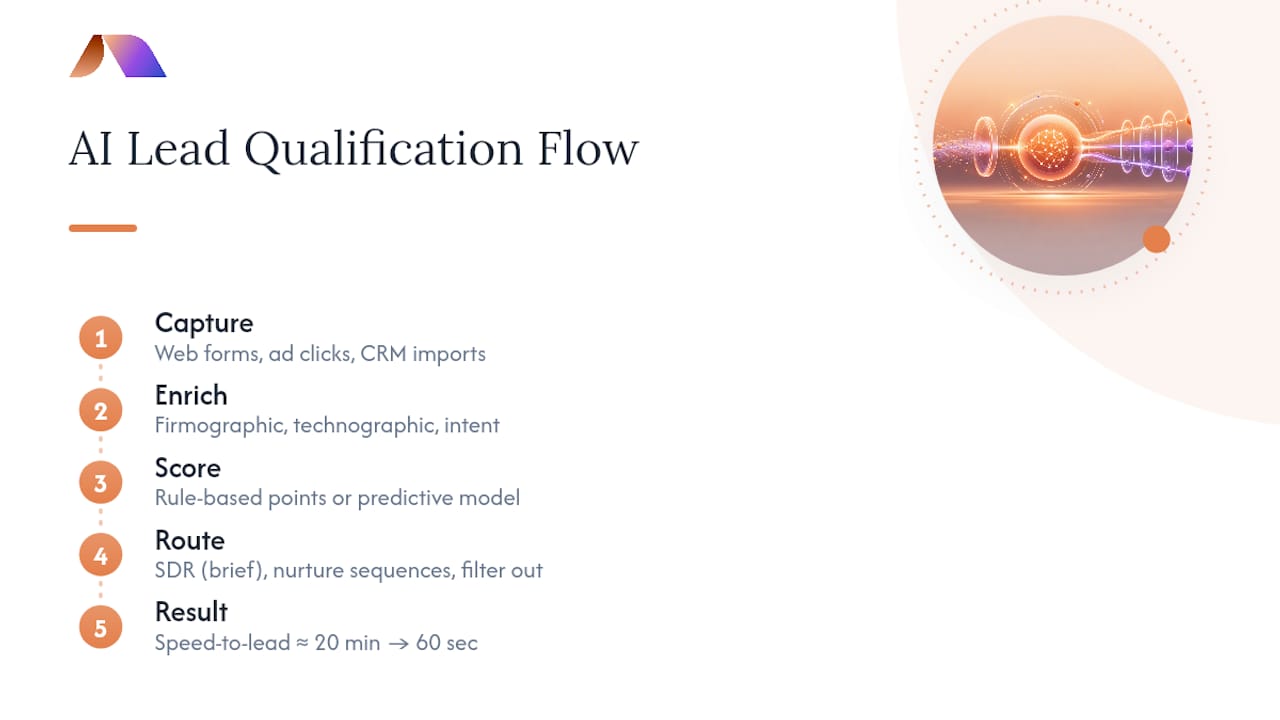
Every automated system starts with capture: web forms, ad clicks, site visitor identification, and CRM imports feed the pipeline. From there, enrichment tools pull firmographic data (industry, headcount, revenue), technographic signals (what software a company already runs), and intent data (content downloads, pricing-page visits) to fill in gaps a form alone never asks about.
Scoring happens two ways. Rule-based systems assign points for attributes (“50+ employees = 10 points”). Predictive models trained on historical conversions output a probability or place leads into bands. ZoomInfo’s automated qualification framework shows this full sequence compressing speed-to-lead from roughly 20 minutes down to about 60 seconds.
Routing logic then applies thresholds: top-band leads go straight to an SDR with a research brief and suggested next steps, mid-band leads enter nurture sequences, and low-band leads get filtered out entirely. The handoff payload matters as much as the score itself.
What Are the Benefits of Automating Lead Qualification with AI?
The biggest win is speed-to-lead. A prospect who fills out a form and gets contacted within a minute behaves differently than one who waits half a day. Momentive’s implementation, cited in ZoomInfo’s breakdown of automated lead qualification, cut that gap from 20 minutes to roughly 60 seconds by automating enrichment and scoring in one pass.
Consistency is the second gain. Two reps reviewing the same lead by hand will rank it differently depending on mood, workload, or how their last call went. A model applies the same criteria every time.
Statistic Callout: Automated pipelines that combine enrichment with real-time scoring can turn a lengthy manual qualification task into a decision made in under a minute, according to ZoomInfo.
That reclaimed time lets SDRs spend more of their day on outreach that actually converts, rather than triage.
How Do You Choose the Right Lead Scoring Framework?
Before picking a model, define what “qualified” actually means for your business. That starts with an ideal customer profile built from firmographic traits (industry, size, revenue band) and, ideally, technographic overlap with your current customer base. A vague ICP produces a vague score, no matter how sophisticated the model behind it.
Fit signals (who the company is) and intent signals (what they’re doing right now) need to work together. A perfect-fit account that never visits your pricing page is a different lead than a mid-fit account requesting a demo. Most mature scoring approaches, similar to BANT, CHAMP, or MEDDIC, blend both categories rather than picking one.

Model choice should match your data volume. Kissmetrics’ guidance on AI lead scoring recommends logistic regression or simple rules when you have a few hundred historical conversions, and tree-based models like XGBoost once you’re working with thousands. Deep sequence models need tens of thousands of examples to earn their complexity.
Set thresholds based on what your sales team can actually handle, not round numbers that look tidy on a dashboard.
Implementation Checklist: From Pilot to Production
Running an AI lead qualification pilot works best as a contained experiment before you touch the whole funnel.
Run an ICP workshop. Get sales and marketing in the same room to agree on firmographic and behavioral criteria for a qualified lead.
Audit your data. Identify missing fields in your CRM before you build any scoring logic around them.
Pick one funnel segment. Choose your highest-volume lead source (usually inbound forms) to pilot against, rather than trying to score everything at once.
Wire up enrichment. Connect a provider or waterfall enrichment setup, as Clay describes in its lead qualification guidance, so missing fields get filled automatically.
Build a minimal scoring model or template. Start with a rule-based system or a vendor template rather than a custom model on day one.
Map CRM fields and set routing triggers. Decide where the score lives and what action fires at each threshold.
Track pilot success criteria. Measure conversion lift on the top band, false-positive rate, and SDR feedback on lead quality.
Plan your scale path. Set a retraining cadence and monitoring routine before you expand beyond the pilot segment.
Pro Tip: Run your pilot on the funnel segment with the most historical data, not the one that feels most urgent. A model trained on 50 conversions will mislead you faster than no model at all.
Where Should Lead Scores Live in Your Tech Stack?
Scores can live directly in CRM contact fields or in a separate scoring layer that syncs back periodically. CRM fields are simpler for reps to see, but a separate score store gives you more flexibility to retrain without disrupting live records.
Latency matters more than most teams expect. Waterfall enrichment, querying multiple data providers in sequence until a field fills, keeps near-real-time scoring accurate without waiting on a single slow source. Audit logs should capture what data fed each score, and the best implementations surface that context back to reps as a short research brief with talking points, something Swan’s AI agent workflows do by design rather than as an afterthought.
All-in-one platforms simplify integration but limit customization. Best-of-breed stacks require more API work but let you swap enrichment or scoring vendors independently.
What Governance Do You Need to Prevent AI Qualification Failures?
Automated scoring still needs human approval for exceptions and enterprise-level routing decisions. Soberan’s implementation guidance recommends keeping enterprise routing human-reviewed even after routine qualification is automated.
Four failure modes show up repeatedly in production systems, according to ZoomInfo’s automated lead qualification framework:
Data quality dependency: a model is only as good as the enrichment feeding it.
ICP drift: your ideal customer changes and nobody updates the scoring criteria.
The speed trap: routing leads so fast that quality checks get skipped entirely.
Compliance exposure: enrichment and scoring that runs afoul of CCPA or GDPR consent rules.
Audit trails, restricted read access to sensitive fields, and manual review bands for borderline scores catch most of these before they become expensive.
How Do You Measure Success and Keep Models Calibrated?
Three metrics matter most: lift of your top scoring band against a random baseline, the MQL to SQL to closed-won conversion rate, and speed-to-contact after a lead enters the system. Set your thresholds based on sales capacity, then measure cohort lift every month rather than assuming a model set once stays accurate.
Feed closed-won and closed-lost outcomes back into the model as labeled training data. ZoomInfo’s guidance on automated qualification treats this feedback loop as the core operational control against model staleness. Watch for a sudden drop in lift or a shift in score distribution. Either one usually means your ICP moved or your data source changed upstream.
How BRDGIT Helps Teams Adopt AI Lead Qualification
An AI readiness assessment exists to answer one question before you spend a dollar building anything: is your data, your CRM, and your team actually ready for automated scoring? An AI readiness assessment maps your current funnel, data gaps, and integration points so the decision to build isn’t a guess.
From there, an AI blueprint lays out the roadmap, and a pilot, whether that’s a custom scoring agent, CRM wiring, or a retraining plan, gets built through custom agent build or workflow crew engagements. Teams that need ongoing technical execution without a full-time hire lean on fractional engineers to run and refine the system after launch.
What Do Successful AI Lead Qualification Rollouts Look Like Across Industries?
A distribution company with a high-volume RFQ funnel is a different problem than a legal services firm fielding a few dozen consultation requests a month, and the scoring approach should reflect that gap.
In manufacturing and distribution, lead volume is usually the bottleneck. Inbound RFQs and quote requests arrive faster than a sales team can triage manually, so the highest-value automation is enrichment plus a rule-based scoring layer that filters by order size, industry fit, and geographic service area before a rep ever opens the record. The win here is almost entirely about speed and volume, not model sophistication.
Staffing and B2B services firms tend to face the opposite problem: sparse, inconsistent lead data. A request submitted through a contact form might list a company name and nothing else. These teams get more value from waterfall enrichment, filling gaps from multiple data providers in sequence, than from a complex predictive model, because a sophisticated score built on incomplete inputs is worse than a simple one built on complete data.
Construction and hospitality businesses often deal with seasonal demand spikes where lead quality shifts by time of year. A scoring model trained on off-season data will misjudge peak-season inquiries unless it’s retrained on a schedule that matches the business cycle, not a generic quarterly calendar.
Legal services firms carry the tightest compliance constraints, since intake often touches personally identifiable information. These teams need the strictest audit trails and the most conservative automation, favoring rule-based transparency over black-box scoring even when a predictive model would technically perform better.
The pattern across all four: the right AI lead scoring setup depends on your funnel’s volume, data completeness, and compliance exposure, not on choosing the most advanced model available.
How Do Leading AI Lead Qualification Tools and Platforms Compare?
Vendors in this space generally fall into three categories, and knowing which one you’re evaluating matters more than any feature checklist.
Built-in CRM scoring tools live inside platforms you may already use. HubSpot’s AI lead scoring workflow is a good example: it evaluates recent lifecycle changes, takes up to an hour to train an initial score, and gives users controls to edit criteria and monitor progress. The advantage is low friction since there’s no new integration to manage. The tradeoff is limited customization if your ICP doesn’t map cleanly to the platform’s default scoring logic.
Enrichment-first platforms treat scoring as secondary to data quality. Clay’s approach to lead qualification centers on waterfall enrichment, pulling from multiple providers until every field is filled, then layering scoring templates on top. This category suits teams whose biggest problem is sparse or missing data rather than scoring sophistication.
Agent-based qualification tools go further than scoring alone. Swan’s AI agent model enriches a lead, evaluates it against plain-English ICP criteria, and returns a research brief with recommended talking points, approximating what a senior rep would do without filing an engineering ticket for every rule change.
Choosing between them comes down to what’s actually broken in your funnel. If your CRM data is solid but scoring is inconsistent, a built-in tool solves it fastest. If your data is incomplete before it ever reaches scoring, an enrichment-first platform fixes the real bottleneck. If your team needs context and reasoning delivered alongside a score, agent-based tools close that gap. No single category is right by default. For teams unsure which category fits, BRDGIT’s approach to scaling AI agents walks through matching tool complexity to actual operational need rather than defaulting to the most feature-rich option.
How Do You Handle Unstructured or Sparse Lead Data?
Most lead qualification problems aren’t model problems. They’re data problems wearing a model-shaped disguise. A form that captures only a name and email gives a scoring system almost nothing to work with, and no amount of algorithmic sophistication compensates for that gap.
Waterfall enrichment is the most reliable fix. Rather than relying on one data provider, the system queries multiple sources in sequence, moving to the next only if a field remains empty, an approach Clay’s lead qualification framework treats as standard practice for minimizing missing signals in real-time scoring.
Unstructured data, free-text form fields, chat transcripts, call notes, presents a separate challenge because it doesn’t map cleanly to a firmographic field. Text extraction models can pull structured signals (company size mentioned in a chat, urgency language in a form submission) out of that noise, but the extraction step needs its own validation before feeding a scoring model. Feeding raw unstructured text directly into a scoring pipeline without cleaning it first is a common way teams end up with scores nobody trusts.
Sparse historical data creates a different problem for predictive models specifically. If you only have a few hundred closed-won and closed-lost records, Kissmetrics’ modeling guidance recommends starting with logistic regression or transparent rules rather than a tree-based model that needs thousands of examples to generalize well. Forcing a data-hungry model onto a small dataset produces scores that look confident and mean very little.
The practical sequence is enrichment first, extraction second, modeling third. Skipping straight to modeling on incomplete data is the single most common reason pilots underperform.
What Are the Best Practices for Data Privacy in AI Lead Qualification?
Enrichment pulls data from third-party providers, public records, and behavioral tracking, which means privacy compliance isn’t optional infrastructure. It’s the foundation the whole system sits on.
CCPA and GDPR both restrict how personal data can be collected, stored, and used for scoring purposes, and ZoomInfo’s framework for automated qualification lists compliance exposure as one of the four recurring failure modes in production systems. Consent tracking needs to happen at the point of capture, not retrofitted after a lead is already enriched and scored.
Read-access restrictions matter as much as collection policies. Not every person on a sales team needs visibility into every enrichment field pulled for a lead, particularly in industries like legal services or staffing where intake data can include sensitive personal details. Limiting who can see what, and logging every access, keeps a system defensible if a regulator or a customer ever asks how a score was generated.

Explainability is itself a privacy and trust safeguard. A model that can’t explain why it scored a lead a certain way is harder to audit for bias or improper data use. Interpretable models, logistic regression or transparent rule sets over black-box deep learning, make it possible to answer “why did this lead get this score” in plain language, which matters both for compliance reviews and for sales leaders who simply want to trust the system they’re using.
The ethical baseline is straightforward: collect only what you need, document where every signal came from, and keep a human able to override a score whenever the reasoning doesn’t hold up.
Author Perspective: Practical Priorities for RevOps and Sales Leaders
The mistake we see most often isn’t choosing the wrong model. It’s treating AI qualification as a replacement for SDR judgment instead of an augmentation of it. The teams that get real lift keep a feedback loop where reps flag misfires and that data retrains the model, not a black box nobody questions.
Start with one funnel segment, measure lift honestly, and only scale once governance keeps pace with automation. Somebody in the organization has to own the model’s accuracy the way a sales manager owns quota. Without that ownership, drift wins.
— Team BRDGIT
Ready to Pilot AI Lead Qualification? Here’s the Faster Path
An alternative to guessing your way through a vendor trial is to start with an AI readiness assessment that tells you exactly where your data and CRM stand before a single dollar goes into building anything.

From there, the roadmap is built with an AI blueprint, a pilot is stood up through workflow crew or custom agent build, and the scoring logic is wired into your existing CRM without forcing a platform migration. Teams that hit a technical ceiling after launch, retraining schedules, drift monitoring, new integrations, don’t need to hire a full-time data scientist. BRDGIT’s fractional engineer services give you experienced AI engineering support sized to what your pilot actually needs, not what a vendor wants to sell you.
If your funnel is drowning reps in unqualified leads right now, the next step is straightforward: start with a readiness assessment and find out what a working pilot would actually look like for your team.
Sources
FAQ
What Is a Qualified Lead?
A qualified lead is a prospect that matches your ideal customer profile on fit criteria (industry, company size, budget) and shows enough intent (demo requests, pricing page visits) to justify sales attention. Frameworks like BANT, CHAMP, and MEDDIC define this slightly differently, but all combine fit and readiness signals rather than relying on either alone.
Who Counts as a Sales-Qualified Lead?
A sales-qualified lead has passed both marketing’s fit criteria and shown behavioral signals strong enough that a sales rep, not just a marketing system, has validated it as worth pursuing. In AI-driven pipelines, this usually means the lead scored above a threshold set by sales capacity and got routed with a research brief attached, an output Swan’s agent-based qualification model is built to generate automatically.
Can ChatGPT Generate Leads?
ChatGPT and similar general-purpose AI tools can help draft outreach copy or answer prospect questions, but they aren’t built to enrich, score, or route leads on their own. Purpose-built lead qualification systems combine enrichment data, scoring models, and CRM routing logic, a workflow general chat tools don’t natively perform.
What Is the Best AI Tool for Lead Generation?
There’s no single best tool. It depends on whether your bottleneck is scoring consistency, data completeness, or rep context. Built-in CRM tools like HubSpot’s AI scoring suit teams with clean existing data, enrichment-first platforms like Clay suit teams with sparse data, and agent-based tools like Swan suit teams that want context delivered alongside a score.
How Much Does BRDGIT’s AI Readiness Assessment Cost?
Pricing for BRDGIT’s AI Readiness Assessment and related services is available directly through BRDGIT’s site, since costs depend on the scope of the funnel and systems being assessed.



