Published on
Role of AI in Contractor Engagement: Faster Bids, Safer Work
AI now automates the administrative load that used to eat contractor hours: sorting inbound leads, drafting first-pass estimates, scanning contracts for risky clauses, and tracking subcontractor compliance. The verdict is simple. Machine learning and document AI handle the repetitive work, while people keep authority over anything with legal, financial, or safety consequences. Contractors who deploy it well see the payoff in specific places.
Estimating hours cut through faster takeoffs and standardized cost assemblies
Fewer compliance gaps from automated license and insurance checks
More qualified leads booked without a person answering every call
Tighter subcontractor coordination through automatic follow-ups and ETA tracking
The sections ahead walk through how the technology actually works, where contractors are seeing results today, how to run a low-risk pilot, and the governance rules that keep AI from becoming a liability instead of an asset.
Key Takeaways
The role of AI in contractor engagement comes down to automating repetitive coordination work while keeping humans accountable for every decision that carries legal, financial, or safety weight.
Point | Details |
|---|---|
Start with lead intake | Automating call and chat qualification delivers the fastest, lowest-risk ROI for most contractors. |
Keep humans on judgment calls | Classification, contract sign-off, and liability clauses always need human review, not AI approval. |
Connect systems before scaling | AI tools that don’t integrate with your PM or ERP platform create new silos instead of removing old ones. |
Track four KPIs | Measure lead-to-appointment rate, hours saved, compliance-gap closure, and RFI reduction from day one. |
Audit for bias regularly | Test matching and scoring models across contractor size and background to avoid replicating past patterns. |
Table of Contents
How AI Works in Contractor Engagement
Where AI Delivers Measurable Results for Contractors
Building a Low-Risk AI Pilot for Contractor Engagement
Where AI Engagement Efforts Go Wrong
How BRDGIT Supports Contractor Engagement AI Projects
AI for Lead Intake and Scheduling: The Front Door Advantage
AI Analytics for Contractor Performance Monitoring
Matching Contractors to Jobs Based on Skills and History
Keeping AI Contractor Engagement Fair and Unbiased
AI Tools That Keep Contractor Communication Moving
What Contract Managers Should Prioritize First
Sources
How AI Works in Contractor Engagement
Five technologies do most of the work behind the role of AI in contractor engagement, and each one solves a different bottleneck.
Document NLP reads contracts, RFIs, and emails, then pulls out clauses, deadlines, and obligations without a human retyping them.
Computer vision measures plans and site photos to generate takeoff quantities and flag defects a walkthrough might miss.
Predictive machine learning forecasts costs, schedules, and risk based on patterns from past projects.
Conversational agents answer inbound calls and chats, qualify leads, and book estimate appointments around the clock.
Robotic process automation moves data between systems, so a signed contract updates the project schedule without manual re-entry.
The inputs are the same documents contractors already generate: plan sets, contract templates, email threads, site photos, and sometimes sensor data from equipment. The outputs are what save time: takeoff quantities, flagged high-risk clauses, scheduled site visits, and status updates that used to require a phone call. Construction firms using AI across planning, cost control, and safety monitoring report stronger data consistency when the AI connects directly into their existing project management or ERP system rather than running as a disconnected tool.
Human judgment still has to own final decisions: contract sign-off, worker classification, and any clause that shifts liability. AI drafts and flags. People approve.
Pro Tip: Start by mapping which of your current admin tasks are pure data movement (copying a bid into three systems) versus judgment calls (deciding contract terms). AI should take the first category off your plate immediately; the second stays with your team.
Where AI Delivers Measurable Results for Contractors
The clearest gains show up in five places, and contractors chasing quick wins should look here first.
Estimating and takeoffs benefit the most from AI right now. Vision models measure plan sets and generate quantities in a fraction of the time a manual takeoff requires, while standardized cost assemblies mean two estimators working the same plan land on consistent numbers instead of two different guesses. AI agents that ingest plans and project documents can suggest scopes and flag RFIs worth reviewing before a bid ever goes out, which shortens the preconstruction scoping cycle considerably. None of this replaces the estimator. It replaces the blank-page problem: someone still checks the AI’s numbers against site conditions before the bid ships.
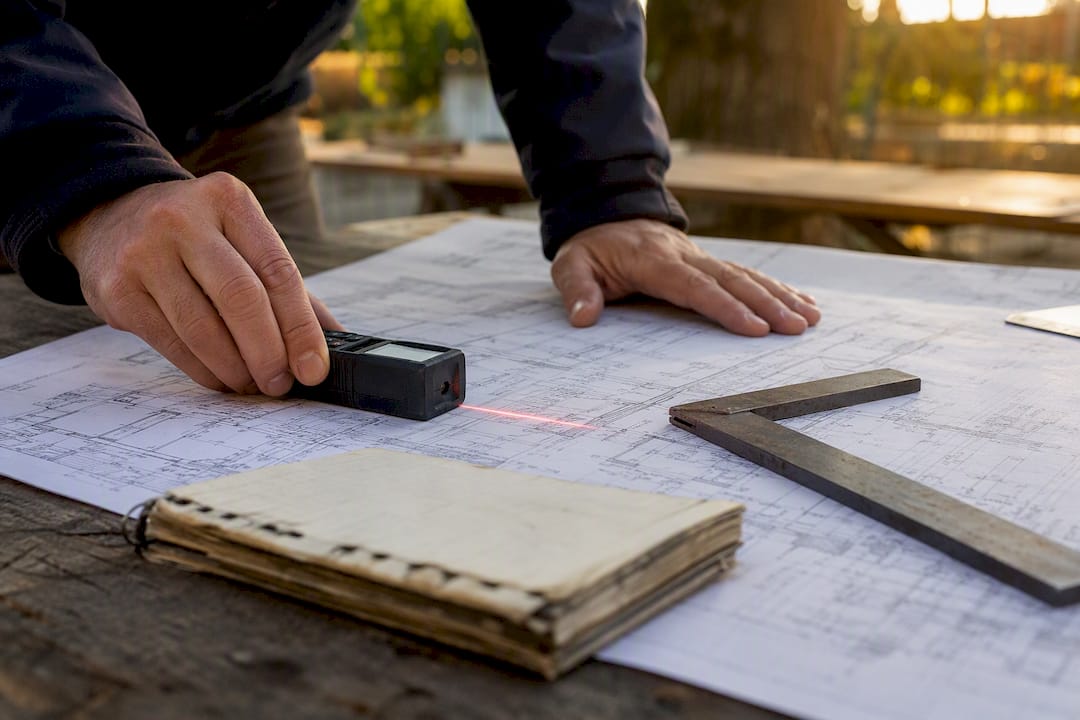
Lead intake and qualification is where AI-powered communication has the fastest payback. A voice or chat agent answers every call, asks the same qualifying questions a front-desk hire would ask, and books the estimate directly onto the calendar. Contractors running this well see contact-to-appointment rates climb because no lead sits in voicemail purgatory overnight. Lead follow-up and estimate automation are consistently cited as among the highest-ROI applications contractors can deploy, mainly because missed calls are pure lost revenue with no offsetting cost.
Onboarding and compliance get faster and more defensible when AI handles certificate of insurance tracking, license verification, and prequalification scoring. Instead of a spreadsheet someone updates when they remember to, the system flags an expired COI automatically and keeps an audit trail showing when each check ran. That audit trail matters more than the speed. When a regulator or an insurer asks why a subcontractor was on-site, “the system flagged the expiration and we followed up” is a much better answer than “we didn’t notice.”
Scheduling and subcontractor coordination improve through automatic follow-ups and ETA tracking. Instead of a project manager calling five subs to confirm tomorrow’s arrival, the system sends reminders, logs confirmations, and escalates only the ones who don’t respond. Dispatch optimization applies the same logic to crew assignments, matching availability against job urgency without a manual whiteboard exercise.
Safety and contract performance monitoring round out the list. Transcribed safety briefings create a searchable record instead of a sign-in sheet nobody reads again. Photo-based defect detection catches issues during routine site photos rather than waiting for a punch-list walkthrough. And clause monitoring can watch a contract for delay provisions or milestone triggers, alerting the project manager before a deadline slips rather than after. Industry reporting on jobsite AI use confirms these applications are already producing measurable engagement gains rather than staying theoretical.
Estimating: faster takeoffs, standardized assemblies, human review before submission
Lead intake: 24/7 qualification and booking, no lost overnight calls
Onboarding: automated COI and license checks with an audit trail
Scheduling: automatic follow-ups and ETA tracking instead of manual check-ins
Safety and QA: transcribed briefings and photo-based defect detection
Building a Low-Risk AI Pilot for Contractor Engagement
Most contractors overcomplicate the first step. The right approach is narrow and measurable.
Pick one high-ROI, low-risk pilot. Lead intake and bid drafting are the two easiest starting points because the downside of a mistake is small and the upside is immediate.
Clean up the data feeding it. Gather past bids, plan PDFs, and contract templates in one place before you connect any AI tool. A model trained on inconsistent or missing data produces inconsistent results.
Connect it to what you already run. An AI tool that doesn’t talk to your project management or ERP platform just creates another silo someone has to check manually.
Define the human checkpoint before launch. Decide exactly who reviews AI output and when, then write it into your standard operating procedures so it survives staff turnover.
Track four numbers. Lead-to-appointment rate, estimate hours saved, compliance-gap closure rate, and RFI reduction tell you within weeks whether the pilot is working.
Pro Tip: Run your pilot for 30 days before expanding it. That window is long enough to see a real pattern in the KPIs and short enough that a bad fit doesn’t cost you a full quarter.
Change management matters as much as the technology. Staff need training on what the tool does and doesn’t decide, and someone on your team needs ownership of monitoring it, not just launching it.
Where AI Engagement Efforts Go Wrong
Adoption is accelerating. A 2026 survey found about 38% of contractors now report measurable business impact from AI, up from 17% the year before, largely through takeoffs, estimating, and administrative drafting. That growth brings real risk alongside the upside.
Classification risk: keep final worker-classification decisions human-reviewed and log the evidence behind each one.
Contract language risk: route any AI-drafted clause affecting liability or contractor control through legal review before it goes out.
Data privacy and security: restrict what training data the AI can see, audit access regularly, and encrypt sensitive files.
Model reliability: version your models, spot-check outputs, and keep a manual fallback process for when the system gets it wrong.
Shadow AI: mandate an approved tool list and train staff on it, because ungoverned personal AI use creates liability nobody signed off on.
Governance frameworks built around human oversight, bias testing, and audit trails are the difference between AI that reduces risk and AI that quietly creates new exposure.
How BRDGIT Supports Contractor Engagement AI Projects
BRDGIT works with construction and contracting teams at exactly this stage: curious about AI, unsure where to start, wary of the risk. Relevant services include:
AI readiness assessments that map where lead intake, estimating, or compliance tracking are costing the most hours
Fractional AI engineers who implement without a full-time hire
Custom workflow automation connecting your existing PM and ERP systems
Staff training so your team trusts and correctly uses whatever gets built
A realistic starting engagement looks like a 30-day lead intake pilot: automate call qualification and appointment booking, measure the appointment rate against your baseline, then decide whether to expand into estimating automation next.
AI for Lead Intake and Scheduling: The Front Door Advantage
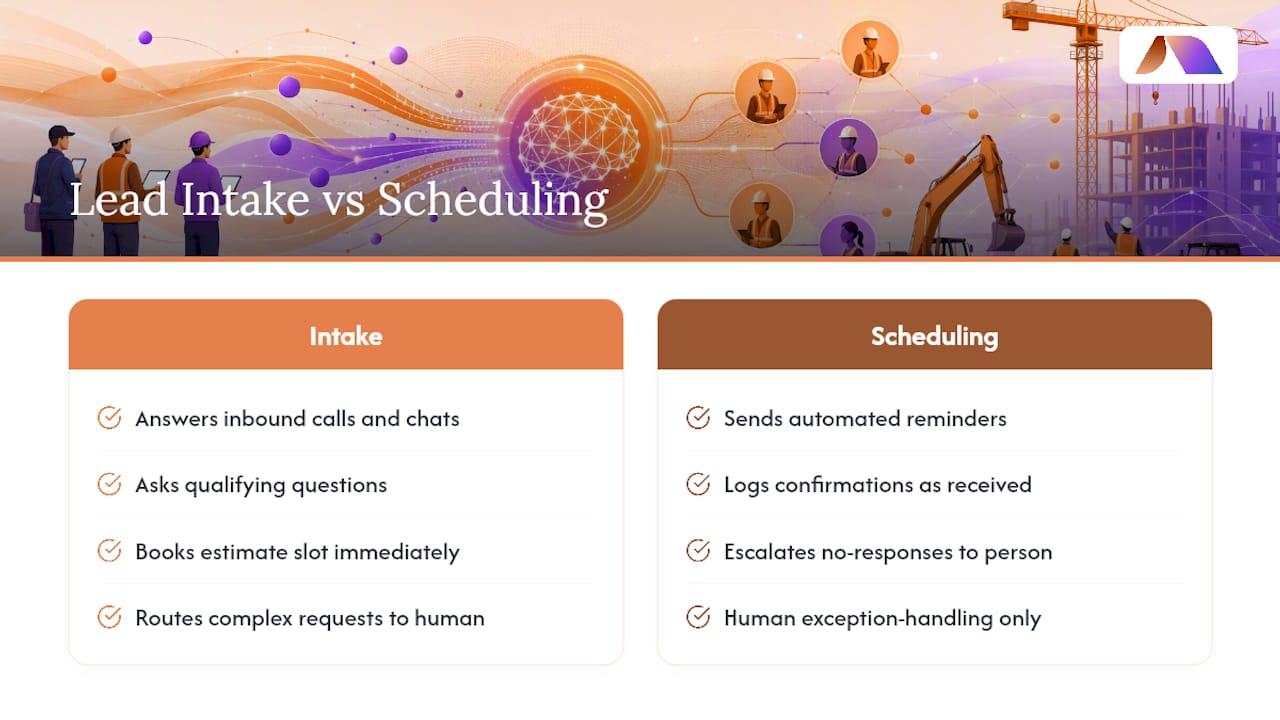
Every missed call is a bid you never got to make. That is the problem AI-powered lead intake solves directly. A conversational agent answers inbound calls or website chats immediately, asks the qualifying questions your office staff would ask (project type, timeline, budget range, service area), and either books an estimate slot or routes the lead to a human when the request is complex.
The scheduling layer works the same way in reverse. Instead of a coordinator calling five subs to confirm a Monday start, the system sends automated reminders, logs confirmations as they come in, and only escalates the no-responses to a person. That single shift, from manual chasing to automated confirmation with human exception-handling, is often where contractors see the fastest return because it touches every job, not just a subset.
The practical benefit compounds. A contractor who books estimates within minutes of an inquiry, instead of a next-day callback, wins more of those jobs simply on responsiveness. Lead follow-up automation is one of the most consistently cited high-ROI applications in contractor AI adoption, precisely because the alternative (a voicemail nobody returns until tomorrow) is pure lost revenue. None of this requires replacing your office staff. It requires giving them a system that never sleeps and never forgets to follow up, while they handle the calls that actually need a human voice.
AI Analytics for Contractor Performance Monitoring
Tracking subcontractor performance used to mean a project manager’s memory and maybe a spreadsheet updated after the fact. AI-driven analytics turn scattered performance signals, punch-list counts, schedule adherence, safety incidents, rework rates, into a running scorecard that updates as the project moves instead of at closeout.
The value is in catching patterns early. A subcontractor whose rework rate creeps up over three jobs is a different conversation than one bad week on a single project, and analytics surface that trend before it becomes a pattern you only notice in hindsight. The same system can flag which crews consistently finish ahead of schedule, information worth feeding back into your next bid.
Feedback works both directions. Contractors who share performance data with subcontractors, not just track it internally, tend to see faster course correction, because a sub who knows exactly which metric is slipping can fix it before the next review instead of guessing. Structuring that feedback loop into contract renewal and prequalification decisions turns a passive dashboard into an active management tool.
Matching Contractors to Jobs Based on Skills and History
Assigning the right subcontractor to the right job has traditionally relied on whoever the project manager remembers had a good experience last time. AI-based matching replaces memory with a searchable record: skills, certifications, past project types, on-time completion rates, and safety history, cross-referenced against what the current job actually needs.
This matters most at scale. A general contractor running two projects can track subcontractor fit informally. One running twenty projects across multiple regions cannot, and that’s exactly where matching algorithms earn their keep, surfacing the three qualified subs who’ve done this specific type of work well before, instead of defaulting to whoever answered the phone first.
The prequalification data that feeds a matching system, licenses, insurance, past performance scores, is the same data your compliance workflow already needs to track. Connecting the two means a sub who falls out of compliance automatically drops out of the matching pool until the issue is resolved, closing a gap that manual processes routinely miss.
Keeping AI Contractor Engagement Fair and Unbiased
An algorithm trained on historical award data will replicate whatever bias lives in that history. If certain subcontractors were consistently overlooked for reasons that had nothing to do with quality, a matching or scoring system trained on that pattern will keep overlooking them, just faster and with a veneer of objectivity that makes the bias harder to spot.
The mitigation isn’t complicated, but it does require deliberate effort. Audit the training data for what it actually reflects before trusting it to make recommendations. Test scoring models across different contractor sizes, ownership backgrounds, and regions to confirm the outputs aren’t systematically favoring one group. And keep a human in the review loop for any decision that affects who gets work, not as a rubber stamp, but as an actual check against what the model recommends.
Transparency helps too. A subcontractor who gets consistently passed over deserves to know why, and a system that can explain its scoring in plain terms (missed two deadlines last year, insurance lapsed for six weeks) is far more defensible than one that just outputs a number nobody can trace. Bias testing and audit trails aren’t optional governance overhead here. They’re what keeps an efficiency tool from becoming a liability that quietly locks out qualified contractors for reasons no one can justify.
AI Tools That Keep Contractor Communication Moving
Ongoing collaboration is where a lot of contractor relationships quietly break down: a question sits in someone’s inbox for three days, a schedule change doesn’t reach every affected sub, a safety update gets mentioned once in a meeting and never again. AI-powered communication tools close those gaps by making updates automatic instead of dependent on someone remembering to send them.
Practitioners increasingly describe this layer of AI as a digital office manager that handles routine coordination so skilled crews and project managers can spend their time on decisions that actually need judgment. A schedule change triggers automatic notifications to every affected subcontractor. A transcribed site briefing becomes a searchable record instead of a memory nobody can quite recall three weeks later. A status question gets answered by a chatbot pulling directly from the project’s current data instead of waiting for someone to check.
None of this replaces a phone call when a real problem needs a real conversation. It removes the routine traffic, status checks, reminders, document requests, that used to consume the same channels, so the calls that do happen are the ones that actually need a human on the line.
What Contract Managers Should Prioritize First
The research here supports a narrower conclusion than most vendor pitches suggest. AI doesn’t transform contractor engagement by doing everything at once. It transforms it when a contract manager picks the two or three tasks that are pure administrative drag, lead intake and estimating draw the strongest evidence, and automates those first, deliberately, with a human checkpoint built in from day one.
The conventional advice oversells scope and undersells governance. Plenty of guidance frames AI adoption as an all-at-once operational overhaul. That’s backwards. The contractors seeing real gains started with one workflow, measured it against real numbers, and expanded only after the pilot proved out. Meanwhile the governance conversation gets treated as a compliance afterthought when it should be a prerequisite. Classification risk and biased matching don’t show up until an audit or a lawsuit forces the issue.
If you’re evaluating where to start, don’t ask “what can AI do.” Ask “which task costs us the most hours with the least judgment required.” That’s your pilot. Everything else comes after you’ve proven it works and built the oversight to trust it.
Sources
AI adoption among small contractors — The Philadelphia Inquirer
AI and compliance: What companies need to know when using AI to manage contractors — TalentDesk