
Published on
Why Construction Needs AI Workflows: A 2026 Guide
TL;DR:
Construction productivity remains low due to outdated processes and limited digitization worldwide. AI workflows automate repetitive tasks, improve project coordination, and free human experts for higher-value work. Successful adoption depends on system integration, strategic planning, and focusing on high-frequency, document-heavy tasks.
Construction productivity is the industry’s most stubborn problem. While digitized sectors grow at 1.5% annually, construction output remains flat to negative, making it the second least digitized major industry in the global economy. Understanding why construction needs AI workflows is not a theoretical exercise. It is a survival question. AI workflows automate the repetitive, document-heavy tasks that consume project teams, and they integrate scattered project data into decisions that actually move work forward. The technology augments human expertise. It does not replace it.
Why construction needs AI workflows: the productivity gap is real
Construction’s productivity problem is structural, not cyclical. The industry runs on fragmented data, manual coordination, and paper-heavy processes that have not changed fundamentally in decades. AI workflows address this directly by automating repetitive tasks and coordinating project data across design, estimation, and execution stages. That coordination is where most project value gets lost.
The benefits of AI in construction show up fastest in document-heavy workflows. Bid leveling, submittal reviews, RFI drafting, and drawing discrepancy detection are all tasks that consume hours of skilled labor per week on a typical project. AI handles the first pass on each of these, freeing estimators and project managers to focus on judgment calls that actually require their expertise.
Bid leveling: AI reads subcontractor proposals and flags scope gaps, unit price anomalies, and missing line items before a human reviewer touches the document.
Submittal reviews: AI cross-references submittals against specifications and highlights deviations, reducing review cycles from days to hours.
RFI drafting: AI reads the project drawings and specs, drafts the RFI, and cites the relevant contract sections automatically.
Drawing discrepancy detection: AI compares drawing sets across disciplines and surfaces conflicts before they become field problems.
On projects ranging from $5M to $500M, these gains compound quickly. A single avoided RFI cycle or a caught bid error can represent tens of thousands of dollars in recovered margin.
Pro Tip: Start with the workflow your team complains about most. If submittal reviews are eating your PMs’ evenings, that is your first AI pilot. High frustration usually signals high frequency, and high frequency is where AI pays for itself fastest.
What challenges in construction workflows does AI address best?
The coordination breakdown is the most expensive problem in construction. Delays and cost overruns trace back, in most cases, to information that existed somewhere in the project data but never reached the person who needed it in time. AI workflows surface that information before it becomes a crisis.
Survey data from late 2025 shows that 80% of commercial contractors see AI as essential for competitiveness within three years, and 81% feel confident adopting it. That confidence reflects a real shift in how the industry understands the technology. AI is no longer a speculative investment. It is a coordination tool.
The specific challenges AI addresses best fall into four categories:
Productivity gaps from low digitization. Construction’s historic resistance to digital tools means most project data lives in PDFs, emails, and spreadsheets. AI reads those formats natively and extracts structured information without requiring a data migration project first.
Coordination breakdowns between trades and disciplines. AI identifies conflicts in schedules, drawings, and scopes before they reach the field, where fixing them costs ten times more.
Skilled labor shortages and knowledge loss. When an experienced superintendent or estimator leaves, their institutional knowledge walks out with them. AI workflows capture and codify that knowledge in the systems they used daily.
Hidden risks in permitting and supply chains. AI extends a project manager’s field of view to flag permitting delays, long-lead material constraints, and subcontractor capacity issues that would otherwise surface too late to act on.
The impact of AI on construction is most visible in risk management. Teams that use AI to audit change orders and monitor procurement timelines catch problems weeks earlier than teams relying on manual review.
How does integrating AI with existing construction systems improve outcomes?
AI effectiveness depends entirely on what data it can access. A standalone AI tool that operates outside your BIM model, your project information system, and your document repository will underperform. Integrated AI workflows that share data across bidding, procurement, and change order review are what deliver measurable ROI.

The AI-as-coworker model is the right mental frame here. Think of AI not as a separate system you query, but as a team member who has read every document on the project and can draft, flag, and summarize on demand. That capability only exists when AI is embedded in the same data environment your team already uses.
Integration approach | What it enables | Risk if skipped |
|---|---|---|
AI connected to BIM | Clash detection, quantity takeoff validation, scope gap analysis | Field conflicts caught late, costly rework |
AI connected to project information system | RFI drafting, submittal tracking, schedule risk alerts | Manual coordination delays, missed deadlines |
AI connected to document repository | Bid leveling, CO auditing, spec compliance checks | Errors in procurement, undetected scope creep |
Siloed AI point tool | Limited single-task output | Low adoption, no compounding value |
The AI estimating tools that deliver the clearest ROI are the ones embedded in the estimating workflow, not bolted on afterward. The same principle applies across every construction workflow category.
Pro Tip: Before selecting any AI tool, map the data it needs to do its job. If that data lives in three different systems with no API connection, the tool will underperform regardless of how good the demo looked.
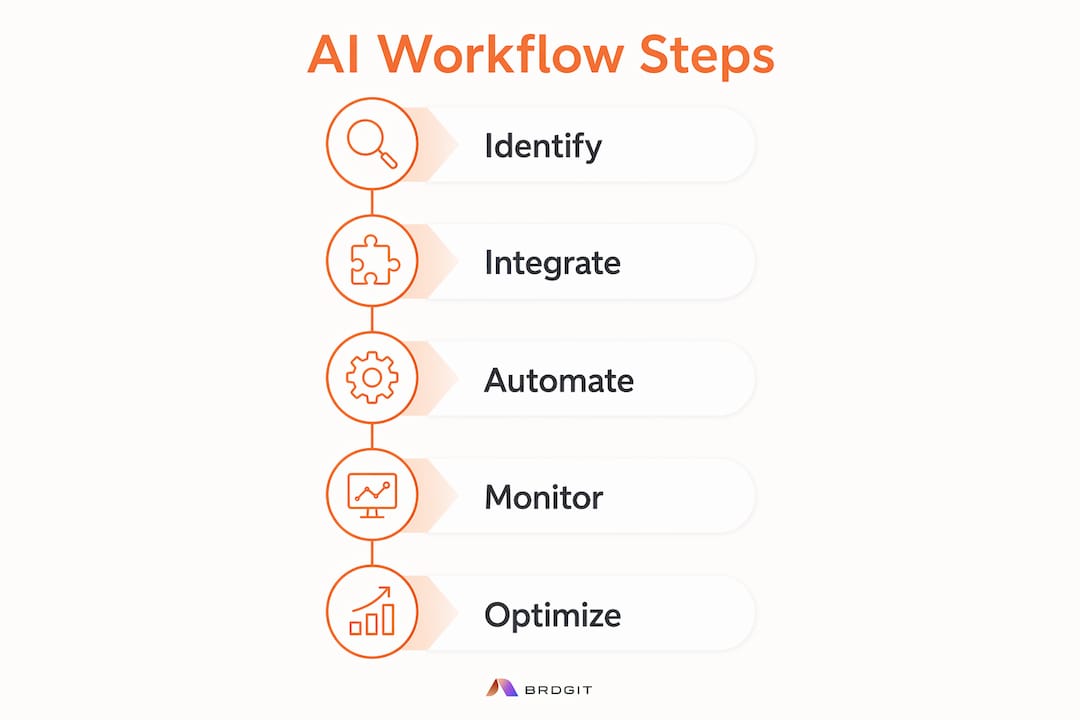
What practical steps can construction teams take to adopt AI workflows?
Adoption fails most often not because the technology is wrong, but because the implementation ignored the human side. Workforce upskilling and workflow redesign are as important as the software selection itself.
Prioritize high-ROI workflows first. Bid leveling, RFI drafting, and submittal review offer the clearest return and the fastest proof of value. Start there before expanding.
Secure executive sponsorship. AI adoption without leadership commitment stalls at the pilot stage. A named executive owner keeps resources and attention aligned.
Identify workflow champions on the ground. The PM or estimator who sees the value early becomes the internal advocate who converts skeptics.
Avoid standalone point apps. A tool that only does one thing in isolation adds another system to manage without adding compounding value. Prioritize productivity with AI through integrated platforms.
Plan for resistance explicitly. The replacement myth is the biggest adoption barrier. Address it directly in team conversations. AI is a capability multiplier, not a headcount reducer.
Require citation transparency. Any AI output that informs a decision should cite its source within the project data. This keeps humans in the loop and builds trust in the system over time.
Protect your data. Understand where your project data goes when it enters an AI system. Vendor contracts should specify data residency, retention, and access controls before you sign.
Automating construction processes works best when the team understands what the AI is doing and why. Black-box outputs create liability. Transparent, cited outputs create confidence.
Key Takeaways
AI workflows in construction deliver the most value when they are integrated into existing project data systems and focused on high-frequency, document-heavy tasks like bid leveling, RFI drafting, and submittal review.
Point | Details |
|---|---|
Productivity gap is structural | Construction lags digitized sectors by 1.5% annually; AI workflows directly address this deficit. |
Integration determines ROI | AI connected to BIM and project information systems outperforms siloed point tools every time. |
High-frequency workflows first | Bid leveling, RFI drafting, and CO auditing offer the fastest, clearest return on AI investment. |
Adoption requires human strategy | Executive sponsorship, workflow champions, and upskilling matter as much as the technology itself. |
AI augments, it does not replace | The capability multiplier framing drives adoption; the replacement myth kills it. |
The uncomfortable truth about AI in construction
We talk to a lot of construction teams at BRDGIT. The ones who struggle with AI adoption share a common pattern. They bought a tool, ran a demo, and handed it to a project manager who already had too much on their plate. Six months later, the tool is unused and the conclusion is that “AI doesn’t work for construction.”
That conclusion is wrong, but it is understandable. AI does not forgive organizational ignorance. If your data is fragmented, your workflows are undefined, and your team has no reason to trust the output, the technology will fail regardless of how capable it is. The teams we see succeed treat AI adoption as work redesign, not software procurement. They ask what the workflow should look like with AI in it, then build toward that.
The other thing worth saying plainly: the fear that AI will eliminate construction jobs is not supported by what we observe. What AI eliminates is the low-value, high-frustration work that burns out good people. The estimator who used to spend three hours leveling bids now spends that time on scope analysis and subcontractor relationships. That is a better job, not a lost one.
— Team BRDGIT
How BRDGIT helps construction teams move from curiosity to execution
Construction professionals who want to move past the pilot stage need more than a tool. They need a path from AI readiness to real execution, with support that fits how construction teams actually work.
BRDGIT provides fractional AI expertise built for teams that cannot justify a full-time AI hire but need more than a vendor’s onboarding call. From AI workflow implementation to custom system design and team training, BRDGIT works alongside your project managers and estimators to build AI into the workflows where it pays off fastest. The focus is always on document-heavy, judgment-rich processes where your team’s time is most valuable and most wasted. If your team is ready to move from curiosity to execution, BRDGIT is built for exactly that.
FAQ
Why do construction projects need AI workflows specifically?
Construction is the second least digitized major industry, with productivity growth flat to negative while other sectors grow. AI workflows address this by automating document-heavy tasks and integrating project data across bidding, coordination, and execution.
What are the biggest benefits of AI in construction management?
The clearest benefits appear in bid leveling, RFI drafting, submittal review, and change order auditing. These workflows are high-frequency and document-heavy, which is exactly where AI delivers the fastest time savings and error reduction.
Does AI replace construction workers or project managers?
AI functions as a capability multiplier, not a headcount reducer. Industry data confirms that successful AI adoption augments human expertise, allowing teams to focus on high-judgment work rather than manual document processing.
How important is system integration for AI to work in construction?
Integration is the single most important factor in AI performance. AI tools connected to BIM, project information systems, and document repositories consistently outperform standalone point applications in both adoption and measurable ROI.
How should a construction team start implementing AI workflows?
Start with one high-frequency, document-heavy workflow such as bid leveling or submittal review. Secure executive sponsorship, identify a ground-level champion, and require that AI outputs cite their sources within your project data before expanding further.