Published on
How to Improve Upsell Offers with AI: A Practical Playbook
The fastest way to improve upsell offers with AI is to deploy a predictive scoring model that identifies high-probability buyers, then trigger signal-specific, personalized offers at the exact moment a customer is most likely to act. That single move outperforms any rules-based upsell playbook by a meaningful margin, and it is achievable in a focused 6–8 week pilot.
Start here:
Data check: Confirm you have at least 90 days of usage, feature adoption, seat count, and billing history in a queryable warehouse or CRM.
Pick one signal: Choose the highest-intent event in your product (seat limit reached, feature trial started, renewal window opened) as your first trigger.
Build a minimal scorer: Use a lightweight predictive model or a rule-enriched scoring layer to rank customers by upgrade likelihood.
Wire to one touchpoint: Push scores into your email service provider (ESP) or CRM and automate a single personalized offer sequence.
Measure lift: Track upsell conversion rate and average order value (AOV) against a holdout group before expanding.
If your team lacks the data engineering or AI implementation capacity to move quickly, fractional AI engineers can compress that timeline significantly.
Key Takeaways
AI-powered upselling works when predictive scoring, signal-triggered timing, and personalized offers operate together as a system, not as isolated tactics.
Point | Details |
|---|---|
Start with one signal | Pick the highest-intent trigger (renewal window or usage limit) and pilot on that alone before expanding. |
Measure incrementally | Always run a holdout group; direct attribution overstates lift and misleads investment decisions. |
Match channel to ACV | Automate fully for low-ACV; use AI briefings plus human outreach for accounts above $5,000. |
Existing customers convert far more readily | Vendasta cites 60–70% conversion probability for existing customers, making upsell ROI faster than new acquisition. |
BRDGIT delivers fixed-scope pilots | BRDGIT’s fractional AI engineers cover signal audit, model build, integration, and experiment design in 6–8 weeks. |
Table of Contents
How does AI-powered upselling differ from rules-based approaches?
What measurable benefits can you expect from AI for upselling?
Where do AI upsells work best? Key trigger moments
Step-by-step checklist to pilot AI-powered upsells
How do you measure upsell performance accurately?
What privacy and ethical guardrails do AI upsells require?
Common mistakes that kill upsell performance and how to fix them
BRDGIT’s recommended phased roadmap for piloting AI upsells
What does an AI upselling system actually cost?
The adoption trade-offs leaders rarely talk about honestly
BRDGIT can deliver your AI upsell pilot in a fixed-scope engagement
Sources
How does AI-powered upselling differ from rules-based approaches?
Rules-based upselling follows a fixed script: if a customer hits a seat limit, send offer X. It is deterministic, easy to audit, and brittle. AI-powered upselling replaces that fixed script with probabilistic scoring, next-best-offer prediction, timing optimization, and personalization at scale. The model learns which signals actually predict conversion, weights them dynamically, and surfaces the offer most likely to close for each individual customer, not just for a segment.
An AI-driven system scores each of those users by purchase history, plan tenure, support ticket sentiment, and feature engagement, then routes high-probability accounts to a personalized email with a rep briefing, mid-probability accounts to an in-app modal with a one-click upgrade, and low-probability accounts to a nurture sequence. Same trigger, three differentiated responses, materially different conversion outcomes.
Gartner’s research on predictive business-performance metrics has consistently shown that organizations adopting predictive approaches see materially higher profitability than those relying on static reporting. BRDGIT applies that same predictive logic to upsell systems for mid-market and enterprise clients.
What measurable benefits can you expect from AI for upselling?
The ROI case for AI-driven upsell techniques is grounded in three levers: higher conversion rates, larger transaction values, and longer customer relationships. Decision-makers scoping a pilot should set realistic targets against each.
Core benefits include:
Higher upsell conversion rate: Existing customers already trust you. Vendasta’s research cites a 60–70% conversion probability for existing customers versus the single digits typical for new-lead acquisition. AI narrows that pool further to the customers most likely to act now.
Increased AOV: Signal-triggered offers matched to actual usage patterns tend to land at a higher price point because they address a real, felt need rather than a generic upgrade pitch.
Improved customer lifetime value (CLTV): Customers who upgrade to a plan that genuinely fits their usage churn at lower rates, extending the revenue relationship.
Better attach and penetration rates: AI surfaces complementary products or tiers that a customer’s usage pattern predicts they will value, increasing the share of wallet without requiring a sales call.
Reduced churn from better-fit expansions: A poorly timed or irrelevant upsell accelerates churn. A well-timed, personalized one does the opposite.
Predictive models can produce double-digit lifts in conversion and AOV depending on the starting baseline, according to Pecan AI’s product guidance. The actual lift you see depends heavily on data quality and signal selection.
Pro Tip: *To translate a projected conversion lift into near-term revenue, multiply your current monthly upsell volume by the lift percentage, then multiply by your average upsell contract value.
One underappreciated benefit: generative AI tooling, as tracked by Forrester, reduces the time required to produce tailored offer copy and rep briefings. That means your team can run more upsell sequences in parallel without proportionally increasing headcount.
Where do AI upsells work best? Key trigger moments
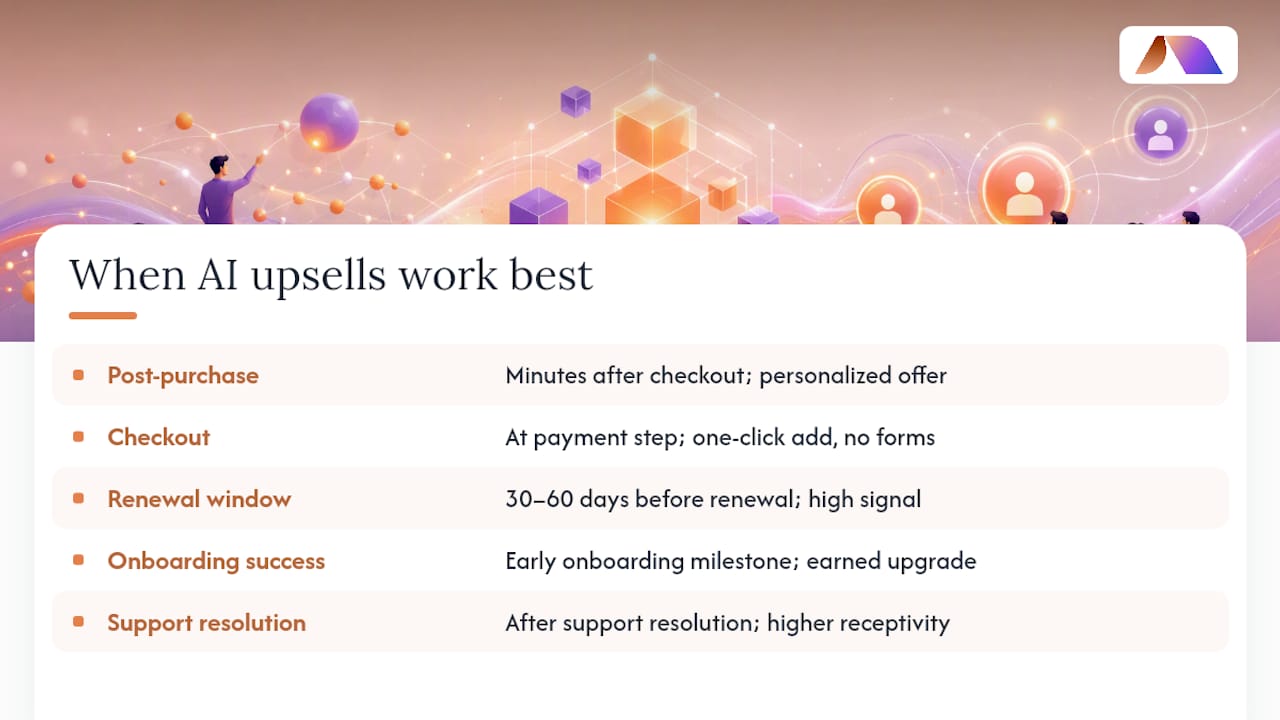
Timing is the variable most teams underestimate. The right offer at the wrong moment is just noise. These are the trigger moments where AI-powered upsells consistently outperform generic campaigns.
Post-purchase: A customer who just completed a transaction is in a buying mindset. An AI-generated complementary offer delivered within minutes of checkout, personalized to what they just bought, captures that momentum before it fades.
Checkout: Predictive models can surface a relevant tier upgrade or add-on at the payment step, where intent is highest. Keep the offer frictionless: one click to add, no new form fields.
Wire your AI scorer to that event and trigger an in-app or email offer immediately.
Renewal window: The 30–60 days before a contract renewal is the highest-leverage upsell window in SaaS and subscription businesses. Usage and renewal signals are among the strongest predictors of successful upsells, making this the first touchpoint most teams should instrument.
Onboarding success: A customer who completes onboarding milestones ahead of schedule is a strong candidate for an early upgrade. AI can detect that pattern and trigger a “you’re ahead of the curve” offer that feels earned, not pushed.
Support resolution: A customer who just had a problem solved is often more receptive than average. A well-timed offer after a positive support interaction can convert at rates that surprise teams who have never tested it.
Pro Tip: Start with either the renewal window or usage-limit trigger. Both have the highest signal quality and the shortest path to measurable lift. Add post-purchase and support-resolution touchpoints in phase two once your scoring model has a feedback loop.
Channel selection matters as much as timing. For low-ACV products (under $500/year), fully automated in-app and email sequences are the right fit. Mid-ACV accounts ($500–$5,000/year) benefit from a hybrid: automated trigger plus a rep notification. High-ACV accounts ($5,000+/year) warrant a rep-led outreach informed by an AI-generated briefing, not a fully automated sequence.
Step-by-step checklist to pilot AI-powered upsells
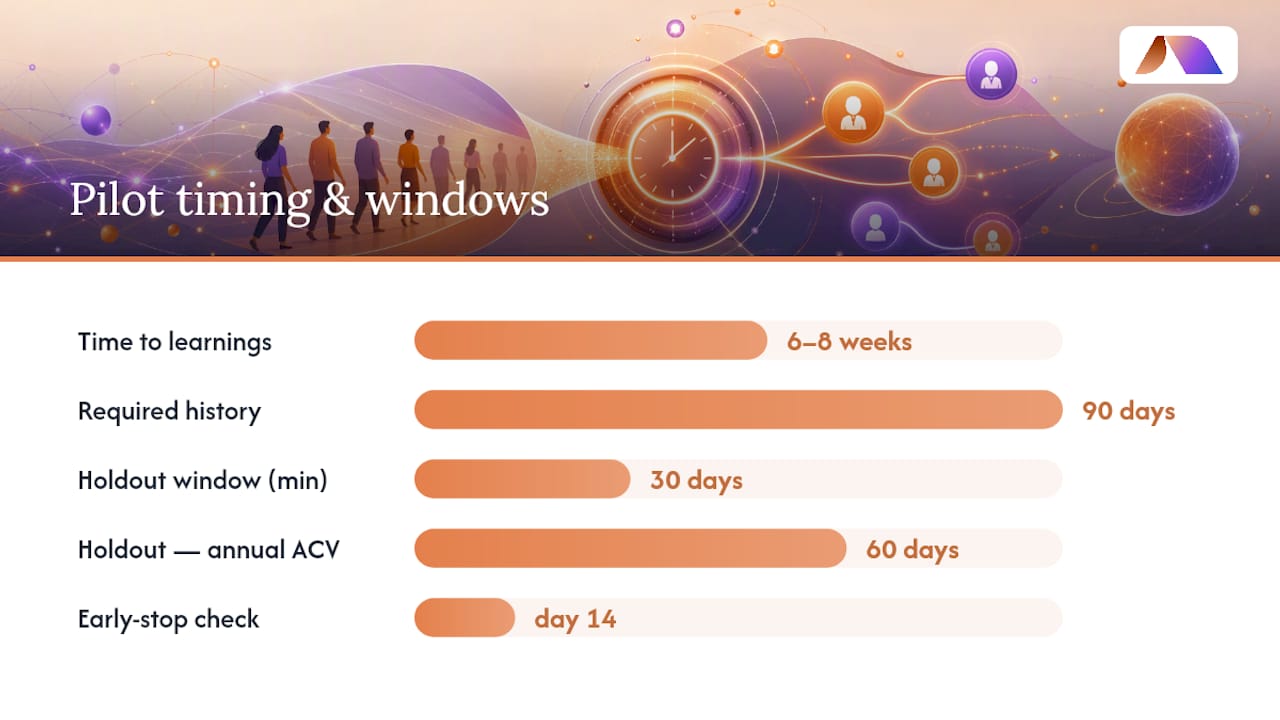
This is the ordered implementation sequence BRDGIT recommends for a first pilot. Hand it to a practitioner and expect 6–8 weeks to first learnings.
Define goals and success metrics. Agree on the primary KPI (upsell conversion rate, AOV lift, or incremental revenue) and a minimum detectable effect size before writing a line of code.
Pick your ACV segment and touchpoint. Choose one customer segment and one trigger event. Scope creep kills pilots.
Run a signal audit. Catalog available data: usage events, feature adoption flags, seat counts, billing history, support ticket sentiment, and NPS scores. Identify gaps.
Prepare your dataset. Clean and label historical upsell outcomes. You need at minimum 90 days of history and enough positive conversion examples to train or validate a scorer.
Choose your predictive approach. Three options: (a) a lightweight propensity scorer using logistic regression or gradient boosting on usage features; (b) a collaborative-filtering recommendation model for next-best-offer; © a contextual LLM offer composer that generates personalized copy from customer context. Start with (a) unless you already have a recommendation layer.
Wire outputs to automation. Push scores or offer recommendations into your CRM, ESP, or in-app messaging platform. Common integration patterns include score fields in Salesforce or HubSpot that trigger campaign automations, or webhook calls from your data warehouse to your ESP.
Design the experiment. Split your eligible population into treatment and holdout groups (80/20 or 70/30). Define holdout windows of at least 30 days. Set early-stopping rules: if conversion in the treatment group is materially below baseline at day 14, pause and diagnose before continuing.
Train reps and set guardrails. For mid- and high-ACV accounts, brief your customer success and account executive teams on how to read AI-generated briefings and when to override the model’s recommendation.
Measure and iterate. Pull conversion, AOV, and incremental revenue data at week 2, week 4, and week 8. Feed conversion outcomes back into the model to improve accuracy over time, as practical build guides confirm.
Experiment design specifics:
Minimum sample size: 200 eligible customers per group for statistical reliability at 80% power.
Holdout window: 30 days minimum; 60 days for annual-contract businesses.
Early-stopping rule: pause if treatment conversion drops more than 20% below the historical baseline at day 14.
Seasonality check: avoid launching a pilot in a period with known demand spikes or drops that would confound results.
Integration targets: CDP or data warehouse (source of truth for signals), CRM (Salesforce, HubSpot) for score storage and rep briefings, ESP (Klaviyo, Marketo, HubSpot) for automated email sequences, in-app messaging (Intercom, Pendo) for product-surface offers, and a checkout API for one-click upgrade flows.
Pro Tip: For high-ACV accounts, never send a fully automated offer without a human review step. The AI briefing tells the rep what to say and when to reach out; the rep decides how. That blend of AI identification and human delivery consistently outperforms pure automation above $5,000 ACV.
Scaling AI agents to handle offer delivery and rep briefing generation is a natural next step once the pilot validates the signal-to-offer logic.
How do you measure upsell performance accurately?
Measurement is where most pilots lose credibility with leadership. Define every KPI before launch, not after.
Core KPI definitions:
Upsell conversion rate: (Number of upsell conversions / Number of upsell offers presented) × 100. Track separately by channel and ACV band.
Attach rate: (Number of customers who purchased an upsell / Total eligible customer base) × 100. Measures penetration across the full opportunity pool.
AOV lift: (Average order value in treatment group / Average order value in control group) - 1. Expressed as a percentage.
Incremental revenue: Revenue attributable to the AI-driven upsell sequence above what the holdout group generated in the same period. This is the number leadership cares about most.
Revenue per user: Total upsell revenue / Total active users. Tracks efficiency of the upsell program over time.
CLTV lift: Compare 12-month projected revenue for customers who upgraded versus matched customers who did not. Requires a longer measurement window.
Time-to-conversion: Median days from offer presentation to purchase. Shorter is better; a spike here often signals friction in the upgrade path.
Attribution guidance: Direct attribution (did the customer who received the offer convert?) overstates impact because some of those customers would have upgraded anyway. Holdout-based incremental attribution is the correct method. Compare conversion rates between your treatment group and your randomly assigned holdout group. The difference is your causal lift.
Watch for selection bias: if your scoring model surfaces customers who were already likely to upgrade, your treatment group will outperform the holdout for reasons unrelated to the offer. Randomize assignment after scoring, not before.
Reporting cadence: Week 1 dashboard should show offer delivery rate, open rate (email), and click-through rate. Month 1 adds conversion rate and AOV. Month 3 adds incremental revenue, attach rate, and early CLTV signals. Gartner’s historical findings on predictive metrics and profitability underscore why tracking these metrics systematically, not just anecdotally, is what separates programs that scale from those that stall.
What privacy and ethical guardrails do AI upsells require?
AI upsell systems process behavioral and transactional data at scale. In the US, that creates real obligations, and ignoring them is an operational risk, not just a legal one.
Minimum guardrails to implement before launch:
Consent and preference respect: Honor existing marketing opt-outs. Do not use data collected for one purpose (support tickets, for example) to drive upsell targeting without a clear basis for doing so.
Data minimization: Use only the signals your model actually needs. Seat count, usage events, and billing history are almost always sufficient. Adding sensitive behavioral data without a clear lift contribution increases risk without proportional reward.
Explainability for sensitive segments: If your model surfaces offers to customers in regulated industries (healthcare, legal, financial services), document why each offer was generated. A black-box model that cannot explain its recommendations creates compliance exposure.
Opt-out mechanisms: Every automated upsell sequence must include a clear, functional opt-out. Customers who opt out of upsell communications should be excluded from future sequences automatically.
Secure data storage: Ensure that customer behavioral data used for scoring is stored with appropriate access controls and retention limits.
US legal context: California’s CPRA gives consumers the right to opt out of the “sharing” of personal information for cross-context behavioral advertising. If your upsell targeting uses third-party data or shares signals across business units, review whether CPRA’s opt-out requirements apply. For most first-party, usage-based upsell systems, the exposure is limited, but consult counsel before using data in ways that go beyond the original collection context.
Practical monitoring: Run regular audits of model outputs to check for patterns that could constitute discriminatory targeting (systematically excluding or over-targeting customers based on demographic proxies). This is not hypothetical; it is a documented failure mode in recommendation systems.
Pro Tip: Before any novel model-suggested offer goes to broad rollout, route it through a human review gate. One person reviewing 20 edge-case recommendations per week catches the outputs that would embarrass the brand or create legal exposure. The cost is trivial; the protection is real.
Common mistakes that kill upsell performance and how to fix them
Most upsell programs underperform not because the AI is wrong, but because the surrounding system is broken. These are the patterns that show up repeatedly.
Common Mistake | Practical Fix |
|---|---|
Generic offers sent to all customers | Segment by usage signal and score; send signal-specific offers only |
Poor timing (batch sends, wrong lifecycle stage) | Replace batch sends with event-triggered sequences tied to real product signals |
Heavy friction in the upgrade path | Implement one-click upgrade flows; remove form fields from the conversion step |
Over-personalization that feels intrusive | Limit personalization to usage and plan data; avoid referencing sensitive behavioral details |
No holdout group | Always run a holdout; without one, you cannot measure true lift |
Model trained once and never retouched | Schedule quarterly retraining; feed conversion outcomes back into the model monthly |
Upsell offers competing with each other | Implement offer suppression logic: one active upsell sequence per customer at a time |
Optimization checklist:
Prioritize the two or three signals with the highest historical correlation to conversion.
A/B test offer creative (headline, value proposition, CTA copy) independently of audience targeting.
Simplify the upgrade path to the fewest possible clicks.
Instrument the full funnel: offer delivery, open, click, upgrade page visit, and conversion.
Retrain your scoring model at least quarterly, or whenever conversion rates shift by more than 10 percentage points.
Pro Tip: When conversion rates drop suddenly, check timing before the model. A change in your product’s notification cadence or a seasonal demand shift will tank conversion faster than model drift. Diagnose the environment before retraining.
For high-ACV accounts showing low conversion despite high scores, escalate to human outreach. The AI identified the opportunity correctly; the channel was wrong. A rep call informed by an AI-generated briefing will close what an automated email cannot.
BRDGIT’s recommended phased roadmap for piloting AI upsells
Team resourcing for each phase:
Data engineer: Builds the signal pipeline from warehouse to scoring layer; critical in weeks 1–4.
Product or growth analyst: Owns experiment design, holdout logic, and KPI reporting.
CRM or automation engineer: Wires model outputs to ESP, CRM, and in-app messaging tools.
Customer success or account executive owner: Reviews AI briefings, handles high-ACV outreach, and provides qualitative feedback on offer relevance.
Fractional AI engineering support: Covers the gaps between these roles, especially model selection, integration architecture, and retraining pipeline design.
Gating criteria for moving from Pilot to Validate: statistically significant conversion lift versus holdout (p < 0.05), positive incremental revenue after model and integration costs, and at least one rep team confirming that AI briefings improved their outreach quality.
BRDGIT’s fractional AI engineers have delivered this exact playbook for clients across manufacturing, B2B services, retail, and SaaS. The fractional model means you get senior implementation capacity without a full-time hire, which is the right structure for a time-boxed pilot.
What does an AI upselling system actually cost?
Cost is the question leadership asks first and implementation teams answer last. Get ahead of it.
Initial investment covers three categories: data infrastructure (connecting your warehouse or CRM to a scoring layer), model development or configuration (building a propensity scorer or configuring a recommendation engine), and integration work (wiring outputs to your ESP, CRM, and in-app tools). For teams using existing cloud infrastructure and a CRM like Salesforce or HubSpot, the integration work is the largest variable. A minimal viable pilot using workflow automation tools your team already has can reduce upfront cost significantly.
Ongoing expenses include model retraining (compute and analyst time, typically quarterly), platform fees for any AI or recommendation tooling you license, and the human review time for high-ACV offer oversight. These costs are generally modest relative to the incremental revenue a well-tuned program generates, but they are real and should be budgeted before the pilot begins.
The honest framing: a pilot scoped to one segment and one touchpoint, using existing infrastructure, is a low-cost proof of concept. The cost scales with ambition, not with the technology itself. Teams that try to build a full multi-touchpoint, multi-model system in the first 90 days consistently overspend and underdeliver. Start narrow, prove the economics, then invest in scale.
Business process automation tooling that already handles renewals, onboarding, and billing workflows can often be extended to carry upsell sequences with minimal incremental cost, which is why a signal audit of your existing automation stack should precede any new tool purchase.
The adoption trade-offs leaders rarely talk about honestly
The conventional wisdom on AI upselling tends to oversell the automation and undersell the organizational work. The technology is the easy part. The hard part is getting your data clean enough to trust, your teams aligned on when to override the model, and your leadership patient enough to let a holdout experiment run without pulling the plug at week two.
There is a real tension between speed and fidelity. A fast pilot using a simple propensity scorer and your existing ESP will produce learnings in 6–8 weeks. A more sophisticated system with a recommendation engine, LLM offer composer, and multi-channel orchestration will take 4–6 months and require more specialized talent. Neither is wrong. The question is whether your organization has the patience and data maturity for the longer path.
On automation versus human touch:
Fully automated sequences are the right call for low-ACV products where the economics of rep involvement do not work.
Hybrid workflows (AI identifies, human closes) are almost always superior for accounts above $5,000 ACV, where relationship context matters and a poorly timed automated offer can damage the account.
For enterprise accounts, the AI’s job is to brief the rep, not replace them.
The leadership signals that indicate genuine readiness to scale: your data team can answer “which customers are most likely to upgrade in the next 30 days” with a defensible answer, your CS and AE teams trust the model’s output enough to act on it without constant manual overrides, and your finance team has agreed on how to measure incremental revenue. Without those three conditions, scaling is premature.
AI does not forgive organizational ignorance. A model trained on bad data, wired to a broken upgrade path, and deployed without rep buy-in will produce worse outcomes than a well-designed rules-based system. The technology amplifies whatever is already true about your upsell process.
BRDGIT can deliver your AI upsell pilot in a fixed-scope engagement
Most teams know they should be using AI to improve upsell performance. The gap is execution capacity: the data engineering, model selection, integration work, and experiment design that turn a good idea into a running system.
BRDGIT’s fractional AI engineers handle exactly that gap. A typical pilot engagement covers signal audit and data preparation, lightweight propensity scorer development, integration into your CRM or ESP, experiment design with a proper holdout, and a results readout with a recommendation for next steps. Engagements run 6–8 weeks, are scoped to a fixed deliverable set, and are designed to produce a measurable lift figure you can take to leadership.
The next step is a discovery call where BRDGIT maps your current data assets, identifies your highest-probability upsell signal, and scopes a pilot that fits your team’s capacity. No long-term contract required to start. Book a discovery call with BRDGIT’s fractional engineers and leave with a pilot scope in hand.
Sources
The sources below were selected for authority, implementation specificity, and direct relevance to AI-powered upsell systems. Analyst reports and documented implementation guides were prioritized over vendor marketing copy.