Published on
AI Concierge Automation Explained for Business Leaders
An AI concierge is a customer- or operations-facing AI agent that delivers proactive, personalized service and executes actions across connected systems, producing white-glove experiences at scale without proportional headcount growth. This is not a rebranded chatbot. It is a fundamentally different class of technology, and the distinction carries real operational consequences for any leader responsible for customer experience or workflow efficiency.
The immediate business takeaway: organizations that deploy AI concierge automation correctly can expect measurable reductions in handling time, higher CSAT scores, and new revenue from timely upsells, all while freeing human staff for judgment-intensive work. Three signals worth knowing before you read further:
Research published in the Journal of Service Management confirms that relational, proactive AI concierges drive stronger customer satisfaction than fragmented scripted interactions.
Hospitality deployments have reported significant call-volume reductions when AI concierges are grounded in live property data.
Key Takeaways
AI concierge automation delivers measurable CX and operational gains when it is scoped tightly, grounded in live data, and supported by a well-designed human escalation model.
Point | Details |
|---|---|
Concierge vs. chatbot | A true AI concierge is relational, proactive, and executes actions — a chatbot only replies. |
30% automation target | Automating roughly 30% of repeatable tasks frees human staff for oversight and higher-judgment work. |
Pilot before scaling | A 90-day pilot on one channel and one use case produces the cleanest signal for a go/no-go decision. |
Benchmark with caveats | Vendor-reported processing-time reductions of 50–70% reflect optimized deployments; realistic first-year pilots should target 20–40% AHT reduction. |
BRDGIT readiness path | BRDGIT’s readiness assessment and fractional engineers move teams from assessment to production without a full-time AI hire. |
Table of Contents
What is an AI concierge, and how does it differ from a chatbot?
How does AI concierge automation work under the hood?
What capabilities should you look for in a useful AI concierge?
Where do AI concierges deliver the most measurable value?
What benefits and ROI metrics should you track?
Human, AI, or hybrid: which operating model fits your situation?
How do you plan and pilot an AI concierge deployment?
What risks and limitations should you plan for?
The 30% rule: how AI concierge adoption changes roles and workflows
How BRDGIT approaches AI concierge readiness and deployment
When to move carefully and when to accelerate
BRDGIT can take you from assessment to production
Sources
What is an AI concierge, and how does it differ from a chatbot?
Most business leaders have encountered chatbots. They answer FAQs, collect form data, and hand off to a human when things get complicated. An AI concierge operates at a different level entirely. According to research in the Journal of Service Management, an AI concierge is a technologically advanced, personalized assistant that proactively manages a customer’s service journey. Three attributes separate it from a basic bot: it is relational (it remembers you across sessions), proactive (it surfaces relevant information before you ask), and capable of acting (it executes bookings, updates records, and triggers workflows in connected systems).
The four primary forms this technology takes in practice:
Dialog interface. A text or voice channel, often embedded in a web app, mobile app, or messaging platform, that handles natural-language requests and executes tasks in the background.
Virtual avatar. A visual representation, sometimes photorealistic, that adds a human-like presence to kiosk or screen-based interactions in retail, hospitality lobbies, or enterprise portals.
Agentic assistant. An AI agent that operates with greater autonomy, running multi-step workflows, coordinating across systems, and completing tasks end-to-end with minimal human prompting.
Physical or tangible robot. Hardware-based concierges deployed in hotels, airports, or healthcare facilities that combine mobility with conversational AI.
In hospitality, a dialog-interface concierge might send a pre-arrival message asking about dietary preferences, then automatically update the restaurant reservation and flag the housekeeping team. In customer support, an agentic assistant might pull live account data, process a refund, and close the ticket without a human ever touching it. The gap between that and a FAQ bot is not incremental. It is architectural.
Pro Tip: Before evaluating any vendor, ask one question: “Can your system execute an action in my CRM or booking system without human approval?” If the answer is no, you are looking at a chatbot, not a concierge.
How does AI concierge automation work under the hood?
Understanding the technology stack helps you ask better questions during vendor evaluations and avoid costly integration surprises. The architecture of a functional AI concierge has three layers.
Language and understanding layer. Natural language processing (NLP) parses what the user says or types. Intent detection classifies the request. Dialog management tracks the conversation state across turns. Generative AI, where applied, produces contextually appropriate responses rather than pulling from a fixed script. This layer is what makes the interaction feel natural rather than robotic.
Decision and intelligence layer. Machine learning models score intent confidence, predict the next best action, and personalize responses based on user history. Computer vision handles image-based inputs, such as reading a document, scanning a product, or interpreting a photo of a damaged item. This layer is where the system decides what to do, not just what to say.
Execution and integration layer. Robotic process automation (RPA) connectors, APIs, and middleware link the concierge to the systems that hold real data: CRMs, booking engines, order management systems, ERPs, and ticketing platforms. Orchestration logic sequences multi-step tasks. Human-in-the-loop checkpoints route low-confidence decisions to a human agent before execution. UiPath describes this convergence of ML, NLP, computer vision, and RPA as the defining architecture of modern AI automation, extending automation into unstructured data and real-time decision-making.
For governance and reliability, you also need a knowledge base the model is grounded in, a monitoring layer that tracks accuracy and latency, and model-versioning controls so you can roll back when a new model degrades performance. Skipping any of these in a production deployment is an operational risk, not a technical nicety.
Pro Tip: Map your integration inventory before you talk to a single vendor. Know which systems hold the data the concierge will need to read and write. That list is your integration checklist and your biggest deployment risk.
For teams building or scaling agents, the BRDGIT guide to creating and scaling AI agents covers the technical and operational design decisions in detail.
What capabilities should you look for in a useful AI concierge?
Not every platform that calls itself an AI concierge delivers the same depth of functionality. These are the capability signals that separate production-ready systems from demos:
Proactivity and persistent memory. The system recalls preferences, past interactions, and stated needs across sessions and channels. A guest who requested a hypoallergenic pillow last stay should not have to ask again.
Action execution. The concierge can write to connected systems, not just read from them. Booking a room, updating a ticket status, processing a return, or sending a follow-up message should all be within scope.
Omnichannel consistency. The same context and conversation history should be accessible whether the customer contacts via web chat, SMS, WhatsApp, email, or voice. Fragmented channel experiences are a common failure mode. Understanding WhatsApp and conversational commerce patterns is particularly relevant here, given WhatsApp’s penetration in customer-facing workflows.
Confidence-based handoff. When the system’s confidence in an answer or action falls below a defined threshold, it escalates to a human with full conversation context attached. No dead ends, no cold transfers.
Performance and reliability signals. Response latency under two seconds, accuracy rates tracked against a labeled test set, graceful error handling when a connected system is unavailable, and clear audit logs.
Capability | What to verify in a demo |
|---|---|
Persistent memory | Ask the same question twice across two sessions — does it remember? |
Action execution | Request a live booking or record update — does it complete without human approval? |
Omnichannel handoff | Start on web chat, continue via SMS — does context carry over? |
Confidence routing | Pose an ambiguous query — does it escalate cleanly or hallucinate an answer? |
Audit and logging | Ask for a sample audit log — is every action traceable? |
Where do AI concierges deliver the most measurable value?
The use cases with the clearest ROI share a common profile: high query volume, repeatable request types, and data that already exists in connected systems. Here is where the pattern holds most consistently.
Hospitality and guest experience is the most mature deployment context. An AI concierge handles pre-arrival personalization (dietary preferences, room configuration, local recommendations), in-stay requests (extra towels, late checkout, restaurant bookings), and post-stay follow-up. The revenue play comes from surfacing upsells at the right moment: a spa offer sent the evening before arrival converts at a meaningfully higher rate than a static email blast. Hospitality deployments have reported call-volume reductions exceeding 70% when the system is grounded in live property data. For a deeper look at the full guest-experience stack, the BRDGIT overview of AI guest experience tools covers the category in detail.

Customer support is the second high-impact domain. An AI support concierge sits before the support queue, resolves the majority of Tier-1 inbound queries by retrieving live account data, executes actions in connected systems, and escalates with structured context when a human is needed. The result is substantial ticket deflection and faster resolution for the cases that do reach agents.
Additional use cases with strong ROI signals:
Retail and e-commerce. Guided selling (helping a customer find the right product based on stated needs) and cart-recovery conversations that address objections in real time.
Enterprise operations. Invoice handling and accounts payable queries, employee onboarding Q&A, and facilities management requests (room bookings, equipment issues, IT support).
Catering and event logistics. Order status, dietary accommodation tracking, and vendor coordination. The BRDGIT breakdown of AI use cases in catering and logistics shows how this plays out operationally.
What benefits and ROI metrics should you track?
The benefits of AI concierge automation are real, but they are not uniform. Results depend heavily on integration depth, data quality, and how well the system is scoped. These are the primary KPIs worth tracking from day one:
CSAT and NPS. The most direct measure of whether the concierge is improving or degrading the customer experience.
Deflection rate. The percentage of inbound queries resolved without human intervention. Track separately for Tier-1 and Tier-2 to avoid inflating the number with easy wins.
Average handling time (AHT). For queries that do reach humans, does the AI-assisted handoff reduce resolution time?
Time-to-resolution. End-to-end, from first contact to closed ticket or completed transaction.
Conversion and upsell lift. For revenue-generating use cases, track incremental revenue attributable to AI-surfaced offers.
Cost per contact. Total support or service cost divided by contact volume, tracked before and after deployment.
Benchmark ranges to calibrate expectations: UiPath reports processing-time reductions of 50–70% and invoice-processing efficiency gains of up to 80% as vendor-reported outcomes. These are upper-range figures from optimized deployments — a realistic first-year pilot should target 20–40% AHT reduction and a deflection rate of 30–50% for well-scoped Tier-1 use cases.
A simple ROI framework for a pilot: estimate the annual cost of the queries you plan to deflect (volume × average agent cost per contact), add projected upsell revenue from AI-surfaced offers, then subtract implementation and licensing costs. If the net figure is positive within 12 months, the pilot has a defensible business case. Pairing the concierge with AI loyalty program tools can extend the revenue-side calculation further.
Human, AI, or hybrid: which operating model fits your situation?
The honest answer is that pure-AI concierge models are appropriate for a narrower set of situations than most vendors suggest. Here is how to think through the trade-offs.
Pure AI works when the query types are well-defined, the data is clean and accessible, the stakes of an error are low, and volume is high enough to justify the integration investment. FAQ deflection, status lookups, and standard booking modifications are good candidates.
Human-first remains the right model for high-stakes, emotionally complex, or legally sensitive interactions: a guest with a serious complaint, a patient asking about a diagnosis, a customer disputing a large charge. Empathy, contextual judgment, and accountability are not yet reliably replicable at scale.
Hybrid is the operating model most organizations should be building toward. The AI handles volume and speed; humans handle judgment and relationship repair. The design of the handoff is where most deployments succeed or fail.
Model | Best for | Red flags |
|---|---|---|
Pure AI | High-volume, low-stakes, well-defined queries | Complex emotional situations, regulated decisions |
Human-first | High-stakes, sensitive, or novel interactions | Unsustainable cost at scale, inconsistent quality |
Hybrid | Most production deployments | Poor handoff design, no shared context between AI and agent |
Hybrid best practices worth building into your design:
Set explicit confidence thresholds: below a defined score, the system escalates rather than guesses.
Pass full conversation context to the human agent, not just a summary. Cold transfers destroy the experience.
Design joint workflows where the AI prepares the case and the human closes it, rather than treating them as sequential silos.
Review escalation logs weekly in the first 90 days. Patterns in what the AI cannot handle tell you where to invest next.
Pro Tip: The quality of your handoff design is a better predictor of customer satisfaction than the quality of your AI model. Spend as much time on the escalation flow as you do on the NLP configuration.
For hospitality-specific staffing and escalation patterns, the BRDGIT guide for hospitality operations managers covers the operational detail.
How do you plan and pilot an AI concierge deployment?
Most failed deployments share a common root cause: they started with the technology and worked backward to the use case. The sequence below reverses that.
Data and integration audit. Identify which systems hold the data the concierge will need. Assess data quality, completeness, and access controls. A concierge grounded in stale or incomplete data will hallucinate or give wrong answers.
Use-case scoping. Pick one high-volume, well-defined use case for the pilot. Resist the temptation to solve everything at once. A focused pilot produces cleaner signal.
Stakeholder alignment. Identify the process owner, the IT integration lead, the compliance reviewer, and the customer-experience owner. All four need to be in the room before vendor selection.
Compliance review. Understand what data the concierge will access, store, and transmit. Map it against applicable regulations (CCPA, HIPAA if relevant, PCI-DSS for payment data). This step is not optional.
Vendor selection. Evaluate platforms on integration depth (can it write to your core systems?), model transparency (can you see why it gave a specific answer?), human-in-loop support, security certifications (SOC 2 Type II is the baseline), and SLA commitments. Cisco’s enterprise guidance recommends unified platforms that combine RPA and AI capabilities with CRM/ERP integrations and model transparency.
Simulation testing. Before going live, run the system against historical tickets or conversations. This surfaces failure modes without exposing real customers to errors. TrustYou’s operational guidance specifically recommends grounding the AI in live data and simulating against historical conversations before production.
Phased rollout. Start with a single channel and a single use case. Measure against your defined KPIs for 30 days before expanding scope.
Pilot timeline signal: A 90-day pilot is the minimum meaningful window. Weeks 1–4 cover integration and simulation testing. Weeks 5–8 cover live deployment with close monitoring. Weeks 9–12 cover measurement, iteration, and the go/no-go decision for scale.
Vendor questions worth asking directly:
What is your average time-to-integration for a CRM like Salesforce or HubSpot?
How does your system handle a query it cannot answer with high confidence?
What does your incident response process look like if the model gives a harmful or incorrect response?
Can you show me an audit log from a production deployment?
For practical guidance on automating guest communication as a pilot use case, the BRDGIT guide covers the implementation steps in detail.
What risks and limitations should you plan for?
AI concierge automation does not forgive organizational ignorance. The risks are manageable, but only if you name them before deployment.
Hallucination. Generative AI models can produce confident-sounding answers that are factually wrong. Mitigation: ground the model in an approved, versioned knowledge base and block it from answering outside that scope. Confidence-based routing catches the edge cases.
Bias. Models trained on historical data can reflect and amplify existing biases in service patterns. Mitigation: audit training data for demographic skew, test across diverse user profiles before launch, and monitor post-deployment for differential error rates.
Data privacy. A concierge that accesses CRM, booking, and payment data is a high-value target. Mitigation: apply least-privilege access (the model reads only what it needs), encrypt data in transit and at rest, and log every data access event.
Integration brittleness. When a connected system changes its API, the concierge breaks. Mitigation: build monitoring that alerts on integration failures within minutes, not hours, and maintain fallback flows that route to humans when a system is unavailable.
Expectation mismatch. Calling a limited bot a “concierge” sets expectations the system cannot meet. When it fails, customer trust erodes faster than it would have with a simpler, honestly scoped tool.
Risk | Mitigation | Governance checkpoint |
|---|---|---|
Hallucination | Knowledge-base grounding, confidence routing | Monthly accuracy audit against labeled test set |
Bias | Training data audit, diverse test profiles | Quarterly differential error-rate review |
Data privacy | Least-privilege access, encryption, audit logs | Annual SOC 2 review, CCPA compliance check |
Integration brittleness | Real-time monitoring, human fallback flows | Weekly integration health dashboard |
Expectation mismatch | Honest scoping, clear capability disclosures | Pre-launch user testing with real customers |
For business leaders who want to go deeper on AI performance governance, the BRDGIT guide on elevating AI performance covers measurement and human-in-the-loop processes in detail.
The 30% rule: how AI concierge adoption changes roles and workflows
AWS describes an operational rule of thumb that has become a practical planning target: automate roughly 30% of high-volume, repeatable tasks to create capacity for human oversight and higher-judgment work. The number is not magic. It represents the share of task volume that, in most service organizations, consists of well-defined, data-rich, low-variance requests that AI handles reliably.
What changes in practice:
Front-line roles shift from execution to oversight. Agents who previously handled routine status queries spend more time on complex cases, escalations, and relationship management.
New roles emerge. Someone needs to own the knowledge base, monitor model accuracy, review escalation logs, and manage vendor relationships. These are not IT roles; they are operations roles with a technical dimension.
Capacity planning changes. You are no longer staffing for peak query volume. You are staffing for peak exception volume, which is a smaller and more predictable number.
Training requirements shift. Staff need to understand when to trust the AI’s recommendation and when to override it. That judgment is a skill that requires deliberate development.
Frame it as a capacity reallocation: the same people handling more complex, higher-value work. The workforce transition succeeds or fails on that framing.*
How BRDGIT approaches AI concierge readiness and deployment
BRDGIT works with operations leaders and CX teams who know they need to move on AI concierge automation but are not sure where to start or how to avoid the failure modes described above. The approach is structured and sequential.
BRDGIT readiness checklist:
Data audit: are the systems the concierge will need to access clean, current, and accessible via API?
Integration inventory: which CRM, booking, ticketing, or ERP systems need to be connected, and what are the access and security requirements?
Governance owners: is there a named process owner, a compliance reviewer, and an IT integration lead assigned before vendor selection?
Stakeholder alignment: do the CX, operations, and technology teams share a definition of success for the pilot?
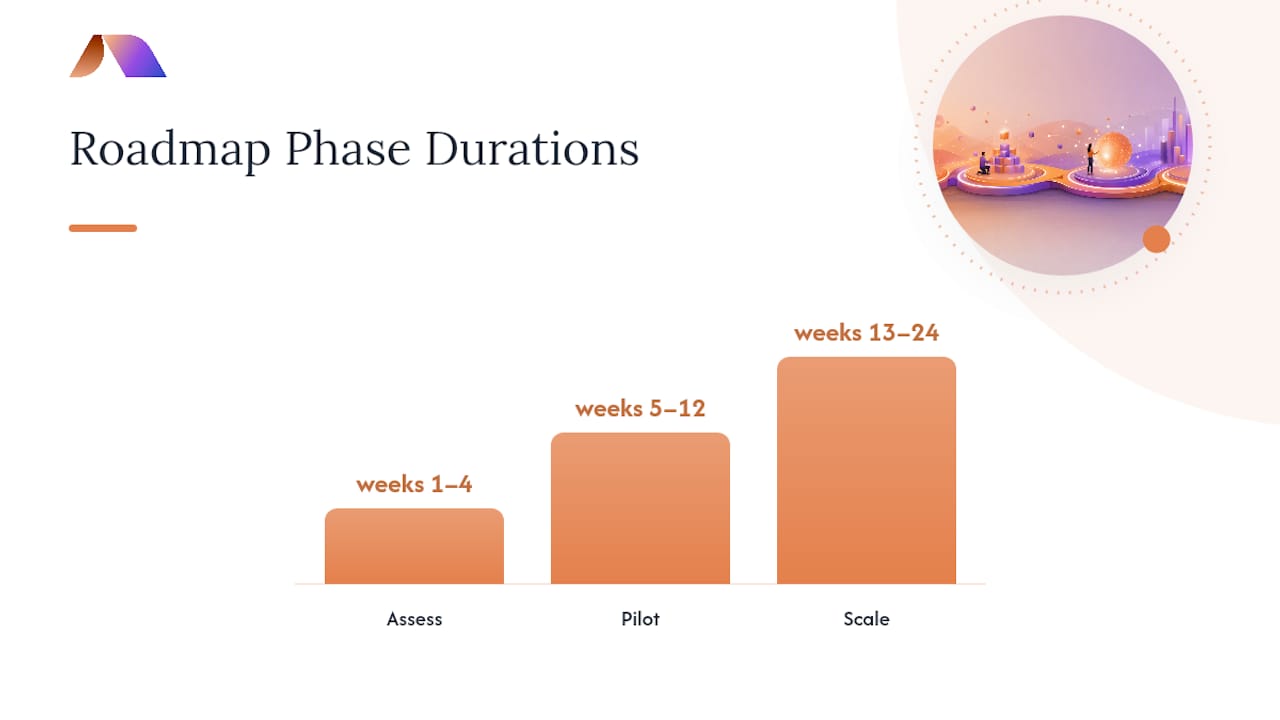
Sample 90–180 day roadmap:
Assess (weeks 1–4). Readiness assessment, data audit, use-case prioritization, and integration inventory. Output: a ranked list of pilot candidates with a clear go/no-go criterion for each.
Pilot (weeks 5–12). Vendor selection, integration build, simulation testing against historical data, and live deployment on a single channel and use case. Output: 30-day performance data against defined KPIs.
Scale (weeks 13–24). Expand to additional channels and use cases based on pilot results. Refine the knowledge base, adjust confidence thresholds, and formalize the escalation workflow.
Govern (ongoing). Monthly accuracy audits, quarterly bias reviews, annual compliance checks, and continuous knowledge-base maintenance.
BRDGIT’s fractional engineers join teams at the pilot stage, providing the technical depth to build integrations, configure models, and set up monitoring without requiring a full-time hire. For organizations that need AI expertise without the overhead of a permanent headcount, this is often the fastest path from assessment to production.
When to move carefully and when to accelerate
The conventional wisdom on AI concierge adoption tends toward one of two extremes: either “move fast before competitors do” or “wait until the technology matures.” Both framings miss the point. The right pace depends on your specific risk profile and data situation.
Move carefully when you are dealing with regulated data (HIPAA, PCI-DSS, CCPA-sensitive), when the decisions the concierge would make carry legal or financial liability, or when your underlying data is fragmented, inconsistent, or poorly documented. Deploying a concierge on top of bad data does not fix the data problem. It institutionalizes it.
Accelerate when you have high query volume with well-defined request types, when the revenue or cost case is clear and measurable, and when you have a named P0 use case with a process owner who is accountable for results. Hospitality pre-arrival communication, Tier-1 support deflection, and guided e-commerce selling are all categories where the signal-to-noise ratio is high enough to move quickly.
The middle ground, which is where most organizations actually sit, calls for a disciplined pilot: tight scope, honest measurement, and a willingness to stop and redesign if the first 30 days produce weak signal. AI does not forgive organizational impatience any more than it forgives organizational ignorance.
BRDGIT can take you from assessment to production
Most organizations stall not because AI concierge automation is too complex, but because the path from “we should do this” to “this is live and working” has too many unresolved questions: which use case to start with, which vendor to trust, how to handle the integration work, and who owns the knowledge base after launch.
BRDGIT removes that friction. The engagement starts with an AI readiness assessment that maps your data, integrations, and use-case candidates against a clear go/no-go framework. From there, BRDGIT builds the roadmap, configures the system, and provides fractional AI engineers who work alongside your team through the pilot and into production. No full-time hire required. No long-term lock-in before you have seen results. If you are ready to move from curiosity to execution, request a readiness assessment at Brdgit and get a clear picture of where you stand within two weeks.
Sources
The sources below informed this article and are worth reading directly for deeper technical or operational detail.