Published on
AI in Hospitality Operations: What Managers Must Know
TL;DR:
AI has become a standard in hospitality, automating tasks and enhancing guest experiences. Effective use depends on clean data, clear policies, and deliberate governance. Operators who plan accordingly can leverage AI for revenue growth and operational efficiency.
AI in hospitality operations is the application of artificial intelligence technologies to automate hotel tasks, sharpen decision-making, and raise the quality of guest service. The industry has moved well past the curiosity stage. 98% of hoteliers had integrated AI into operations by early 2026, with AI handling the majority workload in more than half of common hotel tasks. That number signals a structural shift, not a trend. For hospitality managers and business owners, the question is no longer whether to adopt AI. It is how to do it well.
What is AI in hospitality operations, and where does it apply?
AI in hospitality operations covers a wide range of technologies: machine learning models, natural language processing, predictive algorithms, and agentic AI systems that act on data without waiting for a human prompt. These tools apply across the full operational stack, from the front desk to the back office.
58% of hotels report that guest communications represent AI’s biggest operational impact, including chatbots, multilingual concierge agents, and automated translation. That makes sense. Guest messaging volume is high, repetitive, and time-sensitive. AI handles it at scale without fatigue.
Beyond guest communication, AI applications in hospitality span several critical areas:
Revenue management: Dynamic pricing engines and demand forecasting models that adjust rates in real time
Housekeeping scheduling: Predictive models that assign rooms based on occupancy patterns and checkout data
Energy management: AI systems that control HVAC and lighting based on occupancy and weather data
Predictive maintenance: Sensors and machine learning that flag equipment failures before they disrupt operations
Distribution intelligence: AI agents that monitor channel connectivity and detect booking errors, preventing silent revenue leakage from rate parity failures and sync issues
Upselling and personalization: AI tools that surface the right offer to the right guest at the right moment
Pro Tip: Start AI adoption in revenue management. The ROI is measurable within weeks, and the data infrastructure you build there will support every other AI application you add later.
How does AI improve efficiency and revenue in hotel operations?
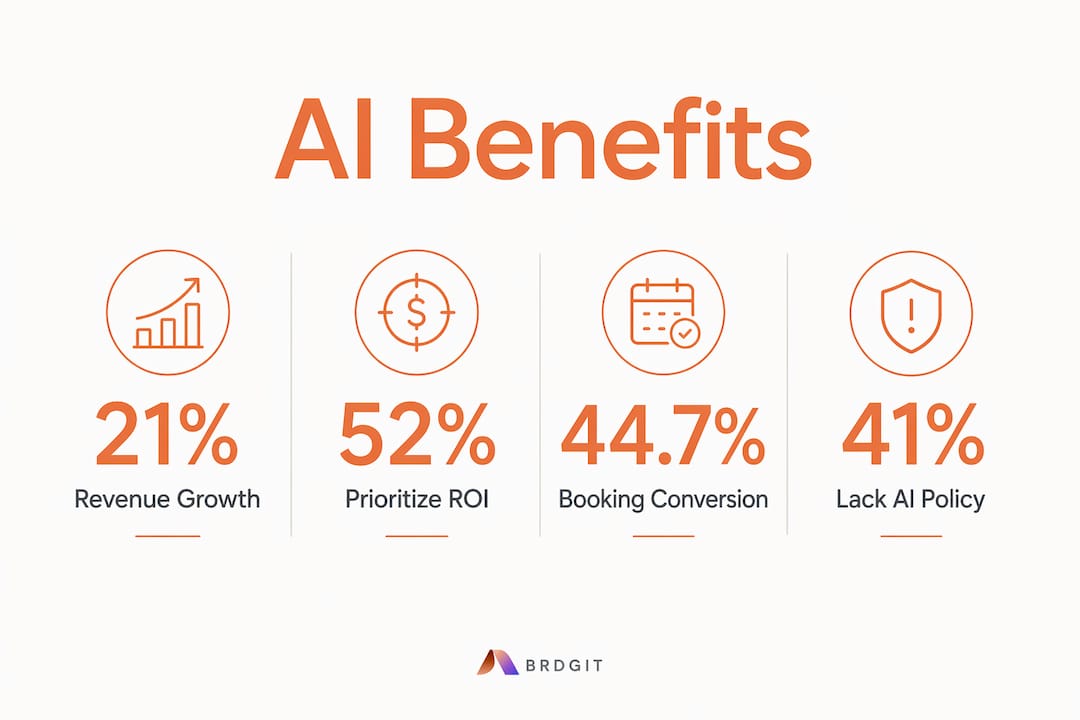
The commercial case for AI in hotel operations is no longer theoretical. Revenue management AI drives up to 21% increase in RevPAR in independent hotels, based on a Lighthouse study of 84 properties. That is a material gain for any operator running on thin margins.

52% of AI-proficient hotel properties prioritize revenue growth from their AI investments, reporting higher revenue per guest and stronger upsell performance compared to peers. The pattern is consistent: hotels that treat AI as a commercial tool, not just a cost-cutting measure, outperform those that do not.
The efficiency gains go beyond pricing. AI compresses the time between identifying an operational problem and acting on it. Tenzo’s Jess Mant describes this as the core functional value: AI integrates multiple data sources and answers plain-English queries in seconds, replacing what used to take a manager hours of spreadsheet work. That time compression changes how quickly a team can respond to a slow booking period, a staffing gap, or a maintenance issue.
On the guest experience side, AI-driven personalization lifts upsell conversion by surfacing relevant offers based on booking history, preferences, and real-time behavior. Hotels using AI guest experience tools report measurable improvements in both ancillary revenue and guest satisfaction scores.
Generative engine optimization pilots from Amadeus show a 44.7% booking conversion rate, compared to 25.9% with traditional methods. That gap reflects how AI improves content discoverability and relevance across digital channels.
Pro Tip: Align every AI tool you deploy to a specific KPI before you go live. If you cannot measure it, you cannot manage it, and you will not be able to justify the next investment.
How do you balance AI automation with human guest service?
The most experienced AI adopters in hospitality draw a deliberate line between tasks they automate and tasks they protect as human-led. 59% of experienced AI users preserve the front desk welcome and check-in as human interactions. That is not a failure of automation. It is a deliberate choice to protect brand equity and the emotional quality of the arrival experience.
The table below captures where that line typically falls:
Task type | Best handled by |
|---|---|
Pre-arrival messaging and FAQs | AI automation |
Dynamic pricing adjustments | AI automation |
Housekeeping schedule optimization | AI automation |
Booking error detection | AI automation |
Front desk welcome and check-in | Human staff |
Complaint resolution and service recovery | Human staff |
VIP and loyalty guest interactions | Human staff |
Emotional or sensitive guest conversations | Human staff |
Governance matters as much as the technology itself. 41% of hoteliers lack formal AI policies, and the trust data is stark. Properties with formal AI policies report 92% trust in their AI tools. Properties without policies report only 49% trust. The policy is not bureaucracy. It is the foundation that makes AI reliable enough to act on.
Managers who want to automate guest communication effectively need to define the human-tech boundary explicitly, not leave it to chance or individual staff judgment.
How can hospitality managers implement AI successfully?
Most AI failures in hospitality trace back to one root cause: data readiness. Hotels apply AI tools before their data is clean, standardized, or connected across systems. The AI then produces confident-sounding outputs based on fragmented inputs. That is operationally dangerous.
Successful implementation follows a clear sequence:
Audit your data. Map every system that holds guest, booking, and operational data. Identify gaps, duplicates, and disconnects.
Integrate your systems. AI needs a single, reliable data layer. Siloed property management systems and channel managers produce unreliable AI results.
Start with a pilot. Choose one high-impact area, such as revenue management or guest messaging, and run a contained pilot before scaling.
Set a governance policy. Define what AI can decide autonomously, what requires human review, and how staff should handle AI errors.
Train your team. Staff who understand what AI does and why it makes certain recommendations will trust it more and catch its mistakes faster.
Budget for iteration. AI tools require tuning. The first deployment is rarely the final configuration.
The shiny-object trap is real. Vendors will show you impressive demos built on clean, curated data. Your property’s data is messier. Buying a tool before fixing your data infrastructure institutionalizes the problem rather than solving it.
Key Takeaways
AI in hospitality operations delivers measurable commercial and operational results only when deployed on clean data, governed by clear policy, and aligned to specific business outcomes.
Point | Details |
|---|---|
AI adoption is near-universal | 98% of hoteliers have integrated AI, making readiness a competitive baseline, not an advantage. |
Revenue management leads ROI | AI-driven pricing delivers up to 21% RevPAR gains, making it the highest-impact starting point. |
Human touchpoints need protection | 59% of experienced operators preserve check-in as human-led to maintain brand and guest satisfaction. |
Governance drives trust | Properties with formal AI policies report 92% trust vs. 49% without, making policy a business priority. |
Data readiness is the critical prerequisite | Most AI failures stem from fragmented data, not flawed technology. Fix data before buying tools. |
The line between AI doing the work and AI doing it well
The hospitality industry has crossed the adoption threshold. What separates operators now is not whether they use AI. It is whether they use it deliberately.
What I observe consistently in the field is that the most effective operators treat AI as an operational assistant with a defined scope, not a universal fix. They know exactly which decisions AI owns, which ones it informs, and which ones stay with a person. That clarity is not accidental. It comes from doing the governance work upfront, before the tools go live.
The shift from efficiency to commercial growth is where things get interesting. Early AI adopters in hospitality used the technology to cut costs. The next wave is using it to grow revenue per guest, improve conversion, and build loyalty through personalization. That is a fundamentally different mindset, and it requires a different kind of AI strategy.
AI does not forgive organizational ignorance. A hotel with messy data, no policy, and undertrained staff will get worse results from a sophisticated AI platform than a well-prepared property gets from a simpler tool. The technology is not the constraint. The organization is.
The operators who will win are the ones who invest in readiness before they invest in software. That means clean data, connected systems, trained staff, and a governance framework that builds trust over time. The AI will follow.
— Team BRDGIT
BRDGIT’s approach to AI-enabled hospitality operations
Knowing where AI fits in your operations is one thing. Building it correctly is another.
BRDGIT works with hospitality businesses that are ready to move from AI interest to real execution. Our fractional engineers bring hands-on AI implementation experience to hotel operations without the cost of a full-time hire. We assess your data readiness, identify the highest-impact AI opportunities, and build the systems and governance frameworks that make AI work reliably in your specific environment. If your property is ready to close the gap between what AI promises and what it actually delivers, BRDGIT is built for that work.
FAQ
What is AI in hospitality operations?
AI in hospitality operations is the use of machine learning, natural language processing, and predictive algorithms to automate hotel tasks, improve pricing decisions, and personalize guest interactions. It applies across revenue management, guest communications, housekeeping, maintenance, and distribution.
Which AI application delivers the fastest ROI for hotels?
Revenue management AI consistently delivers the fastest measurable return. A Lighthouse study of 84 independent hotels found AI-driven pricing produces up to 21% gains in revenue per available room.
Will AI replace hotel staff?
AI replaces repetitive, rule-based tasks, not the full scope of hospitality work. 59% of experienced AI users deliberately preserve front desk welcome and check-in as human-led interactions to protect guest satisfaction and brand value.
Why do AI implementations fail in hotels?
Most AI failures in hospitality trace back to data readiness issues. Hotels deploy AI tools before their data is clean or integrated across systems, which causes the AI to generate inaccurate outputs despite appearing confident.
How does an AI policy affect trust in hotel operations?
Properties with formal AI policies report 92% trust in their AI tools, compared to 49% trust at properties without policies. A governance policy defines what AI can decide autonomously and how staff should handle AI errors, which builds operational confidence over time.