


Published on
Engineer Generative AI Security for Teams: AI BOM, LASM, T3/T4
Generative AI security is the discipline of protecting models, training and retrieval pipelines, and autonomous agents from manipulation, data leakage, and misuse across their full operating lifecycle. The single highest-leverage first move for most security teams is building an AI Bill of Materials, or AI-BOM, that inventories every model, dataset, and connected tool, then applying scoped, least-privilege access controls before anything else. Prompt injection, sensitive-data exposure through retrieval pipelines, and agentic tool misuse are the three risks to triage immediately. Everything else in a mature program builds on that inventory.
TL;DR:
Building an AI-BOM that inventories all models, datasets, tools, and data flows is essential for establishing effective access controls and security measures.
Threats like prompt injection, data exfiltration, model poisoning, agent misuse, and resource attacks require layered defenses that address each system component and operational layer.
Adopting frameworks such as OWASP GenAI Top 10, NIST AI RMF, MITRE ATLAS, and AI TRiSM helps structure risk management, threat modeling, and ongoing governance efforts.
Continuous monitoring, detailed logging of prompts, tool calls, and memory activity, along with red-team exercises targeting agentic risks, are critical for early attack detection.
Most organizations focus on surface-level controls, but substantive investments in provenance tracking, memory governance, and cross-session auditing are necessary to handle high-severity, under-studied threats.
BRDGITBuild a Clearer AI Security PathBRDGIT helps teams assess AI readiness, identify opportunities, create roadmaps, and build practical systems for secure execution.Explore BRDGIT.ai
Table of Contents
Defining the Scope: What Counts as Generative AI for Security Purposes
What Are the Main Threat Categories in Generative AI Security?
Which Security Frameworks Should Guide a Generative AI Program?
How Do You Architect Layered Defenses for Generative AI Systems?
Turning Controls Into a Program: AI-BOM, AI-SPM, and Red Teaming
What Should You Log to Detect Generative AI Attacks Early?
How BRDGIT Approaches Generative AI Security Engagements
Where the Real Investment Gap Is in Generative AI Defense
Sources
FAQ
Defining the Scope: What Counts as Generative AI for Security Purposes
Security teams often draw the boundary around a chatbot interface and stop there. That’s the wrong line. Generative AI security has to cover three distinct system types: large language models (LLMs) answering text prompts, multimodal generators handling images, audio, or video alongside text, and agentic systems that plan, call tools, and act with a degree of autonomy. Agentic systems deserve the most attention because they expand the attack surface in a way static models never did. A model that only predicts the next token is dangerous if it leaks data. A model that can also execute code, send emails, or query a database is dangerous in ways that compound.
Mapping your actual exposure means inventorying every artifact that touches the generation pipeline, not just the model file. That list includes:
The training corpus and any fine-tuning datasets, including third-party or scraped sources
Model checkpoints and adapters (LoRA layers, PEFT modules, quantized variants)
Embeddings and vector stores used for retrieval
Retrieval-augmented generation (RAG) pipelines connecting the model to live data
Memory stores that persist context across sessions
Tool connectors and APIs the model or agent can invoke
Logs, telemetry, and provenance metadata generated during inference
Traditional network security and identity and access management remain necessary. They are not sufficient. A firewall does not know the difference between a legitimate user query and a crafted prompt injection payload hidden inside a PDF the model just ingested. IAM can lock down who reaches an API endpoint, but it says nothing about what an authenticated agent does once it decides, on its own, to call a tool it was never explicitly told to use. Secure generative AI requires controls purpose-built for probabilistic, context-driven systems, layered on top of the infrastructure security you already run.
What Are the Main Threat Categories in Generative AI Security?
Every serious GenAI security program organizes around a working threat taxonomy. Without one, incident response becomes guesswork and red-team exercises miss entire attack classes. Five families cover most of what practitioners see in production today:
Prompt injection. The model has no architectural mechanism to separate instructions from data. Any text the model reads, whether typed by a user or embedded in a document it retrieves, can be interpreted as a command. This is why prompt injection is intrinsic to current LLM applications rather than a bug to be patched away. Defense has to be architectural, constraining what the model is permitted to do rather than trying to filter every malicious input string.
Data exfiltration and membership inference. RAG pipelines and vector stores routinely expose more than intended. An attacker who can query a retrieval system carefully enough can reconstruct fragments of the underlying training data or confirm whether a specific record was part of it. Telemetry logs, if not access-controlled, become a second exfiltration channel entirely separate from the model itself.
Model poisoning and backdoors. Poisoning can happen at pre-training (corrupting the base corpus), during fine-tuning (a compromised or malicious dataset), or through adapter poisoning (a LoRA module distributed on a public hub that activates malicious behavior on a trigger phrase). Adapter poisoning is the least discussed of the three and the easiest to smuggle past a review process that only checks the base model.
Agentic and tool-mediated attacks. This is where the highest-severity risks concentrate. Tool-mediated control-flow hijacking lets an attacker redirect an agent’s actions through a manipulated tool response. Multi-agent propagation lets a single compromised agent spread bad instructions to every agent it communicates with. Researchers classify these by temporality, from T1 single-turn attacks through T4 sub-session-stack threats that persist across nested agent calls. Agentic ecosystem and governance failures, combined with cross-session persistence, represent a small fraction of published research, roughly 6.3% of mapped research paper cell assignments, yet these under-studied zones hold the field’s highest-severity threats.
Resource and financial attacks. Unbounded token consumption, whether from a runaway agent loop or a deliberate denial-of-wallet attack, can turn a functioning application into a five-figure invoice inside a single billing cycle.
The under-studied zone is the dangerous one. Multi-agent coordination, cross-session persistence, and agentic governance gaps make up a small slice of published GenAI security research, but they carry the most severe consequences when exploited, according to the layered attack surface survey.
Tool-mediated hijacking and prompt injection remain the dominant attack families in production LLM agent deployments today, while persistent state corruption and multi-agent propagation are climbing fast as agentic architectures scale, a pattern documented in research on LLM agent communication protocols. If your incident response runbook only has a category for “prompt injection,” it’s already a generation behind.
Which Security Frameworks Should Guide a Generative AI Program?
Building bespoke controls from scratch wastes time three other organizations have already spent for you. Four frameworks cover most of what a mature program needs, and each does a different job.
OWASP GenAI Top 10 and Agentic Top 10. These translate the taxonomy above into a prioritized, testable checklist. Security teams use them to structure vulnerability assessments and to give developers a shared vocabulary for what “prompt injection” or “excessive agency” actually means in a code review.
NIST AI Risk Management Framework (AI RMF). The NIST AI RMF organizes risk management into a lifecycle: govern, map, measure, manage. Teams new to GenAI risk should adopt the “map” function first, since it forces the inventory work that everything downstream depends on.
MITRE ATLAS. ATLAS catalogs adversary tactics and techniques specific to AI systems, functioning as the AI-focused counterpart to the MITRE ATTACK matrix most SOC analysts already know. It’s the right reference for structuring adversary emulation exercises and mapping detection coverage gaps.
AI Trust, Risk, and Security Management (AI TRiSM). This is less a checklist and more an operating model, tying model governance, runtime monitoring, and privacy controls into one continuous program rather than a one-time audit.
The practical move is building a crosswalk: for every entry in your AI-BOM, tag which OWASP risk category applies, which NIST RMF function governs it, and which ATLAS technique an adversary would use against it. That single spreadsheet becomes your risk register, your audit evidence, and your red-team scope document all at once. An AI in risk consulting guide walks through building that kind of crosswalk for operational risk programs more broadly.
How Do You Architect Layered Defenses for Generative AI Systems?
The most important engineering fact in this entire field is one most teams learn the hard way: controls built for one layer of your AI stack have zero detection power against attacks happening at a different layer. That’s the core finding behind the Layered Attack Surface Model, or LASM, which formalizes seven distinct layers across an agentic system, from the model weights up through orchestration and multi-agent coordination. A prompt-filtering tool sitting at the input layer catches nothing when the attack is a poisoned adapter loaded three layers down. This non-transferability is why single-tool GenAI security (“we bought a prompt injection filter”) fails so often. It solves one layer while leaving six exposed.
Building a real layered defense means implementing concrete primitives at each point in the stack:
Artifact provenance. Sign every model checkpoint and adapter. Use content digests for datasets and embeddings. Promote artifacts through environments immutably, and pin exact versions in production so a silent swap can’t happen upstream.
Input isolation. Wrap user and retrieved content in explicit delimiters the model is trained to respect. Retokenize suspicious inputs. Apply paraphrase-based sanitization to strip injected instructions before they reach the model, and maintain declarative allow and deny lists for what categories of instruction the system will act on.
Tool gating and trust-marking. Scope every tool connector to the minimum capability it needs. Require explicit confirmation policies before an agent executes a consequential action (sending money, deleting records, emailing external parties). Sandbox tool execution so a compromised call can’t reach outside its intended blast radius.
Memory governance. Treat persistent memory as a sensitive data store, not a convenience feature. Tag every memory write with its provenance. Set expiration policies. Build revocation paths so a poisoned memory entry can be identified and purged, and quarantine any session showing anomalous memory-write patterns before it propagates to other agents.
Runtime containment. Implement circuit breakers that halt an agent loop showing runaway behavior. Cap token spend per session and per user to blunt financial denial-of-service. Isolate agents from each other so one compromised instance can’t directly manipulate its peers.
Pro Tip: Audit your memory store the same way you’d audit a database with PII in it. If you can’t answer “who wrote this entry, when, and why,” you don’t have memory governance, you have an uncontrolled data lake with a chat interface bolted on.
Provenance-aware state management, grounding, post-hoc output filtering, and red teaming work as complementary layers, not substitutes for each other, a point emphasized in research on GenAI risks for industry and regulators. No single mitigation, however well engineered, closes the gap alone. This is also the point where zero-trust architecture needs updating rather than assuming. A review of 136 primary studies on Zero-Trust Architecture found that 98% offered only partial or no real-world validation against generative AI attacks, meaning the ZTA your network team already runs almost certainly hasn’t been stress-tested against a prompt-injection-driven lateral movement scenario. Assume it needs GenAI-specific extensions rather than assuming coverage you haven’t verified. Teams building tool-heavy agent architectures should also look at how MCP servers change the agentic attack surface, since standardized tool protocols introduce their own trust boundary questions.
Turning Controls Into a Program: AI-BOM, AI-SPM, and Red Teaming
Engineering controls only produce lasting security when they’re wired into repeatable operational practice. Four activities turn a pile of good intentions into an actual program.
Build and own the AI-BOM. At minimum, track model name and version, training data lineage, fine-tuning history, connected tools and their permission scopes, deployment environment, and the name of the accountable owner for each entry. Assign a single owner, not a committee, or the inventory rots within a quarter.
Stand up AI Security Posture Management (AI-SPM). This is continuous monitoring for configuration drift, unauthorized model or adapter changes, and attestation gaps, functioning like cloud security posture management but scoped to AI artifacts instead of cloud resources.
Run a red-team playbook built for GenAI, not just web apps. Scope tests to cover prompt injection, RAG data leakage, tool-mediated hijacking, and multi-agent propagation specifically. OWASP’s GenAI Red Teaming Initiative stresses that agentic scenarios and persistent-memory exploitation need dedicated test cases, not a copy-paste of prompt-hijack checklists from last year.
Set human-in-the-loop approval gates. Define explicit thresholds, dollar amounts, data sensitivity classes, or irreversible actions, above which no AI output executes without a human sign-off.
Roughly 98 percent of studied Zero-Trust research lacked real-world validation against generative AI attacks, based on a review of 136 primary studies from 2022 to 2024. That single figure explains why so many “AI-secured” environments fail their first real red-team exercise.
Track a handful of KPIs that actually mean something to your risk committee: memory-audit coverage as a percentage of active sessions, mean time to detect AI-mediated exfiltration, and raw vulnerability counts surfaced per red-team cycle. An enterprise AI governance case study illustrates how governance failures compound operational cost long before they become a headline breach. And when an agent does go wrong in production, the OpenClaw incident analysis is worth studying as a case of exactly how autonomous systems fail when nobody set a containment boundary.
What Should You Log to Detect Generative AI Attacks Early?
Detection for GenAI systems depends on logging categories most SOC tooling was never built to capture. The essentials include full input prompts and retrieved context, every tool-call argument and its result, memory write events with their provenance tags, vector-store read patterns, and model or adapter deployment events tied to their signed provenance metadata.
Watch for perplexity or entropy spikes in model outputs, which often signal an adversarial or out-of-distribution input.
Flag unusual retrieval patterns, like a single session pulling from vector-store partitions it has no legitimate reason to touch.
Track token-length anomalies and sudden cost spikes, both classic signatures of a runaway agent loop or a denial-of-wallet attempt.
LLMs can help defenders here, functioning as a secondary triage layer that summarizes anomalous logs or flags suspicious patterns for human review. That’s a legitimate use. What’s not legitimate is treating that same LLM’s output as ground truth without validation, since generative AI scales both defensive triage and attacker capability at the same time. Feed these signals into your existing SIEM and SOAR pipelines rather than building a parallel monitoring stack. The integration point is usually the log format, not the platform, so normalize AI-specific events (tool calls, memory writes, provenance checks) into the same schema your SOC analysts already query. For teams auditing multiple models at once, a tool like BabyLoveGrowth’s multi-LLM audit can help surface behavioral inconsistencies across providers before they turn into incidents.
How BRDGIT Approaches Generative AI Security Engagements
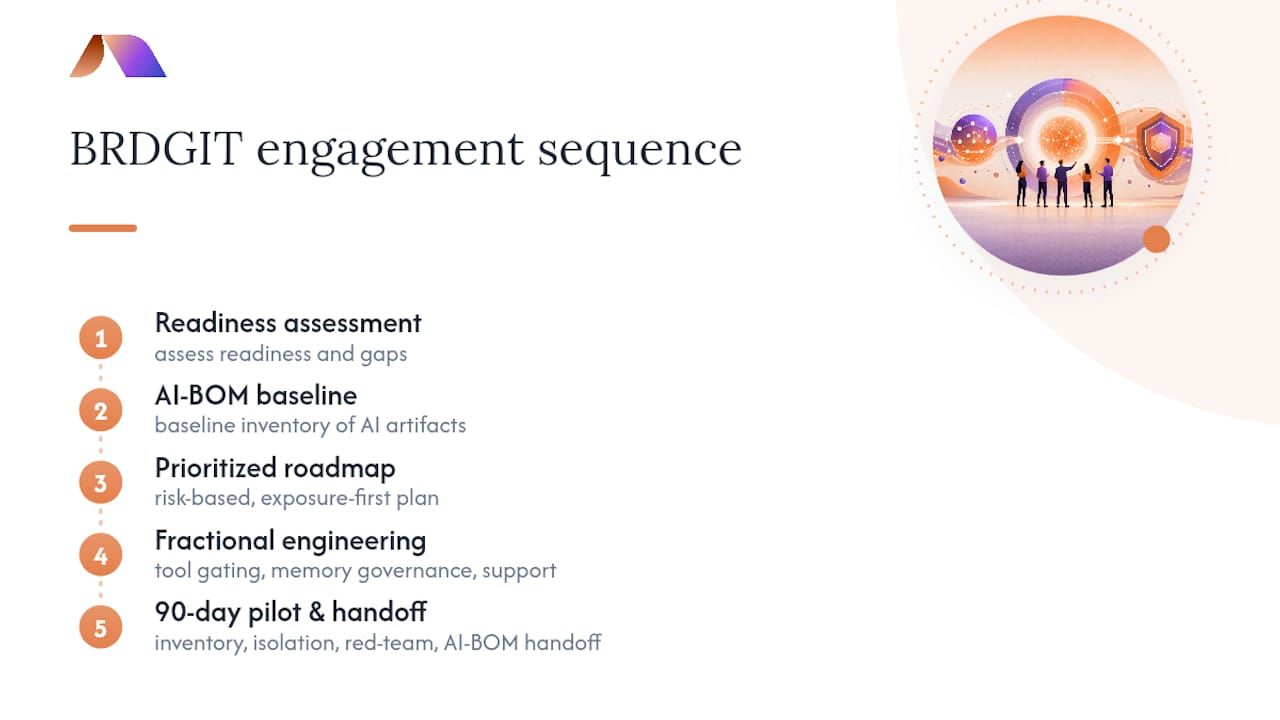
Every generative AI security engagement starts with a readiness assessment, followed by an AI-BOM baseline, then a prioritized roadmap built around the client’s actual exposure rather than a generic checklist. That sequence matters because most teams don’t know what they’re protecting until the inventory forces the question. From there, fractional engineering support fills the gaps, whether that’s building tool-gating logic, standing up memory governance, or running a first red-team pilot. A typical 90-day first engagement covers artifact inventory, input isolation implementation, a scoped red-team pilot targeting agentic risks, and a completed AI-BOM baseline the client owns going forward.
Where the Real Investment Gap Is in Generative AI Defense
Most GenAI security spending still targets input filtering and single-session prompt attacks, the T1 and T2 risks that are easiest to demo. The harder, more consequential work is provenance tracking, memory governance, and cross-session auditing for T3 and T4 threats, the multi-agent propagation and sub-session-stack attacks that current benchmarks barely cover. Relying on one detection layer, however well tuned, leaves the other six layers of your stack unaudited. Leaders should pilot an agentic red-team exercise this quarter, assign explicit AI-BOM ownership, and fund AI-SPM capabilities before the next budget cycle rather than after an incident forces the question. Teams tempted to check a compliance box instead of building real coverage should read a take on why AI safety theater kills real progress before they finalize that plan.
— Team BRDGIT
Sources
FAQ
Who Leads in Generative AI Security Right Now?
No single vendor or lab holds a dominant lead. The field moves through open frameworks instead, chiefly OWASP’s GenAI Top 10 project, the NIST AI RMF, and MITRE ATLAS, which most serious organizations combine rather than picking one authority to follow.
Is Generative AI Replacing Cybersecurity Teams?
No. Generative AI speeds up triage, summarization, and low-risk automation for defenders, but it also scales attacker capability at the same pace. High-stakes decisions still need human-in-the-loop validation, which means security teams are growing more essential, not less.
Which AI Model Is Best for Security Use Cases?
There’s no single best model. The safer question is which model fits your risk tolerance and data sensitivity, since any model connected to sensitive data or autonomous tools needs the same layered controls, including provenance tracking, tool gating, and memory governance, regardless of vendor.
How Can I Protect My Data From Generative AI Systems?
Start with an AI-BOM that maps every dataset, embedding store, and tool connector touching your data, then apply least-privilege scoping to each one. Treat embeddings, retrieval results, and telemetry as sensitive outputs subject to classification and redaction, a surface frequently overlooked in current security research.
What Is the Fastest First Step Toward Securing an Existing GenAI Deployment?
Build the AI-BOM before anything else. You cannot scope access controls, red-team meaningfully, or detect anomalies in systems you haven’t fully inventoried, which is why it’s the starting point of BRDGIT’s own engagement model and most mature GenAI security programs.



