
Published on
How Long Does an AI Project Timeline Actually Take?
A focused small business build runs 8 to 16 weeks from kickoff to production, with the first six weeks often showing measurable payback. An enterprise program that includes proper evaluation, shadow mode, and gated rollout typically runs 14 to 28 months. Every credible AI project schedule, regardless of company size, moves through the same six phases: assess, pilot or proof of concept, build and evaluate, measure, gated rollout, and scale with ongoing support.
The single move that determines whether you land near the fast end or the slow end of either range is what you do in week one.
Run an AI readiness assessment before you scope anything.
Set a go-or-stop review date for week 6 through 8 of the pilot, in writing, on the calendar.
Start procurement and legal review the same week you start data collection, not after.
The takeaway: organizations that treat the readiness check and the review date as mandatory checkpoints, rather than optional nice-to-haves, consistently hit the faster end of these ranges.
Key Takeaways
A realistic AI project timeline runs 8 to 16 weeks for a focused SMB build and 14 to 28 months for a full enterprise program, and both succeed or fail based on readiness assessment quality and queue time management, not model selection.
Point | Details |
|---|---|
Run readiness assessment first | Score data quality, infrastructure, and change capacity before scoping any build. |
Set a go-or-stop date early | Schedule the pilot review for week 6 to 8 and put it on the calendar in writing. |
Start procurement in week one | Queue time for legal and security review is often the largest calendar delay. |
Never skip the measurement window | Baseline-plus-treatment measurement is calendar-bound and cannot be rushed with more staff. |
Get delivery support where gaps exist | BRDGIT’s fractional engineers fill skills gaps for pilots and rollouts without a full-time hire. |
Table of Contents
What Are the Phases of an AI Project Timeline?
How Much Should You Budget for Staff and Contractors?
What Causes the Most Delay in an AI Project Schedule?
How Do You Scope an AI Pilot With a Clear Go-or-Stop Point?
What Do Sample AI Timeline Templates Look Like by Company Size?
Where the Standard AI Timeline Advice Falls Short
How BRDGIT Maps to Every Phase of Your AI Timeline
Sources
What Are the Phases of an AI Project Timeline?
Every AI implementation schedule, whether it serves a 40-person distribution company or a multinational manufacturer, breaks into the same seven checkpoints. Each phase has a specific exit question. Answer it wrong, or skip it, and you inherit the cost later, usually at the worst possible moment.
Selection. Exit question: does this problem have a clear owner and a documented process today? If nobody can describe the current workflow in five sentences, you are not ready to automate it.
Assess data. Exit question: is the data accessible, labeled, and representative of real conditions? This phase runs 1 to 3 weeks for a single workflow and much longer when data lives across disconnected systems.
Procure and review. Exit question: are contracts, data processing agreements, and security sign-off complete? This is calendar-bound and queue-bound at once, and it is where most enterprise timelines quietly lose months.
Build and evaluate. Exit question: does the model or system meet a frozen evaluation set, agreed before building started? Focused builds finish this in 2 to 6 weeks; multi-system integrations take longer.
Measure. Exit question: has a baseline-plus-treatment window run its full course? Measurement windows are calendar time, not effort time, and adding staff will not shorten them.
Roll out. Exit question: are rollback criteria defined and has a shadow-mode or limited-gate period run cleanly? This is where enterprise projects add real weeks that packaged SMB tools skip.
Fund production and scale. Exit question: is there a signed budget line for ongoing hosting, monitoring, and support?
Sample exit criteria worth writing into your own project plan: a signed data processing agreement, a frozen evaluation set that nobody edits mid-build, a documented baseline measurement collected before any change goes live, and rollout gates with explicit rollback triggers. Skipping any of these doesn’t save time. It moves the cost to a later, more expensive phase, usually disguised as a rebuild.
How Much Should You Budget for Staff and Contractors?
Every AI project, no matter the size, needs the same core roles filled by named people, not job descriptions. A project sponsor who can unblock budget and legal review. A product or tool owner who understands the workflow being automated. A data engineer who can get to the data without asking permission five times. An integrator who connects systems. A change lead who trains the team that will actually use the thing.
Contractor hours for a single-workflow integration typically run 20 to 40 hours total, covering setup, testing, and handoff. Fractional engineers fit here well: you get a specific skill set for a bounded window instead of committing to a full-time hire before you know if the workflow justifies one.
Ballpark budgets vary widely by scope:
Focused SMB pilots: contractor costs frequently land under $2,000, with monthly API usage in the tens of dollars once low-code tooling and minimal custom code keep the build lean.
Mid-size rollouts spanning multiple teams or systems: budget scales with integration complexity, not headcount, because the cost driver is the number of systems touched, not the number of users.
Enterprise programs: budget must account for eval set preparation, security audits, and ongoing monitoring infrastructure, which are recurring line items, not one-time costs.
Pro Tip: Recurring costs go up during the measurement window, not down. Budget for a temporary spike in API and monitoring spend during baseline-plus-treatment collection, then expect it to settle once the system reaches steady state.
Use a tool like Bitrupt’s AI development cost calculator to sanity-check contractor and platform estimates before you commit a budget line.
What Causes the Most Delay in an AI Project Schedule?
Queue time, not build time, is what wrecks most artificial intelligence project plans. Procurement, security review, data access requests, and budget approval windows account for the largest calendar delay in nearly every enterprise build, and this queue time is measurable before you even start.
Pull your organization’s last five approval or security review requests and time how long each took start to finish. That number, not a vendor’s promised delivery date, is your real critical path.
Start procurement and legal conversations in week one, in parallel with data collection, never after the build begins.
Collect baseline measurement data immediately, since this window cannot be compressed later.
Parallelize build work with security review wherever the risk profile allows it.
Assign a single named owner to each bottleneck category: one person for security, one for legal, one for procurement, one who controls budget release.
Skipping the measurement window or the gated rollout to hit an earlier deadline creates a specific, predictable failure: rework after launch, often at higher cost than the delay you were trying to avoid.
How Do You Scope an AI Pilot With a Clear Go-or-Stop Point?
A pilot deserves a green light only when it clears four questions. Get any one of these wrong and the pilot drifts, and drift is what turns a 6-week AI project timeline into a 6-month one with no clear outcome.
Does the task consume at least 5 hours per week of someone’s time today? Anything less rarely justifies the build effort.
Does the data already exist in an accessible, usable format? If someone has to manually export and clean data every time, that’s a data project first.
Is there a single named decision-maker who owns the go-or-stop call? Committees don’t make pilot decisions; people do.
Is there a concrete, numeric success metric defined for week 8, before the pilot starts?
Baseline measurement has to happen before any change goes live, because a pilot with no baseline has no way to prove impact. This is why measurement windows are non-negotiable: they are calendar-bound, and you cannot retroactively create a baseline you never collected.
Useful KPIs include hours saved per week, error rate reduction, throughput gain per employee, and cost per transaction.
Pro Tip: Freeze your acceptance criteria in writing before the pilot starts, and refuse any request to add “one more process” mid-pilot. Scope creep is the most common reason a clean 6-week pilot becomes a 4-month one with no defensible result.
What Do Sample AI Timeline Templates Look Like by Company Size?
Timelines vary sharply by organizational complexity, and the biggest mistake executives make is applying an enterprise mental model to a 15-person operations team, or the reverse. Small teams that scope a single documented workflow with accessible data consistently move faster than teams juggling multiple systems and approval layers.
Company Size | Duration | Key Milestones | Go-or-Stop Review |
|---|---|---|---|
SMB, focused build | 8 to 16 weeks | Weeks 1 to 2: readiness assessment and workflow selection. Weeks 3 to 6: build and baseline. Weeks 7 to 8: measure and decide. Weeks 9 to 14: rollout and adoption. | Week 6 to 8 |
Mid-size, staged rollout | 2 to 6 months | Month 1: assessment and pilot scope. Months 2 to 3: pilot and measurement. Months 4 to 6: staged rollout across teams. Months 7 to 8: initial scale. | End of month 3 |
Enterprise, full program | 14 to 28 months | Months 1 to 3: assessment and procurement. Months 4 to 8: eval set and build. Months 9 to 14: shadow mode and gated rollout. Months 15 to 28: scale, audit, and monitoring. | End of shadow mode |
Enterprise programs carry long poles that packaged SMB tools never touch: evaluation set preparation, shadow-mode validation, and audit evidence collection for compliance review. Executive air cover matters most right at the procurement and security review stage, where a stalled approval can silently add months if nobody with authority is pushing it forward.
Where the Standard AI Timeline Advice Falls Short
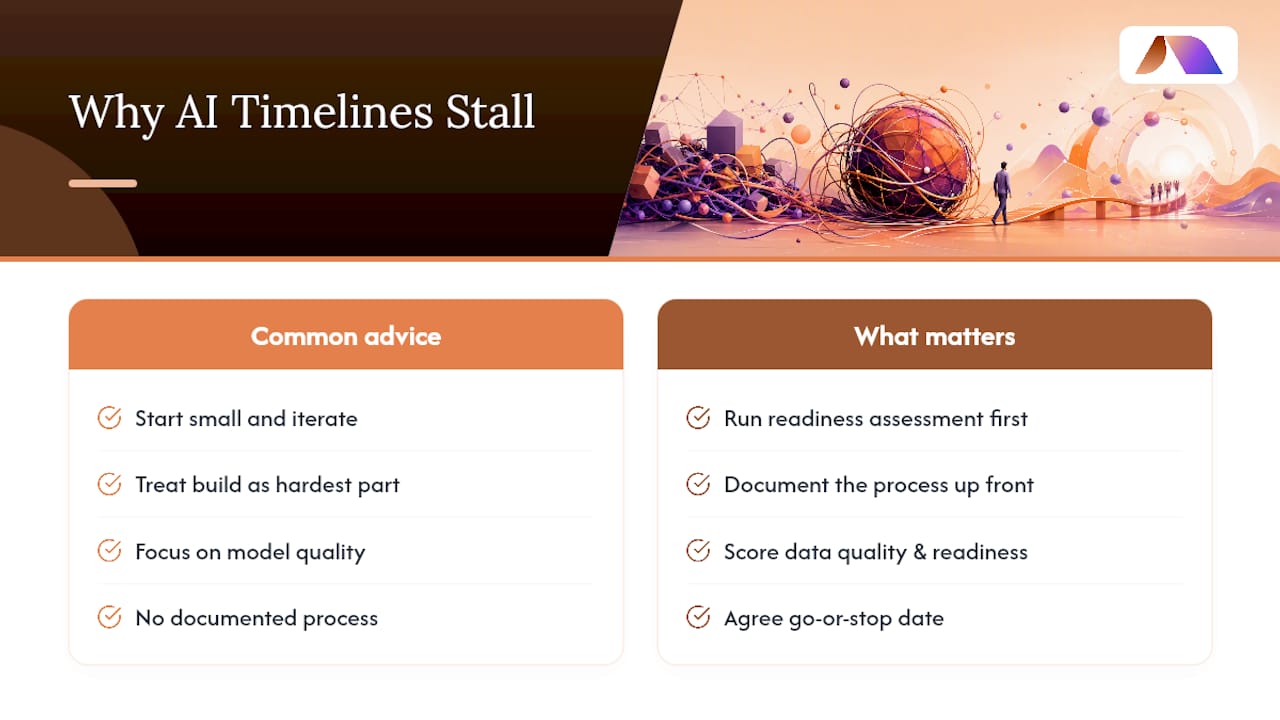
Most guidance on AI project timelines treats the build as the hard part. It isn’t. The evidence from actual SMB rollouts and enterprise programs alike points to the same conclusion: readiness, queue time, and measurement discipline determine the outcome far more than model quality or engineering talent.
The conventional advice tells executives to “start small and iterate.” That’s incomplete. Starting small without a documented process, an accessible data source, and a named decision-maker just produces a smaller version of the same failure. What actually separates successful pilots from stalled ones is whether someone ran an honest readiness assessment first, scoring data quality and organizational change capacity before committing a dollar.
Prioritize the assessment and the go-or-stop date over the technology choice. The tool matters far less than whether your organization can say, with a straight face, what “success by week 8” actually means. Most projects that stall did not fail because of the AI. They failed because nobody agreed on that definition before the clock started.
How BRDGIT Maps to Every Phase of Your AI Timeline
BRDGIT built its process around the exact phases outlined above, starting with an AI readiness assessment that scores your data quality, infrastructure maturity, and organizational change capacity into a concrete scorecard, the same scorecard you’ll use to set realistic phase durations and exit criteria instead of guessing at them.
Once you have that scorecard, the harder question is execution: who actually builds and maintains the system without pulling your best operations people off their real jobs for six months? That’s where fractional engineers close the gap. Instead of hiring full-time before you know if a workflow justifies it, you get experienced AI talent scoped to your pilot’s actual timeline, reducing the calendar risk that comes from skills gaps mid-build.
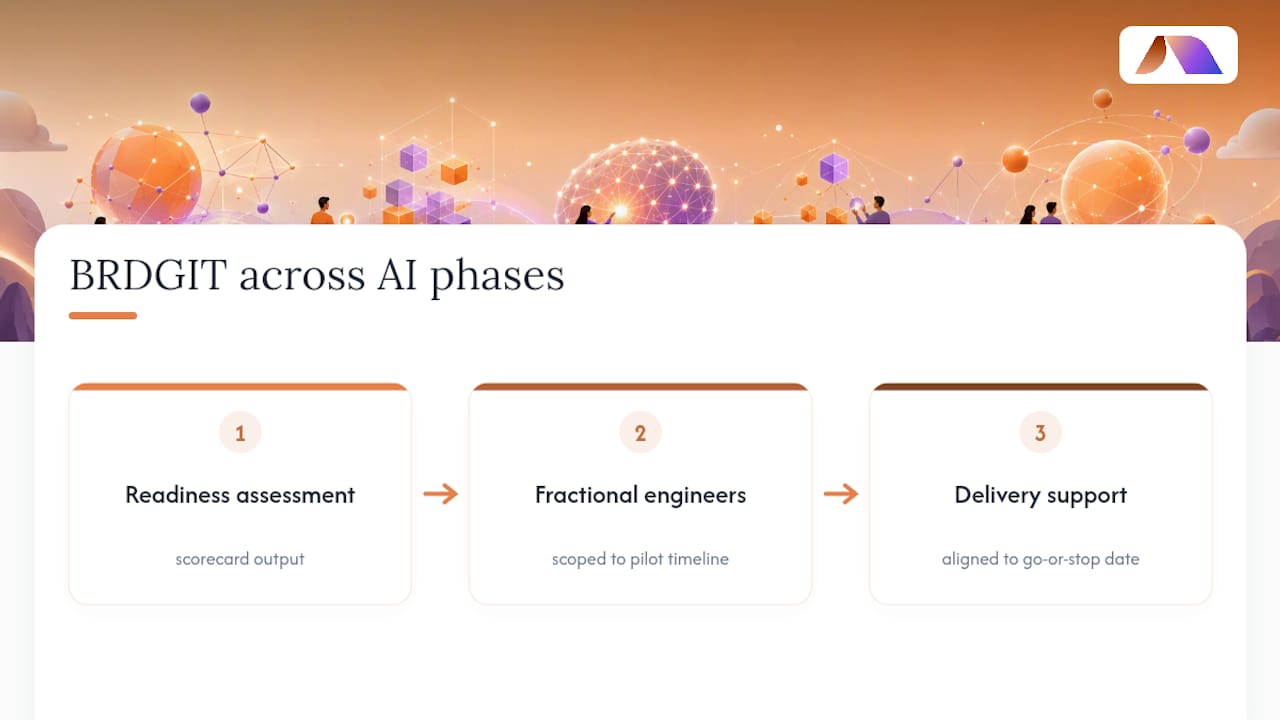
If you’re staring at a 6-week pilot or a 14-month enterprise program and wondering who executes the middle phases, book a readiness check and talk to BRDGIT’s fractional engineers about scoping delivery support around your actual go-or-stop date.
Sources
A strategic approach to assessing your AI readiness · Microsoft Cloud Blog (2024-11-06)
50 SMB AI rollouts: what actually happened · InsiderAITrends (Q1 2026)
The realistic timeline for an enterprise AI project · Multigrid