


Published on
Ship an AI Policy for Employees in Six Weeks for HR Teams
Yes. Every organization letting employees touch generative AI needs a written policy now, not after the first incident. Start with three moves: name a policy owner, publish a scope document with an approved-tools list, and ban personal consumer AI accounts for anything touching regulated or sensitive data. The templates, clause language, and rollout timeline below turn that verdict into a document you can ship this quarter.
TL;DR:
Most organizations need to create a short, practical AI policy focusing on scope, approved tools, and strict data input rules before expanding to a full document.
Implement technical controls like enterprise subscriptions, multi-factor authentication, and blocking consumer accounts for roles managing sensitive information.
Keep essential governance artifacts such as signed acknowledgments, training records, and a documented tools list readily accessible for audits or legal reviews.
Roll out policies gradually over six weeks, starting with publishing scope and tools, followed by tailored training and collecting employee acknowledgments.
Regularly review and update the policy quarterly or after incidents, vendor changes, or new regulations to maintain compliance and relevance.
BRDGITTurn AI Governance Into ActionBRDGIT helps teams assess readiness, build practical AI roadmaps, train employees, and implement systems that support responsible execution.Explore BRDGIT.ai
Table of Contents
What Belongs in an AI Policy for Employees This Week
Section-by-Section Policy Anatomy
How Do You Roll Out an AI Policy Without Killing Adoption?
What Should You Monitor and Keep for Audits?
Copy-Ready Clauses You Can Adapt
What Working With Clients Has Taught Us About AI Governance
Get Help Turning a Policy Template Into an Operating System
Primary Templates and Legal Guidance to Consult
Sources
FAQ
What Belongs in an AI Policy for Employees This Week
Most HR teams stall on employee AI guidelines because they try to write a perfect document instead of a working one. You don’t need perfect. You need a one-page policy that closes the biggest gaps fast, then a longer version that follows.
Publish these day-one items before anything else:
Scope statement: who the policy covers (full-time, contractors, vendors) and which tools count as “AI” under it.
Named policy owner: one person or a small steering group accountable for updates and exceptions.
Approved and prohibited tools list: which platforms employees may use for which tasks, and which are off-limits entirely.
Prohibited inputs, stated concretely: no customer Social Security numbers, no patient health information, no unreleased financials, no source code from proprietary repositories.
Disclosure rule: any AI-assisted output going to a customer or regulator gets flagged as such internally, even if the final copy doesn’t say so externally.
Pair that page with a short set of technical controls. Require enterprise or business-tier subscriptions rather than free consumer accounts, enforce single sign-on and multi-factor authentication on any approved tool, and block free-tier logins on the network for roles that touch sensitive data. SHRM’s generative AI usage policy template builds its entire structure around exactly this pairing: an approved-tools list backed by security requirements, not a vague “use AI responsibly” statement.
Keep three governance artifacts from day one, because an auditor or insurance underwriter will eventually ask for them: signed employee acknowledgments, training completion records, and a dated history of the approved-tools list.
Pro Tip: Don’t publish the full policy and the training program on the same day. Publish the one-page scope and tools list first, run a two-week comment period with department heads, then release the complete policy with training attached. You’ll catch tool requests and edge cases you’d otherwise miss.
Section-by-Section Policy Anatomy
A workplace AI policy that survives legal review and actually gets used has ten recurring components. Each one forces a decision your organization has to make, not just language to copy.
Purpose and scope. Define who is covered (employees, contractors, temporary staff) and where the policy applies (company devices, personal devices used for work, home offices). Vague scope is the single most common weakness Littler flags in its analysis of workplace AI policies, because it leaves contractors and BYOD situations in a gray zone.
Definitions. Spell out what counts as “generative AI,” “AI-assisted content,” and “shadow AI” (unsanctioned tool use outside the approved list). Without these definitions, employees can honestly claim confusion about whether a grammar checker or a search engine’s AI summary falls under the policy.
Approved tools and vendor review. Most working templates use a tiering system: fully approved tools, restricted tools requiring manager sign-off, and prohibited tools. The FRB open-source policy templates recommend documenting, for each vendor, where data is stored, whether it trains on your inputs, and what certification (SOC 2, ISO 27001) the vendor holds.
Data classification with real examples. This is where policies either work or collect dust. Don’t write “confidential information.” Write:
Allowed: publicly available product descriptions, general drafting tasks, internal brainstorming with no client names.
Conditional: aggregated, anonymized business data with manager approval.
Prohibited: customer PII, employee health records, unreleased financial results, source code, anything covered by a signed NDA.
Human review and automated decisions. Any output touching hiring, discipline, promotion, or compensation requires a named human reviewer before action. Fisher Phillips’ sample policy goes further and explicitly forbids AI tools from making employment decisions outright, which is the safer default for most organizations facing emerging state and federal scrutiny of automated hiring tools.
Disclosure and labeling rules. Any AI-assisted content going to a customer, in a contract, or into regulatory filings needs internal disclosure at minimum. Some organizations require external labeling too. Decide which category your outputs fall into and write it down.
Security controls. Require SSO, disable model training on company inputs wherever the vendor allows it, and set conversation retention windows rather than indefinite storage. These are settings, not aspirations. Someone needs to configure them and confirm it in writing.
IP and authorship. Record who contributed what when a document mixes human and AI-generated content. This matters for copyright questions and for internal disputes about credit and accountability later.
Incident response and progressive discipline. A first unintentional violation might mean retraining. A deliberate leak of client data through an unapproved tool is a termination-track offense. Map the matrix now, before an incident forces you to improvise it under pressure.
Ownership, review cadence, and exceptions. Name who owns the policy, how often it’s reviewed (quarterly is common given how fast tools change), and who can approve a temporary exception.
A significant portion of employees using generative AI at work do so without employer awareness or sanctioned tools, according to workplace governance templates. That gap between actual use and documented policy is exactly what these ten sections are designed to close.
How Do You Roll Out an AI Policy Without Killing Adoption?
A policy nobody reads is a policy that doesn’t exist. The rollout matters as much as the document.
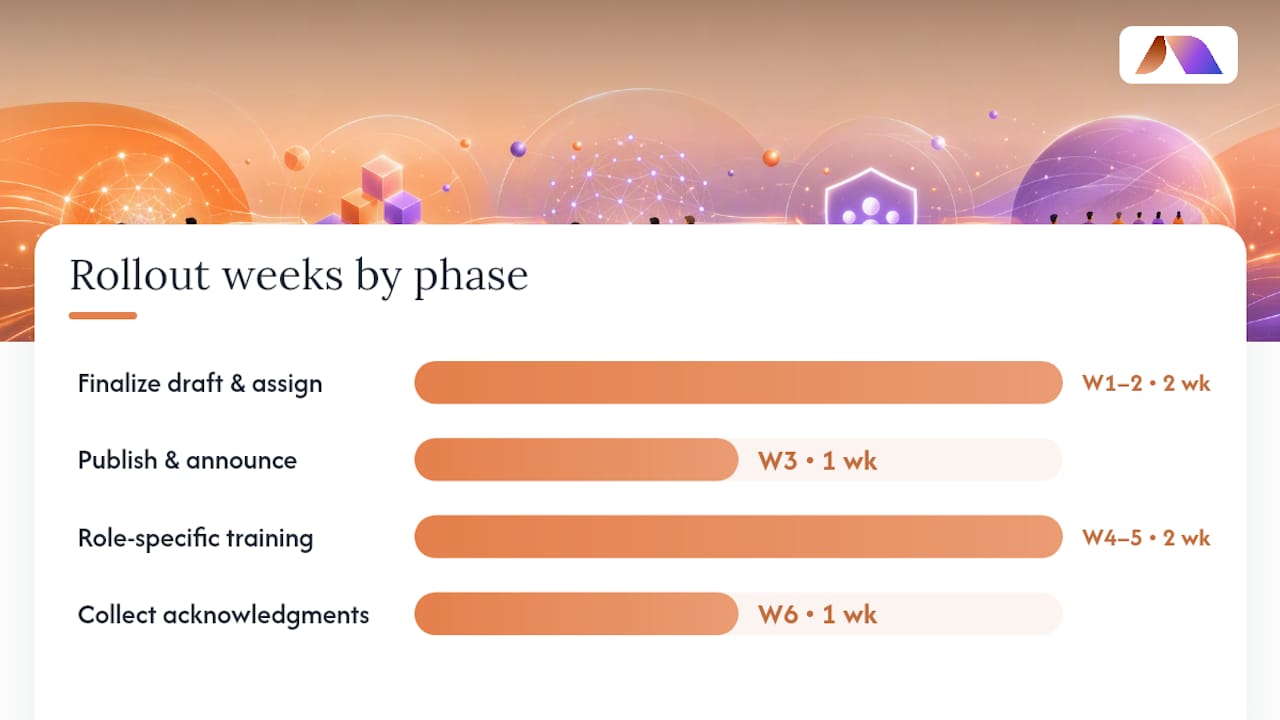
Run it on a six-week clock:
Weeks 1 to 2: finalize the policy draft with legal review, assign a policy owner, and identify department AI champions who’ll field questions.
Week 3: publish the policy and the approved-tools list; announce via an executive sponsor, not just an HR email.
Weeks 4 to 5: run role-specific training. A finance team needs different examples than a marketing team.
Week 6: collect signed acknowledgments and log completion dates for every employee.
Training should include a core module everyone takes and shorter role-specific add-ons for teams with elevated risk, like sales or legal. Set a minimum pass score on a short comprehension quiz (80 percent is typical) and require recertification annually or whenever the tools list changes materially.
Resist the urge to ban tools outright to feel safe. Practitioner guidance on generative AI governance consistently finds that outright bans push employees toward unsanctioned consumer tools rather than eliminating AI use. Give people an approved enterprise alternative instead, and shadow AI drops because there’s no reason left to go around the policy.
Pro Tip: Have your AI champions collect the ten most common employee questions during week 3 and publish an FAQ addendum by week 5. Most policy confusion comes from three or four recurring scenarios, and answering them in writing kills the need for one-off email chains.
What Should You Monitor and Keep for Audits?
Audit readiness comes down to a handful of records, kept current, not a sprawling compliance program. Insurance carriers and legal reviewers increasingly ask for AI governance artifacts at renewal, and you want to hand them a folder, not a scramble.
Evidence type | What to keep | Review trigger |
|---|---|---|
Acknowledgment logs | Signed date, employee name, policy version | Any policy update |
Training records | Completion date, quiz score, module version | Annual or on tool-list change |
Approved-tools history | Dated versions showing what changed and when | Vendor contract change |
Vendor due-diligence files | Data handling terms, certifications, retention settings | New vendor or renewal |
Build these into a single exportable packet so any authorized reviewer can get what they need in under a minute, not after a week of chasing down files. Trigger an immediate policy review after any AI-related incident, any vendor’s terms-of-service change, or new state or federal regulation touching automated decision-making. Littler’s guidance treats scheduled audits and policy updates as the baseline expectation, not an optional extra.
Copy-Ready Clauses You Can Adapt
These starter clauses aren’t legal advice. They’re a drafting shortcut for your legal review, borrowed from the structure of leading templates.
Tool tiering: “Employees may use only tools listed in Appendix A (Approved) without manager sign-off. Tools in Appendix B (Restricted) require written manager approval. All other tools are prohibited for work use.”
Prohibited inputs: “Employees may not input customer personally identifiable information, protected health information, trade secrets, or any data covered by an active non-disclosure agreement into any AI tool, approved or otherwise.”
Human review: “No AI-generated output may be used, in whole or part, to make or substantially inform a hiring, termination, discipline, compensation, or promotion decision without documented human review by a qualified manager.”
Acknowledgment: “I have read and understood the AI Usage Policy dated [date] and agree to complete recertification training within 12 months or upon material policy revision.”
What Working With Clients Has Taught Us About AI Governance
Every AI policy engagement we have scoped starts the same way: a client with either no policy or a two-year-old one written before agentic tools existed. The smallest useful governance package isn’t the fifteen-page document. It’s the scope statement, the tiered tools list, and a signed acknowledgment. Everything else can follow once those three exist and get used.
The pattern we see most often isn’t malice. It’s well-meaning employees solving a real problem with whatever tool is fastest, because the approved list either doesn’t exist or hasn’t kept pace with what people actually need to do their jobs. A policy written once and never revisited institutionalizes that gap instead of closing it.
— Team BRDGIT
Get Help Turning a Policy Template Into an Operating System
A downloaded template gets you 60 percent of the way. The other 40 percent, the part where the policy actually reflects your tools, your risk tolerance, and your industry’s regulatory exposure, is where most HR teams get stuck without dedicated AI expertise on staff. We help close that gap through a readiness assessment that maps your actual AI usage against your risk exposure, a policy customization workshop that turns bracketed template placeholders into decisions your leadership signs off on, and role-specific training modules your employees complete and get logged.

For organizations that need this expertise without a full-time hire, BRDGIT’s fractional AI support gives you an experienced practitioner scoped to your policy rollout, your vendor review process, and your ongoing monitoring needs, without the overhead of a permanent role. If your current approach to AI oversight is a shared document nobody’s updated since last year, a scoped readiness call is the fastest way to find out exactly where the gaps are and what fixing them actually requires. Request that call, get a specific list of what your policy is missing, and decide from there whether you need a one-time workshop or ongoing fractional support.
Primary Templates and Legal Guidance to Consult
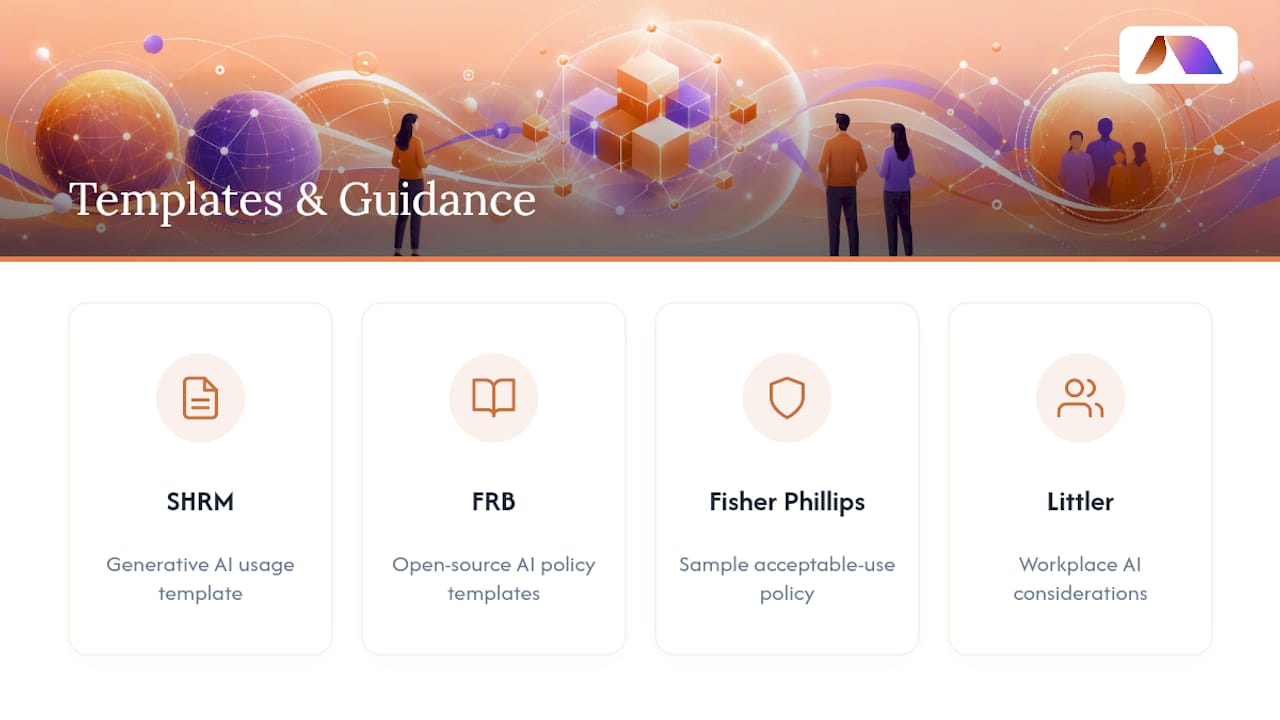
Review these directly before finalizing anything: SHRM’s generative AI usage template, FRB’s open-source AI policy templates, Fisher Phillips’ sample acceptable-use policy, and Littler’s workplace AI considerations. Law firms specifically should map their policy to ABA Formal Opinion 512’s supervision requirements. None of this replaces your own employment counsel’s review before publication.
This article is general information, not a substitute for advice from a qualified lawyer. Consult a qualified legal professional about your own circumstances before acting on anything here.
Sources
FAQ
What Should an Employee AI Policy Include?
At minimum: scope and definitions, an approved and prohibited tools list, data classification rules with concrete examples, human-review requirements for consequential decisions, disclosure rules, security controls, and a disciplinary framework for violations.
What Is the 30% Rule in AI?
There’s no single, universally recognized “30% rule” in AI governance; the phrase gets used inconsistently across different contexts, so treat any specific number you see quoted for it with caution and verify the source before repeating it.
Which Jobs Are Least Likely to Survive AI Disruption?
No credible source can name three specific jobs guaranteed to disappear, since AI’s effect on any role depends on task composition, not job titles; roles built entirely around routine data entry, basic transcription, and simple content summarization face the most displacement pressure, while roles requiring judgment, physical presence, or relationship management are more resistant.
Do Small Businesses Need a Formal AI Policy?
Yes, if employees use AI tools for client-facing work, sensitive data, or decisions affecting people, a business of any size needs written guidance, even if it’s a single page rather than a lengthy document.
How Often Should an AI Policy Be Updated?
Quarterly review is a common baseline, with immediate updates triggered by an incident, a vendor’s terms-of-service change, or new regulation, rather than waiting for a fixed annual cycle.



