Published on
What Is AI Risk Management in Construction for PMs?
AI risk management in construction is the practice of using machine learning, natural language processing, and computer vision to identify, quantify, and mitigate cost, schedule, quality, and safety risks, with humans still making final calls. Sentence-BERT models tested against real accident reports have hit an F1 score of 0.8571, which sounds impressive until you learn what happens across different job sites. Most frameworks map cleanly onto risk structures your team already uses, like PMBOK or ISO 31000, so adoption doesn’t mean throwing out your existing process.
If you’re starting from zero, three moves matter more than the rest:
Run a scoped pilot on one risk category before touching your whole portfolio.
Keep a human reviewer on every AI-flagged output, no exceptions.
Audit your data quality first. Bad inputs produce confident, wrong answers.
BRDGIT works with teams that need a fractional partner to build this out without hiring a full AI department.
Key Takeaways
Effective AI risk management in construction combines targeted AI methods with mandatory human review, cross-project validation, and governance controls mapped to existing risk frameworks.
Point | Details |
|---|---|
Start narrow | Pilot one risk category on one site before expanding scope. |
Validate across projects | Cross-project F1 can drop sharply, so test beyond the original dataset before trusting results. |
Keep humans in the loop | Every AI flag needs a named reviewer with authority to override it. |
Fix data before buying tools | Labeling gaps and fragmented storage break models faster than bad algorithms do. |
Get fractional support if scoped thin | BRDGIT offers readiness assessments and fractional engineering to run pilots without a full-time AI hire. |
Table of Contents
Why Should Construction Project Managers Care About AI Risk Management?
What AI Methods Actually Drive Construction Risk Analysis?
What Are the Biggest AI Risks on a Construction Project?
What Data Do You Need Before Deploying AI Risk Tools?
How Do You Roll Out AI Risk Management Step by Step?
Who Should Own AI Risk Decisions on Your Project?
How Do You Validate AI Outputs Before Trusting Them?
What Should a PM Check Before Approving an AI Pilot?
What Do Real AI Risk Pilots Actually Show?
What Have AI Implementation Teams Learned in the Field?
Getting Help Executing an AI Risk Roadmap Safely
Sources
Why Should Construction Project Managers Care About AI Risk Management?
The upside is concrete. AI flags safety hazards before a foreman walks the site, cuts document review time on contracts and RFIs, and catches cost overruns weeks earlier than a monthly variance report would. That’s the pitch every vendor makes, and it’s true as far as it goes.
The limits are just as real. Models trained on someone else’s job sites degrade when applied to yours. A systematic review of 392 studies found AI methods perform well within their trained domain but struggle to generalize without retraining. Overreliance is the other trap: teams start treating an AI flag as ground truth instead of a lead worth checking.
Fewer cost overruns from earlier variance detection
Faster compliance review on contracts and permits
Earlier safety alerts, but only as good as the camera feed and labeling behind them
Pro Tip: Pilot AI risk tools on your highest-frequency, lowest-stakes risk category first, like PPE detection on a single active site, before touching anything tied to contractual liability.
What AI Methods Actually Drive Construction Risk Analysis?
Five methods do most of the work, and each one solves a different problem. Knowing which one applies to your risk saves you from buying the wrong tool.
Machine learning predicts delay and cost overruns from historical schedule and budget data. Accuracy and mean absolute percentage error are the metrics that matter here.
Natural language processing scans contracts, RFIs, and change orders for compliance gaps and ambiguous clauses. Precision and recall determine whether it catches the risky language without flagging everything.
Computer vision, often built on the YOLO detection algorithm, spots missing PPE or unsafe behavior in real time from site cameras.
Knowledge-based reasoning supports decisions by encoding expert rules, useful for permit sequencing and code compliance logic.
Optimization algorithms handle scheduling and resource allocation across competing constraints.
A broad literature review mapped all five to mainstream cost, time, and safety management functions, confirming these aren’t experimental niche tools anymore. They’re the standard toolkit.
What Are the Biggest AI Risks on a Construction Project?
Research on generative AI adoption in construction sorts the danger into five categories: input quality, technological adaptability, ethical and governance concerns, information integrity, and financial or operational exposure. Human error and data unavailability ranked as the most significant concerns in that study’s risk taxonomy. In practice, these show up as specific failure modes:
Missing or unlabeled data that quietly breaks a model’s assumptions
Model drift after retraining on a new site’s conditions
False positives on safety alerts that erode trust and get ignored
Hallucinated contract clauses from an LLM that sounds authoritative but is wrong
Pro Tip: *Rank pilot risks by blast radius, not likelihood.
What Data Do You Need Before Deploying AI Risk Tools?
Data requirements track directly to method. Computer vision needs labeled images or video from your actual sites, not stock footage. Machine learning for cost and schedule prediction needs clean historical project records. NLP tools need a real corpus of contracts, RFIs, and change orders.
The failures are predictable: missing labels, inconsistent project scopes across your historical data, records scattered across three systems that don’t talk to each other, and privacy gaps in worker-facing video data.
Inventory what data you actually have before talking to any vendor
Fix labeling gaps on a sample set before scaling
Confirm one system of record, not five spreadsheets
Flag any worker-identifiable data and resolve privacy handling upfront
How Do You Roll Out AI Risk Management Step by Step?
A pilot that skips steps almost always stalls at scale. This sequence keeps the risk contained while you build confidence in the tool.
Scope one risk category and one site or project phase. Don’t try to solve safety, cost, and compliance at once.
Audit and prepare data for that specific use case, including labeling and storage cleanup.
Design the pilot with a defined acceptance threshold before you start, not after you see results.
Run the pilot with a human reviewer checking every output against the acceptance criteria.
Validate against a second project to test whether performance holds outside the original dataset.
Roll out in phases, expanding to more sites only after the validation step clears.
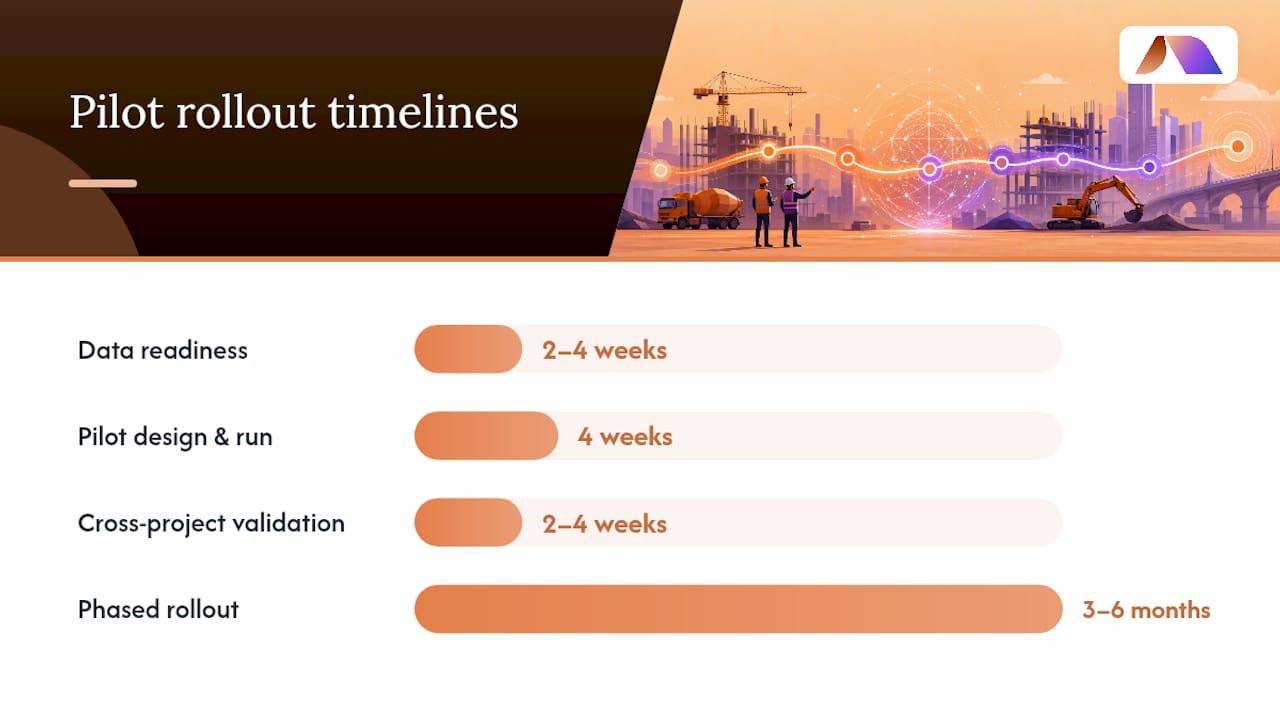
Phase | Timeline | Cost Focus |
|---|---|---|
Data readiness | 2–4 weeks | Labeling, cleanup, system consolidation |
Pilot design and run | 4 weeks | Model setup, integration, fractional engineering support |
Cross-project validation | 2–4 weeks | Testing, threshold tuning |
Phased rollout | 3–6 months | Training, monitoring dashboards, ongoing support |
The go/no-go decision belongs at the end of validation, not the end of the pilot. If cross-project accuracy drops sharply, as it often does, that’s your signal to fix the model before scaling, not a reason to abandon the approach. BRDGIT’s workflow automation guidance covers how this integrates with BIM and existing planning tools.
Who Should Own AI Risk Decisions on Your Project?
AI doesn’t replace your risk process, it feeds it. Someone still has to own the call, and that ownership needs to be explicit before the pilot starts, not sorted out after something goes wrong.
Role | Responsibility |
|---|---|
PM owner | Sets scope, owns the go/no-go decision |
Data steward | Maintains data quality and lineage |
Safety reviewer | Validates safety-related AI flags before action |
Legal/compliance reviewer | Checks NLP contract outputs for accuracy |
Fractional AI engineer | Handles model tuning, integration, monitoring |
Governance controls that matter: explainability (can you trace why the model flagged something), audit trails, access control on who can override an alert, and a documented change-management process for model updates.
Ask vendors: “Can you show me your model’s performance on a project outside your training set?”
Ask vendors: “What does your audit trail look like when a human overrides an output?”
Red flag: no traceable data lineage
Red flag: vendor can’t explain how the model reached a conclusion
An AI Bill of Materials approach, borrowed from software supply-chain security, gives you a useful model for demanding component-level transparency from AI vendors.
How Do You Validate AI Outputs Before Trusting Them?
Validation metrics differ by method. Computer vision and NLP tools get judged on accuracy, recall, and F1 score. Cost and schedule regression models get judged on mean absolute error or mean absolute percentage error.
The Sentence-BERT risk model referenced earlier hit F1 = 0.8571 on its original dataset but dropped to F1 = 0.5607 when tested across a different project. That gap is the entire argument for cross-project validation before you trust any vendor’s headline number.
Test on your own historical data, not just the vendor’s demo dataset
Set a minimum sample size before drawing conclusions, small pilots produce noisy results
Monitor drift, alert-rate shifts, and human override rates once in production
Treat a rising override rate as an early warning, not a nuisance
What Should a PM Check Before Approving an AI Pilot?
Keep this list next to your pilot kickoff notes.
Confirm the data source is traceable and the labeling is consistent.
Require a documented human review gate on every output category.
Set a minimum acceptance threshold (accuracy, recall, F1, or MAPE) before the pilot starts.
Stop the rollout if the vendor can’t explain how the model reaches its conclusions.
Stop the rollout if there’s no override or audit mechanism.
Confirm privacy handling for any worker-facing video or biometric data.
Keep it printed, keep it short, and use it every time a new tool comes up for review.
What Do Real AI Risk Pilots Actually Show?
The Sentence-BERT framework mentioned above tested against 1,368 accident reports and 484 inspection records, hitting recall of 1.00 and accuracy of 0.75 in its original setting, which means it caught nearly every real risk but also flagged some false positives. That’s a reasonable trade for a safety net; it’s a bad trade for a tool making financial decisions unsupervised.
Computer vision built on YOLO-style detection remains the most commonly cited approach for PPE and unsafe-behavior monitoring, largely because it runs in real time on standard site cameras.
LLM-assisted risk identification speeds up awareness, especially for less experienced staff
The same LLM pilots showed experienced professionals catching contextual gaps the model missed entirely
An F1 near 0.86 on in-sample data is strong; expect real-world performance to sit closer to the cross-project figure until proven otherwise on your own sites
What Have AI Implementation Teams Learned in the Field?
Scoping is where most pilots go wrong before they even start. Teams that name one risk category and one site tend to succeed; teams that promise “AI for all our risk” tend to stall for months.

Prompt engineering and iterative review aren’t optional extras, they’re the actual work. Training timelines run longer than vendors quote, usually because change management, not the tool itself, is the bottleneck.
Automation complacency creeps in fast once a model performs well for a few weeks. Pro Tip: Schedule a monthly override-rate review even after a pilot succeeds, because the moment your team stops questioning the model is the moment it stops earning trust.
Getting Help Executing an AI Risk Roadmap Safely
Running this roadmap in-house without dedicated AI expertise is where most timelines slip, not because the plan is wrong, but because nobody has bandwidth to own validation, vendor vetting, and rollout at once.
BRDGIT works with construction teams as a fractional partner, starting with an AI readiness assessment that maps your data gaps and risk priorities, then moving into pilot design, model integration, and staff training. Engagements typically run assessment first, pilot second, then ongoing fractional engineering support for teams that need continued execution without hiring a full-time AI staff. That structure matters because most of the risk in this roadmap sits in the handoff between pilot and production, exactly where fractional support fills the gap. If you’re ready to see where your project stands, start with a readiness conversation through BRDGIT’s fractional engineers page.