Published on
What AI Actually Does for Shelf Replenishment in 2026
AI’s role in shelf replenishment automation is simple to state and hard to execute: it turns raw demand signals into executed replenishment actions, closing the loop between forecast and fulfillment without waiting on a human to push a button. That closed-loop pattern, sometimes called agentic AI, is why a 2026 NVIDIA survey found a significant share of retail and CPG supply chain leaders name operational efficiency and throughput as their top reason for investing in AI. Supply Chain Management Review makes the caveat that matters here: AI only pays off when it’s paired with real operational change, not bolted onto the same broken process as a dashboard nobody checks.
For teams weighing where to start, the practical framing is this: forecasting tells you what’s about to run out, but forecasting alone doesn’t restock a shelf. The value shows up when the system is trusted to act, whether that’s cutting a purchase order, triggering a store-to-store transfer, or dispatching a robot down aisle 7. BRDGIT sees this pattern repeatedly with clients moving from AI curiosity to execution: the gap isn’t intelligence, it’s authority to act.
Here’s what teams typically see once the loop actually closes:
Fewer out-of-stocks on high-velocity SKUs, especially during promotions
Higher on-shelf availability without carrying excess buffer stock everywhere
Lower working capital tied up in slow-moving safety stock
Meaningful labor savings on manual counting, walking, and reorder paperwork
Key Takeaways
AI closes the shelf replenishment loop by converting demand signals directly into executed actions, and the biggest gains come from pairing that automation with real operational change.
Point | Details |
|---|---|
AI’s core job is execution | Forecasting alone doesn’t restock shelves; value comes from agents authorized to act on POs and transfers. |
Track cycle time and OOS rate | PO cycle time proves the pilot works; OOS rate and inventory turns prove it scales. |
Start narrow, then expand | A focused pilot on high-velocity SKUs beats a network-wide rollout with unproven models. |
Fix on-hand accuracy first | Clean store-level inventory data unlocks forecast and execution accuracy faster than any other fix. |
Get fractional support to bridge gaps | BRDGIT’s fractional engineers help teams close the loop on model ops, integration, and agent governance without a full-time hire. |
Table of Contents
The Role of AI in Shelf Replenishment Automation: Core Applications
Building the Technology Stack Behind Automated Replenishment
Measuring the Benefits: KPIs That Prove Replenishment AI Works
Where AI-Driven Shelf Replenishment Runs Into Trouble
A Phased Rollout Plan for Automated Inventory Replenishment
Where AI in Retail Logistics Is Headed Next
What BRDGIT Has Learned From Client Engagements
How BRDGIT Helps Teams Move From Pilot to Scaled Replenishment AI
Frequently Asked Questions
Sources
The Role of AI in Shelf Replenishment Automation: Core Applications
The functional toolkit behind AI-driven shelf replenishment breaks into six applications, and none of them work in isolation. Demand sensing and forecasting sits at the foundation, pulling store-level and SKU-level signals rather than relying on regional or category averages that smear out local patterns. From there, dynamic safety-stock and reorder-point adjustment recalculates buffers continuously instead of relying on a quarterly review, reacting to shifting lead times and seasonal demand swings in near real time.
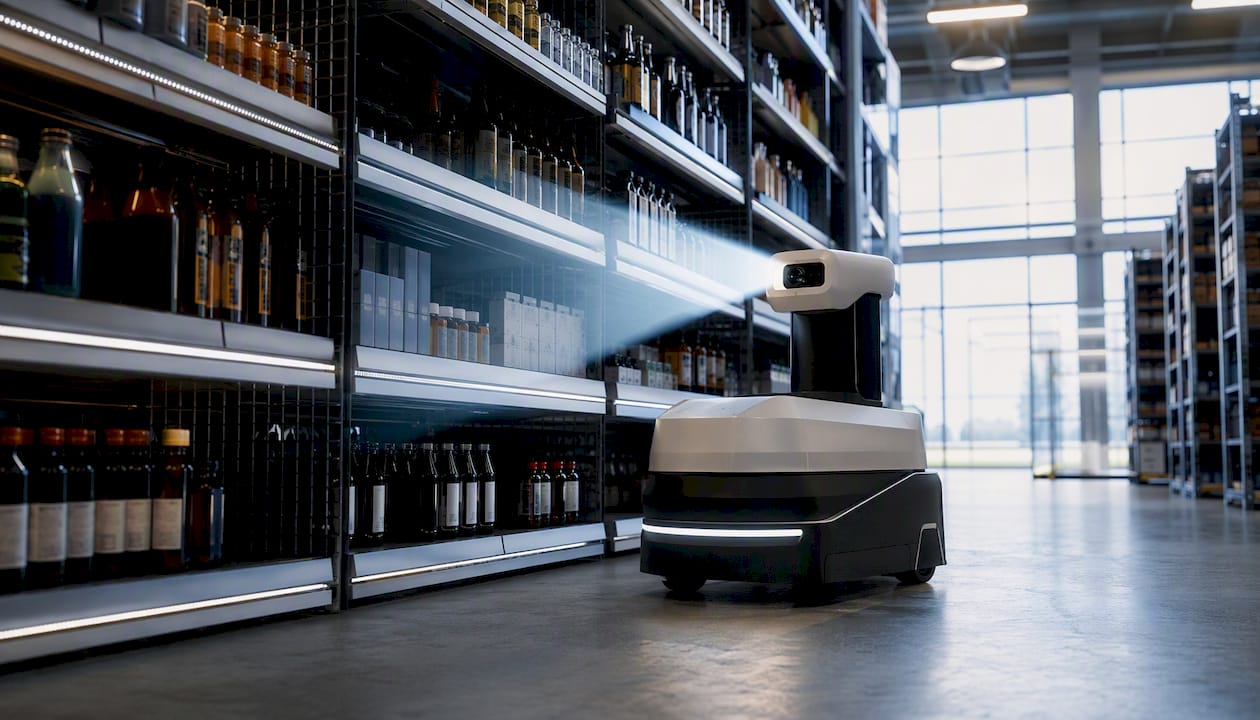
Automated reorder creation and execution is where the “agentic” label earns its keep. Instead of surfacing a recommendation for a planner to approve, the system generates and submits the purchase order or intra-store transfer directly, with humans reviewing exceptions rather than every transaction. Planogram compliance and fronting checks use computer vision to confirm shelves match the intended layout and catch product that’s slid out of place. Out-of-stock detection, also vision-based, scans shelves through fixed cameras, handheld devices, or mobile robots to flag empty facings before a customer notices. Intra-network rebalancing rounds out the list, shifting inventory between nearby stores when one location is overstocked and another is running dry, avoiding a wasted trip back to the distribution center.
Application | Typical inputs required | Common technique | Near-term impact |
|---|---|---|---|
Demand sensing/forecasting | POS history, promo calendar, foot traffic | Time-series ML, causal uplift models | Sharper store-level accuracy, fewer blanket buffers |
Dynamic safety stock | On-hand, lead-time variance, service targets | Statistical reorder-point models | Lower carrying cost without raising stockout risk |
Automated reorder execution | Inventory master, supplier terms, POS | Rule-based agents + ML triggers | Faster cycle time from signal to PO |
Planogram compliance | Store imagery, planogram metadata | Computer vision | Fewer merchandising errors, better fronting |
Out-of-stock detection | Shelf imagery, SKU catalog | Computer vision, robotics | Earlier OOS catch, reduced lost sales |
Intra-network rebalancing | Multi-store on-hand, transfer costs | Optimization/RL | Less markdown risk, better use of existing stock |
Vision and robotics carry the heaviest infrastructure lift, since they require cameras, connectivity, and sometimes physical hardware on the floor. Forecasting, reorder-point adjustment, and automated PO generation are software-only and usually deliver the fastest early wins because they plug into data you likely already collect. Robotics and full planogram automation tend to pay off over a longer horizon, once the software layer is proven and trusted.
Building the Technology Stack Behind Automated Replenishment
Smart inventory systems for shelf replenishment run on a fairly consistent architecture, even when vendors dress it up differently. Point-of-sale data feeds an event stream layer, which updates an inventory master or warehouse management system, which in turn feeds demand models and a feature store. An execution agent, the order generator or transfer orchestrator, sits downstream of the models and connects out to supplier, procurement, and transportation management systems to actually move product.
A few technologies make that pipeline work in practice:
Real-time event streaming (Kafka-style patterns) so on-hand counts update continuously instead of on a nightly batch
A feature store that keeps demand signals, promotional flags, and store attributes consistent across models
Time-series forecasting and causal uplift models to separate baseline demand from promotional lift
Reinforcement learning for allocation decisions where trade-offs shift constantly, like rebalancing across a store network
Computer vision models for out-of-stock and planogram detection, often paired with edge devices for speed
Data hygiene determines whether any of this works. Retailers need POS data refreshed frequently enough to matter (hourly beats daily for high-velocity categories), accurate store-level on-hand counts, realistic supplier lead-time distributions rather than a single average number, a clean promotional calendar, and consistent planogram and SKU hierarchy metadata. DHL’s approach is instructive here: the company standardized processes and cleaned up its data backbone for years before scaling agentic automation and now runs thousands of autonomous warehouse robots across its network.
Pro Tip: If you can only fix one data source first, fix store-level on-hand accuracy. Forecasts built on bad inventory counts produce confident, wrong reorder recommendations, and that error compounds every time the model retrains on its own mistakes.
Measuring the Benefits: KPIs That Prove Replenishment AI Works
The benefits of automated inventory replenishment are consistent across implementations: fewer stockouts, better inventory turns, less capital tied up in safety stock, and real labor savings on manual counting and reordering. But benefits only mean something if you’re tracking the right numbers before, during, and after rollout.
That NVIDIA survey figure, 51% of retail and CPG supply chain leaders prioritizing operational efficiency and throughput as their top AI driver, is worth sitting with. It confirms the industry isn’t chasing AI for novelty. Leaders are chasing it because the operational math, fewer walked aisles, fewer missed sales, tighter inventory, actually closes gaps that manual processes can’t close fast enough.
KPI | What it measures | How to calculate | Directional target |
|---|---|---|---|
Out-of-stock rate | Share of time/SKUs with zero on-shelf inventory | OOS instances / total SKU-days observed | Meaningful reduction from pilot baseline |
Fill rate | Orders fulfilled complete and on time | Units shipped complete / units ordered | Incremental improvement quarter over quarter |
Inventory turns | Speed inventory sells through | Cost of goods sold / average inventory value | Higher turns without added stockout risk |
Days of supply | Buffer coverage at current sales pace | On-hand units / average daily sales | Tighter range, fewer extremes |
Forecast accuracy | How close predictions land to actuals | 1 minus (mean absolute % error) | Improving trend, not a single target number |
PO cycle time | Speed from signal to executed order | Time from trigger to order submission | Sharp drop once execution is automated |
Some vendors advertise dramatic numbers, including claims of high forecast accuracy and large stockout reductions. Treat marketing figures like that as a hypothesis to test in your own pilot, not a guarantee, since results depend heavily on your data quality and category mix. Forecast accuracy and PO cycle time are the KPIs to watch during an early pilot, since they tell you whether the model and the execution agent are behaving as intended. OOS rate, fill rate, and inventory turns are the metrics that matter once you scale, because they reflect the compounding effect across a full store network.
Where AI-Driven Shelf Replenishment Runs Into Trouble
No serious conversation about artificial intelligence shelf stocking skips the failure modes, and there are several worth planning around before you write a single line of code.
Poor data quality, especially inaccurate on-hand counts, quietly poisons every downstream model
Siloed systems (POS, WMS, ERP not talking to each other) block the closed loop before it starts
Supplier lead-time volatility throws off reorder-point math that assumes a stable average
Vision-based OOS detection produces false positives in cluttered scenes or with small training datasets
Robots face a genuine “last-meter” problem navigating narrow, crowded retail aisles safely
Organizational resistance slows adoption even when the technology itself works fine
The precision and recall trade-off in vision detection deserves specific attention. A model tuned to catch every possible out-of-stock (high recall) will also flag plenty of shelves that are actually fine, generating alert fatigue among store staff who stop trusting the system. A model tuned to minimize false alarms (high precision) risks missing real gaps. Recent architecture work addresses this directly: a two-tier design pairing an on-device detector with cloud-based transformer validation can reduce false positives while holding recall steady, which matters because store associates who get burned by bad alerts stop checking them within weeks.
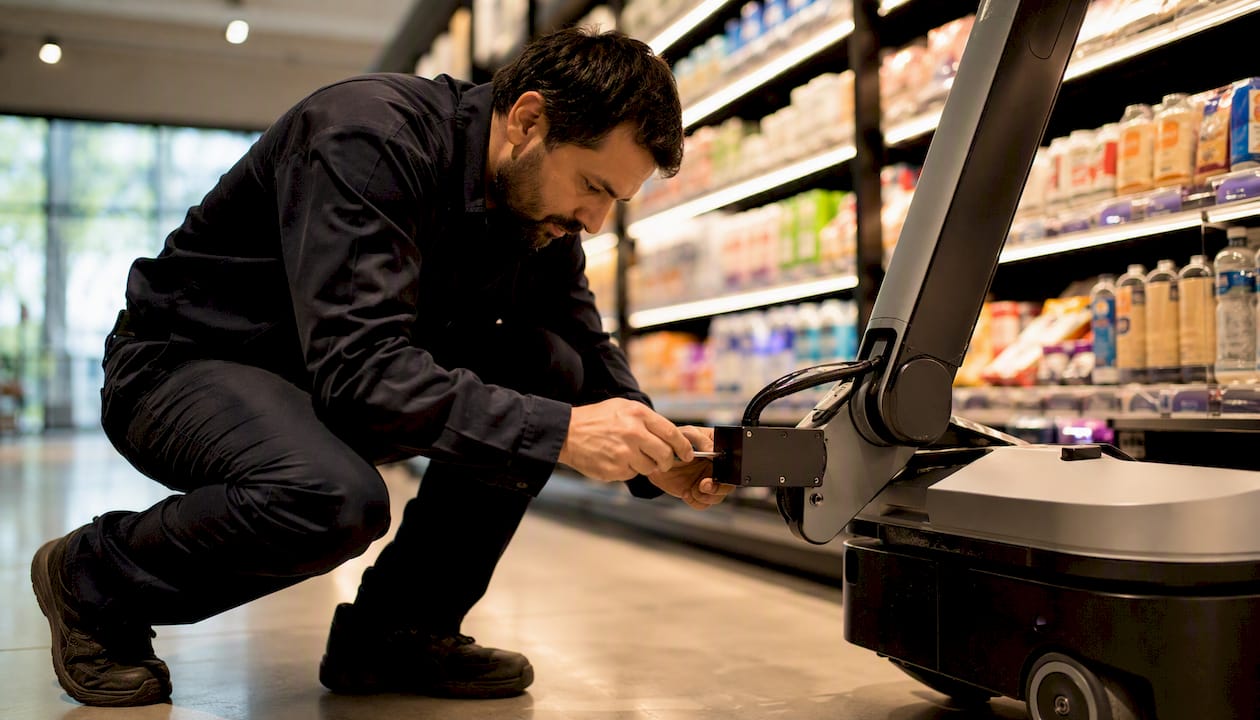
Robotics carries its own honest limitation. Research on end-to-end mobile manipulation for autonomous shelf stocking shows robots can hit high success rates in controlled tests but still often trail human workers on speed and cost-effectiveness. Robotics is progressing quickly, but it’s capital-intensive and best deployed after the software layer is already proven.
Pro Tip: Set a human-in-the-loop verification threshold for the first 60 to 90 days of any vision-based rollout. Route every flagged out-of-stock through a quick human check until you have enough data to trust the model’s confidence scores unsupervised, then dial back oversight as accuracy holds.
A Phased Rollout Plan for Automated Inventory Replenishment
The teams that succeed with AI in retail logistics almost never start network-wide. They start narrow, prove the loop closes cleanly, and expand from there.
Readiness assessment. Audit POS refresh cadence, on-hand accuracy, supplier lead-time data, and system integration gaps before touching a model.
Focused pilot. Pick one or two stores and a narrow set of high-velocity SKUs where a stockout is costly and visible.
Iterate on models and rules. Tune forecast accuracy and execution thresholds using real pilot results, not lab data.
Expand to more stores or regions. Scale once the pilot hits its quantitative success criteria, not on a fixed calendar date.
Move to agentic execution and supplier integration. Grant the system authority to submit orders and transfers directly, with exception-based human review.
Continuous improvement. Retrain models on new promotional patterns, seasonal shifts, and supplier changes on a set cadence.
Each phase needs its own checklist. A pilot needs a clean baseline of current OOS rate and fill rate, sign-off from store operations and merchandising, and a minimum tech stack (POS feed, inventory master, and a forecasting model at minimum). Scaling needs governance roles defined ahead of time: who owns model performance, who approves exception overrides, and who has authority to pause agentic execution if something looks wrong.
A realistic timeline runs three to twelve months from readiness assessment to full agentic execution, with decision gates at the end of the pilot phase and again before full-network rollout. Build in the artifacts that back credible AI work at each gate: documented data lineage, a performance baseline from before the AI system existed, an A/B or holdout comparison design, and a written human-oversight policy, echoing the kind of governance guidance found in IEEE’s published work on AI for replenishment and labor management.
Pro Tip: Fractional engineering pays off most in the phases that require specialized, short-duration expertise, model operations tuning during the pilot, system integration work connecting POS to WMS to supplier systems, and agent governance design before scaling execution authority. Full-time hires for these phases often sit idle between projects; a fractional model, which is what BRDGIT provides, lets you access that expertise exactly when the roadmap calls for it. See BRDGIT’s retail AI readiness checklist for a starting audit template.
Where AI in Retail Logistics Is Headed Next
A handful of trends will shape how AI improves shelf replenishment over the next two to three years, and vendor and platform decisions made today should account for them.
Agentic AI orchestration will increasingly span multiple platforms, not just one vendor’s closed system
Reinforcement learning will take on more allocation and routing decisions where trade-offs shift constantly across a store network
Transformer-based vision models paired with distributed validation architectures will keep pushing false-positive rates down
Lower-cost AMRs (autonomous mobile robots) will chip away at the last-meter navigation problem, though slowly
Tighter integration between planning and execution, sometimes framed as digital twins, will shrink the gap between forecast and action
Some of these, like reinforcement learning for allocation and better vision validation, are attainable through software upgrades on an existing stack. Others, particularly wider robotics deployment, require real capital investment and a longer payback horizon. The sensible posture is to monitor robotics maturity closely without over-committing capital until the software-first foundation, forecasting, dynamic safety stock, automated execution, is already delivering measurable results. Adopt the software layer now; treat the physical layer as a second phase once ROI data from your own pilots justifies it.
What BRDGIT Has Learned From Client Engagements
The pattern BRDGIT sees across engagements is consistent enough to state plainly: the companies that get value from replenishment AI treat it as a workflow change first and a technology purchase second. A few lessons stand out.
Start smaller than feels comfortable. A two-store, ten-SKU pilot that actually closes the loop beats a network-wide rollout that only forecasts.
Make AI part of the existing workflow, not a separate dashboard store associates have to remember to check.
Define execution authority explicitly. Decide up front what the agent can do without approval and what always routes to a human.
Prioritize speed to a working pilot over a perfect model. A rough forecast that triggers real action teaches you more than a polished one that sits unused.
Pro Tip: Write a closed-loop SLA before you go live: how fast an agentic decision executes, what confidence threshold triggers automatic action versus human review, and who gets the escalation when something looks wrong. Teams that skip this step usually end up disabling automation after the first bad order, even when the underlying model was fine.
Teams without the internal bandwidth to build and govern this stack alone don’t need to hire a full department to get moving. That’s precisely the gap fractional AI engineering exists to close.
How BRDGIT Helps Teams Move From Pilot to Scaled Replenishment AI
BRDGIT gives retail and distribution teams the missing execution layer between “we have a forecasting idea” and “the system actually places orders.” Instead of a six-month hiring search for AI engineering talent you’ll only need part-time once the pilot stabilizes, BRDGIT plugs experienced AI engineers directly into your roadmap for exactly the phases that need them.
BRDGIT’s offerings map directly onto the rollout plan covered above: AI readiness assessments to catch data and integration gaps before a pilot starts, fractional engineers for model operations and system integration work, and pilot-to-scale support for the governance and agent-authority decisions that trip up most in-house teams. BRDGIT adds the most value when a team has the retail domain knowledge but lacks the AI engineering capacity to connect POS, inventory, and supplier systems into a working closed loop, or when leadership wants a rapid, well-governed pilot instead of a slow internal build. If your team is ready to move past forecasting dashboards and into agentic execution, start with a conversation about BRDGIT’s fractional engineers and where they’d plug into your current stack.
Frequently Asked Questions
What is the role of AI in shelf replenishment automation? AI’s role is to sense demand at the store and SKU level, decide what needs restocking, and execute that decision, whether as a purchase order, a store transfer, or a robotic restock, without waiting for manual approval on every transaction.
How does AI improve shelf replenishment compared to traditional methods? Traditional replenishment relies on periodic manual counts and static reorder points. AI-driven systems update forecasts and safety stock continuously and can trigger execution automatically, cutting the delay between an emerging stockout and the corrective order.
What technology is required for automated inventory replenishment? At minimum, teams need integrated POS and inventory data, a demand forecasting model, and an execution layer that can generate orders or transfers. Vision-based OOS detection and robotics add capability but aren’t required to start.
What KPIs prove AI-driven shelf management automation is working? Out-of-stock rate, fill rate, inventory turns, days of supply, forecast accuracy, and PO cycle time together give a full picture, with cycle time and forecast accuracy mattering most during early pilots.
What’s the biggest limitation of AI in shelf replenishment today? Data quality and system integration cause more failures than the AI models themselves. Vision-based detection also faces a real precision and recall trade-off, and robotics still struggles with safe navigation in cluttered aisles.
Sources
Retail supply chain professionals validating claims or exploring the technical literature behind AI-driven replenishment should start with these.
Successful AI in retail only works when operations change with it - Supply Chain Management Review
End-to-end mobile manipulation for autonomous shelf stocking (arXiv)
Distributed vision and validation architectures for robust out-of-stock detection (journal source)