
Published on
The Role of AI in Membership Retention for Association Leaders
AI keeps members from quietly leaving by predicting who’s at risk, personalizing outreach before they disengage, and automating the follow-through your staff doesn’t have time for. That is the role of AI in membership retention, in one sentence. The rest of this article is the how.
Predictive scoring flags at-risk members weeks before a renewal deadline, not after.
Personalization at scale matches outreach to what each member actually cares about.
Automated workflows turn a risk score into a timely email, call task, or offer without a staff member remembering to trigger it.
Organizations following the NIST AI Risk Management Framework for governance and referencing standards work from groups like ASAE tend to avoid the two most common failure modes: models nobody trusts and pilots that never scale. If you’re a membership leader at BRDGIT’s typical client size, here’s your next move: pull 24 months of engagement and renewal data this week and scope a 90-day pilot on a single at-risk segment. That’s it. Don’t wait for a perfect dataset.
Key Takeaways
AI improves membership retention by turning scattered engagement data into an early-warning system that lets staff intervene before a member decides to leave.
Point | Details |
|---|---|
Start with churn scoring | Build the predictive model before adding personalization or automation layers on top. |
Consolidate household data | Group members by household and geocode addresses to sharpen risk predictions. |
Pilot on one segment | Test on a single chapter or cohort for 30 to 90 days before scaling organization-wide. |
Track renewal lift with a holdout | Measure a control group against your pilot cohort to prove causal impact, not correlation. |
Get expert help scoping the pilot | BRDGIT’s fractional AI engineers can run the readiness assessment and build the pilot model. |
Table of Contents
Why AI Actually Moves the Needle on Member Retention
Which AI Use Cases Should Membership Teams Pilot First?
What Data Signals Actually Predict Churn?
How Do You Roll Out an AI Retention Pilot Without Overreaching?
What KPIs Prove the ROI of Your Retention AI Program?
What Governance Rules Should Guide Any Member-Facing AI?
A Household-Level Churn Scoring Example Worth Studying
If You Want Help Running Your AI Retention Pilot
Frequently Asked Questions
Sources
Why AI Actually Moves the Needle on Member Retention
AI works for retention because it does something your staff physically cannot: it scores every member, every week, against dozens of signals at once. A membership coordinator managing 3,000 accounts can maybe flag the ten members who missed an event or stopped opening emails, illustrating why strong membership options and local engagement are crucial for understanding churn signals. A model scores all 3,000, continuously, and ranks them by risk.
That difference compounds in three ways.
Early detection. Behavioral drift (a missed renewal reminder, a drop in event attendance, a support ticket that went unanswered) shows up in the data long before a member calls to cancel.
Personalization at scale. The same model that flags risk can also recommend which benefit, event, or content piece is most likely to re-engage that specific member, not a generic “we miss you” blast.
Smarter use of limited staff time. Retention teams are almost always understaffed relative to the member base. A ranked list turns a vague “call some lapsed members” task into a prioritized queue.
None of this is speculative. Statista’s market data shows AI investment climbing year over year, and ASAE’s reporting on associations finds that groups adopting AI are shifting from reactive save efforts to proactive retention strategies built on member trust and clear governance. The organizations getting real value aren’t chasing novelty. They’re using AI to do a well-understood job (early warning) faster and at a scale manual review can’t touch.
Which AI Use Cases Should Membership Teams Pilot First?
Start with four: churn scoring, segmented outreach, automated renewal workflows, and a recommendation layer for events or continuing education. Everything else can wait.
Churn prediction and household scoring. Success metric: percentage of eventual non-renewals flagged at least 60 days early. Data needed: renewal history, engagement logs, payment records. Complexity: medium.
Dynamic segmentation and personalized outreach. Success metric: open and response rate lift versus a generic campaign. Data needed: engagement history, stated interests, event attendance. Complexity: low.
Automated renewal workflows. Success metric: reduction in manual renewal-reminder hours per staff member. Data needed: renewal dates, payment status, prior response patterns. Complexity: low.
AI concierge for member support. Success metric: first-response time and resolution rate on common questions. Data needed: support ticket history, FAQ content. Complexity: medium.
Recommendation engine for events and CPD. Success metric: click-through and registration lift on recommended content versus a static newsletter. Data needed: past attendance, certification progress, stated professional goals. Complexity: medium to high.
Sequence matters more than most teams realize. Build the predictive score first, use it to prioritize who gets outreach, layer in automated campaigns for the segments that respond to low-touch nudges, and only then add deeper personalization for your highest-value or highest-risk members. Vendor examples like MemberRun’s automated renewal tooling show engagement scoring surfacing at-risk members up to 90 days before a renewal window closes. That lead time is the whole point. A recommendation engine built for personalized member experiences only works well once the underlying segmentation is solid, so resist the urge to build the fanciest feature first.
What Data Signals Actually Predict Churn?
Four signal groups drive most of the predictive power: engagement behavior, transaction history, profile changes, and household or geographic context. Everything else is supporting detail.
Signal Group | Why It Matters | Common Pitfall |
|---|---|---|
Engagement (event attendance, email opens, portal logins) | Drop-offs are the earliest visible warning sign | Logging attendance inconsistently across event platforms |
Transactions (payment history, upgrade/downgrade patterns) | Payment friction predicts non-renewal months out | Payment data siloed in a separate finance system |
Profile changes (job change, address update, contact info) | Life transitions correlate strongly with lapses | Stale contact records nobody flags as outdated |
Household/geographic signals | Household-level grouping and distance from chapter events affect renewal odds | Treating each member as isolated instead of grouping households |
Pro Tip: Consolidate members into households before you model anything. Two people at the same address renewing separately look like two data points, but they behave as one decision unit, and geocoding that address adds a distance-to-event variable that often outpredicts demographics alone.
Get your membership database, event system, learning management system, and payment gateway talking to each other before you pick a model. A loyalty program’s underlying tool stack usually fails on integration, not algorithm choice.
How Do You Roll Out an AI Retention Pilot Without Overreaching?
The roadmap is four steps: assess your data, run a scoped pilot, measure results against a control group, then scale what worked. Nothing here requires a data science team on staff.
Audit data readiness. Confirm engagement, transaction, and contact data actually connect across systems.
Run a privacy review. Map what member data you hold, where consent was given, and where it wasn’t.
Choose a pilot cohort. Pick one segment (a single chapter, membership tier, or renewal cycle) rather than your entire base.
Select a model approach. Simple rules-based scoring often outperforms a complex model for a first pilot; AutoML tools can come later once you trust the signals.
Set a 30 to 90 day timeline. Long enough to see a renewal cycle, short enough to keep momentum.
Assign staff roles. Someone owns the outreach list, someone owns the model, someone owns reporting to leadership.
Hand off to operations. Build the workflow into your CRM or membership platform so it survives past the pilot team’s attention.
Your pilot design template needs four parts: a clear objective (reduce non-renewal in the pilot cohort by a stated percentage), a success metric, a sample size large enough to be meaningful, and an intervention playbook describing exactly what staff do when a member scores high risk. MDG’s research on associations recommends automating the tedious, structured work first, which frees staff for the relationship conversations a model can’t replace.
Pro Tip: *Insist on a human-readable factor breakdown for every risk score.
What KPIs Prove the ROI of Your Retention AI Program?
Track five numbers: churn rate, renewal lift, recovered members, cost per retained member, and lifetime value impact. Everything else is commentary.
Renewal lift = pilot cohort renewal rate minus control group renewal rate.
Cost per retained member = total pilot cost divided by members who renewed and would not have without intervention.
Recovered members = count of flagged at-risk members who ultimately renewed after an intervention.
KPI | Reporting Cadence | Owner |
|---|---|---|
Churn rate | Monthly | Retention/membership director |
Renewal lift | Per renewal cycle | Data or analytics lead |
Cost per retained member | Quarterly | Finance partner |
Run a holdout group that gets no AI-driven outreach so you can attribute renewal gains to the intervention, not just seasonal renewal patterns.
What Governance Rules Should Guide Any Member-Facing AI?
Any retention AI program needs documented consent, data minimization, explainable predictions, and a human review step before a member ever sees an automated decision affecting their account.
Maintain a documented inventory of what member data feeds the model.
Map consent for every data source you use, including third-party enrichment.
Require an explainable factor breakdown for every risk score, not a black-box number.
Build in an opt-out and a human escalation path for any automated outreach.
Set a security baseline for data storage and access before launch, not after.
Governance and member trust are becoming competitive advantages for associations that adopt AI well, not just compliance checkboxes bolted on afterward.
That framing comes straight from ASAE’s analysis of AI in associations, and Microsoft’s responsible AI guidance backs the same operational controls: transparency, fairness, and human oversight on anything member-facing. Log every automated decision and keep an audit trail. A member who asks “why did I get this email” deserves a real answer.
A Household-Level Churn Scoring Example Worth Studying
Household-level scoring surfaced at-risk accounts weeks earlier than individual-level tracking and let one association’s team focus outreach on the households most likely to actually respond. Combining attendance history, geocoded distance from chapter events, and household grouping (rather than treating each member as a standalone record) produced a sharper risk map than any single signal alone.
Data sources: event attendance, renewal history, geocoded address, household grouping.
Model approach: an AutoML churn model scoring each household weekly, similar in structure to the household risk scoring described in Domo’s churn agent example.
Output: a household risk score, a factor breakdown, and a geographic churn map showing clusters of risk by region.
For a hypothetical at-risk household, the top contributing factors might read: no event attendance in five months, a 12-mile increase in distance from the nearest chapter event after a move, and a lapsed newsletter open rate. The outreach play: a personal call referencing the specific chapter closest to their new address, not a generic renewal reminder.
Membership World’s reporting found early churn signals present in roughly 38% of upcoming non-renewals in one pilot, with a 17% retention improvement in the group that received targeted intervention.
What Practitioners Are Actually Seeing on the Ground
A retention director running one of these pilots put it simply: a ranked risk list turned a vague “check on lapsed members” task into calls that actually landed.
If You Want Help Running Your AI Retention Pilot
Standing up a churn model, cleaning your member data, and designing a pilot that leadership will actually approve takes real hours most membership teams don’t have sitting idle. BRDGIT runs AI readiness assessments, designs the pilot cohort and success metrics with you, and can supply fractional AI engineers to build the scoring model and integration without you hiring a full data science team.
A typical engagement starts with a readiness assessment, moves into a scoped 90-day pilot on one member segment, and hands off a working workflow your staff can run without ongoing outside help. If your data lives across three disconnected systems, that gets sorted in the assessment phase, not left for you to untangle alone. Talk to BRDGIT’s fractional AI engineers about scoping a pilot around your next renewal cycle.
Frequently Asked Questions
What is the role of AI in membership retention? AI identifies which members are likely to lapse, personalizes the outreach meant to keep them, and automates the follow-up sequences staff would otherwise have to trigger manually.
How accurate are AI churn predictions for membership organizations? Accuracy depends heavily on data quality and history length, but pilots combining engagement, transaction, and household data have surfaced early signals in a substantial share of eventual non-renewals well before the renewal deadline.
Do small membership organizations need a data science team to use AI for retention? No. A well-scoped pilot can start with existing membership and event data, a simple scoring approach, and fractional AI support rather than a full-time hire.
How long should a first AI retention pilot run? Most pilots run 30 to 90 days, long enough to capture at least one renewal cycle without dragging on so long that momentum stalls.
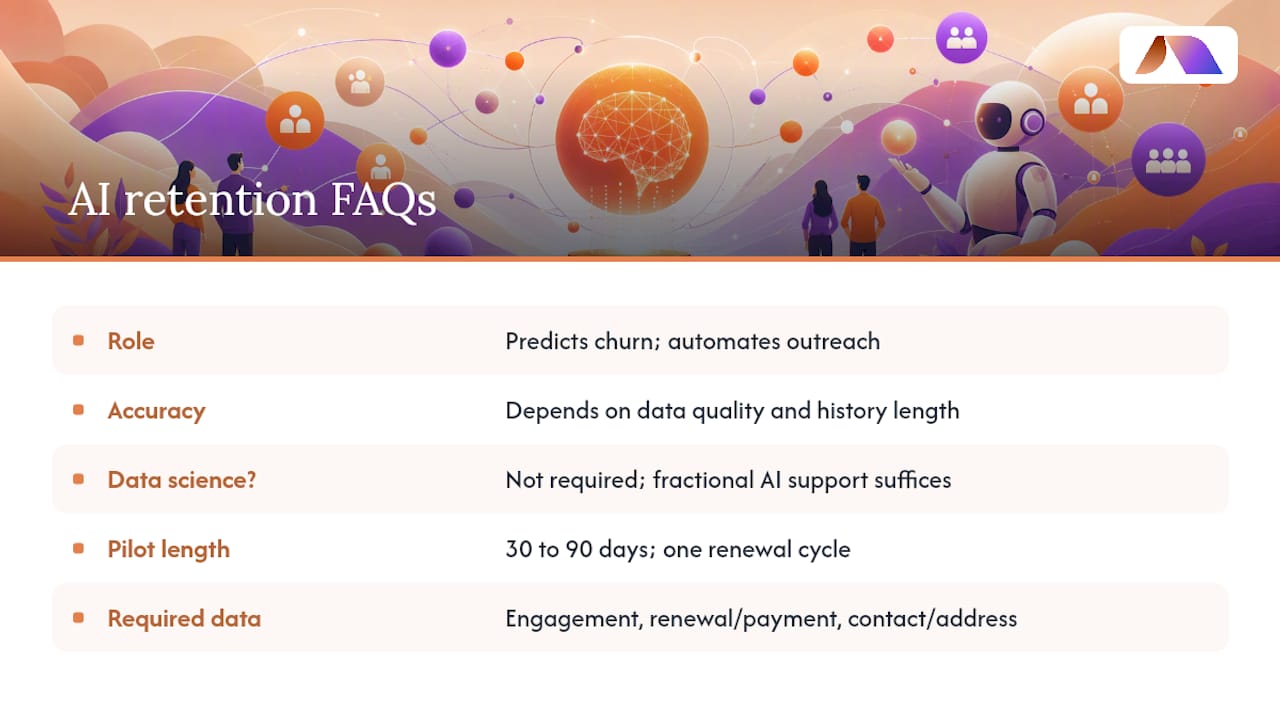
What data do we need before starting an AI retention pilot? At minimum, connect engagement history, renewal and payment records, and contact or address data across your membership database, event system, and payment gateway.