Published on
Reduce Picking Errors With AI: An Operations Playbook
Three levers move the needle fastest: vision verification at the pick face, AI-driven routing and batching, and an SOP-aware orchestration layer catching exceptions before they ship. Together, they address the failure points that RF scanning and voice picking alone tend to miss, especially in split-case and high-mix environments. A domain-tuned model tested in a different high-stakes field, prescription translation, cut near-misses by about 33% once guardrails were added, and a mixed-methods warehouse study found AI-based batching cut travel distance by 27.25% with a corresponding lift in picking accuracy. Those two numbers, from unrelated fields, point at the same mechanism: reduce the decisions a person has to make under time pressure, and errors drop.
Statistic Callout: A domain-tuned language model reduced near-misses by roughly a third in production testing. AI-based batching optimization separately cut picker travel distance by more than a quarter. Different industries, same lesson: fewer decisions, fewer mistakes.
You do not need to overhaul your warehouse management system to start. Here is where to put your first dollar and your first week:
Add pick-face visual verification on your highest-error SKU family before touching anything else in the workflow.
Test AI routing or batching on a single zone with clean order data, rather than rolling it out floor-wide.
Run a 6 to 8 week pilot with three KPIs locked in advance: error rate, return rate tied to picking, and picks-per-hour.
Pro Tip: Pick the zone with the messiest SKU mix for your pilot, not the easiest one. A clean, low-complexity zone will make any tool look good and tell you nothing about how it performs where you actually need help.
If you want a structured way to scope this instead of guessing at sequencing, a readiness assessment from BRDGIT will map your current error sources against the levers above before you spend on hardware or integration work.
Key Takeaways
Reducing picking errors with AI works best as a sequence: verify at the point of pick, optimize the route before it, and orchestrate the exceptions around both.
Point | Details |
|---|---|
Start with verification | Deploy vision or barcode verification at your highest-error zone before adding other AI layers. |
Measure error type, not just rate | Track wrong-SKU, wrong-tote, and short-pick separately to know which lever actually worked. |
Fix data before models | Sync master data and inventory feeds first; skipping this step causes most pilot failures. |
Run a scoped 6 to 8 week pilot | Lock in error rate, OTIF, and cost-per-error-avoided gates before you start, not after. |
Get outside support to scope it | BRDGIT offers readiness assessments and fractional AI engineers to help convert a pilot into production. |
Table of Contents
How Does AI Actually Reduce Picking Errors?
Which AI Technologies Actually Cut Picking Errors?
Does Smarter Routing Actually Reduce Wrong-SKU Errors?
How Should You Design Pick and Pack Verification Stations?
What Integration Work Do Most Pilots Underestimate?
Why Do AI Picking Pilots Actually Fail?
How Do You Run a Pilot That Proves ROI?
Which AI Lever Should You Deploy First?
What Do Successful AI Picking Rollouts Have in Common?
How BRDGIT Helps You Move From Pilot to Production
Sources
How Does AI Actually Reduce Picking Errors?
AI reduces picking errors by narrowing the number of decisions a human has to make correctly, and by catching the ones that go wrong before the box leaves the building. That is the entire mechanism. It is not magic, and it is not one tool. It is three functions working in sequence: prediction, verification, and orchestration.
Picture the flow as a chain. Prediction happens first, when models decide what should be slotted where and which orders should be grouped together. Routing and batching happen next, sequencing the physical work so a picker’s path makes sense. Verification happens at the moment of truth, when a camera or scanner confirms the right item went into the right tote in the right quantity. Orchestration sits above all of it, watching for exceptions, rerouting work when something breaks, and enforcing the standard operating procedure even when conditions on the floor change mid-shift.
“Graph-guided multi-agent frameworks that encode SOPs as directed graphs improve procedural compliance and help agents adapt to real-time warehouse changes while limiting context overload,” according to research on multi-agent warehouse command layers. In plain terms: the system does not just execute a static rule set, it adjusts when the floor gets messy, and it still follows procedure while doing it.
Each of the three functions plays a distinct role:
Predictive models determine who should pick what, from where, and in what order, based on demand patterns and slotting logic.
Verification models confirm, at the moment of action, whether the correct SKU and quantity actually moved, using vision, barcode grading, or both.
Orchestration agents manage the handoffs between people, robots, and systems, and escalate to a human when something falls outside the SOP.
None of this works as a one-time deployment. Closed-loop feedback, where verification failures get fed back into model retraining, is what keeps accuracy from decaying as your catalog, seasonality, and staff turnover change. A review of AI in safety-critical industries recommends keeping a human in the loop for exactly this reason: models drift, and a person needs to be the backstop when they do. That single design choice, human-in-the-loop for edge cases, is the difference between a pilot that holds up after six months and one that quietly degrades.
Which AI Technologies Actually Cut Picking Errors?
Six categories of technology cover almost everything worth deploying, and they are not interchangeable. Each one targets a different error type, and mixing the wrong one into the wrong workflow wastes budget without moving your error rate.
Vision-based pick and pack verification works like Roboflow’s approach to barcode scanning: a camera checks what actually landed in the tote or box against what the order called for. This catches wrong-SKU picks, wrong-tote handoffs, and mixed-order contamination, the kind of error that RF scanning misses because RF only confirms a scan happened, not that the right physical item ended up in the right place.
Barcode-grade verification applies quality standards to the scan itself, flagging codes that are damaged, poorly printed, or misapplied before they cause a downstream shipping error.
AI routing and batching groups orders and sequences picker paths to reduce unnecessary travel and the cognitive load of juggling too many simultaneous instructions. Fewer decisions per minute means fewer chances to grab the wrong item.
SOP-aware orchestration agents, often built on graph-guided frameworks, manage exceptions and route work dynamically instead of relying on a fixed sequence that breaks the moment something unusual happens.
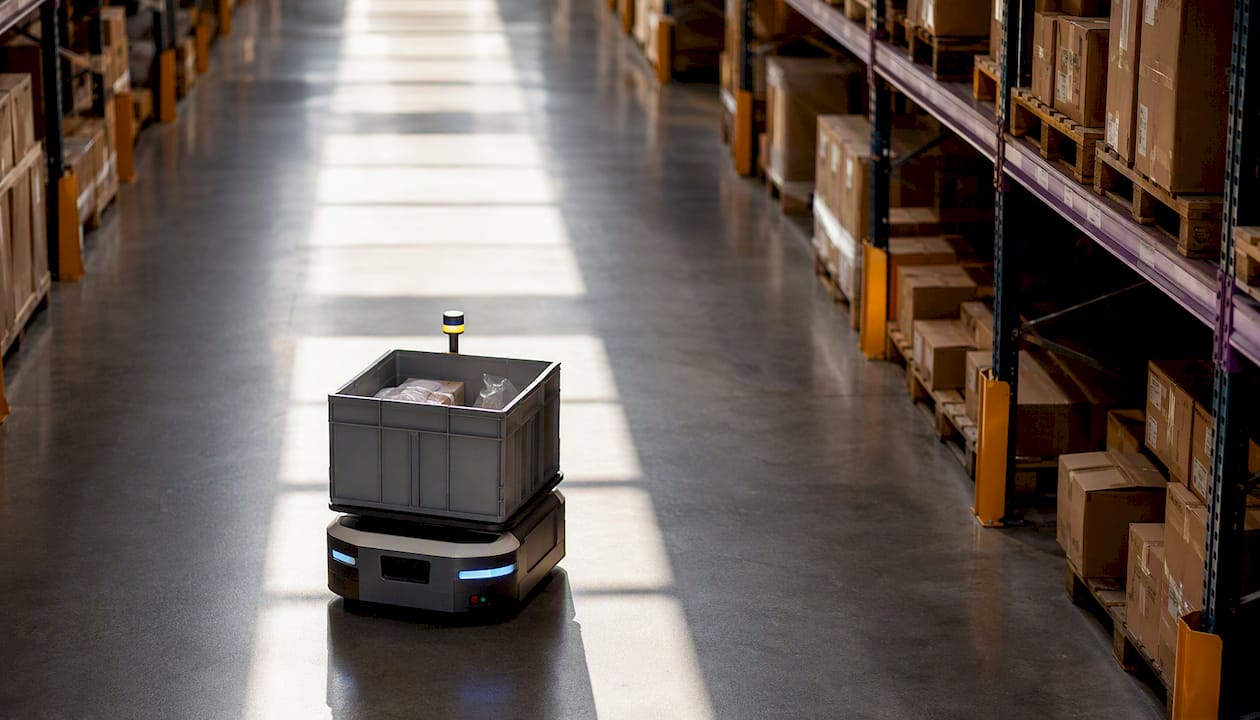
Autonomous mobile robots (AMRs), the category that includes providers like Locus Robotics and Fetch Robotics, physically bring inventory to pickers or pickers to inventory, reducing walk time and the chance of grabbing from an adjacent, similar-looking bin. Goods-to-person storage systems in the AutoStore category work on a related principle: minimize how far a human has to reach or walk, and you minimize opportunities to reach into the wrong slot.
Pick-to-light, voice, and RF handheld systems remain the backbone of most operations and are not going away. AI layers on top of them; it does not usually replace them outright.
Approach | Error types reduced | Integration complexity | Verification timing |
|---|---|---|---|
Vision verification | Wrong-SKU, wrong-tote, mixed-order | Medium | Real-time, pre-ship |
Barcode-grade scanning | Damaged/misapplied labels, wrong-SKU | Low to medium | Real-time, pre-ship |
AI routing and batching | Short-pick, wrong-SKU (via reduced load) | Medium | Indirect, pre-pick |
SOP-aware orchestration | Process deviation, missed exceptions | High | Real-time, throughout |
AMRs / goods-to-person | Wrong-tote, wrong-bin proximity errors | High | Indirect, structural |
Pick-to-light / voice / RF | Wrong-SKU, wrong-quantity | Low (existing systems) | Real-time, at-pick |
Pro Tip: Vision verification works best layered on top of RF or voice, not as a replacement for it. A study on how vision co-pilots operate found they catch what RF alone misses in split-case and multi-line orders, where a confirmed scan does not guarantee the physical item matched.
Deciding where to pilot first depends on which error type is actually costing you money, which is exactly what the types of AI tools available for supply chain operations can help you map before you commit budget.
Does Smarter Routing Actually Reduce Wrong-SKU Errors?
Optimized routing and batching lower picking errors indirectly, by reducing how much a picker has to juggle at once. Fewer simultaneous instructions and shorter, more logical paths mean less cognitive overload, and cognitive overload is where wrong-SKU picks and short-picks actually originate.
Three algorithm types dominate this space, and they solve different problems.
Order-batching groups multiple orders into a single pick run when their SKUs overlap, cutting redundant trips to the same location.
Wave optimization schedules groups of orders to release together based on labor availability, carrier cutoffs, and zone congestion.
Dynamic real-time routing recalculates a picker’s path on the fly as inventory positions, congestion, or order priority shift mid-shift.
Static, pre-planned routes work fine in low-complexity, single-SKU zones. The moment you have high SKU velocity variance or seasonal demand swings, static routing starts generating unnecessary travel, and unnecessary travel is where fatigue-driven errors creep in. A mixed-methods study on AI-based batch order picking found a 27.25% reduction in travel distance, with batch picking also producing a 22.82% reduction in travel time, alongside qualitative improvements in picking accuracy tied to reduced complexity per trip.
Getting this right requires feeding the model the right inputs. Skipping any of these tends to produce a routing engine that looks smart on paper and performs no better than a static route sheet on the floor.
Data input | Why it matters |
|---|---|
Order profiles | Determines which orders can be batched without conflicting priority windows |
SKU velocity data | Identifies high-turn items that should anchor route sequencing |
Pick-face locations | Provides the physical map the routing engine optimizes against |
Congestion/real-time telemetry | Prevents routing pickers into bottlenecked aisles |
AMR positions (where deployed) | Coordinates human and robot paths to avoid collisions and idle time |
Once the pilot is live, track travel distance, travel time, picks-per-hour, and, critically, error rate broken out by pick type. Aggregate error rate hides which specific failure mode actually improved, and that breakdown is what you need to justify scaling the pilot.
How Should You Design Pick and Pack Verification Stations?
Add a visual verification layer to your existing pick and pack workflow, and you catch the errors that RF and voice systems structurally cannot. RF confirms a scan occurred. It cannot confirm the item physically in your hand matches what the scan said it should be. That gap is where wrong-tote handoffs and mixed-order contamination live, and it is exactly the gap vision AI is built to close.
Four checkpoints matter most, and skipping any one of them leaves a hole in your coverage:
Pick-face read: confirm the SKU pulled from the shelf matches the pick instruction before it moves.
Tote handoff: verify contents when a tote transfers between zones or pickers, the single most common point where orders get cross-contaminated.
Pack-station content and count: confirm final quantity and item match before the box seals.
Label application and SSCC check: confirm the shipping label and serialized container code are correct and legible before the unit leaves the dock.
Camera placement and lighting decide whether your model actually works or just generates false rejects that operators learn to ignore. Barcode quality itself should be graded against recognized standards like ISO/IEC 15415 and 15416, which define scan quality thresholds independent of which camera or scanner you use.
Pro Tip: Mount cameras at a fixed, consistent angle relative to the tote, not wherever is physically convenient on the rack. Inconsistent camera angles are the single most common cause of misreads in early vision pilots, and it is almost always cheaper to fix at install than to retrain the model around bad geometry.
Statistic Callout: Vision co-pilots layered onto existing scanning infrastructure are designed to catch wrong-SKU, wrong-tote, and mixed-order errors that pass through RF scans undetected, because RF confirms the scan event, not the physical match.
Integration typically runs through standard APIs into your WMS or WES, which means most vision verification deployments do not require ripping out existing infrastructure, just bolting a check onto the workflow you already run.
What Integration Work Do Most Pilots Underestimate?
Reliable integration and clean data are prerequisites, not nice-to-haves. Skip either one and the AI layer will fail operationally, regardless of how accurate the underlying model is in a lab setting. This is the step most pilots underbudget, and it is usually the actual reason a promising pilot stalls before scale.
Four things need to be true before you flip the switch on any AI verification or orchestration layer:
Master data sync: SKU, GTIN, and unit-of-measure records need to match exactly between your WMS and whatever system is doing verification or routing. Mismatches here generate false errors that erode operator trust fast.
Real-time inventory feeds: routing and orchestration decisions are only as good as the inventory position data feeding them; batch-updated feeds introduce lag that shows up as bad recommendations.
Pick assignment callbacks: your orchestration layer needs a live channel back into the WMS to confirm task completion and trigger the next assignment.
Audit logs: every verification pass, fail, and override needs a timestamped record, both for troubleshooting and for the compliance trail most operations eventually need.
Latency matters more than most teams expect going in. Station-level pass/fail decisions for pick verification generally need to complete in well under a second, often cited around 250 milliseconds or less, to avoid slowing the picker down enough that they abandon the check and revert to old habits. Orchestration callbacks that manage exceptions can tolerate more slack, but not much.
Data quality for training vision models deserves its own line item in the budget, not an afterthought:
Labeling strategy: define exactly what counts as a pass and fail before collecting a single image, not after.
Sampling rates: capture enough edge cases (damaged packaging, unusual lighting, partial occlusion) or the model will fail exactly where it matters most.
Label drift monitoring: revisit and revalidate labels as your product catalog changes, especially with seasonal SKUs.
Integration element | Typical requirement | Risk if skipped |
|---|---|---|
Master data sync | SKU/GTIN/UOM match across systems | False verification failures |
Real-time inventory feed | Sub-minute update frequency | Stale routing recommendations |
Pick assignment callback | Live API channel to WMS | Orphaned or duplicate tasks |
Audit log | Timestamped pass/fail/override record | No traceability for disputes or compliance |
Station latency | Sub-second pass/fail response | Operator workaround, abandoned checks |
AI-powered inventory control systems live or die on exactly this kind of data hygiene, and it is worth treating that groundwork as its own project phase rather than folding it into the pilot timeline.
Why Do AI Picking Pilots Actually Fail?
Most pilots fail because of process mismatch, data drift, and thin feedback loops, not because the underlying model was inaccurate. That distinction changes what you spend your remediation budget on. Teams that assume a failed pilot means “the AI didn’t work” often skip the diagnosis step and either abandon the effort or throw more compute at a problem that was never about model accuracy in the first place.
Here is how the common failure modes map to fixes:
Poor training labels produce a model that looks accurate in testing and fails on the floor. Mitigation: dedicated labeling QA, plus deliberate collection of edge cases like damaged packaging and unusual lighting.
Latency issues cause operators to bypass the check entirely. Mitigation: lightweight edge inference for time-critical decisions, or cached decisions where a full round-trip isn’t necessary.
Data drift as your SKU catalog or seasonality shifts degrades accuracy silently over months. Mitigation: scheduled revalidation cycles, not a one-time training pass.
SOP mismatch, where the AI enforces a procedure that no longer reflects how the floor actually operates. Mitigation: encode SOPs as dynamic, updatable logic, not a static ruleset baked in at launch.
Lack of operator trust, where staff route around the system because it flagged too many false positives early on. Mitigation: transparent override logging and a fast escalation path to a human.
Pro Tip: Structure operator training around “why,” not just “how.” Operators who understand what the system is checking for, and why a false positive occasionally happens, override it less and trust it faster than operators who are just told to follow the new light or alert.
Before any wide release, run a small-scale test on one zone for at least two full weeks, log every override, and review them with the floor team before expanding. If your override rate is climbing rather than falling in that window, that is your signal to pause and diagnose, not push forward on schedule.
How Do You Run a Pilot That Proves ROI?
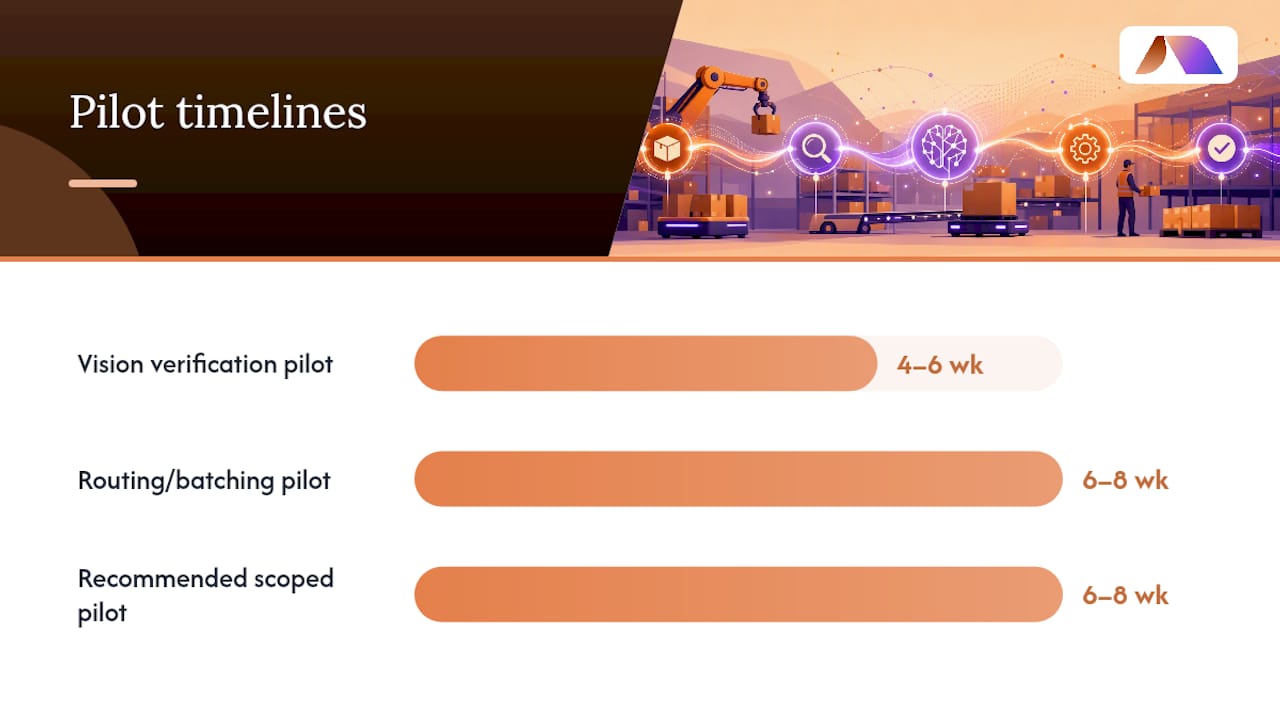
Run a scoped 6 to 8 week pilot with defined KPI gates before you commit to scaling anything. The gates matter more than the timeline; a pilot that hits week eight without clear pass or fail thresholds on error rate, returns, on-time-in-full (OTIF), and labor efficiency is not a pilot, it is an open-ended trial with no decision point.
Week | Activity | Owner | Success gate |
|---|---|---|---|
— | Readiness assessment, baseline error data | Ops leadership + AI partner | Baseline error rate documented by type |
Weeks 1 to 2 | Data collection and labeling | Data/engineering team | Labeled dataset covers key edge cases |
Weeks 3 to 4 | Model or edge deployment | Engineering + IT | Latency under target SLA at station |
6 weeks | Live validation on test zone | Floor supervisor + engineering | Error rate reduction vs. baseline |
6 weeks | ROI review and scale decision | Ops leadership | Cost per error avoided justifies scale |
Four KPIs anchor the decision, and each one has a simple formula worth writing down before the pilot starts so nobody argues about definitions afterward.
Error rate equals wrong-ships divided by total lines shipped, tracked by error type (wrong-SKU, short-pick, wrong-tote) so you know which lever actually moved the needle.
OTIF impact measures whether reduced errors improved on-time-in-full delivery rates, since a caught error before shipping often means a delayed order rather than a returned one, a tradeoff worth tracking explicitly.
Return rate reduction tracks the drop in returns attributable to picking accuracy specifically, isolated from returns caused by product defects or buyer’s remorse.
Cost per error avoided compares the pilot’s cost (hardware, integration labor, model training) against the fully loaded cost of a mis-pick, including labor to correct it, shipping to fix it, and any customer service or refund cost.
A conservative ROI framing: if your current error rate generates a known cost per mistake, and your pilot data shows even a moderate reduction in that rate across a comparable order volume, the math on cost per error avoided usually clarifies the scale decision faster than any qualitative assessment of “it seemed to work.”
Document results using a simple template: baseline metrics, pilot metrics, delta by error type, integration issues encountered, and operator feedback. That template becomes your case for stakeholders, and it is reusable for the next zone you pilot.
Comparison factor | Vision verification pilot | Routing/batching pilot |
|---|---|---|
Typical timeline | 4 to 6 weeks | 6 to 8 weeks |
Upfront cost shape | Camera hardware + integration labor | Primarily software/integration labor |
Recurring cost | Model retraining, monitoring | Model tuning, data feed maintenance |
Best-fit scenario | High-mix, high-error-rate zones | High-volume zones with variable SKU velocity |
Pro Tip: Set your KPI thresholds before the pilot, not after you see the results. Teams that define “success” retroactively almost always find a way to call a mediocre pilot a win, which defeats the entire point of measuring.
Which AI Lever Should You Deploy First?
Match your first move to your actual constraint, not to whichever technology got the most attention at the last industry event. The scenarios below cover most warehouse profiles.
High SKU mix, low automation, high error rate: start with vision verification at the pick face. It is the fastest way to catch errors without touching your routing logic or physical layout.
High-volume, single-SKU or low-mix zones: start with AI routing and batching. Verification adds less value when there is little SKU confusion to catch; travel reduction is where the savings live.
Existing AMR or automation investment, inconsistent SOP compliance: start with an SOP-aware orchestration layer before adding more hardware. The automation you already have is likely underperforming because of process gaps, not equipment limits.
Multiple zones, unclear which error type dominates: start with a two-week diagnostic sprint using existing scan data before committing budget anywhere. You cannot prioritize what you have not measured.
Justifying any of these to stakeholders comes down to three points worth having ready before the meeting:
Expected impact should be tied to a specific error type, not a vague “improve accuracy” claim.
Timeline should reflect the pilot table above, not an optimistic best case.
Cost shape should distinguish upfront integration spend from ongoing recurring cost, since stakeholders often approve the former and balk at an unclear version of the latter.
A quick risk versus reward gut check: vision verification is lower risk, moderate reward, and fast to prove. Routing and batching is moderate risk, high reward, but depends heavily on data quality. Orchestration layers are higher risk, highest reward, and should generally follow, not lead, your first pilot.
What Do Successful AI Picking Rollouts Have in Common?
The single biggest predictor of a successful rollout is starting narrow and measurable, not starting comprehensive. Teams that try to deploy vision, routing, and orchestration simultaneously across every zone almost always lose the thread on which change caused which result, and lose stakeholder patience before they can prove anything.
Three lessons show up repeatedly across the rollouts that hold up past the first quarter:
Start small and measurable. A single zone with a clean baseline tells you more in six weeks than a facility-wide rollout tells you in six months, because you can actually isolate cause and effect.
Prioritize verification layers before orchestration. Catching an error before it ships is a simpler, faster win than trying to redesign how work gets assigned across an entire floor.
Keep a human in the loop for edge cases. The rollouts that stall are usually the ones that tried to remove human judgment entirely on day one, rather than earning that trust incrementally as the system proves itself on the routine cases first.
None of this is exotic advice, and that is the point. The failure pattern is almost never a bad model. It is a team that skipped the boring groundwork, clean data, defined KPIs, a narrow pilot scope, in favor of moving fast on the exciting part.
How BRDGIT Helps You Move From Pilot to Production
BRDGIT helps operations teams convert a promising pilot into a running production system through readiness assessments, fractional AI engineering, and SOP-aware agent builds, without the overhead of hiring a full-time AI team you may not need year-round.
If you have read this far, you already have the framework: vision verification for high-mix zones, routing and batching for high-volume zones, and an orchestration layer once your SOPs are clear enough to encode. What most operations teams lack isn’t the framework, it’s the engineering hours to build and integrate it against a live WMS without disrupting daily throughput. That is the gap BRDGIT fills.
BRDGIT’s work in this space covers a readiness assessment that maps your current error sources against the levers in this article, pilot delivery for the zone you choose to test first, labeling and model training support so your vision layer actually learns your SKU catalog instead of a generic dataset, WMS and WES integration work, and fractional AI engineers who plug into your team for exactly as long as the project needs them.
If you’re ready to scope a pilot instead of guessing at sequencing, get in touch about fractional AI engineering support and start with a readiness assessment before committing to hardware or a full integration build.