


Published on
Fast Start Manufacturing Workflow Automation in 90 Days for Midmarket
Manufacturing workflow automation connects the software, sensors, and human decision points that move a product from order to shipment, replacing manual handoffs with orchestrated, data-driven processes. Done right, it lowers scrap rates, shortens cycle time, and cuts unplanned downtime by feeding operators and machines the same live picture of the plant. The payoff isn’t a single automated task. It’s a system that keeps improving because every step feeds data to the next one.
TL;DR:
Most plants need to focus on connecting data systems like MES, ERP, and sensors to achieve meaningful workflow automation, not just automating individual tasks.
Successful automation projects require thorough process mapping, targeted pilots with clear KPIs, and strong data and security governance from the start.
Data quality issues, outdated workflows, and workforce resistance are the main barriers, and involving operators early improves chances of success.
Digital Thread and digital twin technologies increasingly enable traceability and simulation, supporting smarter decision-making in automation.
A modular, fast-start approach with assessments, scaled pilots, and ongoing support helps avoid overreach and maintains long-term automation viability.
BRDGITTurn Manufacturing AI Ideas Into ActionBRDGIT helps manufacturing teams assess readiness, map opportunities, automate workflows, and build practical AI systems with ongoing support.Explore BRDGIT
Table of Contents
What Manufacturing Workflow Automation Actually Includes
The Benefits: Which KPIs Actually Move
Key Steps to Implement Automation: A Pragmatic Roadmap
Common Challenges and How to Mitigate Them
Real-World Examples and What They Teach
Future Trends: Digital Thread, Digital Twins, and Agentic Workflows
Getting the Readiness Question Right Before You Build Anything
Compliance and Regulatory Considerations in Automation
Security Best Practices Specifically for Manufacturing Environments
Team BRDGIT Perspective: What Leaders Consistently Underestimate
How BRDGIT Helps You Move From Pilot to Sustained Automation
Sources
FAQ
What Manufacturing Workflow Automation Actually Includes
Most plants already run individual automated tasks: a PLC that stops a conveyor when a sensor trips, a barcode scanner that logs inventory. That’s point automation, and it’s been standard since the 1990s. Manufacturing workflow automation is different in scope. It links those isolated actions into a continuous chain, so a quality alert on the line automatically triggers a work order in the maintenance system, updates the ERP’s inventory forecast, and notifies a supplier if a part is running short.
This only works when several layers talk to each other:
IoT and OT sensors that capture real-time conditions on the floor (temperature, vibration, throughput)
MES and ERP systems that manage production scheduling, inventory, and financials
AI and machine learning agents that interpret patterns and trigger or recommend actions
Integration middleware that moves data between these systems without manual re-entry
NIST’s Digital Thread roadmap describes this connective layer as a lifecycle data fabric, one that links design, production, and maintenance records so a part’s history is traceable from raw material to field failure. Workflow automation without that connective tissue is just a collection of smarter silos.
The Benefits: Which KPIs Actually Move
Throughput and yield are the obvious wins, but they’re not the only ones worth tracking. Automated workflows also cut mean time between failures (MTBF) improvements and mean time to repair (MTTR) reductions by feeding maintenance teams earlier, more specific alerts instead of relying on scheduled inspections. Scrap and rework drop when automated inspection catches defects at the station where they occur, not three steps downstream.
The administrative side often gets overlooked. Purchase approvals, supplier response times, and cross-department sign-offs eat hours every week in most plants. Automating these workflows, not just the shop floor ones, tends to free up more manager time than any single machine upgrade.
NIST’s implementation guidance makes a point worth repeating to any team building a business case: measure system-level outcomes like throughput and MTBF, not just how accurate a model is in isolation. A forecasting model can hit 95% accuracy and still fail to move a single plant KPI if nobody redesigned the workflow around it.
Set your baseline before automating anything. Track:
Units per labor hour, before and after
Scrap rate as a percentage of total output
Average approval or response time for cross-functional requests
MTBF and MTTR trends over a rolling 90-day window
Key Steps to Implement Automation: A Pragmatic Roadmap
Skipping straight to software selection is the most common way these projects stall. The sequence below reflects what tends to actually work.
Map the current state first. Use a SIPOC (suppliers, inputs, process, outputs, customers) framework or a similar process map before touching any automation tool. Automating a broken process just makes the mess move faster; NIST’s Digital Thread research flags poorly defined workflows as a recurring reason automation projects underdeliver. A tool like the AI workflow mapping guide walks through how to document this stage properly.
Prioritize targets by ROI and risk. Rank candidate processes by potential impact versus how disruptive they’ll be to change. Quality inspection and predictive maintenance usually score well on both axes; full ERP replacement rarely does.
Design a contained pilot. Define what data the pilot needs, which systems it touches, and the specific KPI it needs to move before you call it a success.
Set up governance before scaling. Assign clear ownership for data quality, model monitoring, and OT cybersecurity. This is not a step to add later.
Build a modular scale plan. Favor APIs and interoperable data models over locking into one vendor’s proprietary stack, so the next pilot doesn’t start from zero.
Pro Tip: Run your first pilot on a process you can fully instrument and measure within 90 days. A six-month pilot with unclear success criteria almost never survives budget review, no matter how promising the technology looks.
Process mining tools that analyze event logs can shortcut the mapping stage considerably. Recent research on make-to-order manufacturing found that event-log analysis surfaced bottlenecks that manual process reviews had missed entirely, turning discovery into a prioritized action list rather than a workshop exercise.
Common Challenges and How to Mitigate Them
Data quality problems surface almost immediately once you try to connect systems that were never designed to talk to each other. Inconsistent part numbers, duplicate supplier records, and unsynced timestamps between MES and ERP all quietly corrupt whatever automation you build on top. Standardizing data models before integration, rather than after, saves months of rework later.
OT cybersecurity deserves the same seriousness as IT security, and most plants haven’t caught up. The GAO’s assessment of IoT and OT risk recommends configuration management, continuous monitoring, and documented risk-assessment metrics as baseline practices, not optional extras.
The human side matters just as much:
Operators need clear training on what changes in their daily role, not just a system announcement
Middle managers often resist automation quietly when they fear it threatens their function
Retention risk rises when skilled workers feel automation is a demotion rather than a tool
Pro Tip: Involve line operators in pilot design, not just pilot rollout. The people running the process daily usually spot integration gaps that engineers miss entirely.
Cost overruns tend to come from vendor overreach more than technology failure. A modular pilot that proves value in one cell beats a plant-wide platform migration that takes eighteen months to show results.
Real-World Examples and What They Teach
Predictive maintenance is the clearest automation win in most plants. Vibration and temperature sensors feed an AI model that flags bearing wear weeks before failure, instead of waiting for a scheduled inspection or a breakdown. The role of AI in preventive asset maintenance shows how this shifts MTBF and MTTR in measurable ways once sensors and maintenance workflows are properly linked.
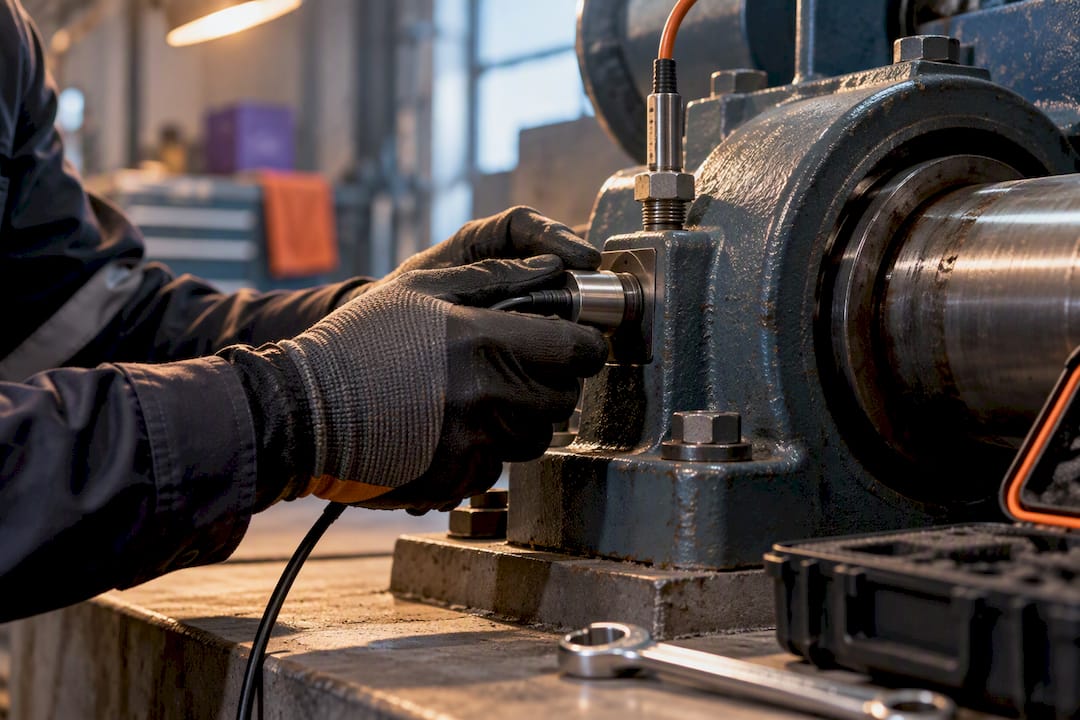
Automated visual inspection is another proven case. Cameras paired with machine learning catch surface defects at the station, cutting scrap and shortening the time between a defect occurring and someone fixing the root cause.
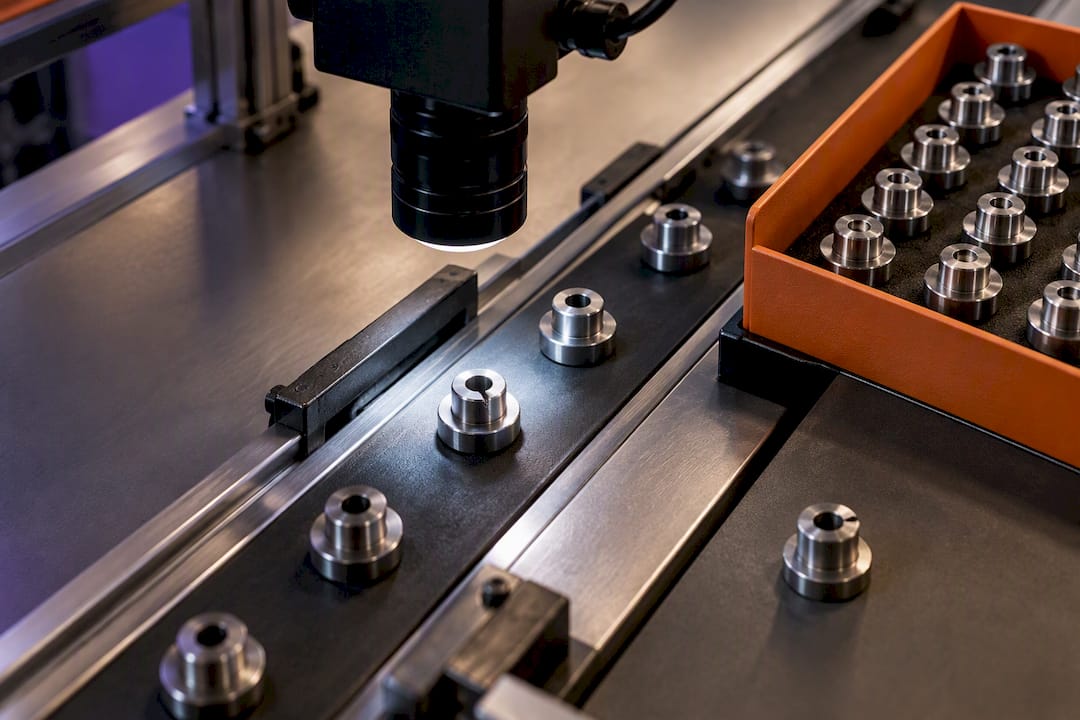
Order-to-fulfillment automation ties customer orders directly to production scheduling and supplier notifications, cutting the manual re-keying that causes shipping errors and delayed lead times.
A few lessons repeat across most successful rollouts:
Start with one line or one cell, not the whole plant
Measure the system KPI you defined at the pilot stage, not just a proxy metric
Expect to iterate the workflow logic at least twice before it’s stable
Document what changed so the next pilot builds on it instead of starting fresh
Future Trends: Digital Thread, Digital Twins, and Agentic Workflows
The Digital Thread concept is moving from aerospace and defense programs into mid-market manufacturing, largely because interoperability standards have matured enough to make it practical. It connects design, production, and field data into a single traceable record, an increasing priority as customers and regulators ask for fuller product histories.
Digital twins let teams simulate a layout change or a new process sequence before touching the actual floor. Digital twin technology combined with live IoT data lets engineers test “what if” scenarios safely, catching problems in simulation rather than during a costly changeover.
Agentic AI, systems that can take multi-step action rather than just generate a recommendation, is starting to show up in documentation and scheduling workflows, handling tasks like drafting work orders or reconciling supplier discrepancies without a human triggering each step.
To prepare for this shift:
Build clean, connected data pipelines now, since agentic systems are only as good as the data feeding them
Train supervisors to review AI-generated recommendations critically, not rubber-stamp them
Keep governance structures ready to expand as automation takes on more autonomous decisions
Getting the Readiness Question Right Before You Build Anything
A readiness assessment worth the name looks at four things: data quality and accessibility, current workflow documentation, workforce readiness for new tools, and existing security posture. Skipping this step is how plants end up automating around gaps instead of closing them.
An effective approach to this stage leans on:
Fast-start modular pilots that prove value in weeks, not quarters
Support options that provide senior expertise without a full-time hire
Ongoing model monitoring and data governance, since industrial AI systems degrade without maintenance
Training built around how staff actually use the tools day to day, covered in more depth in how to train factory staff on AI tools
Pro Tip: Treat the readiness assessment as a diagnostic, not a sales pitch. If a vendor’s assessment always concludes you need their full platform, that’s a signal to get a second opinion.
Compliance and Regulatory Considerations in Automation
Automated workflows touch more regulatory territory than most teams initially plan for. Quality management standards like ISO 9001 require documented, repeatable processes, which means any automated workflow needs an audit trail showing what decision was made, when, and by what logic. If an AI agent adjusts a production parameter, that action needs to be traceable back to a rule or model version, not a black box.
Industry-specific requirements add another layer. Automotive suppliers answering to IATF 16949, medical device manufacturers under FDA quality system regulations, and aerospace suppliers under AS9100 all have documentation and traceability demands that automated systems must satisfy, not bypass. A workflow that speeds up production but breaks the audit chain creates a compliance liability, even if it improves throughput.
Data privacy and export control rules matter too, particularly for manufacturers working with defense or international supply chains. Automated data-sharing between systems can inadvertently move controlled technical data across boundaries it shouldn’t cross, so integration design needs a compliance review, not just a technical one.
The safest approach is building compliance checkpoints into the workflow design itself, not retrofitting them after a pilot succeeds. Legal and quality teams should have a seat at the table during the pilot design step, not just during a final sign-off.
Security Best Practices Specifically for Manufacturing Environments
Manufacturing environments carry a security risk that most office IT frameworks weren’t built for: operational technology that can’t simply be patched and rebooted without stopping production. A vulnerability on a plant floor PLC can sit unaddressed for years because taking the line down to patch it costs more than the risk seems to justify, at least until it doesn’t.
Configuration management is the foundation. Every connected device, from a smart sensor to a legacy PLC, needs a documented baseline configuration and a change log, exactly what the GAO recommends for reducing IoT and OT exposure. Continuous monitoring matters more than periodic audits, since OT networks often carry traffic patterns that look anomalous to generic IT security tools but are perfectly normal for a production line.
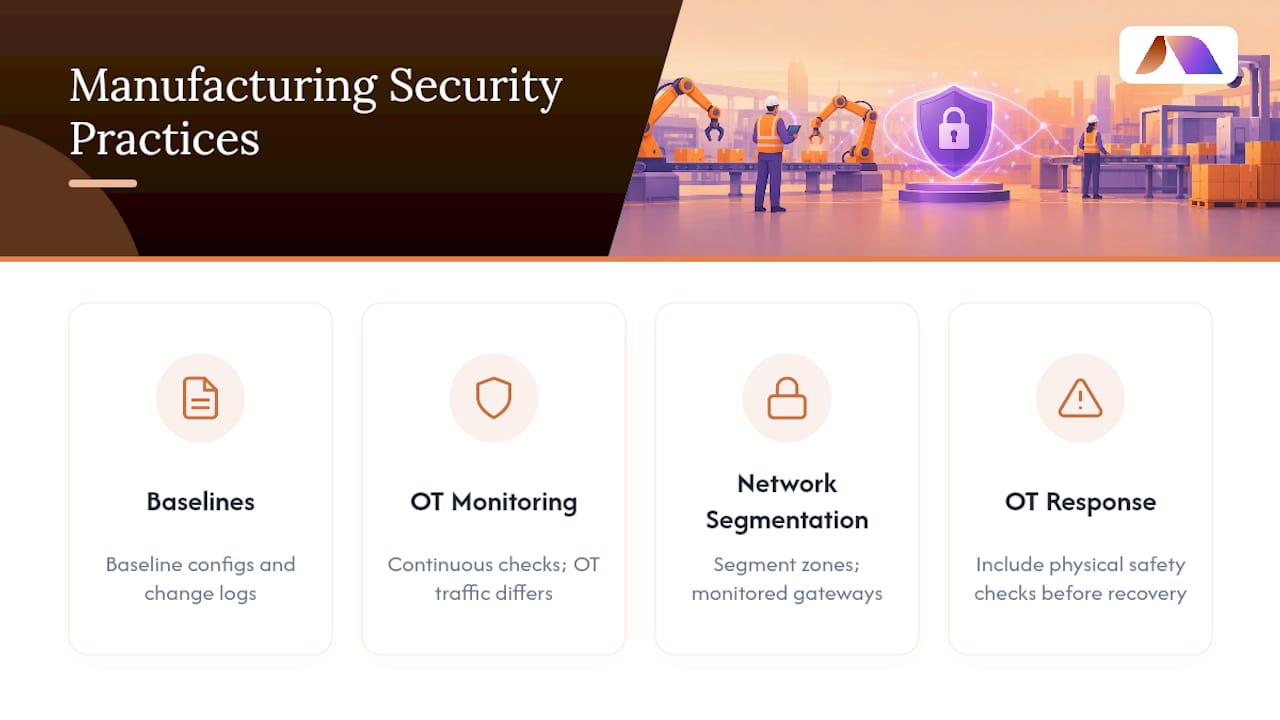
Network segmentation between IT and OT systems limits how far a breach can spread. A ransomware attack that starts in an email system shouldn’t have a direct path to the machines controlling production. Air-gapping isn’t always practical anymore given how connected modern equipment is, but segmented zones with monitored gateways come close.
Finally, build an incident response plan specific to OT, not a copy of your IT plan with different terminology. Recovery on a plant floor often needs physical safety checks before systems come back online, a step office IT incident plans rarely account for.
Team BRDGIT Perspective: What Leaders Consistently Underestimate
Automation isn’t a project with an end date. It’s a system that needs governance the day it launches, not six months later. Leaders who treat readiness assessments as a formality, and who chase model accuracy over floor-level outcomes, end up rebuilding what they just built. Modular, integrable systems beat bloated platforms every time.
— Team BRDGIT
How BRDGIT Helps You Move From Pilot to Sustained Automation
If you’ve read this far, you already know the gap between “we bought automation software” and “our workflows actually changed” is where most projects lose momentum. This gap can be closed with a fast-start, modular approach built for small and mid-sized manufacturing teams, avoiding bloated, months-long platform rollouts that may not fit the plant’s actual size.

An AI Readiness Assessment tells you honestly where your data, workflows, and workforce stand before you spend a dollar on new software. From there, Workflow Crew builds and connects the automated processes your assessment identifies as highest-value, while a Custom Agent Build handles more specialized decision automation where a standard workflow tool falls short. For teams that need senior technical capability without a full-time hire, Fractional Engineer Services provide ongoing support for monitoring, retraining, and scaling what you’ve built, exactly the continuous governance NIST recommends for industrial AI systems.
Start with a conversation about where your workflows actually break down. Visit BRDGIT to scope your first assessment.
Sources
For deeper technical grounding beyond this guide:
FAQ
What Are Examples of Workflow Automation in Manufacturing?
Common examples include predictive maintenance alerts that trigger work orders automatically, automated visual inspection systems that flag defects in real time, and order-to-fulfillment workflows that sync customer orders directly with production scheduling. Administrative examples include automated purchase approvals and supplier notification triggers when inventory drops below a threshold.
What Are the Three Types of Automation in Manufacturing?
The three general categories are fixed automation (dedicated equipment for a single repetitive task), programmable automation (equipment reconfigured through software for different products, like PLCs and robotics), and flexible automation (systems that adjust automatically between product variations with minimal downtime). Manufacturing workflow automation typically layers software orchestration and AI on top of all three.
What Is Automation in the Manufacturing Process?
Automation in manufacturing means using technology, PLCs, robotics, sensors, or software, to perform tasks with minimal human intervention. Workflow automation extends this by connecting individual automated tasks into a coordinated sequence across production, maintenance, and administrative processes rather than automating isolated steps.
How Do I Know if My Plant Is Ready for Workflow Automation?
Readiness comes down to four factors: data quality and accessibility, how well your current processes are documented, workforce familiarity with digital tools, and your existing security posture. A structured AI Readiness Assessment evaluates all four before recommending where to start.
What Does Manufacturing Workflow Automation Typically Cost?
Costs vary widely based on scope, existing infrastructure, and whether you’re piloting one process or scaling across a plant. BRDGIT’s current service pricing for offerings like the AI Readiness Assessment and Workflow Crew is available directly on Brdgit.



