


Published on
HIPAA Compliant AI: What Privacy Officers Must Verify
Yes, AI can be used under HIPAA, but only when a deployment satisfies four non-negotiable requirements: a signed business associate agreement covering every party that touches protected health information, minimum-necessary data scoping and redaction, tamper-evident auditability, and properly configured technical safeguards including encryption, identity controls, and logging. The architecture you choose (cloud under a business associate agreement, private hosting, or a hybrid gateway) determines how hard each requirement is to meet.
TL;DR:
Deployments within a HIPAA-compliant AI system must include a signed business associate agreement covering all parties handling PHI, with strict controls on data scope and auditability.
AI systems processing protected health information require encryption, access controls, and audit logging to meet Security Rule standards, with breach notifications within 60 days for any PHI exposure.
Cloud BAA arrangements are easiest for most organizations but require meticulous configuration, while private hosting offers stronger control at higher operational costs.
Vendors must clearly specify which product tiers are covered under BAA, with contractual rights for audits and explicit data use exclusions for training.
Building internal monitoring, continuous governance, and iterative configuration reviews are critical to maintaining ongoing HIPAA compliance after initial deployment.
Table of Contents
What Belongs on a HIPAA Compliant AI Checklist
How Does HIPAA Apply to AI Systems and Models?
Who Needs a BAA in Your AI Vendor Chain?
Which AI Architecture Keeps PHI Inside a Compliant Boundary?
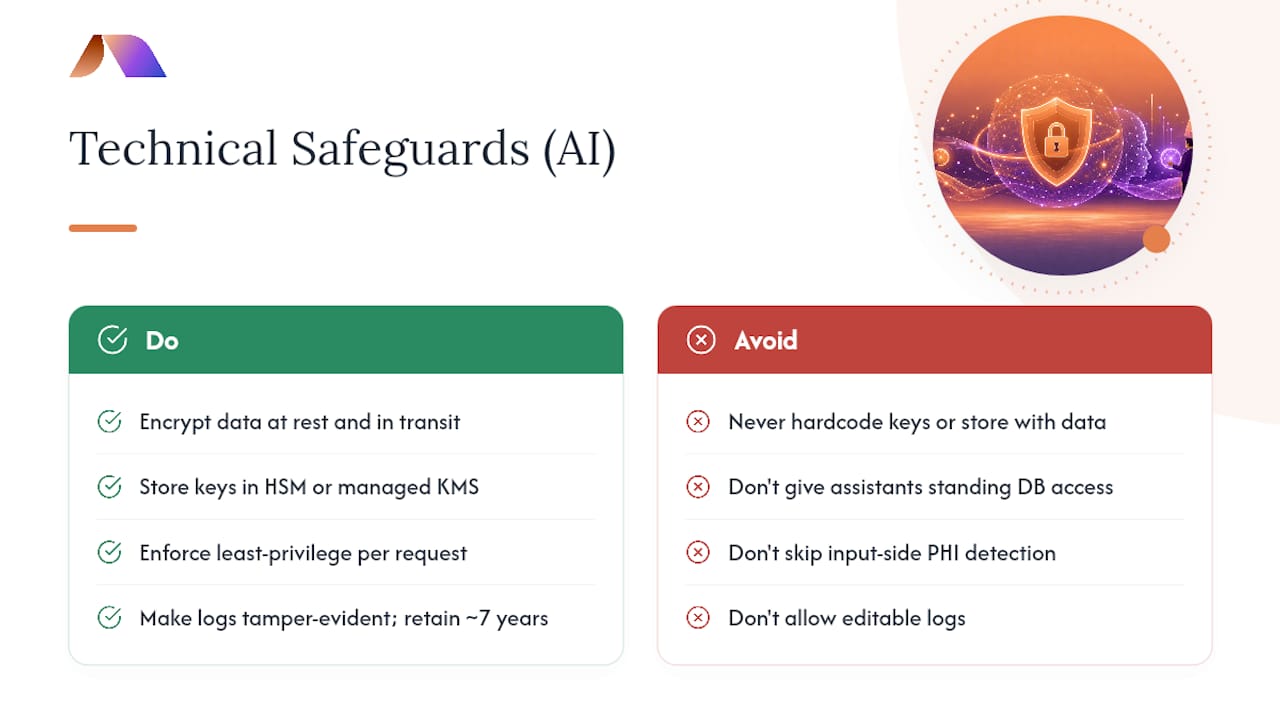
What Technical Safeguards Does an AI Pipeline Need?
Which Operational Controls Keep AI Use Compliant Day to Day?
How Should You Evaluate an AI Vendor Before You Sign?
What Regulatory Changes Should You Track in 2026?
How Do You Decide Between Building and Buying HIPAA-Compliant AI?
Where the Conventional Compliance Advice Falls Short
Get Hands-On Help Implementing HIPAA-Compliant AI
Sources
What Belongs on a HIPAA Compliant AI Checklist
Privacy officers evaluating a new AI pilot rarely have weeks to render a verdict. A vendor demo happens on Tuesday, and a department head wants an answer by Friday. The checklist below is built for that pace: fast enough for a thirty-minute review, thorough enough to catch the mistakes that turn into breach notifications.
Start with the items that make or break the entire arrangement:
BAA coverage confirmed in writing for the AI vendor and every subcontractor in its data path, not just the primary contract.
Minimum necessary controls verified: does the tool receive full patient records or only the fields the task requires?
Redaction layer present before any prompt or document leaves your compliance boundary, whether automated or manual.
Audit logging that is tamper-evident and retained long enough to satisfy your organization’s retention policy.
Encryption confirmed for data at rest and in transit, with key management under your organization’s control or a documented shared-responsibility model.
Model training exclusion verified in writing: your data does not get used to train the vendor’s foundation model unless you explicitly opted in.
Once those pass, run the deal through a quick go/no-go filter:
Does the vendor’s own documentation list the specific product tier as a covered, BAA-eligible service, or only mention “enterprise availability” vaguely?
Can the vendor produce a current SOC 2 report or equivalent, not a promise that one is “in progress”?
Does the contract grant your organization audit rights, or only the vendor’s right to audit you?
Is there a named incident response contact with a defined notification timeline, ideally under 24 to 48 hours for suspected exposure?
Any “no” on the first checklist, or a vague answer on the second, is a red flag serious enough to pause procurement. A PMC-published analysis of AI chatbot compliance found that many consumer-facing AI tools were never designed with covered-entity obligations in mind. Vendors default to the assumption that you will discover this too late to matter.
How Does HIPAA Apply to AI Systems and Models?
HIPAA doesn’t have a separate chapter for artificial intelligence. Instead, the Privacy Rule, Security Rule, and Breach Notification Rule apply to AI exactly as they apply to any other system that touches protected health information, which means the trigger isn’t the technology, it’s the data.
Protected health information under HIPAA covers 18 identifier categories, from names and dates of birth to device identifiers and biometric data, combined with any health context that makes a person identifiable. Feed a patient transcript into a large language model, and both the prompt and the model’s output can qualify as PHI the moment identifying details and clinical context appear together. This matters for AI use in a way many teams underestimate: even a summarization task, where you think you’re just asking a model to “clean up notes,” creates PHI exposure the instant a name or a date of service enters the prompt window.
The Security Rule requires administrative, physical, and technical safeguards for electronic PHI, and AI pipelines have to meet the same bar as your EHR or your billing system. That means access controls scoped to the minimum data an AI tool needs, encryption for anything in transit to or from a model endpoint, and audit controls that can reconstruct who queried what and when. A PMC review of chatbot compliance challenges points out that many AI deployments fail here specifically because logging was treated as a nice-to-have rather than a Security Rule obligation.
Breach Notification timelines don’t bend for AI either. If a model provider without a valid BAA processes PHI, or if a redaction layer fails and unfiltered patient data reaches an uncovered subprocessor, that’s a reportable disclosure under the same 60-day notification clock that applies to a stolen laptop. The scale can be worse: a single misconfigured API integration can expose thousands of records in the time it takes one batch job to run.
The minimum necessary standard applies at every stage: what you train on, what you send at inference time, and what you retain in logs. A model that ingests entire discharge summaries when it only needs a diagnosis code and a medication list is violating minimum necessary before it ever produces an output.
Who Needs a BAA in Your AI Vendor Chain?
Every party in the data path that creates, receives, maintains, or transmits PHI on your behalf needs a business associate agreement, and in an AI stack that path is longer than most people assume. It typically includes the software vendor, the cloud infrastructure host, the model provider if it’s separate from the vendor, and any logging, analytics, or monitoring subprocessor that touches the same data stream.
As Definite’s analysis of HIPAA-compliant AI tools points out plainly, no AI tool is “HIPAA certified.” Compliance is a property of the deployment, not a badge a vendor earns once. A vendor can be fully compliant in one customer’s configuration and non-compliant in another’s, depending on which tier, which endpoint, and which data controls are actually turned on.
This is where consumer-grade AI products cause the most damage. Free or standard chat tiers of major large language models generally don’t carry BAA coverage, according to expert commentary on GPT-5 and HIPAA compliance, while enterprise or zero-retention API endpoints often can be. A clinician pasting a patient note into a free chatbot to draft a referral letter has, in that moment, created an unauthorized disclosure, regardless of how good the output was.
Before signing anything, insist on:
A named list of every subcontractor that will process your PHI, not a generic “we use industry-standard cloud providers” statement.
Explicit contract language confirming your data is excluded from model training unless you opt in.
Audit rights that let your organization (or a designated third party) review the vendor’s controls, not just receive a summary report.
A defined data deletion and retention schedule that matches your organization’s own retention policy, not the vendor’s default.
Pro Tip: Ask the vendor to show you, in writing, which specific product tier or API endpoint is covered under their BAA template. “Enterprise plan” is not an answer. “GPT-4 Turbo via the Azure OpenAI Service with data logging disabled” is.
Common vendor misclaims include marketing pages that say “HIPAA compliant” in bold without ever mentioning a BAA, and sales reps who conflate SOC 2 certification with HIPAA coverage. They are related, but SOC 2 speaks to security controls generally, not to the specific legal relationship a BAA creates. For a broader look at how vendor responsibility chains work outside of AI specifically, BRDGIT’s guide to workforce compliance walks through the same due diligence logic.
Which AI Architecture Keeps PHI Inside a Compliant Boundary?
The architecture you choose determines how much of the compliance burden falls on engineering versus contract negotiation. Three patterns dominate healthcare AI deployments right now, and each carries a distinct cost and risk profile.
Cloud BAA under your own tenant is the fastest path for most mid-sized healthcare organizations. Major cloud providers publish a list of HIPAA-eligible services covered under their standard BAA, and as long as you deploy exclusively within that list, using private endpoints, VPC isolation, and disabling any logging or caching feature not covered by the agreement, you inherit a compliant boundary without building one from scratch. The catch is configuration discipline. Enabling a single non-covered feature, a public API endpoint, or a third-party plugin can pull PHI outside the BAA’s protection without anyone noticing until an audit.

Private or self-hosted deployment puts the model inside infrastructure your organization fully controls. According to Meta’s developer guidance on self-hosted deployments for regulated industries, self-hosting open-weight models offers the strongest data sovereignty and audit control available, because PHI never leaves an environment you own. Nothing crosses a third-party API boundary, so there’s no subcontractor chain to manage. That control comes at a real cost: sustained engineering investment, ongoing model maintenance, and the operational burden of patching, scaling, and securing infrastructure that a cloud vendor would otherwise handle for you.
Hybrid architectures split the difference. A redaction or tokenization gateway strips identifiers before any prompt reaches a cloud model, so PHI stays inside your boundary while the AI itself runs on infrastructure you don’t have to manage. Non-PHI tasks, like generating a template response or summarizing de-identified aggregate data, route to the cloud freely. PHI-bearing tasks either get redacted first or route to a private model reserved for sensitive workloads.
Each pattern demands different governance. Cloud BAA arrangements require someone on your team who understands cloud configuration deeply enough to catch drift. Private hosting requires a standing engineering function, which is exactly the gap BRDGIT’s fractional engineering support exists to fill for organizations that need the control without the headcount. Hybrid setups require confidence that your redaction layer actually catches every identifier format your clinical documentation produces, including the messy, inconsistent free text that real clinicians write under time pressure.
What Technical Safeguards Does an AI Pipeline Need?
The HIPAA Security Rule doesn’t list “AI” as a category of safeguard, but its requirements map cleanly onto specific engineering controls, and auditors will expect to see each one implemented, not just discussed in a policy document.
Encryption has to cover data at rest, typically AES-256, and data in transit, typically TLS 1.2 or higher, at every hop between your systems and the model endpoint. Key custody matters as much as the algorithm: keys belong in a hardware security module or a managed key management service, never hardcoded into application code or stored alongside the data they protect.
Identity and access management should follow least privilege, scoped per request rather than per application. A clinical AI assistant that has standing access to an entire patient database, rather than being handed only the specific record a clinician is actively viewing, is a much larger breach surface if that assistant’s credentials are ever compromised.
Audit logging needs to be tamper-evident, meaning logs can’t be quietly edited after the fact, and retained for the period your organization’s policy and state law require, commonly around seven years for healthcare records. Feeding those logs into a SIEM platform lets your security team catch anomalies (an unusual query volume, an access pattern outside normal hours) before they become incidents rather than after.
PHI detection before the prompt leaves your boundary is the control most organizations skip and most regret skipping. Automated named-entity recognition or tokenization can strip identifiers from free text before it reaches a model, and layering that on top of contractual minimum-necessary commitments gives you a technical backstop, not just a paper promise.
Output monitoring closes the loop. Models can leak PHI in ways prompts never intended, hallucinating a patient’s real name into a synthetic example, or echoing training data fragments. Scanning outputs for identifier patterns catches what input-side controls miss.
A technical implementation guide from Daffodil Systems frames this well: de-identification, encryption, access controls, and MLOps-level auditing aren’t separate compliance tasks bolted onto an AI system. They’re core design requirements, the same way a hospital wouldn’t treat fire suppression as optional in a server room.
Pro Tip: Run a tabletop test where you deliberately try to extract PHI from your own model’s outputs using adversarial prompts. If your team can trick it into leaking identifiers, so can someone outside your organization.
Organizations that embed these controls into MLOps pipelines from the start, rather than retrofitting them after a pilot succeeds, spend far less time and money getting to production. For a look at how encryption and access architecture play out at larger deployment scale, BRDGIT’s analysis of what businesses miss at scale covers the infrastructure side in more depth.
Which Operational Controls Keep AI Use Compliant Day to Day?
Technical safeguards protect the pipeline. Operational controls protect the humans using it, and they’re where most real-world breaches actually originate, not in a misconfigured server, but in a well-meaning employee who didn’t know the rule.
Build a staged approval workflow. Every AI use case should move from pilot to limited production to full rollout, with a documented risk assessment at each gate, not a single approval that covers all future use of the tool.
Operationalize minimum necessary with technical enforcement, not just policy language. Scoped views and parameterized queries that physically limit what an AI tool can retrieve are more reliable than asking employees to self-restrict.
Tie workforce training to role-based access. A billing coordinator and a treating physician interact with AI tools differently, and generic annual training doesn’t cover either use case well.
Write an incident response plan specific to model leakage. Traditional breach response assumes a stolen device or a hacked database. A model that leaks PHI in its output needs its own runbook: which logs to pull, how to determine scope, and who notifies whom within the required window.
Set a recurring audit cadence, ideally quarterly, that reviews access logs, checks for configuration drift in cloud BAA boundaries, and confirms redaction layers are still catching what they’re supposed to catch.
Pro Tip: Keep a standing folder of evidence, BAAs, SOC 2 reports, audit logs, training completion records, ready to hand over. When HHS or a state attorney general’s office comes asking, the organizations that respond fastest are the ones that never had to go looking for the paperwork.
Peer-reviewed commentary on AI risk in clinical settings, including Health Affairs’ case study on AI discrimination risk, makes clear that operational monitoring has to cover fairness and safety, not just privacy. A model that’s technically compliant with the Security Rule can still produce biased or clinically unsafe outputs, and your incident response plan should account for that failure mode too.
How Should You Evaluate an AI Vendor Before You Sign?
Procurement conversations with AI vendors go faster and end better when you arrive with a fixed list of questions instead of letting the sales team set the agenda.
Ask these in order:
“Which specific product tier or API endpoint is covered under your BAA, by name?”
“List every subcontractor that processes our data, and confirm each one’s BAA status.”
“Is our data used for model training, by default or by opt-in?”
“What is your data retention period, and can we configure a zero-retention endpoint?”
“Can you provide a current SOC 2 Type II report and evidence from a recent penetration test?”
“What is your breach notification SLA, in hours, from detection to customer notification?”
Beyond the answers, request the paperwork that backs them up:
A current SOC 2 report, not a summary slide.
Subsystem architecture documentation showing exactly where PHI flows.
A documented breach history and how past incidents were handled.
Configurable redaction or tokenization features you can verify, not just claim.
Red flags that justify walking away include a vendor unwilling to name specific subprocessors, marketing language that says “HIPAA compliant” without ever mentioning a BAA, and any refusal to grant audit rights in the contract. If a vendor can’t answer question one clearly, none of the other answers matter. For organizations new to healthcare procurement generally, this primer on regulatory basics for healthcare startups is a useful companion resource for understanding the broader compliance landscape vendors operate in.
What Regulatory Changes Should You Track in 2026?
The 2025 HIPAA Security Rule amendments published in the Federal Register strengthen cybersecurity expectations for electronic PHI, pushing organizations toward more rigorous encryption, stricter access management, and clearer audit documentation, exactly the controls an AI pipeline needs anyway.
The NIST AI Risk Management Framework gives privacy officers a practical vocabulary for mapping AI-specific risks onto existing Security Rule obligations. Its lifecycle structure, govern, map, measure, manage, translates well into audit evidence: you can show an auditor exactly where PHI risk was identified and mitigated at each stage of an AI system’s life, rather than presenting compliance as an afterthought.
State law adds another layer. Breach notification timelines and definitions of reportable incidents vary by state, and some states impose stricter deadlines than the federal 60-day standard. Keep a state-by-state reference current for every jurisdiction where your patients reside, not just where your organization is headquartered, and check the Federal Register and HHS guidance pages periodically for updates that affect AI-specific interpretations.
How Do You Decide Between Building and Buying HIPAA-Compliant AI?
Most organizations skip a real readiness assessment and jump straight to vendor selection, which is backwards. Before picking an architecture, evaluate four dimensions honestly: people (do you have staff who understand both AI engineering and HIPAA controls?), data (how clean and well-governed is your PHI today?), infrastructure (can your cloud environment support a proper BAA boundary?), and governance (do approval workflows and incident response plans already exist, or would AI be the first thing testing them?).
The decision thresholds are fairly consistent across the organizations BRDGIT works with. If your data is highly sensitive and your engineering team is thin, a cloud BAA architecture with a redaction gateway usually beats private hosting on cost and speed. If you’re handling especially sensitive clinical workloads and already have infrastructure discipline, private hosting earns its engineering cost. Hybrid fits nearly everyone in between.
This is exactly where fractional engineering earns its place: organizations rarely need a full-time AI engineering team permanently, but they need real engineering rigor during the design and implementation phase. BRDGIT’s fractional engineering support exists for that window, bringing the technical depth to configure a compliant boundary correctly the first time, then stepping back once the system is stable.
Where the Conventional Compliance Advice Falls Short
Most guidance on AI and HIPAA treats compliance as a procurement problem: find the right vendor, get the BAA signed, move on. That framing misses the harder truth. A signed BAA tells you a vendor accepted legal liability. It says nothing about whether your organization configured the deployment correctly, whether your redaction layer actually catches the identifiers your clinicians type, or whether anyone is watching the audit logs six months after the pilot launched.
The organizations that get burned aren’t usually the ones that skipped the paperwork. They’re the ones that got the paperwork right and then treated the architecture as a one-time decision instead of an ongoing engineering responsibility. Configuration drifts. Cloud providers change which services fall under the BAA umbrella. A helpful engineer enables a caching feature to speed up response times, and PHI starts landing somewhere it was never supposed to go.
If there’s one priority worth putting ahead of everything else in this playbook, it’s building the internal capacity to keep watching the system after launch, not just at signing. That’s harder than picking a vendor, and it’s the part almost nobody budgets for.
— Team BRDGIT
Get Hands-On Help Implementing HIPAA-Compliant AI
Reading a compliance playbook and actually configuring a redaction gateway, verifying a cloud BAA boundary, or standing up tamper-evident audit logging are two very different challenges. BRDGIT closes that gap without requiring your organization to hire a full-time AI engineering team you may only need for a defined window. Our readiness assessments identify exactly where your people, data, infrastructure, and governance stand today, and our fractional engineers step in to build the specific architecture, cloud BAA, private hosting, or hybrid gateway, that fits your risk profile and budget.

From there, we handle implementation and train your staff to use the resulting systems confidently, so compliance doesn’t live only in a policy document nobody rereads after the audit. If your team is weighing build versus buy on a HIPAA-compliant AI project right now, talk to BRDGIT’s fractional engineers about what a readiness assessment would surface for your specific environment.
This article is general information, not a substitute for advice from a qualified doctor. Consult a qualified healthcare professional about your own circumstances before acting on anything here.



