


Published on
Audit Ready Six Step NIST AI Risk Assessment Template for Practitioners
Adopt the NIST AI Risk Management Framework as your organizing model and run a concise six-step assessment against its four functions, Govern, Map, Measure, Manage, for every AI use case entering production. Start today by scoring your highest-exposure use case against the template below. Where you sell into regulated markets or operate under ISO/IEC 42001, this same assessment can serve as audit evidence with minimal rework.
TL;DR:
The assessment should be conducted before deployment, focusing on mapping data flows, scoring inherent risks, and defining controls for each use case.
It is crucial to regularly monitor metrics like accuracy, error rates, and hallucination rates post-launch to catch issues early and trigger re-reviews.
Addressing risks unique to generative AI, such as hallucination and prompt injection, requires specific control measures and external red-team testing before deployment.
Running risk assessments at the design stage ensures that risks are managed proactively, not just validated at the end of development.
Building a comprehensive audit trail with signed risk scores, control implementation, and incident logs supports compliance and improves organizational risk management.
Table of Contents
What the NIST AI RMF actually asks you to do
The six-step AI risk assessment template
Scoring risk and choosing controls that actually move the number
Monitoring, telemetry, and what happens when something breaks
Generative AI needs its own risk lens
Turning your assessment into audit evidence
What we see go wrong in the field
Why most teams get the sequencing backward
Get fractional AI engineering support to run this
Where to go deeper
Sources
What the NIST AI RMF actually asks you to do
The NIST AI RMF 1.0 is voluntary guidance, not a certification standard, and that distinction matters for how you use it. NIST built it to be use-case agnostic, which means it gives you a common language for risk conversations across engineering, legal, and the executive floor, but it will not tell you exactly what to build. You still have to design the assessment. That is the gap this article closes.
The framework organizes everything into four functions, and each one answers a different question your organization needs answered before an AI system touches customers or employees:
Govern asks who is accountable, what policies apply, and whether anyone actually has authority to say no to a deployment.
Map asks what the system does, what data it touches, and where humans intervene in its decisions.
Measure asks how you will know the system is behaving as intended, using what metrics and what test methods.
Manage asks what you do when measurement reveals a problem, including who decides to pause or kill the system.
If your organization is deploying generative AI specifically, layer in NIST’s Generative AI profile, published as NIST.AI.600-1. It does not replace the core functions. It reprioritizes them for risks that are unique to or dramatically worse in large language models: hallucination, training data leakage, and prompt injection chief among them. A chatbot answering HR policy questions and an agent that can execute financial transactions both get mapped through the same four functions, but the GAI profile highlights which subcategories warrant greater scrutiny for each.
The six-step AI risk assessment template
This is the working artifact. Print it, put it in a shared doc, or build it into your intake workflow, but run every material AI use case through these six steps before launch. Practitioner guides converge on roughly this structure because it compresses cleanly into a sign-off-ready document without losing the substance auditors want to see.
Describe the use case and name an accountable owner. One paragraph: what the system does, who uses it, and who owns the outcome if it fails. No owner, no assessment.
Map the system and its dataflows. Diagram inputs, outputs, third-party model dependencies, and every point where a human reviews or overrides an automated decision.
Score inherent risk across categories. Rate likelihood and impact for privacy, safety, bias, and security before any controls are applied.
Select controls and assign owners. For each risk, list the control, who implements it, and whether it is planned or already in place.
Calculate residual risk and record the decision. After controls, what risk remains? Document the decision, options considered, and who signed off.
Set review cadence and kill-switch triggers. Define what monitoring event forces a re-review, and confirm someone can actually pull the plug.
Pro Tip: Build step 6 before you launch, not after an incident. A kill-switch that only exists as a Slack message to an on-call engineer is not a control, it is a hope.
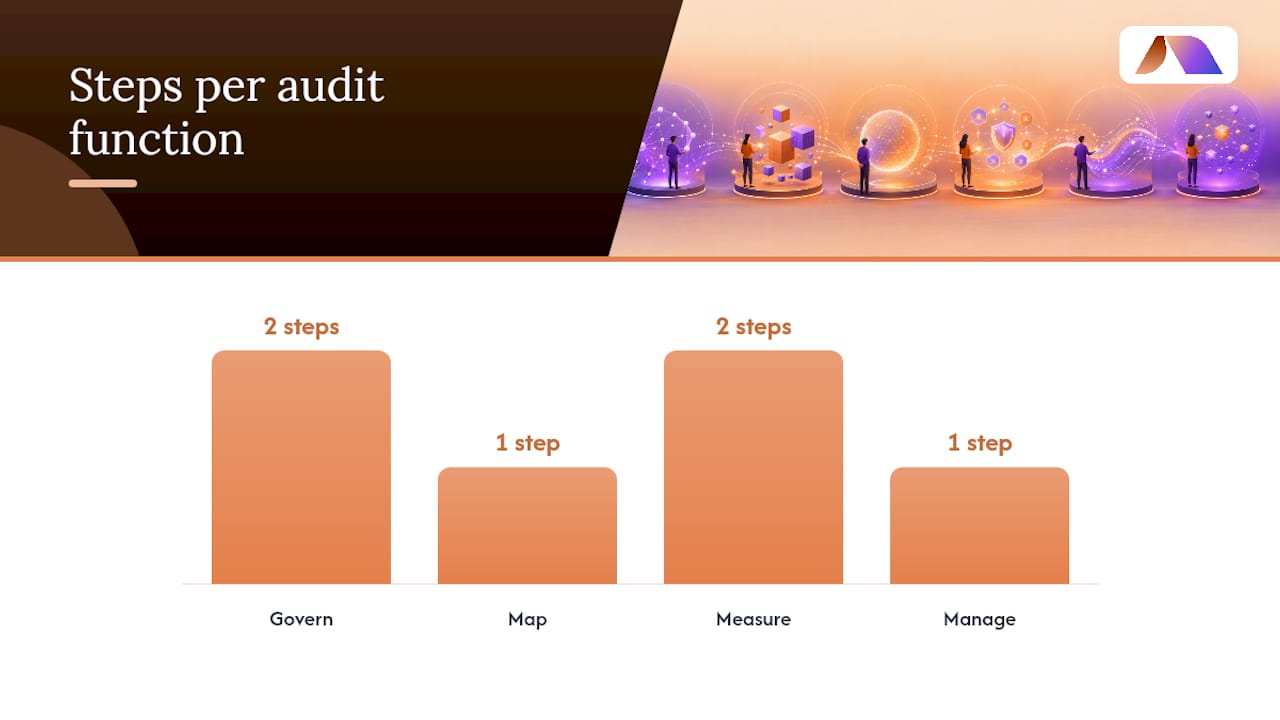
Each step lines up almost exactly with an NIST function. Steps 1 and 6 sit under Govern, step 2 is Map, steps 3 and 5 are Measure, and step 4 is Manage. That alignment is what makes the template defensible when someone outside your team asks how you know this system is safe to run.
Scoring risk and choosing controls that actually move the number
Likelihood and impact scales only work if the words on them mean something specific. A likelihood scale that runs “rare, possible, likely, frequent” needs anchor examples: “possible” might mean the failure mode has occurred in a comparable deployment within the last year; “frequent” means it happens in normal operation without an edge case. Impact scales should reference real consequences, regulatory fine exposure, customer harm severity, and reputational damage scope, not abstract severity labels.
Exposure is the variable that separates a low-stakes pilot from a system that needs a phase gate. Two systems with identical failure likelihood can carry wildly different risk if one touches 50 internal users and the other touches every customer account. Exposure multiplies your likelihood and impact scores by scale, and it is the reason a chatbot pilot and a customer-facing agent with the same underlying model should never share a risk score.
Several control categories frequently reduce residual risk scores in practitioner assessments, including access restrictions and least privilege to limit system invocation; prompt governance and retrieval pipeline safety, notably for RAG architectures; ongoing testing, evaluation, verification, and validation (TEVV) rather than a single test at launch; validation of data rights and provenance to ensure legal use; and having an executable rollback or kill-switch tested proactively rather than implemented post-incident.
Practitioner checklists consistently point to these five as the controls that produce the largest measurable drop between inherent and residual risk scores. Escalation thresholds should be numeric where possible: any residual score above your defined ceiling requires sign-off from someone outside the deployment team, not the engineer who built it.
Monitoring, telemetry, and what happens when something breaks
A risk assessment that ends at launch is half an assessment. The other half is knowing when your scoring was wrong.
Track metrics that catch drift before customers do: output accuracy against a held-out benchmark, refusal and error rates, latency anomalies, and for generative systems, hallucination rate on a sampled output set. Sudden shifts in any of these are your earliest warning that the system you assessed is not the system currently running in production.
Run TEVV on a defined cadence, not just at launch:
Retest core accuracy benchmarks regularly, more frequently for higher-exposure systems.
Re-run red-team prompts against generative systems after any model or prompt template change.
Validate that human-in-the-loop checkpoints function as intended and are not circumvented.
Audit samples of production outputs for policy compliance according to a fixed schedule.
Pro Tip: Write your rollback runbook as if the person executing it has never seen the system before. Incidents rarely happen when your most senior engineer is on call.
Build runbooks that name the specific trigger condition, the specific rollback action, and the specific person authorized to pull it, and test the rollback path in a staging environment before you need it live. Keep logging and audit trails with retention long enough to support an investigation months later, since AI incidents often surface well after the triggering event.

Generative AI needs its own risk lens
A model-level assessment and a use-case-level assessment answer different questions, and conflating them is one of the more common mistakes teams make. Assessing the underlying large language model tells you about its general tendencies. Assessing your specific deployment, a customer support agent built on that model, tells you what actually happens when it meets your data and your users. Run both, but sample your testing effort toward the use-case level, since that is where most real-world failures occur.
Generative AI introduces risks the core RMF functions were not originally built around:
Hallucination and fabricated citations, requiring output verification steps proportional to how consequential the output is.
Training data and retrieval leakage, especially in RAG systems pulling from internal document stores.
Prompt injection and jailbreaking, which grows more dangerous as agents gain tool access.
Intellectual property exposure, both in outputs generated and in data ingested for fine-tuning.
The NIST Generative AI profile maps each of these to specific RMF subcategories with suggested actions attached, which is worth reading directly rather than working from secondhand summaries. Prompt architecture and RAG configuration should be version-controlled documentation, not tribal knowledge, since prompt drift is a real control failure mode that erodes a control you thought was still in place. Any system with autonomous action capability, agents that can send emails, move money, or modify records, should trigger mandatory red-team testing and external review before launch, regardless of how well the underlying model scored in isolation.
Turning your assessment into audit evidence
Your six-step template already produces most of what an auditor wants. The gap is usually organization, not substance.
Map the artifact directly: steps 1 and 6 satisfy Govern evidence requirements under both the AI RMF and ISO/IEC 42001’s management system clauses. Step 2’s dataflow diagram doubles as Map evidence and as the data governance documentation ISO 42001 auditors expect to see. Steps 3 and 5’s scoring records satisfy Measure, and step 4’s control ownership log satisfies Manage.
If you sell into the European Union, add one item: classify the system’s tier under the EU AI Act framework early, since that classification changes which obligations apply and how much documentation you need on hand. This is a mapping exercise, not legal advice, and a compliance attorney should confirm tier classification for anything customer-facing.
An auditor’s short checklist typically covers:
Signed-off risk scores with dated approval records.
Control implementation status, not just control intent.
Monitoring logs demonstrating the review cadence was actually followed.
Incident and rollback records, including near-misses.
What we see go wrong in the field
The most common failure mode BRDGIT encounters is not a missing framework, it is a a framework nobody actually runs. Teams adopt the NIST AI RMF in a slide deck and never operationalize the six steps into an intake process, so every new AI project reinvents its own ad hoc risk review, usually skipping steps 5 and 6 entirely.
For organizations with lower AI maturity, BRDGIT starts smaller than a full assessment. We run an AI readiness screen first, then apply the focused six-step assessment only to use cases actually headed for production, scaling to the full rigor of external review and red-teaming only where residual risk crosses a defined threshold. That staged approach keeps low-risk pilots moving fast while making sure the customer-facing agent gets the scrutiny it needs. Industry-specific patterns, like the ones we’ve documented in construction AI deployments, show the same six steps hold up across very different operational contexts.
Why most teams get the sequencing backward
Most organizations treat AI risk assessment as a compliance checkpoint bolted on right before launch, and that sequencing is the actual problem, not the framework itself. By the time someone runs a risk assessment on a system that is already built, the real decisions, architecture, data sources, vendor selection, have already been made. The assessment becomes a rubber stamp exercise, or worse, a document nobody wants to write honestly because rewriting the system now costs real time.
The NIST AI RMF works best as a design constraint, not a launch gate. Run step 1 and step 2 of the template the day a use case is proposed, before a line of code is written. That single change, moving Map earlier, catches more real risk than any amount of rigor applied at the end. Governance also gets treated as paperwork when it should be the thing that decides whether a project starts at all; a Govern function with no actual authority to stop a deployment is theater, not risk management.
What the evidence in this space actually supports is a probabilistic mindset over a checklist mindset. Teams that model risk pathways, not just checkbox categories, catch failure modes checklists miss entirely. Start there, not with more paperwork.
— Team BRDGIT
Get fractional AI engineering support to run this
Running a six-step assessment on paper is one thing. Building the controls, monitoring, and rollback infrastructure the assessment calls for is where most internal teams stall, usually because nobody has bandwidth to own it alongside their regular workload. BRDGIT closes that gap with fractional AI engineers who slot into your existing team, run the assessment, implement the controls it identifies, and stay on to monitor the systems that matter most.

That means you get someone who has actually built RAG safety pipelines and tested kill-switches, not just someone who can fill out a template. Whether you need a single high-exposure use case assessed and hardened, or ongoing support across a growing AI portfolio, BRDGIT’s fractional AI engineers can be resourced to your actual workload rather than a fixed headcount. If your team is also thinking about where the talent gap sits internally, our work on AI talent gap analysis is a useful next read. Reach out to scope your first assessment.
Where to go deeper
NIST AI RMF 1.0: the core four-function framework this entire template is built on.
NIST Generative AI Profile: required reading for any LLM or agent deployment.
MIT AI Risk Initiative: risk taxonomy and incident data for prioritization.
PRA for AI: probabilistic methods for advanced hazard modeling.
Sources
Artificial Intelligence Risk Management Framework (AI RMF 1.0) — NIST
Artificial Intelligence Risk Management Framework: Generative Artificial Intelligence Profile — NIST



