
Published on
AI in Revenue Forecasting Services: A 2026 Guide
TL;DR:
AI in revenue forecasting uses machine learning to provide continuously updated, probabilistic revenue predictions based on historical and real-time data. It improves accuracy by up to 96%, reduces bias, and offers early risk detection, helping leadership make better decisions. Successful implementation relies on clean data, ongoing model retraining, and integrating human review into organizational processes.
AI in revenue forecasting services is defined as the use of machine learning models to analyze historical and real-time data and produce continuously updated, evidence-based revenue predictions. This approach replaces static spreadsheet forecasts with probabilistic projections that update as new data arrives, giving leadership live revenue figures rather than quarterly snapshots. The industry term for this practice is predictive revenue intelligence, and it sits at the intersection of AI in financial forecasting, CRM data science, and revenue operations. Top-quartile implementations achieve up to 96% accuracy by scoring each deal against historical patterns rather than relying on a sales rep’s gut feel. For business leaders and analysts, that accuracy gap is not a technical detail. It is an operational risk.
What is AI in revenue forecasting services, and how do the models work?
AI revenue forecasting replaces the old “weighted pipeline” method with probabilistic deal scoring. Instead of multiplying deal value by a static stage percentage, machine learning models assign each opportunity a close probability based on hundreds of historical signals.
The most common model types in production systems include:
Gradient boosting models (XGBoost, LightGBM): These score individual deals by learning which CRM attributes, such as deal age, engagement frequency, and competitor mentions, correlate with wins or losses.
Time-series models (Prophet, ARIMA): These forecast aggregate revenue trajectories by detecting seasonality, trend shifts, and cyclical patterns across quarters.
Neural networks: These handle unstructured signals like email sentiment and call transcripts, adding behavioral context that CRM fields miss.
Ensemble approaches: Most production systems combine multiple model types for stability, since no single algorithm dominates across all deal types and market conditions.
What separates AI from traditional forecasting is continuous retraining. The model does not recalibrate once a quarter. It learns from every closed deal, every lost opportunity, and every updated CRM record. That means your forecast reflects what is happening now, not what happened last quarter.
Data requirements are non-negotiable. AI forecasting models need 12–24 months of consistent historical data with defined CRM stages and deal attributes before they produce reliable outputs. Feeding models with “exhaust data” from product usage, meeting activity, and email engagement improves accuracy beyond what CRM records alone can deliver.

Pro Tip: Before deploying any AI forecasting model, audit your CRM for duplicate records, missing close dates, and inconsistent stage definitions. Garbage in, garbage out is not a cliché here. It is the single most common reason AI forecasting projects underdeliver.
How does AI improve forecasting accuracy and reduce bias?
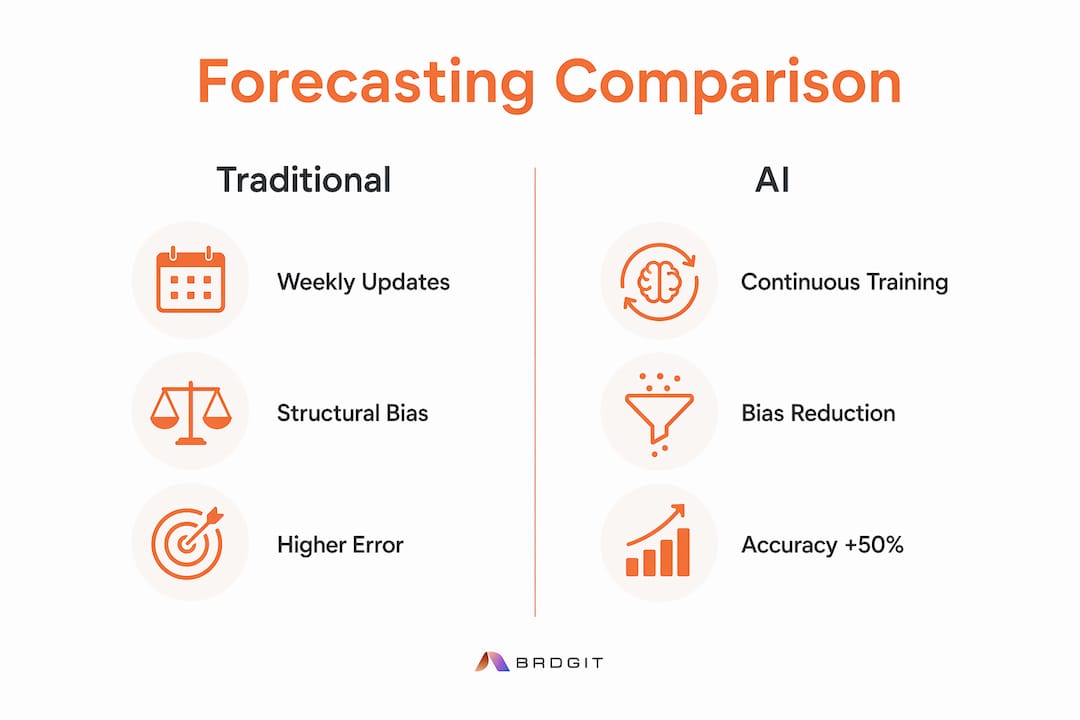
AI cuts mean absolute percentage error (MAPE) by 30–50% compared to traditional spreadsheets. That improvement comes from two sources: better pattern recognition and the removal of human bias.
Traditional forecasting carries structural bias. Sales reps sandbag to protect their bonuses. Managers inflate numbers to satisfy leadership. Neither behavior is malicious. Both are rational responses to how performance gets measured. Machine learning models identify and adjust for these biases by comparing what reps historically said would close against what actually did. The model learns each rep’s personal accuracy pattern and corrects for it automatically.
The table below shows how AI forecasting compares to traditional methods across the dimensions that matter most to revenue leaders.
Dimension | Traditional forecasting | AI forecasting |
|---|---|---|
Update frequency | Weekly or monthly, manually | Continuous, triggered by data changes |
Accuracy benchmark | 60–75% typical MAPE range | Up to 96% with clean data |
Bias source | Human judgment, sandbagging | Model-corrected, pattern-based |
Risk detection | End-of-quarter surprises | Early flagging of stalled deals |
Output format | Single point estimate | Probabilistic range with confidence intervals |
Early risk detection is where AI delivers its most underappreciated value. When a deal goes quiet, the model flags it before the rep does. Your team can intervene weeks earlier than a manual review cycle would allow. That is the difference between saving a deal and writing it off.
Common misconceptions about AI revenue forecasting
The most persistent misconception is that AI replaces the sales manager’s judgment. It does not. AI augments human judgment by surfacing risks and anomalies for human review. The model tells you which deals look at risk. Your team decides what to do about it.
Practical limitations business leaders need to understand include:
Structural market changes: A model trained on pre-recession data will not automatically account for a sudden shift in buyer behavior. Human review catches what the model cannot.
CRM inconsistencies: Reps who skip CRM updates or use stages inconsistently degrade model performance faster than any algorithm flaw.
Confidence interval management: Teams that focus on probabilistic ranges rather than single point estimates reduce end-of-quarter surprises. Most organizations are not yet trained to read and act on ranges.
Cold-start problem: New sales teams or new product lines lack the historical data needed for accurate model training.
The human-in-the-loop requirement is not a weakness. Successful implementations build review processes where managers refine model outputs based on context the data cannot capture, such as a key champion leaving an account or a competitor dropping their price.
Pro Tip: Run a weekly “model vs. rep” review where your team compares AI deal scores against rep-submitted forecasts. The gaps reveal coaching opportunities and data quality issues simultaneously.
Practical applications and organizational impact of AI forecasting
AI forecasting changes what your revenue team does with its time. The shift is from debating the number to acting on insights. Teams using AI forecasting pivot their planning conversations toward risk mitigation and strategic adjustments rather than arguing over whose pipeline estimate is right.
The organizational applications extend well beyond the forecast call. Predictive sales analytics create a closed loop connecting forecasts to territory design, quota setting, compensation planning, and pipeline management. Here is how that plays out in practice:
Integrate your data sources. Connect CRM data, product usage signals, and engagement data into a single model input layer.
Establish baseline accuracy. Run the model in parallel with your existing process for one quarter to measure MAPE improvement before switching over.
Redesign territory and quota logic. Use AI-generated win-rate data by segment, region, and rep to set quotas grounded in evidence rather than last year’s numbers plus a percentage.
Embed forecasts into compensation planning. Align incentive structures with the behaviors the model identifies as predictive of wins.
Build a review cadence. Schedule weekly human-in-the-loop reviews to catch anomalies and feed corrections back into the model.
The AI in demand forecasting literature shows a consistent pattern: organizations that connect AI outputs to execution systems outperform those that treat forecasting as a reporting exercise. The forecast is only as valuable as the decisions it drives.
For a deeper look at how AI improves accuracy across order and revenue workflows, the AI-powered sales forecasting benefits research from Swipe Credit AI provides a useful frame for business leaders evaluating adoption.
Key Takeaways
AI in revenue forecasting services delivers its highest value when clean data, continuous model retraining, and human-in-the-loop review work together as a system, not as separate initiatives.
Point | Details |
|---|---|
Accuracy improvement | AI cuts forecasting error by 30–50% compared to traditional spreadsheets when data quality is maintained. |
Probabilistic outputs | AI produces confidence intervals, not single estimates, which reduces end-of-quarter surprises for leadership. |
Bias elimination | Machine learning corrects for sandbagging and optimism by learning each rep’s historical accuracy pattern. |
Data quality is foundational | Models require 12–24 months of clean CRM data before producing reliable revenue predictions. |
Human judgment stays essential | AI flags risks and anomalies, but human review and contextual knowledge determine the right response. |
Why most AI forecasting projects stall before they deliver
The organizations I see struggle with AI forecasting share one pattern: they treat it as a technology project rather than a revenue operations change. They buy the platform, connect the CRM, and wait for the numbers to improve. They do not fix the data. They do not train the managers to read confidence intervals. They do not redesign the review cadence. Six months later, the model is running, the forecast is still wrong, and the team blames the AI.
AI does not forgive organizational ignorance. The model reflects the quality of your data and the discipline of your process. If your CRM is a mess, the model will be a mess. If your managers still run the forecast call as a number negotiation, the AI output becomes one more data point to argue about rather than a signal to act on.
What actually works is treating AI forecasting as a culture change with a technology component. The teams that get the most from it are the ones that connect AI insights to professional services strategy and execution, not just reporting. They build the human-in-the-loop review into the weekly rhythm. They train reps to understand why the model scores their deals the way it does. They use the forecast to have better conversations, not to avoid them.
The technology is ready. The question is whether your organization is ready to use it honestly.
— Team BRDGIT
BRDGIT’s approach to AI forecasting implementation
Revenue forecasting is one of the highest-leverage places to apply AI in any business. Getting it right requires more than a model. It requires clean data pipelines, integrated execution systems, and people who know how to act on probabilistic outputs.
BRDGIT works with business leaders to move from AI curiosity to real execution. That means assessing your data readiness, identifying the right forecasting architecture for your revenue model, and building the workflows that connect AI outputs to territory design, quota setting, and pipeline management. For organizations that need AI expertise without a full-time hire, BRDGIT’s fractional engineering team provides experienced AI talent that can support planning, delivery, and ongoing model refinement based on your actual needs. The path from a broken spreadsheet forecast to a live, probabilistic revenue model is shorter than most leaders expect when the right expertise is in place.
FAQ
What is AI in revenue forecasting services?
AI in revenue forecasting services uses machine learning models to analyze historical deal data and real-time pipeline signals, producing continuously updated, probabilistic revenue predictions. It replaces static, manually weighted forecasts with evidence-based projections that can achieve up to 96% accuracy.
How does AI reduce forecast bias?
Machine learning models learn each sales rep’s historical accuracy pattern and correct for tendencies like sandbagging or over-optimism automatically. This creates more consistent forecasts that leadership can trust without manual adjustment.
What data does an AI forecasting model need?
Most AI forecasting models require 12–24 months of consistent historical closed-deal data with defined CRM stages and deal attributes. Accuracy improves further when models also ingest engagement signals from meetings, emails, and product usage.
Does AI replace the sales manager in forecasting?
AI augments the sales manager’s judgment rather than replacing it. The model flags at-risk deals and surfaces anomalies, but human review and contextual knowledge determine the right response to those signals.
What is a confidence interval in AI revenue forecasting?
A confidence interval is a probabilistic revenue range the model produces instead of a single point estimate. Teams that plan against these ranges reduce end-of-quarter surprises and make more realistic commitments to boards and investors.