


Published on
90 Day AI Governance Framework for Enterprises That Delivers Controls
An effective AI governance framework is an operational system, not a policy document: a defined set of accountability roles, risk processes, and technical controls mapped to lifecycle stages and aligned to a recognized standard like the NIST AI RMF. The single best first step is a focused risk map of your two or three highest-priority AI use cases, scored by probability and severity, before you write a single policy line.
TL;DR:
Most organizations should prioritize creating a risk map of their top AI use cases before developing policies or controls.
Implementing the NIST AI RMF involves continuously generating artifacts like inventory logs, risk treatment plans, and signed governance policies, not just policies.
Embedding lightweight, stage-specific controls into the AI lifecycle—such as model cards, provenance logs, and telemetry—ensures governance becomes part of regular engineering workflows.
Risk scoring using probability and severity helps escalate high-risk AI cases for proper review, with critical risks requiring documented approval and traceability.
Layered guardrails for large language models should include input filtering, prompt constraints, output checks, and strict access controls, with regular testing for effectiveness.
Table of Contents
What Do NIST, OECD, UNESCO, the EU AI Act, and ISO 42001 Actually Cover?
How Do GOVERN, MAP, MEASURE, and MANAGE Work Together?
Five Governance Pillars Every Enterprise Needs to Staff
How Do You Embed Controls Into the AI Lifecycle Instead of Bolting Them On?
How Do You Score and Prioritize AI Risks?
What Guardrails Keep LLM Deployments From Going Sideways?
What’s a Realistic 90-Day Governance Roadmap?
How BRDGIT Operationalizes AI Governance for Real Teams
How Do You Resolve Conflicting AI Governance Priorities?
How Should You Communicate With Regulators and Internal Teams?
Team BRDGIT Perspective: Frequent Pitfalls and Rules of Thumb
Ready to Move From Governance Policy to Working Controls?
Sources
What Do NIST, OECD, UNESCO, the EU AI Act, and ISO 42001 Actually Cover?
Every framework in this space solves a different problem, and confusing them wastes budget. Here is what each one is actually for.
NIST AI RMF: A voluntary, cross-sector operational framework built around four functions, GOVERN, MAP, MEASURE, MANAGE. It’s the closest thing the field has to a playbook for building internal controls rather than stating values.
OECD AI Principles: High-level commitments (fairness, transparency, accountability) adopted by dozens of governments. Useful for setting your organization’s ethical north star, not for writing test plans.
UNESCO Recommendation on the Ethics of AI: A global normative instrument focused on human rights, dignity, and environmental impact. It shapes how you talk about AI publicly and to regulators, more than how you configure a model pipeline.
EU AI Act: Binding law for any organization placing AI systems on the EU market or affecting EU residents, with tiered obligations by risk category. If you have European customers or operations, this is the one with actual penalties attached.
ISO/IEC 42001: The certifiable management-system standard for AI, structured like ISO 27001. It’s what you point to when a customer or auditor asks, “Can you prove you have a governance system, not just a policy?”
Most enterprises don’t pick one. They use NIST AI RMF as the operational backbone, borrow OECD and UNESCO language for ethics statements and board communication, treat the EU AI Act as a legal compliance floor where it applies, and pursue ISO/IEC 42001 certification when customers or procurement teams demand third-party assurance. Layering them is normal. Treating any single one as sufficient on its own is the mistake.
How Do GOVERN, MAP, MEASURE, and MANAGE Work Together?
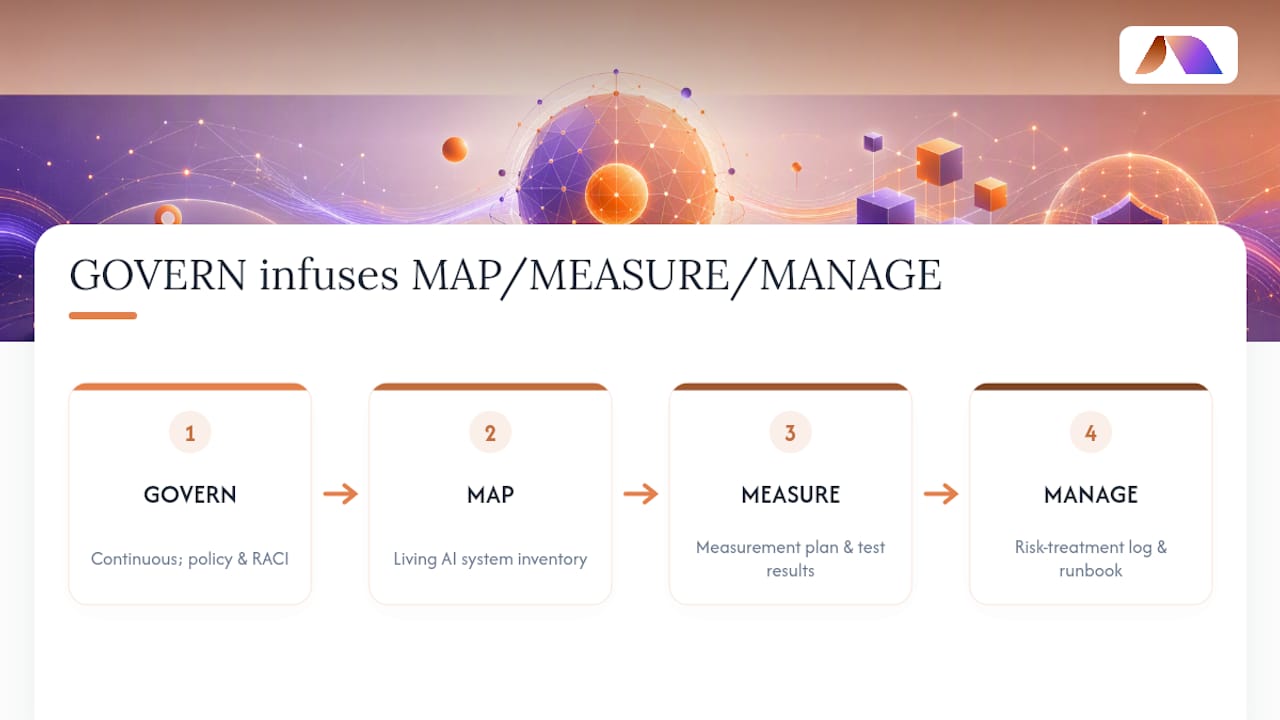
The NIST AI RMF has become the default operational spine for enterprise AI governance for one simple reason: it was built to produce artifacts, not sentiments. Each of its four functions maps to specific work product your teams can actually generate and defend in an audit.
GOVERN is the cross-cutting function that infuses the other three. It covers accountability structures (who owns AI risk decisions), legal and regulatory awareness, and documentation practices that support auditability. A GOVERN artifact looks like a signed AI usage policy, a RACI chart for model approval, and a documented risk appetite statement. This function doesn’t run once; it operates continuously, checking that the other three are actually happening.
MAP is where you inventory AI systems and their context: what the system does, who it affects, what data feeds it, and what could go wrong. The artifact here is a living AI system inventory with intended use, deployment context, and known limitations logged for each entry.
MEASURE turns risk into numbers. Teams define metrics for accuracy, bias, robustness, and safety, then test against them. The artifact is a measurement plan tied to specific model cards, plus test results logged against defined thresholds.
MANAGE is risk treatment: deciding what to accept, mitigate, transfer, or reject, and building the response plan for when something breaks. The artifact is a risk-treatment log and an incident-response runbook specific to AI failures, not a generic IT one.
NIST published a generative-AI profile in July 2024 that adapts these four functions specifically for large language model risks, alongside the AI RMF Playbook, which gives suggested actions and references for each function. That’s a critical detail: the RMF is voluntary, but its Playbook and sector profiles mean you don’t have to design your controls from scratch.
Statistic to know: NIST’s own Core documentation is explicit that GOVERN activities are meant to be “infused” throughout MAP, MEASURE, and MANAGE rather than run as a separate compliance phase. Organizations that treat governance as a bolt-on checklist consistently struggle to keep their risk inventories and monitoring dashboards current once the initial audit pressure fades.
Five Governance Pillars Every Enterprise Needs to Staff
Standards tell you what to cover. They don’t tell you who owns it. These five pillars are where most governance programs either take root or quietly die.
Leadership and accountability. A named executive sponsor (often a CIO, CRO, or newly created AI governance lead) and a cross-functional review board. Quick win: charter the board in writing within 30 days, even before every policy exists.
Policy and standards. A written AI acceptable use policy and a generative AI usage policy covering approved tools, prohibited data inputs, and escalation paths. Quick win: a one-page policy draft beats a stalled 40-page one.
Data governance. Documented data provenance, quality checks, and privacy controls feeding every model. Quick win: tag your three riskiest data sources first, not all of them.
Model lifecycle controls. Testing, validation, and monitoring requirements tied to each MEASURE function output. Quick win: require a model card before any production deployment, no exceptions.
Security and supply chain. Vetting of third-party models, APIs, and vendors, including how they handle your data. Quick win: add an AI-specific clause to vendor contracts renewing this quarter.
Owners typically split across a CISO or security lead (pillar five), a data governance lead or privacy officer (pillar three), engineering managers (pillar four), and legal or compliance (pillar two), all reporting into the executive sponsor from pillar one.
Pro Tip: Don’t wait to hire a full governance team before starting. A fractional AI engineer or governance lead can stand up the review board charter, draft the first policy, and build the initial risk inventory in weeks, then hand off to internal owners once the scaffolding exists. Speed beats org-chart perfection in month one.
How Do You Embed Controls Into the AI Lifecycle Instead of Bolting Them On?
Governance fails most often when it exists as a separate compliance gate that teams route around under deadline pressure. The fix is mapping specific, lightweight controls to each stage of the AI lifecycle so governance becomes part of the work, not a review that happens after it.
At the design stage, the control is a documented use-case justification and an initial risk classification, done before any code gets written. At training and development, controls include dataset provenance logging, bias testing against defined metrics, and model cards documenting intended use and known limitations. At pre-deployment, the control is a MEASURE-stage evaluation against thresholds, paired with a sign-off from the risk owner for anything above a defined severity level. At deployment, controls include access restrictions, monitoring instrumentation, and a rollback plan. At operations, ongoing telemetry, drift detection, and periodic re-evaluation keep the system honest as usage patterns shift.
The practical trick is integrating these artifacts into workflows your engineers already use rather than creating parallel paperwork.
Require a model card as a merge-blocking check in your CI/CD pipeline, the same way you’d require a passing test suite.
Log data provenance automatically at ingestion rather than asking someone to document it after the fact.
Route any model scoring above your defined risk threshold to a required human sign-off step before deployment, enforced in the pipeline itself.
Feed production telemetry (error rates, flagged outputs, unusual query patterns) into the same dashboards your ops team already monitors.
Tooling matters less than discipline here. A simple shared model registry with mandatory fields will outperform an expensive governance platform nobody updates. The goal is that GOVERN, MAP, MEASURE, and MANAGE stop being a quarterly audit exercise and become checkpoints inside the normal software delivery cadence.
How Do You Score and Prioritize AI Risks?
A probability × severity matrix gives you a repeatable way to decide which AI use cases need heavy controls and which can move fast with light oversight. Score probability from 1 (rare) to 5 (near-certain) and severity from 1 (negligible) to 5 (critical), then multiply.
Severity level | Example harm | Score range | Typical response |
|---|---|---|---|
Critical (5) | Physical safety failure, major legal noncompliance | 20 to 25 | Executive sign-off, mandatory human-in-the-loop, board notification |
High (4) | Significant privacy breach, discriminatory outcome | 12 to 19 | Governance board review, documented mitigation before launch |
Moderate (3) | Reputational damage, moderate accuracy failure | 6 to 11 | Manager-level review, monitoring plan required |
Low (1 to 2) | Minor inconvenience, easily corrected error | 1 to 5 | Standard testing, routine monitoring |
Singapore’s Model AI Governance Framework popularized this exact matrix structure for deciding how much human involvement a given AI decision needs, and it maps cleanly onto NIST’s MAP and MEASURE functions.
Once a use case is scored, don’t let the number sit in a spreadsheet. Anything scoring above your “moderate” threshold should get escalated to your governance board with the risk score, the proposed mitigation, and an owner assigned. Anything scoring critical needs a paper trail showing who approved it and why, because that’s exactly the record a regulator or auditor will ask for first.
What Guardrails Keep LLM Deployments From Going Sideways?
Simple keyword filters catch almost nothing that matters in production. Research on LLM safety consistently finds that robust guardrails require layered, multidisciplinary design rather than a single filter sitting in front of the model.
A workable layered stack looks like this:
Input filtering: Screen prompts for injection attempts, prohibited data categories, and policy violations before they reach the model.
Prompt templates: Constrain what the model is asked to do, reducing the surface area for unpredictable behavior.
Output validators and schema checks: Verify structured outputs match expected formats before they flow into downstream systems.
Post-processing redaction: Strip sensitive data (PII, credentials, internal identifiers) from responses before they reach the end user.
Identity binding and least privilege: Tie every request to an authenticated identity and grant the model only the permissions that specific user or workflow actually needs, especially for any tool-invocation or agentic action.
That last point deserves emphasis. As LLMs move from answering questions to taking actions, calling APIs, updating records, sending communications, authorization has to happen at the tool-invocation level, not just at the chat interface. A model with broad system access and a thin prompt filter in front of it is a liability waiting for the wrong input.
Guardrails also aren’t a “set and forget” investment. Datadog’s operational guidance on LLM security recommends building observability into the guardrail layer itself, tracing which filter caught what, and testing guardrail effectiveness on a recurring schedule rather than assuming controls that worked at launch still work after six months of prompt drift.
Pro Tip: Run a quarterly “red team” pass against your own guardrails using prompts your team invents specifically to break them. If nobody internally has tried to jailbreak your production system in the last 90 days, assume someone external already has.
What’s a Realistic 90-Day Governance Roadmap?
You don’t need a finished framework before you start. You need a sequence.
Days 1 to 30: Complete an AI system inventory, charter the governance review board, and draft your acceptable use policy. Success metric: every active AI use case has an owner and a risk score.
Days 31 to 60: Build the probability × severity risk map for all inventoried systems, finalize policy drafts, and stand up a pilot set of controls (guardrails, monitoring) on your highest-risk use case. Success metric: at least one production system has documented MEASURE-stage evaluation results.
Days 61 to 90: Launch a monitoring dashboard covering your priority systems, run your first internal audit against the policy, and train department leads on escalation paths. Success metric: the governance board has reviewed and signed off on at least one real risk decision.
A structured readiness assessment at day one shortens this timeline considerably, and fractional AI talent can staff the inventory and control-building work in parallel rather than waiting for a full-time hire to onboard.
How BRDGIT Operationalizes AI Governance for Real Teams
BRDGIT builds the artifacts this article describes, not just the strategy behind them. Engagements typically start with an AI readiness assessment that produces an initial system inventory and risk map, then move into strategy work that defines your policy framework and governance board structure. From there, BRDGIT’s implementation and fractional AI engineering support builds the actual controls: guardrails, monitoring dashboards, and CI/CD checkpoints, plus staff training so the controls survive after the engagement ends. Deliverables are concrete: a documented risk inventory, a working monitoring dashboard, drafted policy language, and a trained internal owner for each pillar. Engagement models range from a scoped assessment to an ongoing fractional retainer, sized to what the team’s actual maturity gap requires rather than a fixed package.
How Do You Resolve Conflicting AI Governance Priorities?
Governance boards rarely fail because nobody cares about ethics. They fail because speed, cost, and risk tolerance pull in different directions and nobody has a defined process for resolving the conflict.
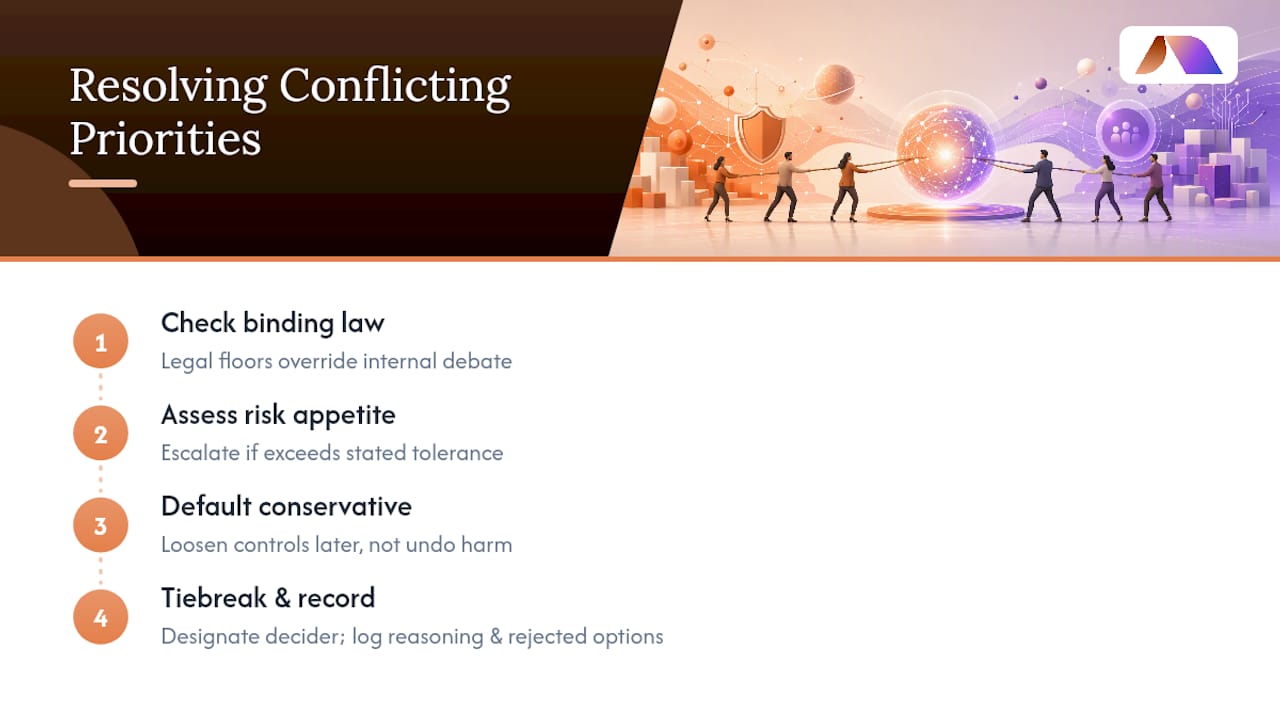
The workable approach borrows from risk management generally: define decision rights before the dilemma arrives, not during it. Assign a clear tiebreaker, usually the executive sponsor or a designated ethics lead, for cases where legal, product, and engineering disagree on acceptable risk. Document the reasoning behind close calls, not just the decision, because the reasoning is what protects you if a regulator or journalist asks later why a system was approved.
A practical framework for these moments: first, check whether the EU AI Act or another binding regulation resolves the question outright (legal floors override internal debate). Second, weigh the decision against your documented risk appetite statement, if the answer exceeds your stated tolerance, it needs board escalation regardless of how good the business case is. Third, where no clear rule applies, default to the more conservative option and revisit once real-world data is available; it’s far easier to loosen a control later than to walk back harm that already happened.
Tools built for decision traceability, like those used for auditable bet and decision logging, illustrate a broader principle worth borrowing: every consequential AI decision should leave a paper trail explaining who decided, on what basis, and what alternative was rejected. That habit turns ethical disagreement from an unresolved argument into a documented, defensible process.
How Should You Communicate With Regulators and Internal Teams?
Internal and external stakeholder communication require almost opposite instincts, and conflating them is a common governance mistake.
Internally, the goal is adoption, not compliance theater. Department leads need to understand why a control exists, not just that it exists, or they’ll route around it under deadline pressure. Short, role-specific training beats a single all-hands presentation: an engineer needs to know what a model card requires, while a sales leader needs to know what customer data is off-limits for AI tools. Build a feedback channel so frontline teams can flag friction in the policy itself; a rule nobody can follow gets ignored, not respected.
Externally, particularly with regulators, the priority is documentation and consistency. Whatever you tell an auditor or regulator should match what your internal risk logs actually show. This is where a proactive stance pays off: organizations that can hand over a risk inventory and decision log unprompted read as governed. Organizations that scramble to reconstruct one after a request read as exposed. Given the pace of emerging federal policy direction on AI, keeping a designated person tracking regulatory developments and translating them into policy updates is no longer optional for organizations operating at scale. A single named point of contact for regulatory inquiries, briefed and current, prevents the scramble entirely.
Team BRDGIT Perspective: Frequent Pitfalls and Rules of Thumb
The pitfall we see most often is checklist mentality: a team completes a policy document, files it, and treats governance as finished. It isn’t. The second most common failure is siloed ownership, where security owns guardrails, legal owns policy, and engineering owns none of it, so nothing actually connects.
Three rules of thumb hold up: score risk before you write policy, assign one accountable owner per pillar, and revisit your risk map quarterly, not annually. We’ve watched programs stall for months chasing a perfect policy draft while a genuinely risky use case sat live in production, unscored, the whole time. Iteration beats perfection here, every time.
— Team BRDGIT
Ready to Move From Governance Policy to Working Controls?
Most organizations we talk to already have a governance policy sitting in a shared drive. What they don’t have is anyone dedicated to turning it into inventoried risks, tested guardrails, and a monitoring dashboard that runs without someone chasing it manually. That gap between the document and the working system is exactly where engagements stall, and it’s exactly where BRDGIT’s fractional AI engineers step in.

A typical starting engagement is scoped tight: an AI readiness assessment covering your top three to five use cases, a risk map built against the probability × severity model, and a pilot set of guardrails on your highest-priority system, usually deliverable within the first 60 days. Teams come out of that scoped pilot with a working risk inventory and at least one production control they didn’t have going in, not just another slide deck. If your governance program has stalled somewhere between “we wrote a policy” and “we have controls that actually run,” a scoped fractional engagement is the fastest way past that wall. Reach out to BRDGIT to scope a readiness assessment and see what a 60-day pilot could look like for your priority systems.
Sources
Artificial Intelligence Risk Management Framework (AI RMF 1.0) — NIST
National Policy Framework for Artificial Intelligence — White House (March 2026)



