
Published on
What Is AI in Facility Management: A 2026 Guide
TL;DR:
Artificial intelligence in facility management uses analytics and automation to optimize operations and reduce costs. It enhances decision-making by handling repetitive data tasks, allowing managers to focus on strategic activities. Successful deployment depends on high-quality data, clear goals, and integrated workflows.
Artificial intelligence in facility management is defined as the application of machine learning, predictive analytics, and automation technologies to optimize building operations, reduce costs, and improve maintenance outcomes. AI does this by analyzing real-time sensor data, historical maintenance records, and occupancy patterns to surface decisions that used to require hours of manual work. The core value is clear: facility managers gain the ability to shift from reactive firefighting to proactive asset stewardship. Key capabilities include predictive maintenance, energy management, security analytics, and AI-driven workflow automation.
What is AI in facility management, and what does it actually do?

AI in facility management is not a single tool. It is a category of technologies that work across building systems, data sources, and operational workflows to reduce manual effort and improve decision quality. The industry term you will encounter most often is “intelligent building management,” though AI in FM covers everything from agentic AI assistants to predictive analytics engines.
The most important thing to understand is what AI replaces and what it does not. AI amplifies human decision-making rather than replacing skilled facility managers. It handles the data-heavy, repetitive work so your team can focus on relationships, vendor negotiations, and capital planning.
AI in FM operates across three core layers:
Data ingestion: Sensors, IoT devices, and building management systems feed continuous data into AI models.
Pattern recognition: AI identifies anomalies, trends, and failure signatures faster than any manual review process.
Decision support: The system surfaces prioritized recommendations, work orders, or alerts for human review and action.
What are the primary AI applications in facility management today?
The practical applications of AI in building operations are broader than most facility managers realize when they first start exploring the technology.
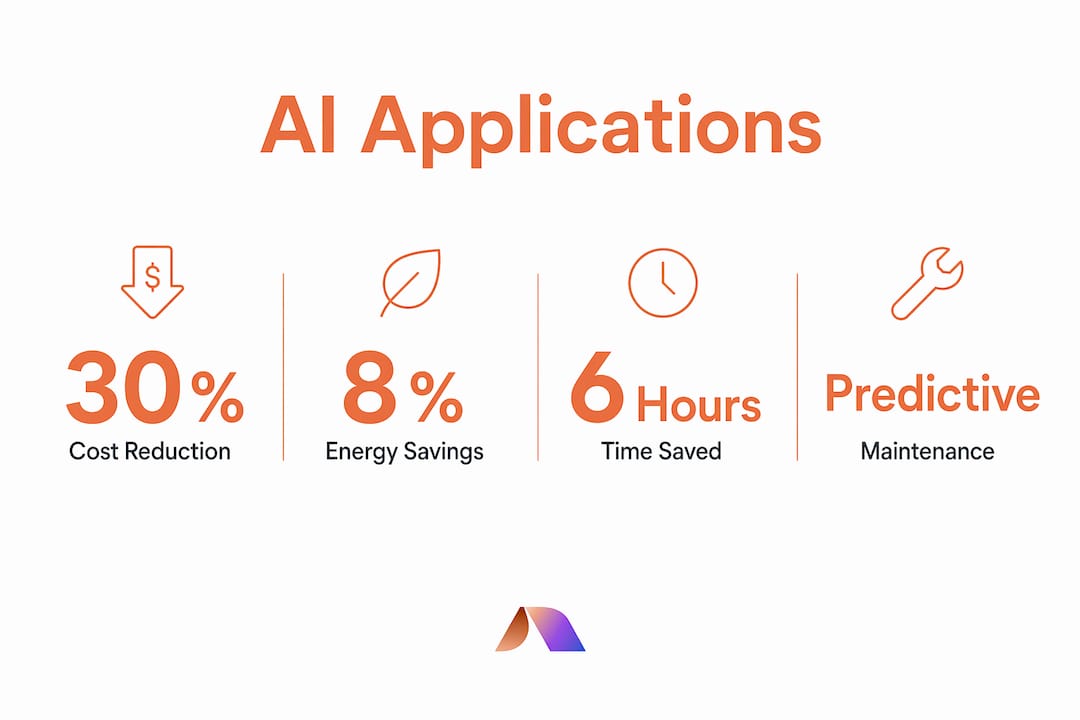
Predictive maintenance is the most proven use case. AI monitors equipment performance in real time, identifies early failure signatures, and flags issues before they become emergency repairs. Real-time anomaly detection extends asset life and reduces unplanned downtime. This is a direct shift from calendar-based maintenance schedules to condition-based intervention.
Energy management is the second major application. AI-enabled smart thermostats and energy management systems reduce energy bills by an average of 8% using real-time occupancy and weather data. That figure compounds across a large portfolio.
Security and access control benefit from automated anomaly detection. AI reviews camera feeds and access logs to flag unusual patterns without requiring a human to watch every monitor.
Operational analytics covers work order prioritization, resource allocation, and demand forecasting. AI ranks incoming tickets by urgency and asset criticality, so your team works the right problems first.
Predictive maintenance reduces emergency repair frequency
Energy AI cuts utility costs through occupancy-aware adjustments
Security AI flags anomalies in access and surveillance data
Operational analytics prioritizes work orders by risk and cost impact
AI assistants answer asset and contract queries in minutes, not hours
How does AI transform facility management workflows and decision-making?
The transformation is not cosmetic. AI changes the speed and quality of decisions at every level of facility operations.
The most striking example involves administrative overhead. AI assistants reduce search times from roughly six hours to a few minutes per inquiry, cutting administrative overhead by over 95%. That time goes back to your team for higher-value work. For field teams, faster access to contracts and asset histories directly improves responsiveness on site. You can read more about this shift in how field teams use AI tools across operations.
AI also changes how disruptions get resolved. Integrating AI workflows with centralized knowledge bases can cut ticket resolution times from six days to as little as six minutes in optimal scenarios. That is not a marginal improvement. It is a structural change in how facility teams operate.
The key to making this work is integration. AI works best when embedded within existing FM systems, maintaining workflow continuity rather than forcing teams to adopt a parallel tool. Adoption rates rise when the AI fits into the process people already use.
AI integrates with existing CMMS, ERP, and energy management platforms
Real-time insights replace end-of-month reporting cycles
Proactive issue resolution reduces reactive maintenance costs
Transparent AI recommendations build team trust over time
Pro Tip: Before selecting any AI tool, map your current workflow and identify the three highest-friction points. The best AI deployment targets those friction points directly, not the features that look impressive in a demo.
What measurable benefits can organizations expect from AI in facility management?
The benefits of AI in facilities are well documented, and the numbers are specific enough to build a business case around.
“AI adoption succeeds when focused on measurable operational outcomes, reducing reactive maintenance, and improving cost control. Organizations that start with clear financial and operational targets consistently outperform those that start with technology selection.”
The financial case is grounded in real benchmarks. Operational costs drop by 15–30% through predictive maintenance and energy optimization combined. Energy savings alone average 8% annually. Administrative time savings exceed 95% for routine data queries.
Benefit area | Measured outcome |
|---|---|
Energy cost reduction | Average 8% savings with smart energy management |
Operational cost savings | 15–30% reduction via predictive maintenance |
Administrative overhead | Search time cut from ~6 hours to minutes |
Ticket resolution speed | From 6 days to as low as 6 minutes |
These numbers matter because they give you a framework for evaluating AI projects before you commit budget. If a proposed AI deployment cannot point to one of these outcome categories, the business case is weak. Data-driven capital planning powered by AI transforms investment decisions from intuition-based to evidence-based. That shift alone justifies the implementation cost for most mid-to-large portfolios.
What challenges should facility managers know before implementing AI?
AI does not forgive organizational ignorance. The technology is only as good as the data and processes behind it.
The most common failure point is data quality. Successful AI tools require standardized, consistent terminology in facility data. Fragmented asset inventories, inconsistent maintenance records, and siloed contract data all degrade AI accuracy. Before deploying any AI system, audit your data taxonomy and clean your asset database.
The second failure point is starting with technology instead of outcomes. One common reason AI fails is selecting a platform before defining measurable operational goals. The question is never “what can this AI do?” It is “what specific problem do we need to solve, and how will we measure success?”
There are also technical limitations to understand:
AI models do not retain persistent memory between sessions, which requires specific architectural approaches for portfolio-scale use
AI-generated outputs for cost estimates and safety-critical instructions require human validation to catch potential inaccuracies
Integration complexity increases with the age and fragmentation of existing FM systems
Pro Tip: Run a 90-day pilot on one building or asset class before scaling. Define your success metric on day one. If the pilot cannot show measurable improvement in that metric, fix the data or the process before expanding.
Key Takeaways
AI in facility management delivers measurable cost savings and operational improvements only when deployed against clear goals, clean data, and integrated workflows.
Point | Details |
|---|---|
AI is an amplifier, not a replacement | AI handles data-heavy tasks so facility managers can focus on strategy and relationships. |
Data quality is the prerequisite | Standardized asset data and consistent terminology are required before any AI deployment. |
Outcomes must come before technology | Define measurable financial and operational targets before selecting any AI platform. |
Cost savings are well documented | Organizations typically see 15–30% operational cost reductions and 8% energy savings. |
Integration drives adoption | AI embedded in existing FM workflows achieves higher adoption and faster return on investment. |
The uncomfortable truth about AI and facility management
We talk to facility managers and business leaders regularly, and the pattern is consistent. The ones who struggle with AI adoption share one trait: they started with the technology. They saw a demo, got excited about the interface, and bought before they mapped the problem. The ones who succeed started with a specific operational pain, usually reactive maintenance costs or administrative overhead, and worked backward to the right tool.
The shift AI enables in facility management is real. We have seen teams move from six-day ticket resolution to same-day resolution. We have seen energy budgets shrink without any capital investment in new equipment. But none of that happens without the unglamorous work first: cleaning the data, standardizing the taxonomy, and getting clear on what success looks like in numbers.
The future of facility management is not about which AI platform you choose. It is about whether your organization has the data discipline and outcome clarity to use any AI well. Soft skills matter more than most people expect. The facility manager who can translate AI-generated insights into executive-level capital planning conversations is the one who will define what this profession looks like in five years.
AI does not care about your org chart. It rewards preparation and punishes vagueness. Start there.
— Team BRDGIT
BRDGIT’s approach to AI-driven facility management
Facility managers who are ready to move from curiosity to execution need more than a platform. They need experienced people who understand both the technology and the operational realities of building management.
BRDGIT provides fractional AI engineers who specialize in embedding AI into existing facility management workflows. The work covers everything from AI readiness assessments and data standardization to workflow automation and custom AI system builds. If your team needs to reduce downtime, control maintenance costs, or improve response times without hiring a full-time AI team, BRDGIT’s fractional model gives you experienced execution capacity on demand. Teams working with AI deployment specialists consistently reach measurable outcomes faster than those building capability internally from scratch. Reach out to BRDGIT to define your first AI use case and build a clear path to results.
FAQ
What is AI in facility management?
AI in facility management is the use of machine learning, predictive analytics, and automation to optimize building operations, reduce costs, and improve maintenance outcomes. It analyzes real-time and historical data to support faster, more accurate decisions.
How does predictive maintenance work with AI?
AI monitors equipment sensor data continuously, identifies early failure patterns, and alerts facility teams before breakdowns occur. This reduces emergency repairs and extends asset life compared to calendar-based maintenance schedules.
What cost savings can AI deliver in facility operations?
Organizations typically see operational cost reductions of 15–30% through predictive maintenance and energy optimization, plus an average 8% reduction in energy bills from smart building systems.
What data do you need before implementing AI in facility management?
You need standardized asset inventories, consistent maintenance records, and clean contract data. Fragmented or inconsistent data directly degrades AI accuracy and is the most common cause of failed implementations.
Does AI replace facility managers?
AI does not replace facility managers. It handles data-intensive, repetitive tasks so managers can focus on strategic planning, vendor relationships, and capital investment decisions that require human judgment.