
Published on
AI Catalog Management: What It Means and How It Works
AI catalog management is the use of machine learning, natural language processing, and computer vision to automate the creation, enrichment, categorization, and ongoing maintenance of product data so your catalog stays complete, accurate, and ready for every channel you sell on. The industry term you’ll encounter in vendor conversations is intelligent catalog automation, though “AI catalog management” has become the working shorthand across retail and e-commerce ops teams.
Three things make it worth your attention right now:
Faster onboarding: New SKUs can move from raw supplier data to channel-ready listings in hours rather than days.
Fewer data errors: Automated validation catches missing attributes, inconsistent naming, and conflicting variant rules before they reach Google Merchant Center, Shopify, or your marketplace feeds.
Channel-ready outputs: A single enriched product record can be transformed and syndicated to multiple channels simultaneously, each formatted to that channel’s schema.
The single most practical next step: baseline your current catalog completeness rate before you evaluate any solution. Without that number, you cannot measure whether AI is moving the needle.
Key Takeaways
AI catalog management automates attribute extraction, categorization, quality monitoring, and channel syndication so product data stays complete, accurate, and channel-ready without manual enrichment at scale.
Point | Details |
|---|---|
Definition | AI catalog management uses NLP, computer vision, and classifiers to automate enrichment, categorization, and channel formatting of product data. |
Top pilot target | Baseline catalog completeness rate first; aim for a significant improvement and faster time-to-onboard in a 90-day pilot. |
Governance is non-negotiable | Every AI-generated field needs lineage, prompt versioning, approval states, and rollback procedures to prevent bad data at scale. |
Biggest risk | Hallucination and mapping errors in auto-applied fields; constrain outputs to allowed-value schemas and require human review for safety-critical attributes. |
BRDGIT | BRDGIT provides readiness assessments, pilot design, fractional AI engineering, and staff training to get catalog AI running without a full-time hire. |
Table of Contents
What AI catalog management actually covers in practice
Core AI capabilities your catalog solution should have
How AI actually performs these tasks under the hood
Business benefits that show up in your metrics
Key implementation questions to answer before you deploy
A practical 90-day pilot roadmap
KPIs to measure catalog AI impact
Where AI catalog management helps most: vertical use cases
Common risks and how to avoid them
How to evaluate vendors or decide to build internally
What we’ve learned from running catalog AI pilots
BRDGIT can run your catalog AI pilot from day one
Sources
What AI catalog management actually covers in practice
The scope is wider than most teams expect. AI catalog management automates creation, enrichment, categorization, quality detection, and cross-channel optimization. It commonly pairs with a PIM to handle operational execution rather than only storage. That distinction matters: your PIM remains the system of record; the AI layer is what acts on the data.
In practice, the activities that fall under this umbrella include:
Product data maintenance: Keeping titles, descriptions, and attributes current as supplier data changes.
Attribute and taxonomy management: Mapping incoming supplier fields to your internal schema and to channel-specific taxonomies.
Quality control: Flagging missing images, duplicate records, conflicting variant rules, and out-of-spec copy.
Syndication: Transforming a master record into channel-specific feeds for Amazon, Google Shopping, Shopify, and wholesale portals.
Enrichment: Pulling additional attributes from images, spec sheets, or web sources and writing them into the record.
Ownership typically splits across roles. Catalog managers own taxonomy decisions and quality thresholds. PIM admins control schema and integration mapping. ML engineers or fractional AI engineers configure models, prompts, and confidence thresholds. Merchandisers set copy standards and review flagged records. Channel ops own feed validation and submission.
One terminology note worth flagging: “AI Catalog” sometimes refers to a data catalog for ML assets, a centralized hub for finding and reusing model-ready data. That is a different tool. This article is about AI applied to product catalog operations.
Core AI capabilities your catalog solution should have
Think of this as a checklist to run against any vendor demo or internal build. AI automates catalog work by extracting attributes, categorizing products, flagging data-quality issues, syndicating channel-ready feeds, and continuously enriching new products at scale. Here is how each capability maps to automation difficulty:
Automated attribute extraction (Easy): Pulls structured fields from unstructured text, spec sheets, or supplier data. Example: extracting thread count and fabric weight from a raw textile description.
Intelligent categorization (Easy to Medium): Classifies products into your taxonomy using a trained classifier. Example: routing a new SKU to “Women’s Athletic Footwear > Trail Running” without manual assignment.
Image-based attribute inference (Medium): Uses computer vision to infer material, color, pattern, or style from product images. Example: detecting “brushed nickel finish” from a hardware photo when the supplier omitted it.
Normalization and deduplication (Medium): Standardizes inconsistent values (“blk,” “Black,” “BLK” → “Black”) and merges near-duplicate records using embedding similarity.
Copy generation to house style (Medium): Generates or rewrites titles and descriptions to match your brand’s tone, length, and keyword requirements. Example: rewriting a 400-word supplier description into a 75-word SEO title and bullet set.
Channel transformation and syndication (Medium to Hard): Converts a master record into channel-specific formats. Example: mapping your internal attribute schema to Amazon’s Browse Node requirements.
Quality monitoring (Easy): Continuously scores records against completeness and accuracy rules, surfacing degraded records before they affect storefront performance.
Continuous enrichment (Hard): Monitors new product additions and re-enriches existing records as models improve or category rules change.
Pro Tip: Start with the two or three capabilities rated “Easy” in your category. Prove ROI there before layering in image inference or copy generation, which require more governance overhead.
How AI actually performs these tasks under the hood
The architecture follows a predictable pattern: data sources feed an AI enrichment layer, which routes outputs through a validation and human-in-the-loop step, and then a channel feed transformer publishes to destinations.
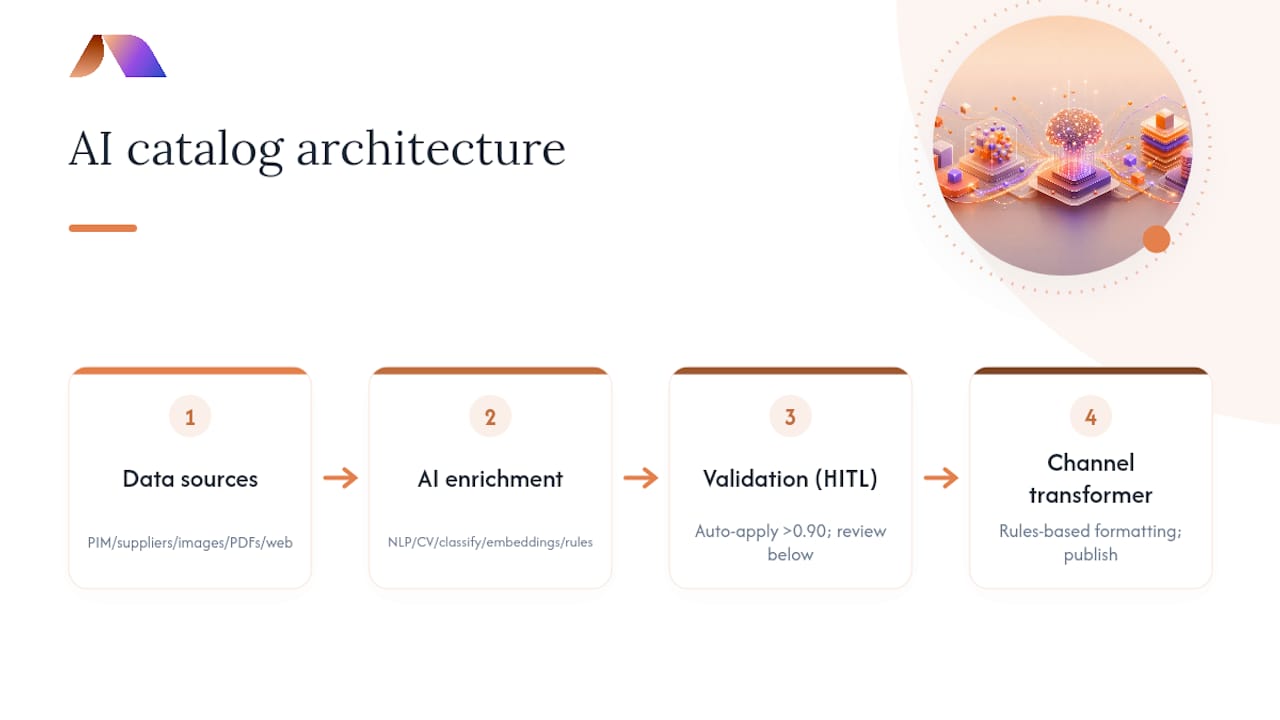
Data sources include your PIM, supplier data files, product images, spec PDFs, and web-scraped content. The AI enrichment layer applies several model types depending on the task. NLP models handle text extraction, normalization, and copy generation. Computer vision models infer attributes from images. Classification models assign taxonomy nodes. Embedding models find similar or duplicate records by measuring semantic distance between product vectors. Rules-based transformers handle channel formatting, where the logic is deterministic rather than probabilistic.
Governance is not optional. An AI product catalog requires machine-readable structure, normalized naming, and source-of-truth lineage for every generated field so downstream systems and audits can trace content back to inputs and reviewer decisions. That means storing prompt version history, approval states, and rollback options alongside the enriched data.
Human-in-the-loop flows work on confidence thresholds. A well-designed system auto-applies attribute values above a set confidence score (say, 0.90) and routes anything below that threshold to a review queue. Reviewers correct the flagged record; the model learns from the correction. Over time, the volume of flagged records shrinks as the model calibrates to your catalog’s patterns. Designing prompts and model outputs as structured, constrained records with confidence scores lets downstream transformers automatically pick high-confidence fields and route low-confidence ones for human review.
Business benefits that show up in your metrics
Catalog quality directly influences search, recommendations, and conversions. Treating it as a revenue lever rather than a background chore changes how you prioritize the work. The benefits that catalog teams report most consistently include:
Faster time-to-onboard: New vendor lines go live in hours rather than the days or weeks a manual enrichment process requires.
Improved search and filter accuracy: Complete, normalized attributes mean shoppers find products through faceted search instead of hitting zero-result pages.
Fewer returns: Accurate size, material, and compatibility attributes reduce “not as described” returns, which carry both logistics cost and review damage.
Higher conversion: Catalog completeness and correct attributes directly affect collection pages, search rankings, and recommendation engines.
Lower manual headcount for routine enrichment: Teams shift from data entry to quality oversight, which is a better use of catalog expertise.
Vendor-reported figures from the AI Wiki overview suggest platforms claim reductions in catalog management time and attribute accuracy rates above 90% in specialized categories. Treat those as directional benchmarks, not guarantees. Your actual results depend on catalog complexity, data source quality, and how well your governance layer is configured.
A practical illustration: a mid-market apparel retailer onboarding a new vendor line of 800 SKUs might spend three weeks on manual attribute entry. With AI enrichment handling size, material, and care instructions from supplier spec sheets, that same onboarding can compress to two to three days, with human review focused only on flagged edge cases.
Connecting catalog health scores to revenue metrics rather than counting time saved alone gives you the business case that resonates with finance and leadership. See also how AI-powered order fulfillment depends on catalog accuracy to reduce fulfillment exceptions.
Key implementation questions to answer before you deploy
Skipping the pre-deployment checklist is how teams end up automating bad data at scale. Work through these three phases before you go live.
Pre-deployment
Inventory your current data sources: PIM exports, supplier feeds, image libraries, spec PDFs.
Audit schema completeness: which required attributes are missing across what percentage of your catalog?
Define your taxonomy: is it stable enough to train a classifier, or does it need cleanup first?
Identify integration points: PIM API, ERP product master, marketplace connectors, feed management tools.
Pilot
Select a representative sample of 200–500 SKUs across two or three categories.
Map the enrichment flow: PIM export → AI enrichment layer → validation UI → human review queue → channel transformer → feed submission.
Set confidence thresholds and approval states for each attribute type.
Scale
Establish prompt versioning and rollback procedures before expanding to the full catalog.
Build alerting for sudden drops in attribute accuracy or spikes in channel rejections.
Schedule periodic model re-evaluation as your catalog grows and category rules evolve.
Governance controls including lineage, prompt history, and approval workflows are required because unenforced auto-enrichment creates new data quality problems quickly. Framing the catalog as infrastructure rather than a content project shifts team priorities toward schemas, provenance, and channel transformers rather than one-off copy projects. This connects directly to AI-powered inventory control, where SKU-level catalog accuracy and stock status need to stay synchronized.
A practical 90-day pilot roadmap
A focused pilot on high-impact attributes yields faster measurable wins than attempting full-catalog automation in the first phase. Here is a week-by-week structure your team can adapt.
Weeks 1–2 (Discovery): Audit catalog completeness for your pilot category. Document current time-to-onboard for a new vendor line. Identify the three to five attributes with the highest missing-value rate. Define your “golden set” of 50–100 expert-reviewed products that will serve as your ongoing validation dataset.
Weeks 3–4 (Schema and integration): Clean the taxonomy for your pilot category. Map PIM fields to AI input schema. Configure integration between your PIM and the AI enrichment layer. Confirm channel transformer output format for your primary channel.
Weeks 5–8 (Build and configure): Configure attribute extraction prompts for your target fields. Set confidence thresholds. Build the human review queue. Run the golden set through the model and measure baseline accuracy.
Weeks 9–10 (Validation): Process the full pilot SKU set. Measure attribute accuracy against the golden set. Measure time-to-onboard versus your pre-pilot baseline. Collect reviewer feedback on flagged records.
Weeks 11–12 (Ramp and decision): Adjust confidence thresholds based on validation results. Document errors and retrain or adjust prompts. Present results against acceptance criteria to stakeholders. Decide: expand scope, adjust model, or pause.
Roles: Catalog manager owns taxonomy and golden set. PIM admin owns integration and schema. ML or fractional AI engineer owns model configuration, prompts, and threshold tuning. Merchandiser reviews flagged records and provides correction feedback. BRDGIT supports pilot design, engineering configuration, and measurement.
KPIs to measure catalog AI impact
Baseline these before the pilot starts. Without a pre-AI baseline, you cannot attribute improvement to the system.
KPI | Definition | Sample formula | Suggested pilot target |
|---|---|---|---|
Catalog completeness rate | Share of required attributes populated across all SKUs | (Populated required fields / Total required fields) × 100 | Improve by a significant percentage |
Time-to-onboard | Calendar days from supplier data receipt to channel-live | Average days across a vendor line cohort | Reduce the time significantly versus baseline |
Attribute accuracy | Share of AI-generated attributes confirmed correct by reviewers | (Correct AI attributes / Total AI-generated attributes) × 100 | Above average on golden set |
Search zero-result rate | Share of on-site searches returning no results | (Zero-result searches / Total searches) × 100 | Reduce post-enrichment |
Conversion lift | Change in conversion rate on enriched vs. non-enriched product pages | (Enriched CVR / Control CVR) − 1 | Positive lift; A/B test or phased rollout |
Measure completeness and accuracy weekly during the pilot. Use a phased rollout rather than a full A/B test for conversion lift if your traffic volume is too low for statistical significance. Time-to-onboard is best measured across a full vendor line cohort rather than individual SKUs.
Where AI catalog management helps most: vertical use cases
Fashion and apparel: Size variants, color normalization, and care instruction extraction are high-volume, low-complexity tasks that AI handles well. The primary KPIs are completeness rate and return rate. Implementation friction: inconsistent supplier size charts require a normalization layer before enrichment.

Consumer electronics: Compatibility attributes (device model, OS version, connector type) are critical for search and returns. AI can extract these from spec sheets and infer them from images. Primary KPIs are zero-result rate and return rate. Friction: compatibility data changes with firmware updates, requiring continuous re-enrichment.
Grocery and food: Ingredient lists, allergen flags, and nutritional attributes must be accurate for regulatory and liability reasons. AI can extract and normalize these from supplier data, but human review is non-negotiable for any health-related field. Primary KPI is attribute accuracy. Friction: label changes require rapid re-enrichment workflows.
B2B parts and industrial: Specification attributes (dimensions, material grade, thread pitch) drive search and compatibility filtering. AI performs well on structured spec sheets. Primary KPI is time-to-onboard for new supplier catalogs. Friction: legacy supplier data arrives in inconsistent formats, often PDF or spreadsheet.
Marketplace and multi-brand onboarding: High SKU volume from multiple suppliers with different schemas is the canonical AI catalog use case. AI normalizes and maps incoming data to your master taxonomy at scale. Primary KPI is time-to-onboard. See how this connects to the broader AI toolset for supply chain when you are managing multi-vendor data flows.
Common risks and how to avoid them
AI catalog management does not forgive weak governance. The failure modes are predictable, and most are preventable.
Hallucination and generation errors: Language models can generate plausible-sounding but incorrect attribute values. Mitigation: constrain outputs to structured schemas with allowed-value lists; never auto-apply generated values for safety-critical fields (allergens, electrical ratings) without human review.
Taxonomy mapping errors: A classifier trained on one category structure will misclassify products when the taxonomy changes. Mitigation: version your taxonomy alongside your model; retrain or adjust prompts when categories are restructured.
Duplicate proliferation: Embedding-based deduplication works well within a single data source but can miss cross-source duplicates with different naming conventions. Mitigation: run deduplication across all ingestion sources before enrichment, not after.
Bias in training data: If your historical catalog over-represents certain product types, the model will perform worse on underrepresented categories. Mitigation: audit model accuracy by category, not just overall.
Data privacy and leakage: Sending supplier data to third-party AI APIs may violate data sharing agreements. Mitigation: review contracts before configuring any cloud-based enrichment pipeline; consider on-premise or private cloud deployment for sensitive categories.
When a bad enrichment job is detected, the rollback playbook should include: pause the enrichment job, restore the last approved version of affected records from lineage logs, notify channel ops to hold feed submission, and root-cause the prompt or model issue before restarting.
How to evaluate vendors or decide to build internally
The build-versus-buy decision turns on three factors: your engineering capacity, your catalog complexity, and your timeline. Most mid-market retailers are better served by a configurable platform than a ground-up build, at least for the first phase.
Vendor checklist:
Data lineage and field-level provenance for every generated attribute
Schema flexibility to match your PIM’s attribute model
Image inference capability (not just text extraction)
Native connectors for your PIM, marketplace feeds, and channel management tools
Defined SLAs for enrichment accuracy and issue resolution
Security and compliance documentation (SOC 2, data residency options)
Availability of fractional or embedded support for configuration and tuning
10 RFP questions to copy and use:
What data sources does your system ingest natively, and how do you handle unstructured inputs like PDFs and images?
How do you store and expose data lineage for AI-generated fields?
What is your confidence threshold model, and how does the human review queue work?
How do you version prompts and model configurations, and what does rollback look like?
Which channel templates do you support out of the box, and how are custom transformers configured?
How do you measure and report attribute accuracy, and against what ground truth?
What is your SLA for identifying and correcting a systematic enrichment error?
What does a typical pilot scope look like, and what do you need from us to start?
How does your system handle taxonomy changes without requiring full retraining?
What ongoing maintenance and retraining budget should we plan for after go-live?
TCO considerations: Implementation effort (integration, schema mapping, golden set creation) is often underestimated. Licensing models vary from per-SKU to per-seat to usage-based API pricing. Human review cost does not disappear; it shifts from enrichment to oversight. Budget for periodic model re-evaluation and prompt tuning as your catalog evolves. Reviewing AI vendor management tools alongside catalog-specific vendors can surface procurement efficiencies when both workflows are in scope.
The role of AI across e-commerce systems extends well beyond the catalog layer, so evaluate vendors on their ability to integrate with your broader stack, not just their enrichment accuracy in isolation.
What we’ve learned from running catalog AI pilots
The teams that get the most out of a catalog AI pilot are the ones that resist the urge to automate everything at once. The instinct is understandable: the backlog is large, the manual work is painful, and the technology looks capable. But scope creep in the first phase is the single most reliable way to produce a noisy result that leadership cannot act on.
What actually works is narrower than most people expect. Pick one attribute family, one category, and one channel. Measure it rigorously. Then expand. The governance infrastructure you build for that first narrow scope, the lineage tracking, the confidence thresholds, the review queue, scales to the full catalog. The enrichment logic does not.
BRDGIT can run your catalog AI pilot from day one
Catalog AI is not a product you buy and deploy. It is a system you configure, govern, and tune. That requires AI engineering capacity most catalog teams do not have on staff.
BRDGIT works with retail and e-commerce operations teams to design and run AI catalog pilots from the ground up. The engagement starts with a readiness assessment that baselines your catalog completeness, maps your data sources, and identifies the highest-ROI enrichment targets. From there, BRDGIT’s fractional AI engineers handle integration, model configuration, confidence threshold design, and review queue setup so your catalog team can focus on quality decisions rather than infrastructure. Training is included so your team owns the system after go-live, not just the outputs.
If you are ready to move from curiosity to a working pilot, book a readiness assessment with BRDGIT and leave with a scoped plan in one session.