
Published on
What a Voice AI Agent Actually Does for Your Business
A voice AI agent answers phone calls, books appointments, qualifies leads, and resolves routine requests without a human on the line, running around the clock on the same phone number your customers already call. If your call volume is repeatable and predictable, a scoped pilot is the right first move. If you’re dealing with compliance requirements, legacy system integrations, or a rollout across multiple locations, hiring an execution partner like BRDGIT to run discovery and build is the faster and safer path.
The technology behind this has matured past the robotic phone tree. Modern systems combine automatic speech recognition, natural language understanding, and text-to-speech into something that holds a real conversation, interrupts gracefully, and hands off to a human when the conversation calls for judgment.
Three things worth knowing before you evaluate anyone:
Editorial buyer guides consistently recommend piloting with defined transfer-rate and completion metrics before any production rollout.
Developer documentation, including LangChain’s voice agent framework, shows that real-time function calling and interruption handling are the hard engineering problems, not the conversation itself.
An AI readiness assessment is the fastest way to know whether your organization should pilot, buy, or build.
Quick verdict: pilot internally if you have one clear, high-volume call pattern (appointment booking, order status, basic FAQ) and no regulatory complexity. Bring in BRDGIT when the deployment touches protected data, multiple systems, or more than one business unit.
TL;DR:
Pilot with high-volume, repeatable call intents and clear transfer and completion metrics to ensure a successful deployment.
Use an AI readiness assessment to determine if your organization should pilot, buy, or build before starting development.
Deploy off-the-shelf solutions for fast implementation in low-risk, low-compliance scenarios, but opt for custom or private systems when handling sensitive data or complex integrations.
Evaluate vendors based on intent recognition accuracy, real-world latency, and contractual transfer and completion thresholds, not just sales demos.
Most failures occur due to integration and governance issues, so prioritize operational back-end systems, data security, and escalation protocols during deployment.
Table of Contents
What Does a Voice AI Agent Do, and Where Does It Add Value?
Off-the-Shelf vs. Custom: Which Deployment Pattern Fits?
How Do You Evaluate and Choose a Voice AI Partner?
What’s a Realistic Timeline From Pilot to Production?
What Integrations and Metrics Keep a Voice Agent Running Well?
How BRDGIT Helps Teams Execute Voice AI Projects
Key Takeaways
The Procurement Mistake Most Companies Repeat
Ready to Move From Voice AI Curiosity to a Working Pilot?
Sources
What Does a Voice AI Agent Do, and Where Does It Add Value?
A voice AI agent is a software system that listens to a caller, understands intent, decides what to do, and speaks back, in a loop that repeats until the request is resolved or escalated. That loop rests on four components working together in real time, and understanding them matters because each one is a separate point of failure or opportunity.
Automatic speech recognition (ASR) converts spoken audio into text, and its accuracy on accents, background noise, and industry jargon determines whether the rest of the pipeline has a chance.
Natural language understanding (NLU), sometimes narrowed to spoken language understanding (SLU) in voice-specific systems, extracts intent and entities from that text. This is where “I need to move my Tuesday appointment” becomes a structured reschedule request.
Dialog management decides the next action. Ask a clarifying question, call an API, or transfer to a human.
Text-to-speech (TTS) turns the response back into audio that sounds like a person, not a 2008 IVR system.
Layered on top of that core loop is function calling, the ability for the agent to actually do something, like check a calendar, pull an order status, or update a CRM record, rather than just talk about it. Multi-turn context, the memory that lets the agent remember what the caller said two exchanges ago, separates a genuinely useful agent from a frustrating one.
Where this delivers real business value tends to cluster around a handful of use cases:
Reception and call answering. Every call gets picked up, every time, including nights, weekends, and the lunch rush your front desk can’t staff.
Appointment booking and rescheduling. High-volume, low-complexity, and exactly the kind of repeatable task voice AI handles well.
Lead qualification. The agent asks the same three or four screening questions your sales team asks anyway, then routes qualified leads to a human.
Order status and basic support. “Where’s my order” and “what’s my balance” are answerable without a person touching the call.
Surveys and collections outreach. Structured, scripted conversations at volume, where consistency matters more than improvisation.
The metrics that matter here are concrete and measurable: missed-call reduction, booking-rate uplift, and cost-per-resolution compared to a human agent handling the same call. Buyer guides that test these products treat transfer rate and completion rate as the two numbers that separate a working deployment from a demo that never should have shipped.
Off-the-Shelf vs. Custom: Which Deployment Pattern Fits?
The deployment decision usually comes down to three tensions pulling against each other: how fast you need to move, how much control you need over the system, and what your compliance obligations demand. You rarely get all three at once.
Off-the-shelf, packaged services get you live in days. A vendor’s pre-built voice agent handles common intents out of the box, and you configure rather than build. The tradeoff is limited customization and, often, less visibility into where your call data actually lives.
Custom-engineered solutions take longer and cost more upfront, but they integrate with your specific CRM, follow your exact call scripts, and give you control over data retention and model behavior. This is the path for organizations where the off-the-shelf intent library doesn’t match how your business actually talks to customers.
Cloud-hosted vs. private/on-premises deployment is where compliance stops being theoretical. Technical guidance from LangChain’s voice agent documentation notes that regulated sectors, healthcare and legal work in particular, routinely choose private or tightly controlled deployments even when it slows down time-to-production. If you’re handling protected health information or privileged client data, that tradeoff usually isn’t optional.

Managed service vs. build-it-yourself is the commercial version of the same question. A managed engagement hands the ongoing operation to a partner; building internally means you own the maintenance, the monitoring, and the on-call rotation when something breaks at 2 a.m.
A few operational factors deserve attention regardless of which pattern you pick:
Latency above roughly 500 milliseconds starts to feel unnatural to callers, who unconsciously expect conversational timing.
Language coverage varies significantly between vendors. Test your specific dialects and accents, not just “English.”
Voice quality and the system’s ability to handle interruptions (a caller talking over the agent) separate usable products from ones that frustrate people within the first thirty seconds.
Function-calling reliability, whether the agent can actually book the appointment it just confirmed, is worth stress-testing before you trust it with live traffic.
Pro Tip: Run your evaluation call list through the vendor’s demo with a deliberately messy caller, someone who interrupts, changes their mind mid-sentence, or has a strong regional accent. That’s a better acceptance test than a clean scripted demo call.
Data governance considerations map directly onto architecture choices, and guidance on enterprise agent types makes the same point from a different angle: pick the agent design that matches your actual data-risk tolerance, not the one that demoed best.
How Do You Evaluate and Choose a Voice AI Partner?
Treat this like the procurement decision it is, with specific pass/fail criteria rather than a gut check after a sales demo. Vendors that can’t answer these questions directly are telling you something.
Technical acceptance criteria to set before you sign anything:
Intent recognition accuracy on your actual call types, tested with your own recorded calls, not the vendor’s sample data.
Latency benchmarks under real network conditions, not a controlled demo environment.
Transfer rate thresholds. What percentage of calls should the agent hand to a human, and does the vendor agree to that number contractually?
Completion rate for the specific tasks you’re automating (bookings confirmed, orders resolved, leads captured).
Editorial reviews of the category consistently point to transfer rate and completion rate as the pilot-gating metrics that should decide whether a system moves to production, rather than a vendor’s marketing claims about “human-level accuracy.”
Integration and security checks:
Confirm SIP trunk compatibility with your existing phone system before you assume it’ll just work.
Verify CRM API access covers read and write, not just read, since a lead-qualification agent needs to create records, not just look them up.
Ask for the data retention policy in writing, including how long recordings and transcripts are stored and where.
Confirm SOC 2 or, for healthcare applications, HIPAA readiness with actual documentation, not a verbal assurance.
Commercial red flags worth walking away from:
Pricing that’s opaque about per-minute telephony costs on top of the platform fee.
Data-use clauses that allow the vendor to train future models on your call recordings without an opt-out.
No clear exit path. Ask specifically what happens to your data, your custom intents, and your call recordings if you switch providers.
On that last point, security guidance for enterprise AI deployments recommends requesting data export and model retraining artifacts contractually, upfront, before you’re locked into a system that’s expensive to leave. Vendor lock-in rarely announces itself at signing. It shows up eighteen months later when you want to switch and discover your call data doesn’t export cleanly.
What’s a Realistic Timeline From Pilot to Production?
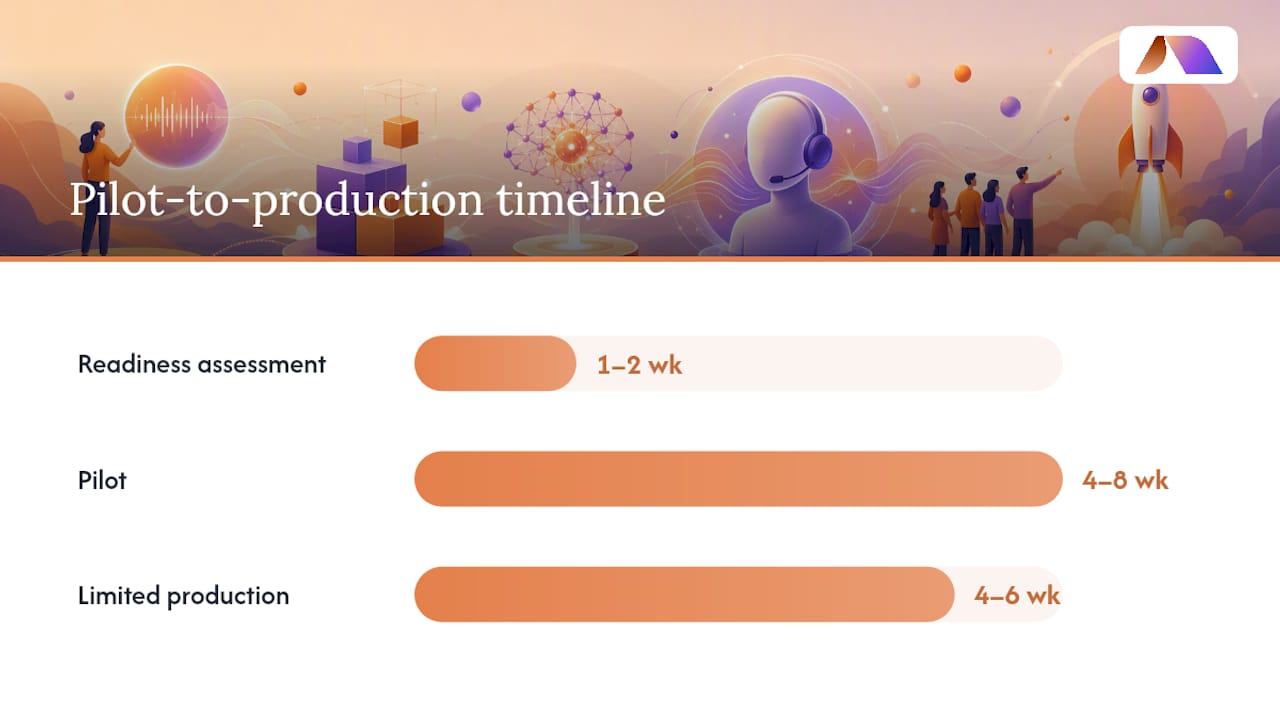
Most organizations underestimate this timeline by roughly half, because the conversation itself is the easy part and the integration work is not. A stage-by-stage plan keeps expectations honest.
Readiness assessment (1 to 2 weeks). This is where you map your actual call data, existing systems, and organizational readiness before writing a line of code. An AI readiness assessment at this stage tells you whether you’re a pilot candidate or need a build.
Pilot (4 to 8 weeks). Narrow scope to one or two call intents, define your KPIs upfront (transfer rate, completion rate, caller satisfaction), and run it on a subset of real traffic.
Limited production (4 to 6 weeks). Expand to the full call volume for the piloted intents, add monitoring, and start tracking regression against your pilot baseline.
Scale (ongoing). Add new intents, additional languages, or additional locations once the core system has proven stable.
What extends this timeline is rarely the AI itself. It’s integration complexity (a CRM with a poorly documented API), compliance reviews that add weeks for legal sign-off, and voice model tuning to get accents and industry terminology recognized reliably. Buyer guides recommend gating each stage transition on hitting specific KPI thresholds rather than a calendar date, which is the right instinct even though it makes the timeline less predictable on paper.
Cost drivers break into five buckets worth budgeting separately: platform licensing fees, telephony costs (per-minute rates and phone number provisioning), engineering hours for integration work, data labeling and voice model tuning, and ongoing monitoring and operations once the system is live. Playbooks for scaling AI agents recommend starting with a narrow set of high-volume intents rather than trying to automate everything at once, since that concentrates your engineering budget where the call volume actually justifies it.
What Integrations and Metrics Keep a Voice Agent Running Well?
A voice agent that works in the pilot and breaks in production almost always failed on the plumbing, not the conversation design. The integrations below aren’t optional extras. They’re the operational backbone.
Telephony stack connecting the agent to your existing phone numbers, typically via SIP trunking.
CRM integration so the agent can read customer history and write new records, not just answer generically.
Scheduling systems for real-time calendar availability, since a booking agent that can’t see actual open slots isn’t solving the problem.
Knowledge base access for FAQ resolution, kept current, since an agent citing outdated policy is worse than one that says “let me transfer you.”
Identity and verification steps for any call touching account-specific or sensitive information.
Operational guardrails matter just as much as the integrations themselves. Every call needs a clear consent and recording prompt where legally required. Escalation paths need to be unambiguous. When a caller says “let me talk to a person,” the agent should transfer immediately, not attempt three more clarifying questions. Human-in-the-loop review of a sample of calls, weekly at minimum during the first months, catches drift before it becomes a pattern of complaints.
Pro Tip: Build your escalation trigger list before launch, not after your first angry customer call. Frustration cues (repeated phrases, raised volume detected by the ASR, explicit requests for a human) should route to a person within one exchange, not three.
On the measurement side, a dashboard tracking transfer rate, completion rate, average handle time, and caller satisfaction gives you the early warning system for regression. Developer-level implementation patterns show that real-time function calling and interruption handling are where most production issues originate, which is exactly where your monitoring should point first.
How BRDGIT Helps Teams Execute Voice AI Projects
BRDGIT works across the full path from “should we do this” to “this is running in production,” which matters because most voice AI projects stall somewhere in that middle stretch, not at the idea stage.
AI readiness assessments that score your data availability, integration complexity, and organizational readiness before you commit budget.
Strategy development that maps voice AI opportunities against your actual operational priorities, not a generic use-case list.
Custom AI systems and agents engineered for your specific call patterns, CRM, and compliance requirements.
Fractional AI engineering for teams that need experienced technical talent for planning and delivery without a full-time hire.
Staff training so your team trusts and uses the system correctly once it’s live, rather than routing around it.
Choose an internal build only when you already have the engineering bandwidth to own ongoing maintenance and monitoring. Choose a packaged service only for the simplest, lowest-stakes intents with no compliance overlay. For anything touching regulated data, multiple integrated systems, or a rollout across several business units, an execution partner closes the gap between a promising pilot and a system that survives contact with real call volume.
The gap between a working demo and a production system that survives real call volume is almost always integration work and governance decisions, not the conversation design itself. That’s the stretch where most internal projects lose momentum.
Key Takeaways
Voice AI agents succeed when organizations pilot narrow, high-volume call intents with clear acceptance metrics before scaling, and bring in specialized execution support for regulated or multi-system deployments.
Point | Details |
|---|---|
Start narrow | Pilot one or two high-volume call intents with defined transfer and completion rate targets before expanding. |
Match architecture to compliance | Regulated data (health, legal) usually requires private or tightly controlled deployment even if it slows launch. |
Set gating metrics upfront | Use transfer rate, completion rate, and latency thresholds as go/no-go criteria, not vendor marketing claims. |
Protect against lock-in | Request data export and model retraining artifacts contractually before signing with any vendor. |
Bring in BRDGIT for complexity | BRDGIT’s readiness assessments and fractional engineering fit deployments involving compliance, multiple systems, or scale. |
The Procurement Mistake Most Companies Repeat
The conventional advice on voice AI still treats this as a vendor-shortlist exercise: compare features, pick the best demo, sign a contract. That approach undersells the actual decision, which is an architecture and governance choice disguised as a purchasing decision. A system that demos beautifully can still fail in production if nobody defined a transfer-rate threshold or asked where the call recordings live.
What the evidence actually supports is treating the pilot as the real test, with numeric acceptance criteria agreed before a single live call happens. Most organizations skip that step and discover their acceptance criteria only after something has already gone wrong for a customer.
Readers evaluating this space should prioritize the readiness assessment first, ahead of any vendor conversation. It tells you honestly whether you’re a pilot candidate or a build candidate, and it prevents the expensive mistake of discovering a compliance blocker three months into a vendor engagement.
— Team BRDGIT
Ready to Move From Voice AI Curiosity to a Working Pilot?
BRDGIT is the execution partner for the deployments this article just walked through: the ones involving compliance requirements, multiple integrated systems, or a rollout across more than one location, where a packaged, off-the-shelf service runs out of runway fast.
What sets BRDGIT apart is the sequencing. Instead of jumping to a vendor demo, BRDGIT starts with an AI readiness assessment that scores your actual data, integrations, and organizational capacity, then builds a roadmap that tells you honestly whether to pilot, buy, or engineer a custom system. For teams that need voice AI expertise without a full-time hire, BRDGIT’s fractional AI engineers can run planning, delivery, and the ongoing operational support that keeps a system stable after launch, on a schedule that matches what your team actually needs rather than a fixed retainer.
If your organization is weighing a voice AI project and wants a clear-eyed answer on readiness before committing budget, start with a readiness assessment and get a roadmap built around your specific call volume, systems, and compliance requirements.
Sources
For readers who want to go deeper on the technical or compliance side, a few resources are worth bookmarking alongside this guide.