Published on
The Role of AI in Job Market Trend Analysis: 2026 Guide
TL;DR:
AI transforms job market analysis by converting labor data into real-time workforce insights using machine learning.
It reveals a decline in junior and mid-level job postings linked to large language model adoption, indicating lasting demand shifts.
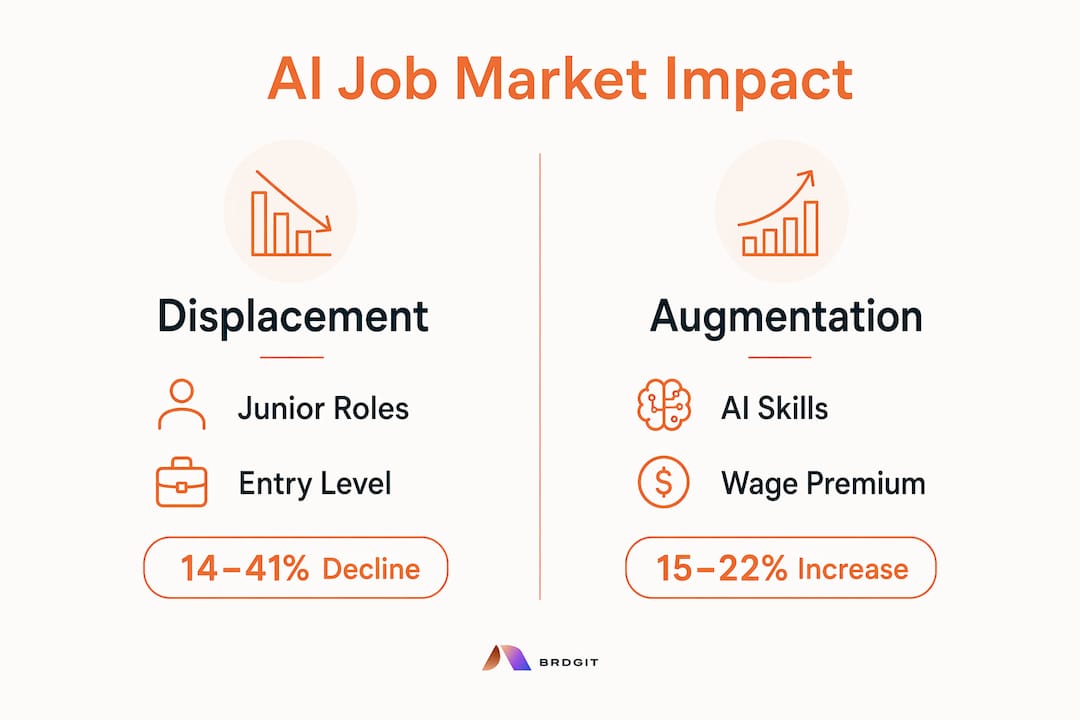
The role of AI in job market trend analysis is to convert raw labor data into forward-looking workforce intelligence, replacing gut-feel hiring decisions with evidence from machine learning and natural language processing. Job postings for junior and mid-level roles exposed to large language models have declined by 14–41% by Q2 2026. That single data point tells HR professionals and business analysts more about where the labor market is heading than a decade of annual salary surveys. AI-driven labor market analysis, the recognized industry term for this practice, is no longer a research experiment. It is an operational necessity.
How does AI change job market trend analysis?
AI changes job market trend analysis by processing millions of job postings, salary records, and skills databases simultaneously, at a speed no human team can match. Traditional workforce analytics relied on lagging indicators: annual surveys, quarterly reports, and anecdotal hiring manager feedback. AI replaces that with real-time signal detection across job boards, professional networks, and government labor databases.

The shift matters because labor markets move faster than annual reporting cycles. A skills gap that appears in Q1 can create a talent shortage by Q3 if HR teams are not watching the right signals. Natural language processing identifies emerging job titles, clusters related skills, and flags when employer language shifts from “preferred” to “required” for a given competency. That granularity is what separates AI-driven job market insights from conventional workforce planning.
BRDGIT works with business analysts and HR teams who are making exactly this transition, moving from static headcount models to dynamic, AI-powered labor intelligence.
What do job posting trends reveal about AI’s impact on employment?
Job posting data reveals a clear structural shift in employer demand, not just a temporary dip. Junior and mid-level cognitive roles have seen a median 23% decline in postings between 2022 and 2024. That decline is not random. It tracks directly with the adoption of large language models in knowledge work.
The sectoral picture is uneven, and that unevenness is the most useful signal for analysts.
Sector | Posting trend | Driver |
|---|---|---|
Technology and consulting | Declining junior roles | LLM task substitution |
AI infrastructure | Growing demand | Model deployment and maintenance |
Quality assurance | Expanding roles | AI output validation needs |
Routine cognitive work | Significant contraction | Direct automation exposure |
Roles tied to AI infrastructure and quality assurance are expanding precisely because AI systems require human oversight. Someone has to validate model outputs, audit decisions, and manage the workflows AI touches. That creates a new category of demand that did not exist five years ago.
Pro Tip: Track task-level job requirements inside postings, not just job titles. A “data analyst” posting in 2024 looks nothing like one from 2021. The tasks listed inside the posting reveal the real shift.
The AI impact on employment trends is not a single story of replacement. It is a redistribution of which tasks employers pay humans to perform.
What wage trends reveal about AI skill premiums
Workers with AI-augmentation skills command a 15–22% wage premium across industries. That premium reflects a simple supply and demand reality: employers need people who can work alongside AI systems, and those people are still scarce.
The skills driving that premium are specific. Post-2021, demand for prompt engineering, fine-tuning, and model validation has grown sharply in job postings across sectors. HR professionals recruiting for these skills need to understand what they are actually buying. Prompt engineering is not just typing questions into a chatbot. It is structuring inputs to produce reliable, auditable outputs from AI systems at scale.
The skills commanding the highest premiums include:
Prompt engineering: Designing inputs that produce consistent, high-quality AI outputs
Model validation: Testing AI outputs for accuracy, bias, and reliability before deployment
Fine-tuning: Adapting pre-trained models to specific organizational datasets and use cases
Human-in-the-loop design: Building workflows where humans review and correct AI decisions at defined checkpoints
Pro Tip: When auditing your workforce for AI augmentation potential, look at roles where employees already review, correct, or contextualize outputs from any system. Those workers adapt to AI-augmented workflows faster than average.
The wage polarization effect is real. Workers who develop AI-adjacent skills see compensation rise. Workers whose roles consist entirely of routine cognitive tasks face declining demand. HR teams that ignore this split will find their compensation benchmarks outdated within two years.
How AI affects labor market dynamics: displacement versus augmentation
AI’s labor market impact is currently concentrated, not systemic. Goldman Sachs projects around 9% of U.S. workers will be reallocated due to AI, with a current drag of 10,000 to 15,000 jobs per month, mostly in technology and consulting. That is a meaningful number, but it is not the economy-wide disruption some forecasts predicted.
The more nuanced concern is where displacement concentrates. Displacement focuses on entry-level roles, the same roles that historically served as the training ground for senior leadership. Junior analysts, entry-level consultants, and early-career knowledge workers learn by doing the work that AI now handles. Eroding that pipeline creates an organizational risk that will not show up in headcount data for several years.
Effect | Current evidence | Workforce implication |
|---|---|---|
Displacement | 14–41% decline in junior postings | Talent pipeline erosion for senior roles |
Augmentation | 15–22% wage premium for AI skills | Compensation restructuring required |
Labor cost stickiness | More staff needed to manage AI workflows | Headcount does not fall as fast as expected |
Complementarity lag | Complex role integration projected beyond 2026 | Productivity gains are not yet broad |
Labor cost stickiness is a counterintuitive finding worth sitting with. Companies automate routine tasks but then need additional staff to manage the AI systems handling those tasks. The net headcount reduction is smaller than expected, but the skill profile of the workforce shifts significantly.
Pro Tip: Do not model AI’s labor impact as a straight headcount reduction. Model it as a skill redistribution. Your total workforce cost may stay flat while the mix of roles changes substantially.
The future of jobs with AI is not a binary of humans replaced by machines. It is a more complex reallocation that demands careful monitoring at the task level, not just the job title level.
How can HR professionals use AI-driven labor market insights?
Business analysts and HR professionals can use AI-driven labor market insights most effectively by shifting from job-posting counts to task-level analysis. Relying solely on job postings to track AI’s impact misleads analysts because posting volumes lag actual labor market shifts by months. Task-level data, drawn from job description text, performance reviews, and workflow audits, gives a more accurate picture.
A practical framework for integrating AI in labor market analysis looks like this:
Audit tasks, not titles. Map every role in your organization to its core tasks. Identify which tasks are routine and cognitive, which require judgment, and which require relationship management.
Monitor skill signal velocity. Track how fast specific skill mentions are growing or shrinking in job postings within your sector. Skills like AI integration in technical roles are accelerating faster than most HR teams realize.
Build a wage benchmark refresh cycle. With AI skill premiums shifting quarterly, annual salary surveys are too slow. Refresh compensation benchmarks every six months for roles with high AI exposure.
Identify augmentation candidates internally. Before recruiting externally for AI-adjacent skills, assess which current employees have the analytical disposition to learn prompt engineering or model validation.
Partner with AI execution specialists. BRDGIT’s fractional AI talent model gives HR teams access to experienced AI practitioners without the cost or commitment of full-time hires. That matters when you need to run a workforce analytics pilot before committing to a full program.
The AI impact on talent sourcing is already reshaping how leading HR teams recruit. The organizations moving fastest are those treating AI workforce analytics as a continuous process, not an annual exercise.
Key takeaways
AI-driven labor market analysis is the most accurate tool available for tracking how employment demand, skill requirements, and compensation are shifting in real time.
Point | Details |
|---|---|
Job posting declines are structural | Junior and mid-level cognitive roles fell 14–41% by Q2 2026, signaling lasting demand shifts. |
AI skill premiums are measurable | Workers with AI-augmentation skills earn 15–22% more, requiring HR to update compensation benchmarks. |
Displacement is concentrated, not systemic | Goldman Sachs data shows AI’s current drag is focused in technology and consulting, not economy-wide. |
Task-level analysis outperforms posting counts | Monitoring tasks inside job descriptions gives earlier and more accurate signals than tracking posting volumes. |
Talent pipeline risk is underreported | Entry-level role erosion threatens the development path for future senior leaders. |
What we’ve learned from watching AI reshape workforce analytics
The most common mistake I see business analysts and HR professionals make is treating AI’s labor market impact as a future problem. The data says it is a present one. The 23% median decline in junior postings is not a projection. It is observed evidence from 2022 to 2024.
What I find equally important is the counter-narrative that gets less attention. AI’s complementary productivity gains remain limited until it integrates into complex professional roles, which Goldman Sachs projects may not happen broadly until 2027 or later. That means the disruption window is real but bounded. Organizations that use this period to retrain workers for AI verification, model management, and human-in-the-loop roles will come out ahead.
The fear of AI-induced job loss is understandable but often misdirected. The actual risk is not mass unemployment. It is skill mismatch at scale. Companies that fail to track which tasks AI is absorbing will find themselves with a workforce optimized for work that no longer exists. That is the operational risk worth losing sleep over.
The AI professional development path for employees is not about becoming a data scientist. It is about becoming fluent enough in AI tools to manage, validate, and direct them. That is a trainable skill, and organizations that invest in it now will not be scrambling for talent in 2027.
— Team BRDGIT
BRDGIT’s approach to AI-powered workforce intelligence
HR teams and business analysts who want to act on AI-driven labor market data need more than a dashboard. They need practitioners who understand both the analytics and the organizational context behind the numbers.
BRDGIT’s fractional AI engineers work directly with HR and analytics teams to build task-level workforce monitoring, identify AI augmentation opportunities, and design retraining programs grounded in real labor market signals. This is not a software subscription. It is experienced AI talent embedded in your planning process, scoped to what your organization actually needs. If your workforce strategy still relies on annual job posting counts, the gap between your data and the market is already costing you.
FAQ
What is AI-driven labor market analysis?
AI-driven labor market analysis uses machine learning and natural language processing to identify shifts in job demand, skill requirements, and compensation patterns across large datasets in real time. It replaces lagging survey-based methods with continuous, task-level workforce intelligence.
How much have AI tools reduced junior job postings?
Job postings for junior and mid-level roles exposed to large language models declined by 14–41%, with a median of 23%, by Q2 2026. This reflects direct task substitution, not a temporary hiring freeze.
What wage premium do AI skills command?
Workers with AI-augmentation skills, including prompt engineering and model validation, earn a 15–22% wage premium compared to peers in equivalent roles without those skills.
Is AI causing widespread job loss across the economy?
Goldman Sachs data shows AI’s current labor drag is concentrated in technology and consulting sectors, running at 10,000 to 15,000 jobs per month. The impact is real but not yet a systemic shock across the broader economy.
Why should HR teams monitor tasks instead of job postings?
Job posting volumes lag actual labor market shifts by months, making them unreliable for tracking AI’s real-time impact. Task-level analysis, drawn from job description text and workflow audits, gives earlier and more accurate signals for workforce planning.