


Published on
Decide to Pilot RAG With 512 Token Chunks and Top 5 Rerank for Leaders
RAG for business is the right call whenever an LLM needs to answer from proprietary data that changes faster than a model can be retrained. The system retrieves relevant documents at the moment a question is asked and hands them to the model as context, which produces grounded, sourceable answers instead of guesses. Choose retrieval augmented generation over fine-tuning when your knowledge base updates weekly or daily; choose fine-tuning when you need to bake in a specific tone or behavior rather than facts.
TL;DR:
Retrieval augmented generation is ideal for frequent data updates, allowing real-time grounding that a fine-tuned model cannot provide efficiently.
Proper implementation requires careful chunking, embedding, hybrid retrieval, reranking, and strict permission controls to ensure accuracy and compliance.
The biggest production hurdles are poor data quality, outdated metadata, and weak evaluation protocols, which can cause significant performance failures.
A phased approach with data assessment, scoped pilot, and fractional engineering support reduces risk and ensures the system remains reliable at scale.
BRDGITTurn Your RAG Pilot Into ExecutionBRDGIT helps teams assess AI readiness, define practical roadmaps, build custom AI systems, and support ongoing implementation.Explore BRDGIT
Table of Contents
What Retrieval Augmented Generation Means for Your Business
How RAG Works: Components and Architecture Decisions
Where RAG Delivers Measurable Business Value
What RAG Gets Right and Where It Can Still Go Wrong
A Step-by-Step Path From Pilot to Production
Why So Many RAG Pilots Stall Before Production
What We’ve Learned Building These Systems
Get Hands-On Help Piloting RAG for Your Team
Sources
FAQ
What Retrieval Augmented Generation Means for Your Business
Retrieval augmented generation works by pulling relevant documents from your own data at the exact moment someone asks a question, then feeding those documents to the language model alongside the query. The model generates its answer from that retrieved context rather than from memory alone. That single design choice changes everything about how trustworthy the output is.
A standalone LLM answers from what it learned during training, which might be a year or two out of date and has no idea what your return policy says today. A RAG pipeline queries your live document store first, so the answer reflects whatever is true right now. Pinecone’s primer on retrieval augmented generation frames this as grounding: the model’s outputs are tied to retrieved, domain-specific documents instead of floating on statistical guesswork.
That grounding matters most in decisions where being wrong is expensive. A few examples come up constantly in enterprise deployments:
A support agent answers a billing question by citing the exact clause in the current terms of service, with a link the customer can click.
A procurement team asks which vendor contracts include a specific indemnification clause, and the system returns the actual paragraphs, not a paraphrase.
A field technician asks about a product spec that changed last month, and gets the updated spec sheet instead of a stale training snapshot.
The economics favor RAG too. Fine-tuning a model every time a policy or price list changes is slow and costs real engineering time. Updating a document index takes minutes. For any knowledge base that shifts on a weekly cadence, RAG is usually the cheaper and faster path to accuracy. A literature review of RAG and LLM applications for business information extraction found measurable gains in extraction accuracy across several business tasks, though the review also flagged that categorizing best-fit approaches across industries still needs more work. Translation for a decision-maker: the pattern is proven, but the details of how you implement it for your specific documents still require real engineering judgment.
How RAG Works: Components and Architecture Decisions
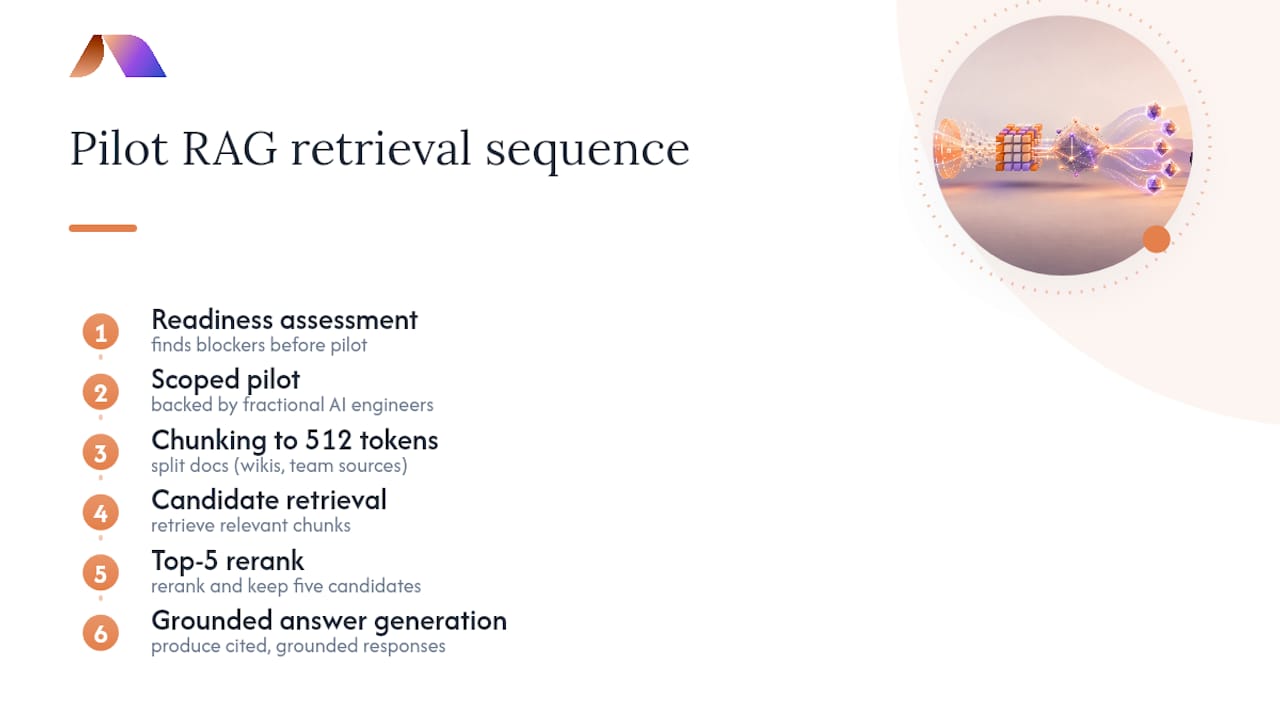
A production RAG pipeline has six moving parts: ingest, chunk, embed, store, retrieve, and generate, with reranking usually inserted between retrieve and generate. Each stage carries a decision that affects accuracy, cost, or both.
Chunking. Documents get split into smaller pieces before they are indexed, because feeding an entire 40-page contract into a retrieval step wastes context and dilutes relevance. Practitioner benchmarks recommend 512-token chunks with a 50-token overlap as a starting default. That size holds enough context for a coherent answer without burying the specific fact a query is looking for.
Embeddings and vector storage. Each chunk gets converted into a numeric vector and stored in a database built for similarity search. For teams already running Postgres, pgvector avoids adding new infrastructure. Pinecone suits teams that want a managed service with minimal operational overhead. Qdrant fits teams that need heavy metadata filtering, like restricting retrieval by department or client, according to engineering benchmarks comparing the three.
Retrieval strategy. Dense retrieval (embedding similarity) catches conceptual matches; sparse retrieval like BM25 catches exact keyword matches such as part numbers or legal citations. Hybrid search runs both and merges the results, which is why most production systems default to hybrid rather than picking one.
Reranking. A cross-encoder reranker takes the top candidates from retrieval, typically the top 50, and re-scores them against the query before passing the final top 5 to the model. This step consistently produces the largest single jump in answer relevance for a modest increase in latency, according to production RAG benchmarks.
Prompt augmentation and guardrails. The final prompt should instruct the model to answer only from retrieved context, cite the source, and refuse when no relevant document was found. Low-temperature generation settings reduce the model’s tendency to improvise when the retrieved context is thin.
Pro Tip: If you only have budget to fix one thing after a rocky pilot, fix reranking before you touch the model. A better rerank step routinely closes more of the accuracy gap than swapping in a bigger LLM.
Where RAG Delivers Measurable Business Value
The use cases that justify a RAG investment share one trait: someone in the organization is currently spending real hours searching for an answer that already exists in a document somewhere.
Customer support. A permission-aware support assistant references current policy documents and a customer’s own ticket history, cutting time-to-resolution because the agent (human or AI) isn’t hunting through three systems to confirm a return window.
Contract analysis. Legal and procurement teams use RAG to pull specific clauses across hundreds of contracts, flag risk language like unusual indemnification terms, and summarize negotiation points before a call, instead of reading every document manually. A tool like AmmarAI’s document analyzer shows what this looks like when the interface is built around chatting directly with a document set.
Enterprise search and knowledge management. Most mid-sized companies have knowledge scattered across a shared drive, an email archive, and a CRM that nobody trusts to be current. RAG unifies retrieval across those silos so a search actually returns the right answer instead of twelve loosely related documents.
Business intelligence and reporting. Instead of a dashboard full of numbers nobody has time to interpret, a RAG-backed system can generate a narrative summary explaining what changed in this quarter’s numbers and why, pulling from historical reports for context.
Sales enablement and agentic workflows. A rep preparing for a call can get an auto-generated brief pulling from the account’s contract history, support tickets, and last quarter’s usage data. Push this further into agentic territory and the system starts taking safe, logged actions on its own, like drafting a follow-up email or flagging a renewal at risk, a pattern also visible in AI-driven recruiting screening workflows where retrieval feeds an automated first pass before a human reviews it.
Each of these examples has the same underlying shape: a person was already doing the retrieval manually, slowly, and RAG just automates the lookup so the human can spend time on judgment instead of searching.
What RAG Gets Right and Where It Can Still Go Wrong
The upside is real, and it is specific. Answers stay current because the index updates faster than any retraining cycle. Citations let a user verify a claim instead of trusting a black box. You retain control over which sources feed the model, which matters enormously in regulated industries. And the recurring cost of an index refresh is a fraction of what repeated fine-tuning runs would cost over a year.
None of that erases the risks, though.
Residual hallucination risk. RAG reduces hallucination; it does not eliminate it. A model can still misread retrieved context or blend two documents into a wrong answer.
Retrieval failure modes. If the right document was never indexed, or the chunking split a critical clause across two chunks, the retriever returns nothing useful and the model may fill the gap with a guess.
Metadata and filtering pitfalls. Retrieval that ignores document freshness or department scope can surface an outdated policy right alongside the current one.
PII exposure and access control misalignment. This is the risk that should worry a compliance officer most. If your retrieval layer isn’t permission-aware, an employee’s query can surface documents they were never supposed to see. Amazon Q Business’s documentation on production RAG treats ACL-aware indexing and identity management as core features, not add-ons, because enterprise deployments require permission checks at index time, not just at the UI layer.
Adoption is moving faster than most governance programs can keep up with. Forrester’s 2026 research found that over 45% of organizations already use AI agents, with another 25% actively piloting them. That means the governance conversation about permissions, sourcing, and hallucination risk must happen before the pilot ships, not after.
Cost is manageable but not zero: embedding generation, vector storage, and the generation calls themselves all add up at scale, and infrastructure choice (managed versus self-hosted) shifts where that cost lands on your budget.
A Step-by-Step Path From Pilot to Production
Most RAG projects don’t fail because the model was too weak. They fail because a step in this sequence got skipped.
Define the job and the metrics before you write code. Decide what “good” means: an accuracy target, a latency ceiling, and a cost-per-query cap. Without this, you can’t tell a working pilot from a broken one.
Prepare the data. Clean the source documents, attach metadata (date, department, sensitivity), scrub PII where it doesn’t belong, and ingest access controls at the same time you ingest content, not afterward.
Build the pipeline. Chunk at 512 tokens with overlap, embed, store in your chosen vector database, retrieve the top 50 candidates with hybrid search, rerank down to the top 5, then generate. These are the defaults engineering teams keep landing on because they balance precision against context window limits.
Test before you trust it. Build a test set of 50 to 200 real questions with known correct answers. Run it through RAGAS evaluation, scoring faithfulness, context precision, and context recall. A faithfulness score below 0.8 is a hard stop, not a note for later.
Operate it like a system, not a demo. Set up monitoring for retrieval quality drift, define a refresh cadence for the index, and have a rollback plan ready before the first real user touches it.
Pro Tip: Retrieval quality breaks production RAG far more often than model choice does. If your pilot’s answers feel off, check what got retrieved before you consider swapping the LLM.
Why So Many RAG Pilots Stall Before Production
The pattern repeats across industries: a RAG prototype looks great in a demo, then stalls the moment it needs to handle real document volume and real permission boundaries. Three failure modes show up again and again.
Missing data context. A pilot built on a clean sample dataset breaks when it meets the messy, duplicate-filled, inconsistently formatted reality of a company’s actual file shares.
Incomplete metadata. Without department tags, dates, or sensitivity flags attached at ingestion, retrieval can’t distinguish a current policy from one that expired two years ago.
Weak evaluation. Teams that skip a real test set discover accuracy problems from angry users instead of from a dashboard.
An AI readiness assessment exists to catch these gaps before they become production incidents, by mapping data architecture and governance gaps while the project is still cheap to redirect. Analysts covering the broader agentic AI landscape have made a similar point: many teams that fail to scale focus entirely on the model and skip the harder work of getting the data architecture right, a pattern also visible in how organizations approach creating and scaling AI agents. For teams that don’t have a data architect on staff, fractional AI engineers can carry a pilot through exactly the stretch where most projects stall, the move from a working prototype to something that survives real usage and real access-control requirements.
What We’ve Learned Building These Systems
The clients who get the most out of RAG rarely start with the model. They start by asking what a specific team keeps looking up manually, then measuring how long that lookup takes today. One support team we’ve seen this pattern with cut ticket resolution time meaningfully once agents could pull cited answers instead of searching three internal wikis by hand.
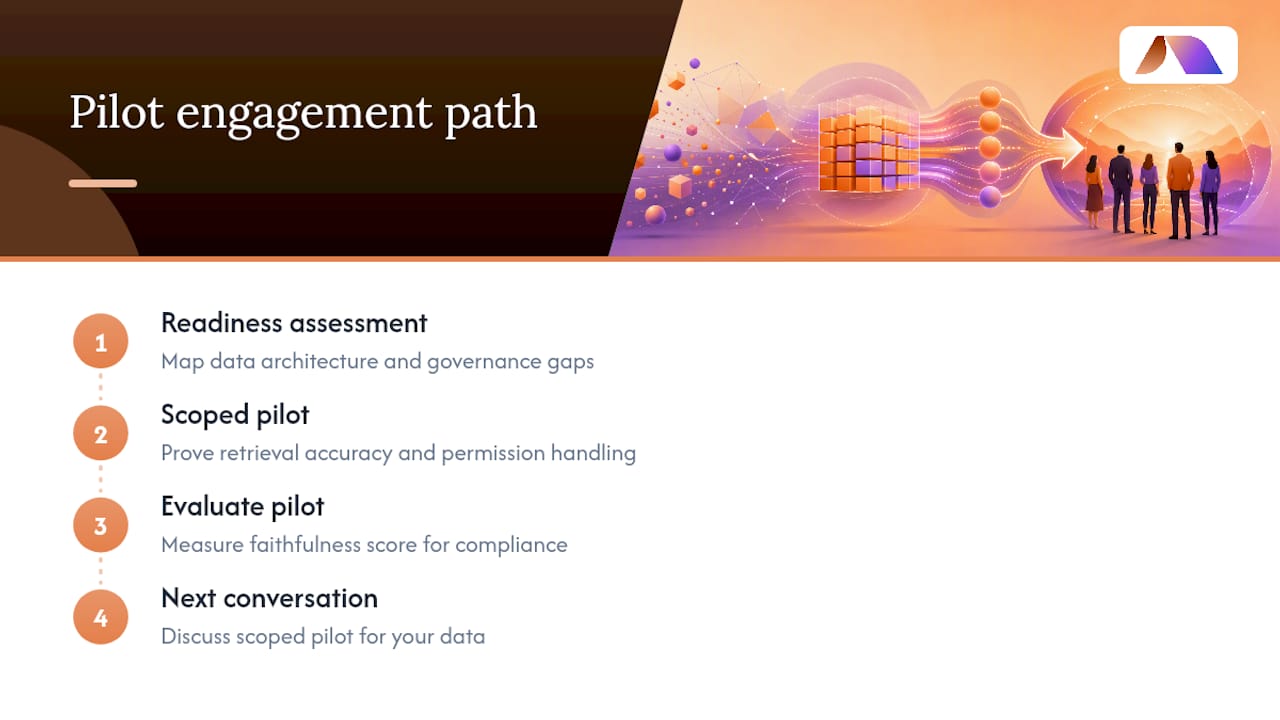
BRDGIT’s path runs through a readiness assessment first, then a scoped pilot backed by fractional AI engineers. That sequence exists because skipping the assessment is the single most common reason pilots stall before production. If you’re weighing whether to pilot RAG this quarter, the assessment is the cheapest way to find out what’s actually in your way.
— Team BRDGIT
Get Hands-On Help Piloting RAG for Your Team
Fractional AI engineers provide production-grade retrieval expertise, chunking strategy, reranking, and RAGAS evaluation, without a full-time salary commitment or a long-term staffing contract.

An engagement typically starts small: a readiness assessment maps your current data architecture and governance gaps, then a scoped pilot proves out retrieval accuracy and permission handling on a real subset of your documents before anyone commits budget to a full rollout. That path gives you a working, evaluated pilot with a faithfulness score you can actually defend to a compliance team, not a demo that falls apart under real traffic.
If your team keeps hitting the same wall of scattered documents and outdated answers, the next step is a conversation about what a scoped pilot would look like for your data. Visit BRDGIT’s fractional engineers page to see how an initial engagement is scoped and start the conversation.
Sources
For deeper technical grounding, review Forrester’s agentic AI adoption data, AWS’s Amazon Q Business documentation, and Pinecone’s RAG fundamentals.
The state of agentic AI in 2026: companies are chasing, few are catching — Forrester
How to Build a Production RAG Pipeline in Python (2026) — Inventiple
FAQ
Is ChatGPT a RAG Model?
Not by default. ChatGPT is a standalone LLM; it becomes a RAG system only when connected to a retrieval layer, such as browsing tools or a custom document index, that feeds it live context at query time.
Is RAG Still Relevant?
Yes, and increasingly so. Adoption of AI agents built on retrieval patterns is accelerating, with Forrester finding over 45% of organizations already using AI agents and another quarter piloting them, and the trend toward agentic RAG is extending the pattern rather than replacing it.
Can I Build My Own RAG Pipeline?
Yes. The core stack, chunking, an embedding model, a vector database like Qdrant or Pinecone, and an LLM API, is accessible to most engineering teams, though production-grade permissions and evaluation take real planning. A readiness assessment or fractional AI engineer can shorten that path considerably if your team hasn’t built one before.
What Does RAG Stand For?
RAG stands for retrieval augmented generation, a pattern where a language model retrieves relevant documents at query time and uses them as grounding context before generating its answer.



