
Published on
Best FractionX.com Alternatives for Fractional AI Support
TL;DR:
Fractional AI support offers flexible, cost-effective leadership but requires careful provider selection. BRDGIT provides full implementation services with proven results and flexible contracts. Choosing a provider with deep industry expertise and clear execution focus maximizes value and minimizes risk.
What are the top FractionX alternatives for fractional AI support?
The strongest FractionX alternatives in the U.S. fractional AI support market include BRDGIT and a handful of specialized providers, each suited to different company sizes, AI maturity levels, and budget realities. Choosing the wrong one costs more than money. It costs momentum.
Here is how the leading options compare across the criteria that actually matter:
Feature Category | Entry-Level Advisors | Mid-Market Platforms | Full-Service Providers (e.g., BRDGIT) |
|---|---|---|---|
Specialization focus | Narrow (single-use-case AI) | Broad strategy, light execution | Strategy through implementation |
Service scope | Advisory only | Roadmapping + some delivery | Readiness, roadmap, build, train |
Pricing model | Project-based | Monthly retainer | Flexible: scoped or ongoing |
Typical monthly cost | $3,000–$7,500 | $4,000–$20,000 | Varies by scope |
Contract terms | Short-term or project | month-to-month or scoped phases | Scoped phases available |
Client support depth | Light-touch | Moderate | Embedded partnership |
Fractional AI advisors typically charge $3,000 to $7,500 per month for hands-on automation work inside your environment. More senior fractional heads of AI working part-time command $4,000 to $20,000 monthly depending on scope and governance requirements. Providers with board-level oversight and compliance mandates cost 20–40% more than those focused purely on execution.
Key differentiators to weigh when comparing fractionx.com alternatives:
Execution depth: Some providers stop at strategy. The best ones stay through delivery.
AI maturity fit: Early-stage companies need readiness assessments first; scaling companies need implementation muscle.
Contract flexibility: Month-to-month or scoped phases reduce risk for first-time fractional buyers.
Industry specialization: Regulated industries (healthcare, finance) require providers with compliance-aware governance experience.
Team bench depth: A solo fractional advisor carries concentration risk. Firms with multiple practitioners do not.
Table of Contents
How do you choose the right fractional AI provider for your business?
What does fractional AI support actually include?
What do real fractional AI engagements look like in practice?
What questions should you ask a fractional AI provider before signing?
How does provider expertise and industry specialization affect your results?
BRDGIT brings AI execution, not just AI advice
Key Takeaways
How do you choose the right fractional AI provider for your business?
The criteria that separate a good fractional AI engagement from a costly misfire come down to five things: expertise area, service scope, pricing flexibility, contract terms, and governance fit. Get all five right and the engagement pays for itself. Miss one and you are likely to restart the search in six months.

Start with service scope. A provider who only delivers strategy decks is not the same as one who builds and deploys AI systems inside your actual workflows. Know which you need before you start conversations. Most companies at the 50–200 employee stage need both, sequenced correctly.
Pricing flexibility matters more than the headline rate. A $6,000 monthly engagement with clear deliverables and a 30-day exit clause is far less risky than a $4,500 engagement locked into a six-month minimum with vague scope. Ask for a scoping phase before committing to a longer term. The best fractional AI engagements often begin with a short workshop to confirm the actual leadership need, and sometimes that workshop reveals a technical hire is the better answer.
For sourcing candidates, a hybrid recruitment approach combining investor referrals, fractional marketplaces, and LinkedIn outreach consistently produces the best mix of quality and candidate diversity. Niche fractional platforms offer curated pools but typically charge 10–25% placement fees with narrower reach than a well-targeted LinkedIn search.
Confirm the provider has delivered in your industry, not just adjacent to it.
Ask for measurable outcomes from prior engagements, not just client names.
Verify the governance model: who owns decisions, who reports to whom, and how success is measured.
Clarify whether the engagement is advisory, embedded, or a hybrid of both.
Pro Tip: When vetting fractional AI candidates, check whether they currently hold multiple fractional roles simultaneously. Candidates with concurrent advisory roles are typically genuine fractional professionals who have deliberately built that career model, not executives between full-time jobs using “fractional” as a placeholder title.
What does fractional AI support actually include?
Fractional AI support places experienced AI leadership inside your organization on a part-time, flexible basis. It is not consulting in the traditional sense. The practitioner operates as a member of your team, accountable for outcomes, not just recommendations.
A mature fractional AI engagement typically covers some combination of the following:
AI readiness assessment: Identifying where AI can create real value versus where it adds complexity without payoff.
Roadmap development: Sequencing use cases by impact, feasibility, and organizational readiness.
Implementation oversight: Managing build and deployment of AI systems, often working directly with internal or external technical teams.
Workflow automation: Building and maintaining custom AI automations inside the client’s existing environment.
Team training: Helping employees use AI tools confidently in daily work, not just in theory.
Ongoing optimization: Continuously refining AI systems as the business evolves.
The cost case is straightforward. Full-time Heads of AI in the U.S. typically earn $240,000–$340,000 in annual base salary. Fractional engagements are 60–75% cheaper, making them far more cost-effective when part-time leadership genuinely meets the need. For companies with 2–6 active AI use cases, that math is hard to argue with.
The companies best suited for fractional AI support tend to be mid-sized with real AI ambitions but limited capacity to hire and retain senior AI talent at full-time cost. They are past the curiosity stage but not yet at the scale where a dedicated AI team makes financial sense. For a deeper look at how this model fits different business stages, the fractional AI guide for business leaders covers the tradeoffs in detail.
What do real fractional AI engagements look like in practice?
Published case evidence from the fractional AI market points to a consistent pattern: the engagements that deliver measurable results share three characteristics. They start with a defined scoping phase, they have clear governance from day one, and the provider is accountable to specific outcomes rather than hours logged.
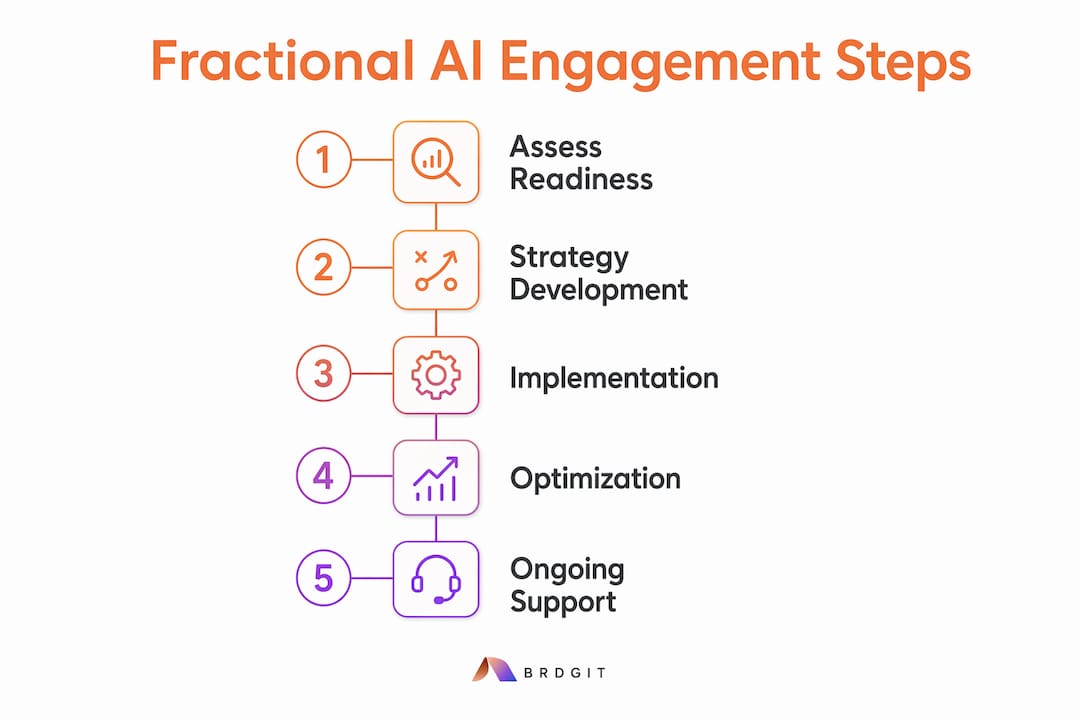
Providers focused on operations-level AI work, like those building custom automations inside client environments, tend to show faster time-to-value than those operating purely at the strategic layer. The reason is simple: a working automation produces a measurable result within weeks. A strategy document does not.
What separates credible providers from aspirational ones is the specificity of their prior work. A provider who can describe exactly what they built, what broke, how they fixed it, and what the outcome was in measurable terms has actually done the work. Vague references to “AI transformation” at named companies are not the same thing. When evaluating fractionx.com substitutes or any fractional AI provider, push for that specificity in every reference conversation.
What questions should you ask a fractional AI provider before signing?
The right questions surface whether a provider can actually execute or just articulate a vision. Ask these before any engagement begins:
What specific AI systems have you built and deployed, not just advised on?
How do you measure success in a fractional engagement, and what does a 90-day outcome look like?
What happens if the engagement is not delivering value at the 60-day mark?
How many concurrent clients do you currently serve, and how do you manage capacity?
Who on your team would actually be embedded in our work, and what is their background?
Have you worked in our industry or with companies at our stage of AI maturity?
What does your governance model look like: who owns decisions, and how are they documented?
The capacity question deserves particular attention. A fractional professional managing eight clients simultaneously is spread thin. The best providers are transparent about their load and will tell you directly if they are at capacity. That honesty is itself a signal worth noting. For additional context on how AI is reshaping talent sourcing decisions, AI in talent sourcing offers useful framing for HR and operations leaders.
How does provider expertise and industry specialization affect your results?
Specialization is where fractional AI providers diverge most sharply. A generalist AI advisor can map use cases across industries, but a provider with deep experience in your sector arrives with pre-built intuition about what works, what the compliance constraints are, and where the organizational resistance typically shows up.
For regulated industries, governance fit is non-negotiable. Providers with board-level oversight experience cost more, but for companies under formal audit requirements or operating in healthcare, financial services, or legal tech, that premium is justified. The alternative is an AI program that creates operational risk rather than reducing it.
Industry specialization also affects speed. A provider who has already navigated similar AI implementations in your sector compresses the learning curve significantly. They know which vendors to trust, which integrations break under real load, and which internal stakeholders will resist adoption. That institutional knowledge does not show up in a proposal, but it shows up in results. Cloud infrastructure decisions often intersect with AI deployment choices, and a cloud provider comparison can help contextualize the infrastructure layer when evaluating provider recommendations.
BRDGIT brings AI execution, not just AI advice
If you have spent time evaluating FractionX and similar fractional AI providers, you have likely noticed a gap between providers who advise and providers who build. BRDGIT sits firmly in the second category.
BRDGIT’s fractional AI model covers the full path from readiness assessment through implementation and ongoing optimization, with experienced practitioners embedded in your actual workflows. With over 92% twelve-month retention across placements in 30+ U.S. metros, BRDGIT’s track record reflects something rarer than a good pitch deck: clients who stay because the work delivers. Pricing is transparent, contract terms are flexible, and the engagement model is built around your company’s actual AI maturity, not a templated playbook.
For businesses that need AI expertise without the overhead of a full-time hire, BRDGIT’s fractional AI services offer a concrete next step. See what an embedded AI partnership looks like for your organization at BRDGIT fractional engineers.
Key Takeaways
Fractional AI support is the most cost-effective path to senior AI leadership for companies with 50–500 employees and real implementation goals, provided you choose a provider with proven execution depth, not just strategic credentials.
Point | Details |
|---|---|
Cost advantage is significant | Full-time Heads of AI cost $240K–$340K annually; fractional engagements run 60–75% cheaper. |
Pricing ranges vary by role | Fractional AI advisors run $3,000–$7,500 monthly; fractional heads of AI reach $4,000–$20,000. |
Start with a scoping phase | Short upfront workshops confirm the real leadership need and prevent costly misaligned engagements. |
Vet for genuine fractional practice | Candidates holding multiple concurrent fractional roles are professionals, not executives in transition. |
BRDGIT covers the full path | With 92% twelve-month retention and placements across 30+ U.S. metros, BRDGIT delivers from strategy through execution. |