


Published on
Board Ready AI: Fractional Head of AI for Mid Market Leaders
A fractional head of AI is a senior AI executive who works part-time across a set of client companies, setting AI strategy, approving vendors, and owning governance without a full-time salary or equity grant. Retainers typically run $4,000 to $30,000 a month depending on hours and scope, with most mid-market companies landing around $8,000 to $12,000. Hire one the moment you have more than one AI use case in production and no single person accountable for whether those systems are working, safe, or worth the spend.
TL;DR:
Companies should consider hiring a fractional head of AI once they have three or more AI use cases in production and lack clear ownership of AI governance.
The role involves judgment, strategy, and governance oversight, with most hours spent in meetings, reporting, and vendor review rather than hands-on technical work.
Market rates for a core-tier engagement range from $8,000 to $12,000 per month, providing strategic oversight at a fraction of the cost of a full-time C-level AI executive.
Clear onboarding, explicit response expectations, and progressing concrete artifacts within 90 to 180 days are crucial for effective fractional leadership.
Companies should move to a full-time AI leader only when use cases multiply beyond what a core-tier retainer can support or daily availability becomes critical.
BRDGITMove From AI Plans To ExecutionBRDGIT helps leaders assess readiness, set strategy, implement practical AI systems, and access experienced fractional AI support.Explore BRDGIT
Table of Contents
What Does a Fractional Head of AI Actually Do?
Which Companies Are Ready to Hire One?
What Does a Fractional Head of AI Cost?
What Should You Get in the First 90 to 180 Days?
How Do You Hire and Onboard One Without Getting Burned?
What Goes Wrong With Fractional AI Leadership?
When Does Fractional Leadership Win, and When Should You Convert?
How BRDGIT Fits Into Your Fractional AI Plan
Sources
FAQ
What Does a Fractional Head of AI Actually Do?
The job is judgment, not code. A fractional head of AI builds what practitioners call a leverage map: a ranked view of where AI can move revenue or cut cost, weighed against what your team can actually execute in the next two quarters. Just as important is the restraint perimeter, the list of projects worth killing before they burn budget on a proof of concept nobody asked for.
Governance sits at the center of the role. That means a named owner for AI decisions, regular reporting to the board or ownership group, and sign-off authority on vendor contracts before anyone signs a multi-year SaaS deal. IBM’s C-suite research points to a widening expectation among boards that someone specific, not a committee, owns AI outcomes.
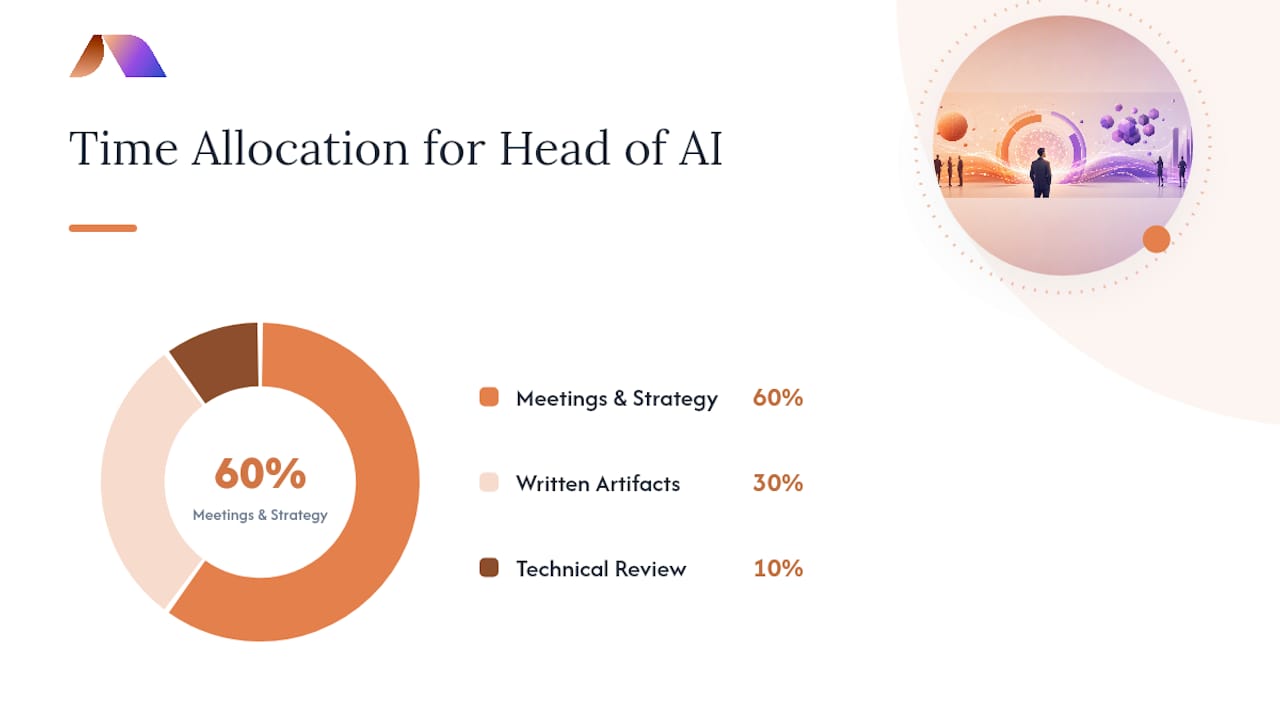
Time typically breaks down this way, based on market benchmarks from KORE1:
About 60% in meetings and strategy sessions with leadership and department heads
Roughly 30% producing written artifacts like roadmaps and risk registers
Close to 10% on hands-on technical review of vendor tools or internal builds
This is not a consultant dropping a slide deck and disappearing. A consultant advises; a fractional head of AI decides and stays accountable for the decision. It also differs from a fractional CTO, who typically owns broader engineering infrastructure, and from an interim executive, who is a placeholder until a permanent hire arrives rather than a standing part-time role.
Which Companies Are Ready to Hire One?
Readiness shows up operationally before it shows up on a wish list. Watch for these signals, roughly in order of urgency:
You have three or more AI use cases live in production, and nobody can tell you which ones are actually profitable.
Inference and API costs have crept up quarter over quarter without a clear owner tracking the trend.
A customer or investor procurement questionnaire has asked who owns your AI governance, and the honest answer was “nobody, specifically.”
Department heads are buying overlapping AI tools independently, creating duplicate spend and inconsistent data handling.
Your last AI pilot stalled for months with no one authorized to kill it or fund it further.
If none of these apply yet, you are probably too early. Industry guidance from KORE1 suggests many companies do better investing in two senior machine learning engineers and six months of hands-on experimentation before adding an executive layer. Spending on strategy before you have anything to strategize around is how AI budgets quietly evaporate.
Pro Tip: Rank your signals honestly before you call anyone. If your strongest signal is “leadership feels behind,” that is a marketing problem, not a governance problem, and a fractional hire will not fix it.
What Does a Fractional Head of AI Cost?
Pricing tracks hours and governance load more than title alone. Based on documented market benchmarks, three tiers dominate the market:
Entry tier: 8 to 12 hours per month, roughly $4,000 to $7,000, suited to companies with one or two use cases and light governance needs.
Core tier: 16 to 24 hours per month, roughly $8,000 to $12,000, the sweet spot for mid-market companies running several production systems.
Premium tier: 24 to 32+ hours per month, often above $15,000, for governance-heavy mandates involving board reporting, audits, or regulated industries.
Compare that to a fully loaded full-time Head of AI or Chief AI Officer, which frequently runs into six figures once salary, benefits, and equity are counted. A core-tier fractional engagement can deliver comparable strategic oversight at a fraction of the annual cost, which is exactly why the model has caught on with companies that need judgment more than they need headcount.
Contracts typically run on a 90-day minimum, with 30-day termination notice after that and a defined path to convert the engagement to full-time if the company scales into needing one. Read that minimum as a trial period for both sides, not a lock-in.
Why the caution matters: Gartner predicts that 30% of generative AI proof-of-concept projects will be abandoned by the end of 2025, and a separate Gartner forecast puts agentic AI project cancellations above 40% by the end of 2027. Paying for governance now is cheaper than paying for a canceled project later.
What Should You Get in the First 90 to 180 Days?
A fractional head of AI who shows up without a concrete work product in the first quarter is a red flag, not a slow starter. Expect this progression:
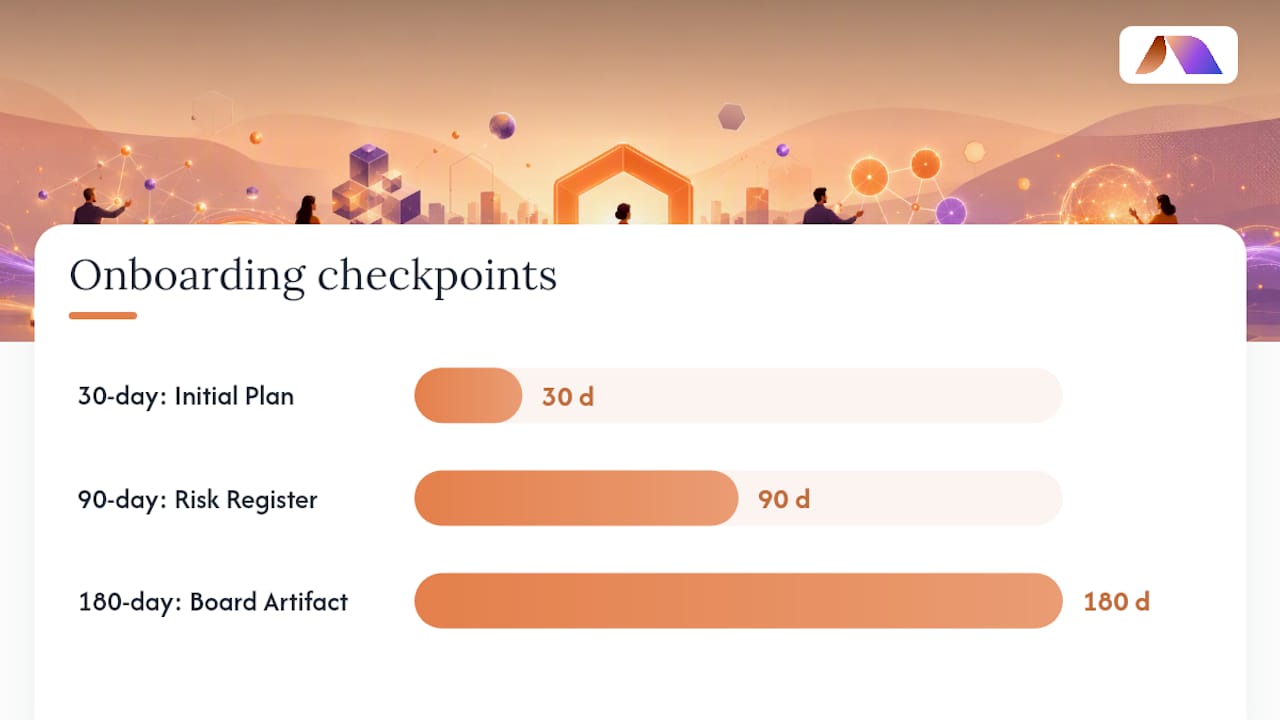
Days 1 to 30: A readiness assessment covering data quality, existing tools, and staff AI literacy, plus an initial leverage map ranking opportunities by feasibility and payoff.
Days 30 to 90: A prioritized roadmap with two or three use cases greenlit for build, a risk register flagging model, data, and vendor exposure, and a vendor evaluation framework for any tool under consideration.
Days 90 to 180: A board-ready presentation translating technical progress into financial terms, plus governance documentation aligned to frameworks like NIST AI RMF, ISO 42001, or SOC 2 depending on your industry’s audit expectations.
The KPIs that matter most are concrete: cost savings from automated workflows, time-to-production on new AI initiatives, revenue attributable to AI-driven changes, and a simple readiness score for governance and audit purposes. Procurement teams increasingly ask who owns AI decisions and whether your framework alignment holds up under scrutiny, and having that documentation ready before it’s requested saves weeks in a sales cycle. A leverage map built on a clear strategic framework also gives your board something concrete to evaluate instead of vague progress updates.
How Do You Hire and Onboard One Without Getting Burned?
Interview for judgment, not vocabulary. Ask direct questions: “Tell me about an AI project you killed and why.” “How would you report AI risk to a board that doesn’t know what a model is?” “What’s your process for vendor evaluation, and can I see a redacted risk register from a past client?” Someone who can only describe tools and not decisions is not ready for the role.
Your contract should specify, in writing:
Named-owner status and what decisions that authority covers
Guaranteed hours per month and required deliverables tied to each engagement tier
Board or leadership meeting attendance expectations
Termination terms and a defined conversion path to full-time hire if needed
Watch for red flags during the trial period: vague answers about specific projects, reluctance to name past clients or outcomes, or a pitch heavy on AI trends and light on your company’s actual data.
Pro Tip: Build your onboarding around three checkpoints, at 30, 90, and 180 days. Each one should end with a concrete artifact reviewed by leadership, not a status update meeting that produces nothing you can show a board.
What Goes Wrong With Fractional AI Leadership?
The most common failure isn’t skill. It’s fit and continuity. A fractional leader splitting attention across four or five clients can lose the thread on your specific data quirks or internal politics, especially if your team expects daily availability that a part-time contract was never built to provide.
Mitigate that by setting explicit response-time expectations in the contract and by designating an internal point person, usually an operations or IT lead, who works alongside the fractional executive rather than waiting on them for every decision. Continuity also breaks down when companies rotate fractional leaders too often, resetting institutional knowledge every few months. Favor a longer initial term with a clear renewal checkpoint over a series of short, disconnected engagements.
Another real limitation: a fractional leader typically won’t manage day-to-day engineering execution. If you need someone reviewing pull requests or debugging pipelines at 2 a.m., that’s a fractional engineering hire, not a fractional head of AI. Pairing strategic oversight with hands-on technical support closes that gap without forcing you into a full executive-plus-engineer hire before you’re ready. Finally, be wary of scope creep: a fractional leader asked to also run vendor negotiations, staff training, and IT security review is being asked to do three jobs at one job’s rate, and something will slip.
When Does Fractional Leadership Win, and When Should You Convert?
Fractional leadership wins whenever the problem is judgment and prioritization rather than volume of daily execution. If your board needs someone accountable for AI decisions but your use case count is still in the single digits, a core-tier retainer solves that cleanly without the overhead of a full executive hire.
The mistake I see most often runs the other direction: companies rush a full-time Chief AI Officer hire before they’ve proven out even one production use case, then spend a year paying six figures for someone building the same readiness assessment a fractional leader could have delivered in 30 days. Convert to full-time only when use cases multiply past what a core-tier engagement’s hours can reasonably cover, or when daily availability becomes non-negotiable for the business.
Keep this in the board packet: named owner, current retainer tier, next conversion trigger, and the date of your last governance review.
— Team BRDGIT
How BRDGIT Fits Into Your Fractional AI Plan
If you’ve been weighing a full-time Chief AI Officer against doing nothing at all, there’s a middle path that doesn’t require either extreme. A fractional model built specifically for companies that need executive-level AI judgment without carrying a six-figure salary on the books.

An initial engagement with BRDGIT typically starts with an AI readiness assessment, the same first step outlined earlier in this guide, followed by a prioritized roadmap and, where it makes sense, ongoing fractional AI leadership and execution support that covers both the strategic decisions and the technical build. That combination matters: many fractional offerings stop at strategy and leave the implementation to whoever you can find next, which is exactly where handoffs break down. Fractional engineers can work alongside the strategic function so the roadmap doesn’t sit in a slide deck.
If your company matches the readiness signals covered above, the next step is a conversation about scope and hours. Visit BRDGIT’s fractional engineers page to see how an engagement gets structured around your actual use cases, not a generic package.
Sources
Gartner press release: 2024 prediction on generative AI PoC abandonment
IBM C-suite study: CEO perspectives on AI and executive ownership
FAQ
What Is a Fractional Head of AI, in Plain Terms?
It’s a senior AI executive who works part-time, typically 8 to 32 hours a month depending on tier, setting AI strategy and owning governance without full-time salary costs.
What Does a Fractional CEO or Fractional Executive Typically Earn?
Fractional executive compensation varies widely by role and scope, but for a fractional head of AI specifically, market benchmarks put retainers between roughly $4,000 and $30,000 a month, with $8,000 to $12,000 as the common mid-market range.
Is a $900,000 AI Job Real, and What Does It Involve?
Full-time Chief AI Officer roles at large enterprises can carry total compensation packages in that range once salary, bonus, and equity are combined, but that scale reflects enterprise headcount and scope, not what a mid-market company needs. A fractional engagement delivers comparable strategic judgment at a fraction of that cost.
How Do I Know if My Company Is Ready for a Fractional AI Leader?
You’re likely ready if you have three or more AI use cases in production, rising inference costs with no clear owner, or a procurement questionnaire that asked who owns your AI governance and got no clear answer.
Can a Fractional Head of AI Convert to a Full-Time Hire Later?
Yes, most contracts build in a conversion path, and it makes sense once your use case volume outgrows what a core-tier retainer’s hours can reasonably cover.



