


Published on
Decide Build vs Buy AI in One Workshop: 6 Step Scorecard
Choose build only when proprietary data or hard regulatory constraints demand direct control over your models. For nearly every other case, buying or boosting an existing AI product wins on cost, speed, and risk. The trade-off is real: buying gets you live in weeks, building can take months and never fully escapes ongoing engineering load.
TL;DR:
Building AI only makes sense if proprietary data or high regulatory requirements justify the long-term maintenance and control costs.
Buying AI solutions offers rapid deployment and lower initial costs but risks vendor lock-in and limited customization.
Boosting combines off-the-shelf models with your own data to enhance relevance without full development overhead.
The total cost of ownership includes hidden expenses like data labeling, monitoring, retraining, and infrastructure, which often outweigh initial estimates.
Clarifying urgency, data ownership, differentiation, and talent capacity guides whether to buy, boost, or build within a 30 to 60-minute decision workshop.
Table of Contents
Build vs Buy AI: Executive Summary and Quick Checklist
The 60-Second Decision Path and Mini Scorecard
Total Cost of Ownership: How to Estimate Build vs Buy AI Spending
Timeline Comparison: Speed to Value and Pilot Patterns
What Risks Should Guide Your AI Deployment Strategy?
When Does Building Custom AI Actually Make Sense?
A 6-Step Decision Framework You Can Run This Quarter
How BRDGIT Runs This Assessment and Supports Implementation
Impact on Organizational Skills and Talent Requirements
Case Studies: How Build vs Buy AI Decisions Play Out
Team BRDGIT Perspective: Lessons Learned
Get Hands-On Help Deciding Build vs Buy AI
Sources
Build vs Buy AI: Executive Summary and Quick Checklist
Most organizations overestimate what building teaches them and underestimate what it costs to maintain. The MIT Sloan framework of buy, boost, or build treats these as a spectrum rather than a binary, and that framing holds up in practice.
Buying gets you speed and low upfront cost, but you inherit vendor limitations and get generic outputs that competitors can access too.
Building gives you full control and defensible differentiation, but it demands sustained engineering investment and a tolerance for slower time to value.
Boosting (an off-the-shelf model layered with your proprietary data) often lands in the middle, improving relevance without the full weight of custom development.
Before you pick a lane, ask three questions:
Does this workflow touch data or logic that competitors cannot replicate?
What happens to the business if this isn’t live in 30 days?
Do we have, or can we get, the engineering capacity to maintain this for three years, not three months?
If the answers point to speed and generic functionality, buy. If they point to unique data with a real deadline pressure, boost first and build later. Full custom builds are for cases where nothing on the market fits and the differentiation is worth the maintenance burden.
The 60-Second Decision Path and Mini Scorecard
Most build vs buy AI debates drag on for weeks because nobody frames the decision as a scored exercise. Run it in a room, not in a Slack thread.
The decision flow:
Differentiation check. Does this capability create a competitive edge, or does it just need to work? Commodity functions (transcription, basic chat, standard OCR) rarely justify a build.
Data check. Do you own proprietary, structured data no vendor can access? If yes, boosting or building becomes viable; if no, buying stays the default.
Timeline check. Is there a hard deadline inside 90 days? Anything urgent pushes you toward buy or boost, since building typically requires weeks to many months of engineering and compute investment before it ships.
Ops check. Can your team support model monitoring, retraining, and incident response indefinitely? If not, buying transfers that burden to a vendor.
For the scorecard, score each of those four criteria 1 to 5, weighting differentiation and data ownership at double value. A total above 15 leans build. Between 8 and 15, boost. Below 8, buy outright.
Run this in a 30 to 60 minute workshop with product, engineering, and finance in the room together. Score independently first, then compare. The gaps in scoring reveal more than the average does.
Total Cost of Ownership: How to Estimate Build vs Buy AI Spending
Sticker price is the least useful number in this decision. What matters is the total cost of ownership across a three-year horizon, and most teams miss half the line items.
Upfront build costs include:
Engineering salaries or contractor rates for model development and integration
Data acquisition, cleaning, and labeling
Compute for training and initial inference testing
Tooling and infrastructure setup (vector databases, orchestration, evaluation frameworks)
Ongoing costs, often underestimated, include:
Hosting and inference compute
Monitoring and observability tooling
Periodic retraining as data drifts
MLOps staffing to keep the pipeline healthy
License renewals if you’re layering vendor models underneath a custom system
Organizations routinely underestimate hidden costs like data labeling, monitoring, and retraining when they budget only for the initial build phase. That’s the gap that turns a projected six-month payback into an eighteen-month one.
Vendor pricing usually runs per-seat, per-API-call, or tiered by volume. At low usage, that’s cheaper than any build. At very high, predictable volume, the math flips, and the per-use fees eventually eclipse what a custom system would have cost to run.
A rough TCO formula: (build labor + data + compute + tooling) + (ongoing hosting + monitoring + retraining, annualized over 3 years) versus (vendor license, annualized over 3 years) + (integration cost). Training large models is also resource intensive at scale, which is one reason smaller domain-specific models often beat full custom builds on ROI. Run this math before the workshop discussed above, not after.
Timeline Comparison: Speed to Value and Pilot Patterns
Speed is where the build vs buy AI decision gets emotional, and where clear thinking matters most.
Typical durations look like this:
Buying: days to a few weeks for a working deployment
Boosting: four to eight weeks to integrate proprietary data into a vendor model
Building an MVP: several months
Building a production-grade custom system: often over half a year with additional time for retraining cycles
Buying a vendor solution enables rapid adoption precisely because you skip the engineering and compute investment building requires.
Pilot-first patterns compress this further. Instead of committing to a six-month build, run a two-week proof-of-value against a narrow slice of real data. That single decision, more than any other, separates teams that ship from teams that spend a year in development purgatory.
When a deadline is genuinely fixed (a regulatory filing date, a client contract, a board commitment), buy or boost becomes the only realistic option regardless of how much better a custom build might be in theory.
What Risks Should Guide Your AI Deployment Strategy?
Cost and speed get the attention, but governance is where build vs buy AI decisions quietly go wrong.
Data privacy and compliance obligations don’t disappear because you bought instead of built. You still need to know where data flows, who can access it, and whether a vendor’s model training practices create exposure. Building keeps that data inside your walls, at the cost of owning every compliance control yourself.
Explainability trades differently depending on the industry. If a regulator or auditor needs to see exactly why a model produced a decision, a custom system built for auditability beats a vendor’s black-box API most of the time. If explainability isn’t a hard requirement, this concern shrinks fast.
Vendor lock-in deserves more attention than it usually gets. Switching AI vendors after two years of integration work can cost more than the original deployment, and migration risk compounds quietly the longer a system stays embedded in daily operations.
Key operational risks to weigh:
Data residency and third-party access under your compliance regime
Audit trail requirements for regulated decisions
Contract terms around data ownership and model retraining rights
Staffing gaps in SRE, MLOps, and data stewardship roles after launch
Gartner recommends building a TRiSM layer, meaning trust, risk, and security management practices, once an organization runs more than one or two AI initiatives at scale.
Pro Tip: Ask any vendor upfront what happens to your data if you cancel. If the answer is vague, that’s your answer about lock-in risk.
When Does Building Custom AI Actually Make Sense?
Building is justified less often than most roadmaps assume, but when the conditions align, it’s genuinely the right call.
The criteria that hold up under scrutiny:
You hold proprietary data or intellectual property that a vendor model cannot replicate, and that data drives a real product advantage.
Regulatory or explainability requirements demand internal control that no vendor contract can fully satisfy.
Usage volume is high enough and predictable enough that build costs amortize below what per-use vendor fees would total over three years.
Your organization already has, or is committed to hiring, the engineering and MLOps talent to maintain the system indefinitely, not just launch it.
Access to a frontier model isn’t the same as capability to run one responsibly. The UN’s independent scientific panel on AI makes this point directly: complementary investments in skills, workflows, and governance determine whether access translates into safe, effective deployment. Buying the technology is easy. Buying the organizational readiness to run it is not for sale.
If even one of these four criteria is missing, particularly the talent commitment, boosting a vendor solution with your own data usually delivers most of the differentiation at a fraction of the operational risk.
A 6-Step Decision Framework You Can Run This Quarter
This is a sequence used with clients, designed so each step produces a go or no-go signal rather than more debate.
Discovery interviews. Talk to the people who’ll use the system daily. Define outcome metrics before touching a single tool or model.
Critical vs commodity split. Separate features that create differentiation from features that just need to function. Commodity features default to buy.
Constraint mapping. Document security requirements, data availability, timeline pressure, and budget ceiling in one page, not a slide deck.
Prototype or proof-of-value. Pilot-first evaluation against a narrow data slice, whether that’s a custom prototype or a vendor trial, beats committing blind.
Pilot evaluation and gates. Set numeric thresholds before the pilot starts, not after you see results, and walk away if the gate isn’t met.
Scale plan and governance handoff. Assign ownership for monitoring, retraining, and vendor relationship management before go-live, not during the first outage.
Skipping step 5’s pre-set gates is the single most common failure point. Teams that see promising pilot numbers tend to rationalize weak results after the fact instead of walking away.
How BRDGIT Runs This Assessment and Supports Implementation
BRDGIT built its AI readiness assessment around this exact framework, not a generic maturity survey. The engagement typically starts with discovery interviews and constraint mapping (steps 1 and 3 above), then moves into a structured workshop where the scorecard gets scored live with your team in the room.
From there, fractional AI engineers execute the prototype or pilot phase directly, providing real technical talent instead of a slide deck promise. That fractional model matters most between certain steps, when most internal teams lack the bandwidth to run a proof-of-value alongside their regular workload.
Services that map directly onto the framework include readiness assessments, engineering for prototypes and pilots, roadmap development and governance handoff support, and ongoing fractional support for teams that choose build or boost and need sustained engineering capacity.
Impact on Organizational Skills and Talent Requirements
The build vs buy AI decision is, underneath the technical question, a staffing question. Buying a vendor solution requires prompt engineering literacy and integration skills, roles that most operations teams can develop in weeks through structured training.
Building custom AI systems requires a fundamentally different bench: MLOps engineers, data scientists who understand model evaluation, and site reliability staff who can keep inference infrastructure running under load. Hiring for these roles takes months in most labor markets, and retention is a real problem once you have them, since demand for this talent outpaces supply in nearly every sector outside big tech.
Boosting sits in between. You need people who understand your proprietary data well enough to structure it for a model, plus enough technical fluency to manage the integration, but you don’t need a full internal ML team.
This is where fractional talent models change the calculus. Instead of hiring full-time staff for intensive projects, fractional engineering support scales down after launch without leaving the system unmanaged. For small and mid-sized teams especially, that flexibility often decides whether build is even feasible, independent of the cost math. Skills planning deserves the same rigor in your decision workshop as the cost and timeline questions get.
Case Studies: How Build vs Buy AI Decisions Play Out
Real deployments rarely follow a clean build or buy line, and the ones that succeed tend to share a pattern: they matched the decision to the actual differentiation at stake, not internal politics.
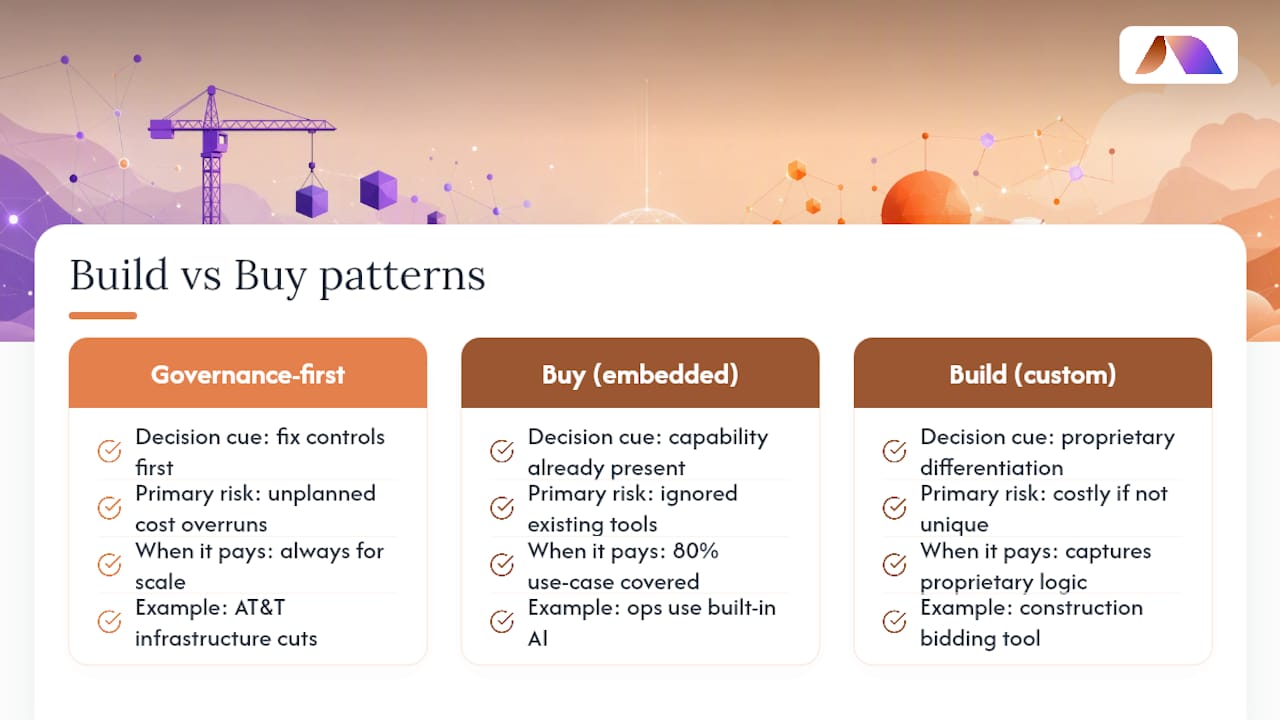
One instructive pattern from enterprise governance failures: organizations that scaled AI infrastructure without first fixing decision-making structure paid for it later in unplanned cost overruns. AT&T’s experience cutting AI infrastructure costs illustrates how governance gaps, not the initial build-or-buy call, drove the bulk of wasted spend. The lesson generalizes: the technology choice matters less than whether governance and cost controls were built in from day one.
On the buy side, embedded AI already sitting inside existing software often gets ignored while teams evaluate new vendors or plan a custom build. Many operations leaders discover AI capability already present in their current tools that solves 80% of the use case they were about to fund a project for.
On the build side, industry-specific tools show where custom development earns its cost. Contractors adopting AI estimating tools built for construction workflows succeed when the tool reflects proprietary bidding logic no generic vendor product captures. That’s differentiation paying for itself, not a build for its own sake.
Team BRDGIT Perspective: Lessons Learned
Three lessons repeat across nearly every engagement. First, the teams that skip the scorecard and go straight to building almost always discover the differentiation they assumed didn’t survive contact with real data. Second, “we’ll hire for maintenance later” is the most reliable predictor of an abandoned system within eighteen months. Third, boosting gets dismissed too quickly, usually by whoever wants to build something impressive rather than something useful. Watch for a team that can’t name specific proprietary data justifying a build. That’s a clear red flag.
Get Hands-On Help Deciding Build vs Buy AI
Running the scorecard in a spreadsheet is a start. Running it with engineers who’ve already sat through forty of these decisions is faster, and it’s why BRDGIT built its readiness assessment around fractional talent instead of a generic audit.

Fractional AI engineers step directly into latter steps of the framework: building the prototype, running the pilot against pre-set gates, and handing off a governance structure a team can sustain. This approach provides necessary technical capacity for the pilot phase, then scales down once the system is stable.
If you’re staring at a build vs buy AI decision right now and want a second set of eyes before you commit budget, book a fractional engineering engagement with BRDGIT and get the pilot moving inside weeks, not quarters.
Sources
The frameworks in this article draw on a small set of sources worth reading directly if you want the full context behind the numbers and recommendations.



