Published on
How to Build an AI Strategy for Your Local Service Business
TL;DR:
An AI strategy for local service businesses involves prioritizing workflows, preparing quality data, and establishing governance to maximize measurable outcomes. Implementing AI is most effective when starting with a data audit, testing one workflow, and scaling incrementally with transparent governance and clear metrics. BRDGIT offers fractional AI talent to help businesses assess, plan, and execute AI initiatives without full-time hiring.
An AI strategy for a local service business is a prioritized, sequenced plan that maps AI capabilities to measurable outcomes like improved lead capture, faster appointment booking, and better customer follow-up. It is not a list of tools. It is a decision about which workflows to automate or augment, in what order, with what data, and under what governance. The U.S. Small Business Administration frames it plainly: start small, test for real value, and treat ethical transparency as a baseline practice from day one.
The foundational elements of any solid AI strategy include:
Use-case selection: Which two or three workflows produce the highest return if automated?
Data readiness: Is your customer, scheduling, and financial data clean enough for AI to act on?
Tool compatibility: Do the platforms you choose connect to your existing CRM, scheduling, and accounting systems?
Governance: Who reviews AI outputs, handles exceptions, and monitors for errors?
Workforce education: Does your team understand what the AI does and why?
AI does not forgive organizational ignorance. A business that skips these foundations and jumps straight to deploying a chatbot will spend more time cleaning up mistakes than capturing leads.
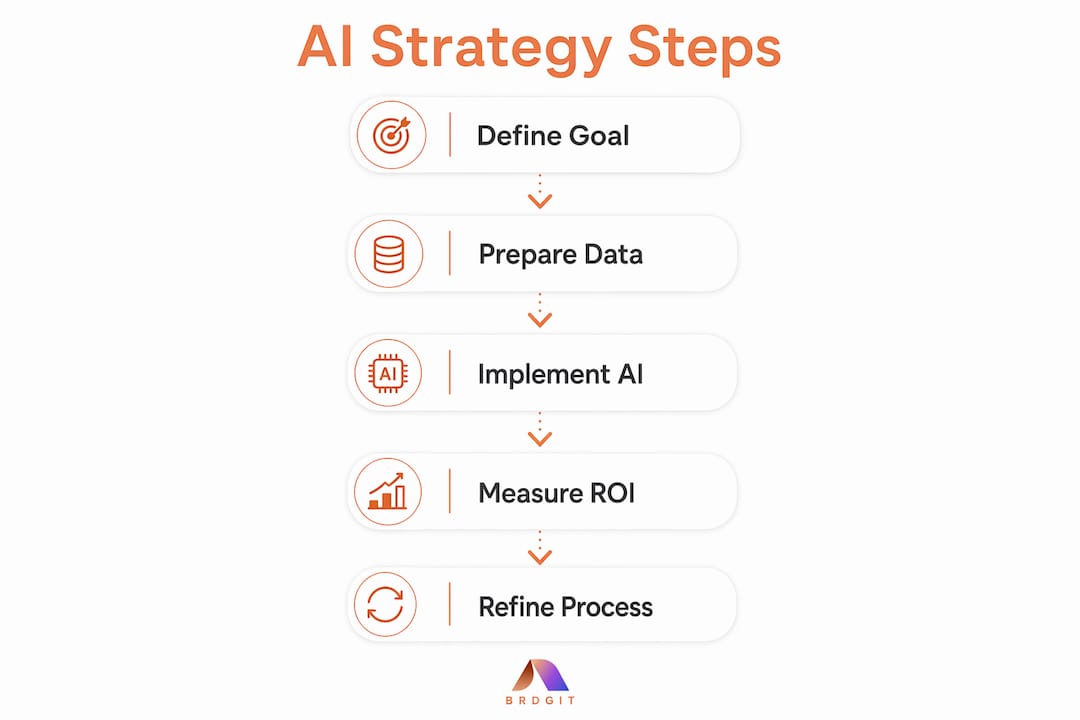
How to build an AI strategy for your local service business, step by step
Audit your operations and data first. Map every tool you use: CRM, scheduling software, accounting, communication platforms. Most AI failures trace back to disconnected data systems, not bad AI. Identify where data lives, who owns it, and whether it is clean enough to act on.
Identify your highest-friction workflows. Ask one blunt question: what costs you the most time each week while producing the least value? For most local service businesses, the answer is lead response, appointment reminders, or post-job follow-up.
Clean and standardize your data. Before any AI touches your systems, fix duplicates, fill missing fields, and standardize naming conventions. A one-week data cleanup produces more AI return than a month of tool evaluation.
Start deterministic, then add AI. Build workflows with hardcoded rules first, then replace rule nodes with AI decision nodes after you trust the logic. This prevents premature failures and builds team confidence incrementally.
Select tools that integrate with what you already use. Platforms like Zapier, Make.com, or n8n connect over 2,000 apps and include native AI modules. Choosing a tool that cannot connect to your existing stack creates the exact data silo problem you just audited away.
Run a real pilot on one workflow. Test with actual customer interactions, not internal assumptions. Track one metric: time saved per week. AI chatbots for local service businesses have captured additional after-hours leads, reduced no-shows, and increased reviews through automated follow-up, according to documented outcomes from real deployments.
Establish governance before you scale. Decide who approves AI-generated outputs before they reach customers. Document it formally. This is not bureaucracy; it is operational risk management.
Scale incrementally. Once the first workflow proves ROI, add a second. Confidence and data quality compound over time.
“The first day they showed up, they were like, ‘What even is this? I know nothing.’ Then, within the first three hours, they were building AI agents themselves. By the end of three months, they had an agent doing meaningful work for them.” — Nick Damoulakis, CEO of Orases, on McCutcheon’s Apple Products’ phased AI engagement
Why your team’s reaction to AI matters more than the tools you pick
Human resistance is the primary barrier to AI adoption, and fear of job loss sits at the center of it. Research confirms that phased engagement and upfront education reduce anxiety more effectively than any reassurance memo. The businesses that get this right treat education as the first deliverable, not an afterthought.
Practical steps that actually move the needle:
Introduce AI concepts before introducing AI tools. Give your team a month to understand what AI is and where it could help before anyone touches a live workflow.
Involve employees in use-case selection. When people help identify the problems, they are far less likely to resist the solutions.
Communicate transparently about what AI will and will not do. Specificity kills anxiety. Vague reassurances do not.
Celebrate early wins publicly. When AI saves your front desk two hours on a Tuesday, say so out loud.
Pro Tip: Designate an internal AI champion, ideally your operations lead or a department manager who owns a key workflow. This person becomes the bridge between the tool and the team, fielding questions, logging issues, and keeping momentum alive between formal training sessions. For guidance on training staff on AI tools, BRDGIT has published frameworks that apply directly to service business contexts.

Governance and ethics: the part most local businesses skip
Governance is not a large-company problem. For any local service business deploying AI in customer-facing workflows, the practical requirements are straightforward: restrict who can edit workflows, require human review for sensitive outputs, log AI decisions, and define who acts when something goes wrong.
Key governance practices worth building in from the start:
Role-based access controls on any AI system with write access to customer data or payment systems
Human review steps for outputs that affect customers directly, such as pricing estimates or appointment confirmations
Audit logs so you can trace what the AI did and when
Escalation paths that are documented, not improvised
The SBA recommends drafting a public statement disclosing how your business uses AI. No federal law currently requires this, but customer expectations are shifting. Businesses that disclose AI use in booking and follow-up workflows tend to see higher trust, not lower. Telling customers “our booking assistant will get you scheduled, and a team member will confirm details” increases completion rates in most markets. Transparency here is a competitive asset, not a liability.
How BRDGIT moves local service businesses from AI curiosity to real execution
Most local service business owners know AI could help. The gap is between knowing that and knowing exactly what to do on Monday morning. That is the gap BRDGIT was built to close.
BRDGIT’s approach starts with an AI readiness assessment that maps your current workflows, data systems, and team capabilities before recommending anything. From there, the path moves through strategy planning, phased implementation, and fractional AI staffing for businesses that need ongoing execution support without a full-time hire. The educational assets BRDGIT provides are not generic tutorials; they are built around the specific decisions local service businesses face, from why AI matters for local competitiveness to sequencing AI adoption across departments.
“BRDGIT’s fractional AI talent model means you get experienced execution capacity matched to your actual needs, not a retainer for advice you have to implement yourself.” — BRDGIT
For businesses that want deeper strategic advisory alongside implementation, AI strategy consulting can complement BRDGIT’s fractional model at the planning stage.
How do you measure the ROI of AI in a local service business?
Measurement starts before deployment, not after. Define one success metric per workflow before you go live. Time saved per week is the most honest starting point. Revenue impact follows once the workflow stabilizes.
Concrete metrics worth tracking from week one: lead response time, appointment no-show rate, review volume, and hours spent on manual follow-up. AI scheduling tools have demonstrated a noticeable reduction in no-shows within a few months in various implementations. Automated review requests have substantially increased the number of Google reviews businesses receive over several months. These are not projections; they are documented outcomes from real local service deployments.
Common pitfalls that derail AI adoption for small local businesses
The failure modes are predictable, which means they are avoidable. Over-automation too quickly is the most common: businesses deploy three or four tools simultaneously, nothing integrates cleanly, and the team loses confidence in all of them. The fix is one workflow, one tool, one month of honest measurement.
Data inconsistency is the second killer. AI agents depend on clean, connected data. If your CRM and scheduling system do not talk to each other, any AI layer built on top will surface errors, not efficiency. Hidden costs from poor planning round out the top three: tool subscription fees are visible, but integration work, data cleanup, and training time rarely make it into the initial budget. Account for all of them before committing.
BRDGIT gives you AI execution without the full-time hire
Local service business owners who have read this far know what needs to happen. The harder question is who does it, and how fast.
BRDGIT provides fractional AI talent that covers the full path from readiness assessment through live implementation and ongoing support. You get experienced AI professionals working on your actual workflows, not a slide deck and a handoff. For businesses that need fractional AI engineers without the cost or commitment of a full-time hire, BRDGIT matches the right expertise to your specific stage and goals. The engagement scales with your needs, whether that is a focused 90-day build or ongoing monthly execution support. Visit BRDGIT to start with a readiness assessment and get a clear picture of where AI can move the needle in your business this quarter.
Key takeaways
Building an effective AI strategy for a local service business requires clean data, governed workflows, and phased execution before any tool delivers consistent ROI.
Point | Details |
|---|---|
Start with a data audit | Map all connected systems and clean data before deploying any AI workflow. |
Pilot one workflow first | Track a single metric like time saved per week before expanding to additional use cases. |
Govern from day one | Define who reviews AI outputs, who has access, and what triggers a human escalation. |
Disclose AI use to customers | SBA recommends a public transparency statement; customers respond with higher trust, not lower. |
BRDGIT for execution support | BRDGIT’s fractional AI talent covers readiness assessment through live implementation without a full-time hire. |