Published on
AI Use Cases for Building Inspections: 2026 Guide
The most practical AI use cases for building inspections right now are drone exterior surveys, automated plan and drawing review, thermal and moisture imaging analysis, interior photo condition scoring, structural defect detection against BIM models, safety and PPE compliance monitoring, and AI-generated report drafting. Every one of them is deployable today, and every one of them requires a human professional to validate the output before it carries legal or contractual weight. The single most important next step: run a small, instrumented pilot that pairs AI outputs with human verification, measures precision and recall on your specific defect types, and uses your own inspection records as the ground truth. Standards bodies like RICS are explicit that AI should support professional judgment, not replace it. FAA Part 107 governs any drone operations in the U.S. BRDGIT helps teams design and execute those pilots without the guesswork.
The top use cases at a glance:
Drone exterior surveys for roofs, facades, and high-access areas
Automated plan review for code/spec cross-checks and clash detection
Thermal and moisture imaging for hidden insulation gaps and water intrusion
Interior photo scoring for condition assessment and defect flagging
Structural defect detection compared against BIM or digital twin data
Safety and PPE monitoring on active construction sites
Automated report generation with evidence bundles for inspector sign-off
Table of Contents
What are the main AI use cases for building inspections?
How do AI inspection systems actually work?
How does AI handle plan and drawing review?
What can drones and AI detect on building exteriors?
What does AI find in interior photo walkthroughs?
How does AI compare site conditions against BIM models?
Can AI monitor safety compliance on construction sites?
How do you run a 4–8 week inspection AI pilot?
BRDGIT supports building teams through every stage of inspection AI adoption
Key Takeaways
What responsible AI adoption actually looks like in practice
Useful sources and further reading
What are the main AI use cases for building inspections?
Use Case | Description | Typical Input | Output | Best For |
|---|---|---|---|---|
Drone exterior survey | AI analyzes UAV imagery for surface defects | Drone photos/video | Defect map, condition score | Roofs, facades, large portfolios |
Plan and drawing review | Cross-checks digital plans for code/spec issues | PDF/CAD files | Clash report, annotation gaps | New construction, permit review |
Thermal/moisture imaging | IR imagery processed for anomalies | Thermal camera data | Heat map, moisture flags | HVAC, envelope, electrical |
Interior condition scoring | Photo analysis for damage and wear | Smartphone/360° photos | Condition score, defect list | Multifamily, commercial leasing |
BIM/digital twin comparison | Compares site imagery against design model | Photos + BIM model | Deviation report, progress log | Large new-build projects |
Safety/PPE monitoring | Detects PPE absence and hazardous conditions | Site cameras/video | Alert log, violation summary | Active construction sites |
Automated reporting | Drafts structured reports from inspection data | Photos + metadata | PDF report, CMMS ticket | All inspection types |
A few clarifications on fit:
Interior scoring degrades fast without controlled lighting and consistent camera angles.
Plan review requires digital plan files; paper scans introduce OCR errors that compound downstream.
BIM comparison is most practical on large new-build projects where model fidelity is maintained throughout construction.
Safety monitoring works at scale but needs conservative alert thresholds and a human review loop.
How do AI inspection systems actually work?
Most inspection AI is built on computer vision with model-specific training. The core pipeline starts with image capture, runs through a detection or scoring model, and ends with structured output that feeds a report or a workflow system. Understanding the components helps you evaluate vendor claims and design a pilot that measures what actually matters.
The main building blocks:
LLMs for reporting: multimodal large language models combine image analysis with natural language to draft structured inspection narratives. Research on the AutoRepo framework shows multimodal LLMs paired with UAS data can generate regulatory-grade reports in field trials, reducing resource waste significantly.
One important distinction: Cambridge research on VLMs found that large pretrained vision-language models generalize well in zero/few-shot settings but need task-specific fine-tuning for reliable grounding. Closed-set detectors still outperform VLMs on strict localization tasks. That trade-off matters when you are choosing between a general-purpose AI tool and a purpose-built inspection model.
Pro Tip: The three data quality factors that matter most are image resolution (minimum 2 cm/pixel for crack detection), frame overlap (at least 70–80% for photogrammetry), and metadata completeness (GPS coordinates, timestamp, camera calibration). Missing any one of them degrades model output more than switching to a better algorithm.
How does AI handle plan and drawing review?
AI can automate cross-discipline checks and flag likely code or spec deviations from digital plan data, but it cannot certify compliance without a licensed professional’s sign-off. That distinction is not a caveat; it is the legal reality in every U.S. jurisdiction. What AI does well here is volume and consistency: it processes hundreds of sheets in minutes and surfaces the issues a human reviewer might miss on sheet 47 of 200.
Concrete outputs from an automated plan review:
Missing or inconsistent annotations and dimensions
Cross-discipline clashes (structural vs. MEP, architectural vs. structural)
Constructability warnings based on tolerance rules
Spec deviations flagged against a reference code library
Evidence bundles with sheet references for human follow-up
For a plan-review pilot, the metrics worth collecting are false positive rate (how often the AI flags a non-issue), review time saved per sheet, and the percentage of real issues the AI caught versus what a human reviewer found independently. Those three numbers tell you whether the tool earns its place in the workflow.
“AI should be used to support, not replace, the professional judgment of the surveyor. The surveyor remains responsible for the final assessment and must be able to explain and justify their conclusions.” — RICS guidance on responsible AI use in building surveying
What can drones and AI detect on building exteriors?
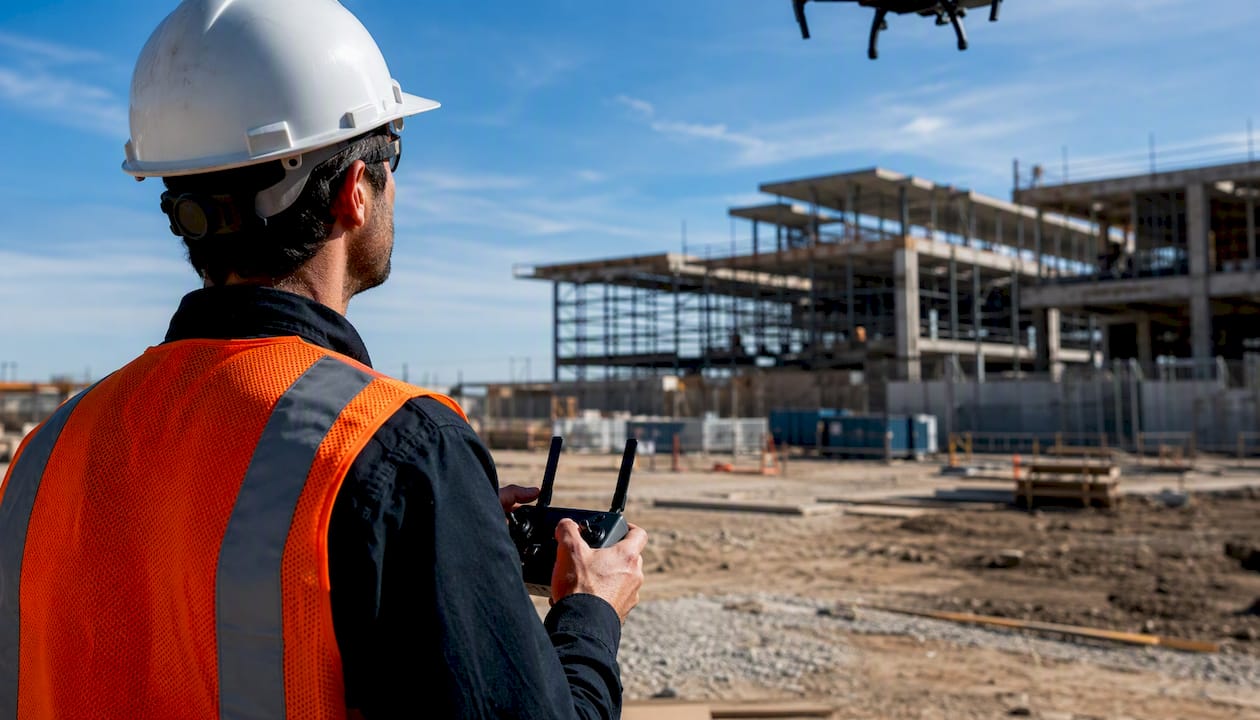
Drone surveys paired with AI reliably scale exterior condition coverage across roofing, facades, cladding, and large-area defects that would otherwise require scaffolding or rope access. For portfolio owners managing dozens of properties, that coverage shift alone changes the economics of routine inspection. MDPI case studies on UAV-AI integration confirm the approach works for facades and roofs but emphasize that flight planning, data capture quality, and privacy considerations are non-negotiable operational requirements.
Typical detections from drone plus AI workflows:
Shingle damage, membrane tears, and ponding water on flat roofs
Facade spalling, efflorescence, and cladding delamination
Corrosion on metal elements and missing or failed flashings
Thermal anomalies indicating moisture ingress or insulation failure
Structural cracks in concrete and masonry at scale
Pro Tip: Plan flight paths for 70–80% image overlap and fly at consistent altitude to enable photogrammetric 3D reconstruction. That model lets inspectors map defect locations to a spatial index, which is far more useful for maintenance prioritization than a flat photo gallery.
Stat: Hybrid AI-assisted inspections can reduce inspection time significantly and cut overall costs compared with manual-only approaches in portfolio scenarios compared with manual-only approaches.
For U.S. operations, FAA Part 107 certification is required for commercial drone flights. Residential properties carry additional privacy obligations; check state-level drone privacy laws before flying over occupied buildings. Practical guidance on drone inspection planning for building maintenance covers operational setup and privacy considerations in detail.
What does AI find in interior photo walkthroughs?
Interior photo scoring automates consistency and speeds reporting, but it struggles with occluded or non-visual issues: a loose fixture, a smell, a floor that feels soft underfoot. The camera sees what the camera sees. That boundary matters when you are writing a condition report that will inform a purchase decision or a lease renewal.
What AI reliably detects from interior photos:
Water stains, ceiling damage, and visible mold indicators
Flooring damage including cracking, lifting, and wear patterns
Door and window condition (gaps, hardware, frame damage)
Appliance condition and visible installation defects
Paint condition, wall damage, and finish deterioration
Data requirements are strict. Controlled lighting, consistent camera angles, and a defined photo capture protocol are prerequisites for reliable scoring. An inspector who shoots 15 photos in one unit and 40 in the next produces data the model cannot compare fairly. Standardized field capture protocols solve this before the model ever runs.
How does AI compare site conditions against BIM models?
AI can compare imagery or scan data against BIM models to detect deviations from design and track construction progress at scale. On a large new-build project, that means catching a missing fire-stop installation or a misplaced structural element before it is buried in the next trade’s work. The Frontiers research on BIM-integrated Smart Readiness Indicator calculations demonstrates how structured BIM data exchange can automate compliance-related assessments and reduce planning workload, with JSON-based workflows enabling floor-level verification.
Outputs from BIM comparison workflows:
Deviations from design geometry and specified materials
Missing installations flagged against the model’s expected elements
Schedule slippage indicators based on progress photography
Quantity take-offs for damaged or non-conforming areas
This use case requires good model fidelity throughout construction and a disciplined capture workflow. A BIM model that was accurate at permit stage but never updated during construction is not a useful reference. The technology is most practical on projects where the BIM is actively maintained and the site team captures regular progress photography on a defined schedule. AI estimating tools for contractors can support BIM-linked quantity and cost workflows alongside defect detection.
Can AI monitor safety compliance on construction sites?
Vision models and VLMs can detect PPE presence or absence and common safety violations at scale, but grounding accuracy and precise localization vary significantly by model and training dataset. The Cambridge study on VLMs evaluated against the ConstructionSite10k dataset found that large pretrained VLMs need task-specific training for reliable deployment on real construction sites. Zero-shot performance is promising; production-grade performance requires fine-tuning on site-specific data.
Typical safety monitoring applications:
Hard hat, vest, and harness presence/absence detection
Fall hazard identification (unguarded edges, open floor penetrations)
Unsafe material stacking and storage violations
Access control violations in restricted zones
Pro Tip: Set alert thresholds conservatively. A false negative on a PPE violation is a safety failure; a high false positive rate burns inspector trust fast. Build a human review loop into every safety-critical alert before any disciplinary or corrective action is taken.
How do you run a 4–8 week inspection AI pilot?
Start with a scoped pilot that limits liability, measures precision and recall on your target defects, and produces a go/no-go decision based on your data, not a vendor’s. A short, instrumented pilot is the fastest path to procurement confidence.
Pilot checklist:
Define the objective: one or two specific defect types or inspection tasks (e.g., roof condition scoring, PPE detection).
Select a representative sample: 20–50 properties or inspection events that reflect your actual portfolio or site conditions.
Establish a human baseline: have inspectors complete the same inspections manually before running the AI, so you have ground truth.
Collect standardized data: photos, drone imagery, or thermal scans captured under a defined protocol (resolution, overlap, lighting conditions).
Run the model and record outputs: defect flags, condition scores, and report drafts.
Measure accuracy: precision (how many AI flags were real defects), recall (how many real defects the AI found), and false positive rate.
Integrate outputs: route AI findings into your CMMS, CAFM, or asset register and measure workflow friction.
Set KPIs for scale-up: minimum acceptable precision and recall thresholds, time saved per inspection, and defect detection uplift versus baseline.
Timeline and cost guidance:
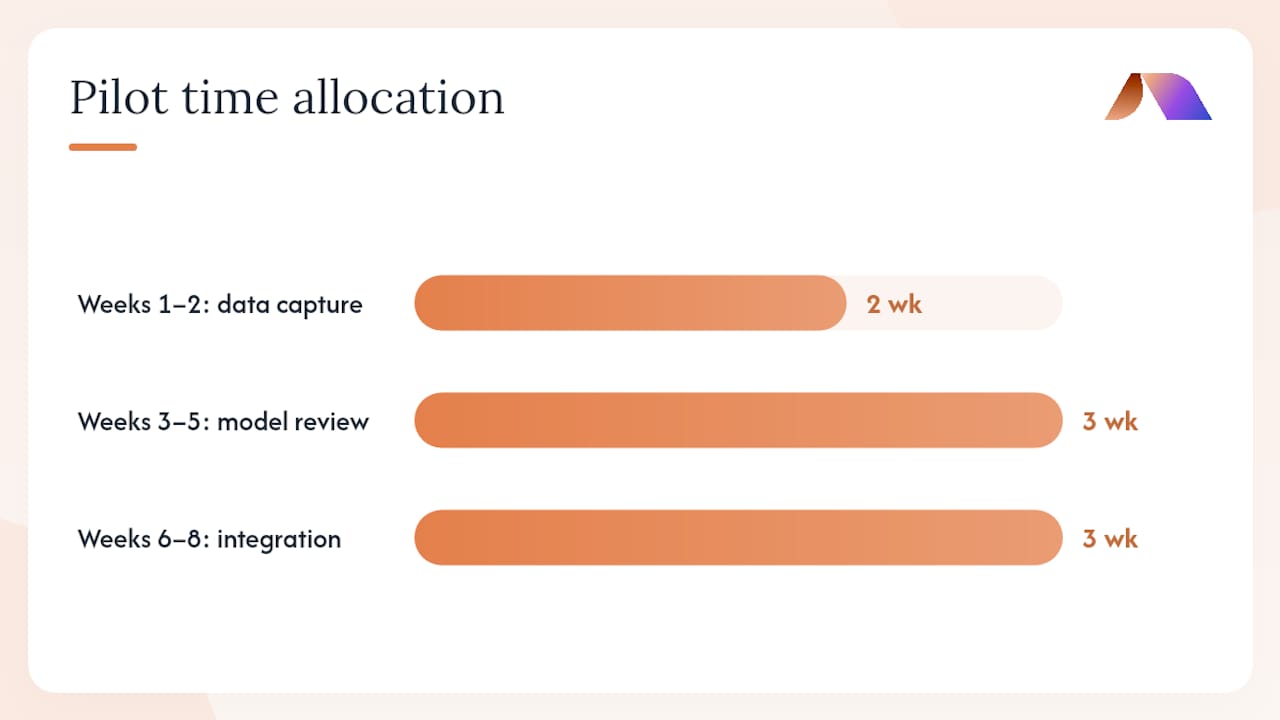
Weeks 1–2: data collection protocol, baseline human inspections, and data capture.
Weeks 3–5: model run, output review, and accuracy measurement.
Weeks 6–8: integration test, KPI review, and scale-up decision.
A small portfolio pilot covering 20–50 properties typically costs less than a single large-scale manual inspection campaign. The investment is in protocol design and measurement, not hardware. AI cost control tools can help track pilot spend against projected savings throughout the process.
BRDGIT supports building teams through every stage of inspection AI adoption

Running an inspection AI pilot without a clear data strategy and verification protocol is how teams end up with a vendor demo that never makes it to production. BRDGIT’s fractional AI engineers work directly with building owners, operators, and inspection teams to design pilots that produce real procurement decisions, not just proof-of-concept slides.
Concretely, BRDGIT supports inspection AI adoption by delivering data collection templates and capture standards, model validation frameworks with defined precision/recall thresholds, KPI dashboards that track pilot performance against human baselines, and integration support for CMMS, CAFM, and BIM workflows. For teams that need AI expertise without a full-time hire, the BRDGIT fractional engineering model provides experienced AI talent scoped to your actual pilot needs, from a single use case through to full workflow deployment.
The next step is straightforward: book a readiness assessment with BRDGIT to identify which inspection use cases fit your portfolio, what data you already have, and what a 4–8 week pilot would cost and measure.
Key Takeaways
AI inspection tools deliver real value today when deployed in hybrid workflows with human verification, and the fastest path to scale is a short, data-first pilot that measures precision and recall on your specific defect types.
Point | Details |
|---|---|
Top use cases ready now | Drone exterior surveys, plan review, thermal/moisture imaging, interior scoring, BIM comparison, safety monitoring, and automated reporting are all deployable today. |
Human oversight is non-negotiable | RICS and Perth AI Consulting are explicit: AI produces evidence bundles; a licensed professional validates and signs every load-bearing finding. |
Pilot first, then scale | A 4–8 week pilot measuring precision, recall, and time saved on 20–50 properties gives you the data to make a confident scale-up decision. |
U.S. regulatory obligations | FAA Part 107 governs all commercial drone operations; state-level privacy statutes apply to flights over occupied residential properties. |
BRDGIT pilot support | BRDGIT’s fractional AI engineers design and execute inspection AI pilots, including data standards, model validation, and CMMS/BIM integration. |
What responsible AI adoption actually looks like in practice
The conversation around AI in building inspections tends to split into two camps: vendors promising full automation and skeptics dismissing the technology as unproven. Both positions miss the practical reality.
The teams getting real value from inspection AI right now are not replacing inspectors. They are using AI to handle the volume work: photo triage, report drafting, exterior coverage at scale, and defect flagging that gets a human to the right location faster. The inspector’s judgment, professional liability, and signed report remain exactly where they belong.
What BRDGIT consistently recommends is treating your firm’s existing inspection records as the most valuable asset in any AI adoption process. That labeled historical data, built from years of real inspections on your specific property types, is what separates a model that performs on your portfolio from one that performed on someone else’s test set. Verification routines, sample review rates, and audit trails are not bureaucratic overhead; they are how you build the feedback loop that improves the model over time and protects you legally if a finding is ever challenged.
The urgency is real. Portfolio owners who build these data assets and verification standards now will have a compounding advantage over those who wait for the technology to mature further. It is already mature enough to deliver measurable ROI. The question is whether your organization is ready to capture it.
Useful sources and further reading
Responsible use of AI case study — Building surveying
Are large pretrained vision-language models effective construction safety inspectors?
Integration of unmanned aerial vehicles and AI for building inspections (case studies)
AI vs Manual Property Inspections Compared 2026
AI in building inspections, Mid-2026 | Perth AI Consulting