


Published on
Leaders: Run an AI Readiness Framework in 2–4 Weeks
An AI readiness framework is a structured model that scores your organization across core pillars, usually strategy, data, infrastructure, governance, and people, to reveal exactly where AI initiatives will succeed or stall. The immediate move is not a strategy deck. Run a 15-item scored check this week, identify your weakest foundation, and build a one-page readiness profile before you commit budget to anything larger.
TL;DR:
Organizations often underestimate the impact of weak data foundations, as poor governance and scattered spreadsheets limit AI success more than infrastructure or strategy.
A rapid 15-item checklist scored by cross-functional teams can produce a reliable readiness profile within two to four weeks, highlighting the weakest pillar for targeted action.
Benchmarking frameworks like AIRI and ITU are best suited for policy and cross-industry assessment, while Cisco and Microsoft tools focus on operational infrastructure and cloud deployment.
Addressing the weakest pillar first accelerates AI progress, with most organizations benefiting from a three-phase approach: stabilize, build foundation, and scale.
Leaders must prioritize change management, early pilots, and manager training over elaborate governance frameworks to ensure adoption and long-term success.
BRDGITTurn AI Readiness Into ActionBRDGIT helps leaders assess readiness, identify AI opportunities, build a roadmap, and move from evaluation to practical execution.Explore BRDGIT
Table of Contents
What Does an AI Readiness Framework Actually Measure?
How Do AIRI, ITU, Cisco, And Microsoft Compare?
How Do You Run An AI Readiness Assessment This Quarter?
How Do You Turn Assessment Results Into A Roadmap?
How Does BRDGIT Run A Readiness Assessment In Practice?
Leader Perspective: What Gets Readiness Assessments Wrong
How Can BRDGIT Help You Move From Assessment To Execution?
Sources
What Does an AI Readiness Framework Actually Measure?
Most frameworks converge on the same five pillars, even when the branding differs. That convergence matters: it means leaders comparing AIRI to Cisco’s index or Microsoft’s assessment tool are looking at variations on the same underlying map, not competing philosophies.
Strategy and business value. This pillar asks whether AI use cases connect to a specific revenue or cost outcome, not a vague ambition to “use AI more.” Good looks like a named executive sponsor, two or three prioritized use cases with dollar figures attached, and a stated tolerance for which risks are acceptable. Bad looks like a pilot with no owner and no metric beyond “see how it goes.”
Data readiness. Can the data that would feed a model actually be found, trusted, and accessed without a two-week ticket queue? Good means documented data lineage and a named data owner. Bad means three spreadsheets that disagree with each other and nobody sure which is current.
Infrastructure and tools. This covers compute access, integration paths into existing systems, and whether IT can stand up a pilot without a six-month procurement cycle. Good means cloud access already provisioned and API connections mapped. Bad means every new tool request routes through a ticketing system built for desktop software refreshes.
Governance and ethics. Who approves a model going into production, and what happens when it produces a wrong or biased output? Good means a lightweight review process and clear escalation. Bad means nobody has thought about it until legal asks after the fact.
People and culture. This is the pillar leaders most consistently underweight, and it’s the one CIO’s analysis of enterprise AI adoption identifies as the dominant failure mode. Organizational factors, change resistance, low trust in outputs, absent leadership sponsorship, tend to sink initiatives faster than any data pipeline problem.
Maturity gets scored one of two ways. Some frameworks use a 0 to 5 scale with five discrete levels; others use a 0 to 100 point scale mapped to bands. Cisco’s model, for instance, treats scores of 0 to 30 as “Laggards” and anything above 86 as “Pacesetters”, with several tiers in between. On a 0 to 5 scale, Level 2, often labeled “AI Ready,” is the target most frameworks recommend for typical organizations rather than the top tier.
Strategy: named sponsor, prioritized use cases, defined success metric
Data: documented lineage, accessible without manual extraction, owned by a named person
Infrastructure: provisioned compute, mapped integrations, no procurement bottleneck
Governance: review process for production models, escalation path for errors
People and culture: manager literacy, change sponsorship, front line trust in outputs
Here’s the part leaders skip past too quickly: a single low pillar constrains everything else. An organization can have excellent infrastructure and a well-funded strategy, but if data is scattered across ungoverned spreadsheets, every downstream initiative inherits that fragility. This is the weakest-link principle, and it’s the single most useful mental model in this entire field. Score high on four pillars and low on one, and your real readiness level is the low one, not the average.
How Do AIRI, ITU, Cisco, And Microsoft Compare?
Four frameworks dominate the current conversation among leaders trying to benchmark readiness, and they solve different problems. Picking the wrong one for your situation wastes the exercise before it starts.
AIRI (AI Readiness Index) is an open framework built for cross-industry benchmarking. It scores organizations on a 0 to 5 scale across five pillars mapped to fifteen dimensions, and it’s released under a Creative Commons CC BY 4.0 license, meaning any organization can adopt, adapt, and republish it without a licensing fee. AIRI’s own guidance recommends Level 2, “AI Ready,” as a sufficient target for most organizations rather than chasing the top of the scale. That’s a meaningfully different message than most vendor materials send, and it’s worth sitting with: the framework itself tells you not to overinvest in maturity you don’t need.
ITU’s AI Readiness framework comes from the International Telecommunication Union and takes a broader, more infrastructural view. Its 2024 to 2025 work identifies six technical readiness factors, including open data availability, research capacity, deployment support, standards adherence, open source engagement, and sandbox environments. ITU also built a pilot AI Readiness Enablement Toolkit designed for self-evaluation and regional customization, which makes it the strongest choice when a national policy body, industry association, or multi-stakeholder group needs a shared reference point rather than a single-company benchmark. Sandbox environments in particular let teams validate use cases without exposing production data, a detail worth borrowing even if you never touch the full ITU model.
Cisco’s AI Readiness Index takes a more operational, infrastructure-heavy angle. Its 0 to 100 scoring approach and named tiers (Laggards through Pacesetters) give leaders a fast way to see where they sit relative to peers, and the model leans into questions about production monitoring, role-based access, and rollback planning for deployed models. Organizations where infrastructure is the known constraint, manufacturing floors, distribution networks, anywhere compute and connectivity are genuine bottlenecks, tend to get the most direct value from Cisco’s framework.
Microsoft’s AI Readiness assessment takes yet another angle: pragmatic and cloud-operational. Rather than benchmarking against a global standard, Microsoft’s tool focuses on the mechanics of getting a model into production inside a Microsoft cloud environment, security posture, integration points, and operational monitoring. It’s the right tool when the question isn’t “how do we compare to the industry” but “how do we actually ship this pilot on the infrastructure we already pay for.”
The practical selection rule is simple: use an open standard like AIRI or ITU when you need benchmarking, board-level reporting, or policy alignment across departments or partners. Use a vendor assessment like Cisco’s or Microsoft’s when the immediate job is operationalizing a specific rollout on specific infrastructure. Many leaders get the best of both by doing exactly that in sequence, benchmarking first with an open model, then running a vendor-specific check once a use case is chosen.
Framework | Scope | Scale | Openness | Best for |
|---|---|---|---|---|
Enterprise, cross-industry | 0–5, five pillars, fifteen dimensions | Open (CC BY 4.0) | Benchmarking, target Level 2 | |
National / multi-stakeholder | Six technical factors, toolkit-based | Open, public report | Policy alignment, sandbox testing | |
Enterprise, infrastructure-heavy | 0–100 scale, named tiers | Vendor index | Infrastructure-constrained orgs | |
Microsoft | Enterprise, cloud rollout | Assessment checklist | Vendor tool | Operational cloud deployment |
How Do You Run An AI Readiness Assessment This Quarter?
You don’t need a six-month consulting engagement to get a usable answer. A lightweight, 15-item checklist mapped to five foundations produces a defensible one-page profile in two to four weeks, and it’s the same structure practical checklist guidance recommends for exactly this reason.
Score each item from 1 to 5. Group into five foundations, three items apiece:
Data is documented. Someone can point to a data dictionary or lineage map without searching.
Data is accessible. Relevant teams can pull what they need without a multi-week IT ticket.
Data is governed. A named owner is accountable for data quality and access decisions.
Infrastructure supports experimentation. Compute and integration paths exist without new procurement.
Infrastructure is monitored. Someone would notice if a system feeding AI initiatives went down.
Tools are already licensed or approved. Teams aren’t blocked by a shadow-IT policy fight.
Governance has an owner. A specific person or committee reviews AI use cases before launch.
Escalation paths exist. There’s a defined process for when a model produces a wrong or harmful output.
Compliance requirements are mapped. Legal and regulatory obligations tied to AI use are documented, not assumed.
Leadership sponsorship is visible. An executive has publicly committed time and budget, not just approval.
Managers understand AI basics. Middle management can explain, in plain language, what the pilot actually does.
Front-line staff trust the tools. Adoption resistance has been surfaced and addressed, not ignored.
A change communication plan exists. People affected by the rollout know what’s changing and why.
Use cases connect to business value. Each pilot ties to a specific metric leadership already tracks.
Success criteria are defined before launch. Nobody is deciding what “working” means after the fact.
Compute an average for each of the five foundations separately. This is the step people get wrong most often: do not average across foundations. A 4.5 average across fifteen items can hide a foundation scoring 1.5, and that low foundation is your real ceiling. Name the weakest foundation explicitly. That’s the number that goes at the top of the one-page profile, not the blended score.
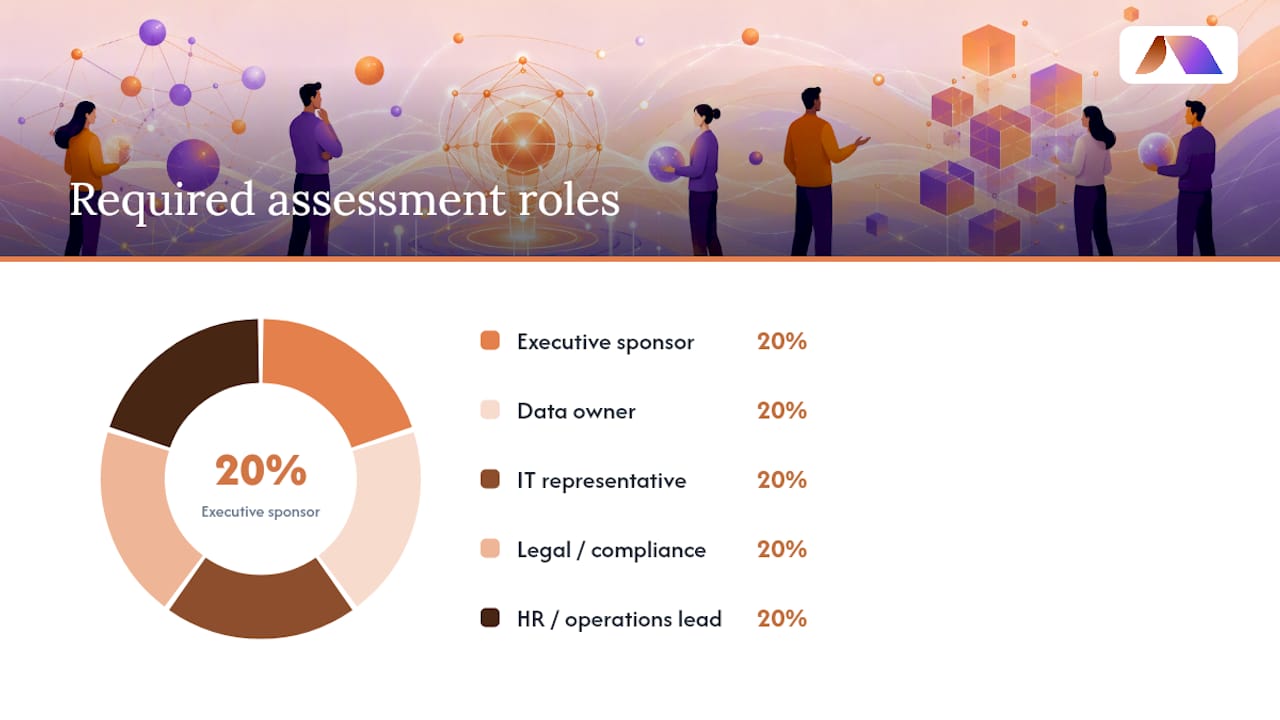
Involve five roles at minimum: an executive sponsor who owns the outcome, a data owner who can speak honestly about pipeline quality, an IT representative who knows the real infrastructure constraints, someone from legal or compliance, and an HR or operations lead who understands the people side. Skipping the HR seat is a common mistake. Given that organizational factors are frequently the biggest hurdle, per CIO’s reporting on enterprise AI misconceptions, leaving culture and change readiness out of the room defeats the point of the exercise.
Budget two to four weeks for a lightweight version. The deliverables are a one-page readiness profile showing all five foundation scores, the named weakest link, and a prioritized gap list ranked by effort and impact. A detailed breakdown of what a full assessment involves covers the deeper version of this process for organizations that want more rigor than a self-run checklist provides.
Pro Tip: Run a 90-minute cross-functional workshop to validate the numeric scores before finalizing them. Self-assessment scores drift, usually upward, when nobody in the room has to defend the number out loud. A workshop surfaces disagreement fast, and disagreement is often more informative than the score itself.
How Do You Turn Assessment Results Into A Roadmap?
Fixing the weakest foundation first isn’t just tidy methodology. It’s the fastest route to visible impact, because organizational readiness behaves like a chain: world-class infrastructure cannot compensate for a data foundation nobody trusts, and a brilliant strategy document cannot compensate for managers who have never used the tool they’re supposed to champion. Spending on the strong pillars first is money that produces no additional readiness, because the weak pillar caps what the whole system can deliver.
A three-phase structure works for most organizations, regardless of size:
Stabilize (0 to 90 days). Fix the operational fixes that don’t require new budget: clean up data access permissions, name a governance owner and run the first manager training session. This phase is cheap and fast, and it’s where most of the “quick win” energy should go.
Build foundation (90 to 365 days). This is where real investment happens: formal data pipelines, a written governance policy, structured training programs, and the first properly scoped pilot tied to a business metric.
Scale (beyond year one). Monitoring infrastructure, MLOps practices, and a continuous learning loop that lets the organization take on a second and third use case without repeating the readiness work from scratch.
Budget shapes vary predictably by size. Smaller organizations often run initial phases primarily with internal effort and modest external support, while mid-sized organizations typically allocate a project budget for foundational work such as data engineering and training programs. Larger enterprises often coordinate these efforts across multiple business units with central governance involvement.
RACI clarity matters at every size. A common failure pattern is a stabilize phase with no single accountable owner, where five people are “involved” and nobody is actually responsible for the deliverable. Name one accountable owner per phase, even in a five-person leadership team, before the roadmap gets scheduled.
How Does BRDGIT Run A Readiness Assessment In Practice?
BRDGIT’s process for organizations moving from AI curiosity to real execution starts with intake and stakeholder interviews, not a slide deck. The goal in week one is understanding the actual business problem before anyone talks about tools.
The engagement typically follows a consistent structure:
Intake and stakeholder mapping. Identify the executive sponsor, data owner, and functional leads who need a seat at the table.
Scored checklist and data review. Run the same kind of five-foundation scoring described above, grounded in real access to systems rather than guesswork.
One-page readiness profile. A clear summary naming the weakest foundation and the specific gaps behind it.
90-day priority roadmap. A phased plan focused on the stabilize actions that produce visible progress fastest.
For teams that need ongoing capability rather than a one-time report, fractional engagement models can provide fractional AI engineers, hands-on training sessions, rapid pilot builds, and governance templates the organization can reuse for its next use case. This is deliberately framed as capability access rather than a guarantee of specific outcomes; every engagement is scoped to the organization’s actual gaps, not a fixed package.
Pro Tip: Ask any assessment provider, BRDGIT included, to show you the one-page profile format before the engagement starts. If a provider can’t show a sample deliverable, you’re likely buying a lengthy report instead of a decision-ready summary.
Leader Perspective: What Gets Readiness Assessments Wrong
The mistake we see most often isn’t a technical one. It’s treating AI readiness as an IT project, then wondering months later why adoption stalled despite a technically sound pilot. Skipping change management is close behind: leaders assume that if the tool works, people will use it, and that assumption is usually wrong.
The other recurring error is overcustomizing before the first pilot even ships. Teams spend weeks perfecting a governance framework for a use case that hasn’t been tested yet, when a lightweight pilot would have surfaced the real requirements in days.
The corrective pattern that actually works: name one sponsor, run a small pilot fast, and put training budget into manager literacy before infrastructure spend. One team we’ve seen described in similar assessments skipped the elaborate rollout plan entirely and instead spent two weeks getting one manager fluent enough to champion the tool to their own team. That single decision moved adoption faster than the six-month infrastructure plan sitting in the drawer beside it.
— Team BRDGIT
How Can BRDGIT Help You Move From Assessment To Execution?
BRDGIT is built for the gap between knowing your readiness score and actually closing it, without the overhead of hiring a full-time AI team you may not need for another year. Where an open framework like AIRI gives you the benchmark and a vendor tool gives you the operational checklist, BRDGIT gives you the people who actually run the assessment, build the roadmap, and staff the early pilots on a fractional basis, so the weakest foundation gets fixed by someone who’s done it before, not by a spreadsheet sitting in a shared drive.

The services map directly onto everything covered here: readiness assessments scored against the same five-foundation structure, AI strategy work that ties use cases to business value, workflow automation and custom AI systems once the foundation is solid, staff training that addresses the people pillar directly, and fractional AI engineering for teams that need real delivery capacity without a full-time hire. A typical starting engagement runs as a two to four week assessment followed by a 90-day delivery plan, mirroring the stabilize phase described above.
If your organization has a rough sense of where it’s weak but no bandwidth to fix it internally, the practical next step is a conversation about fractional support. Visit the BRDGIT fractional engineers page to see how an initial engagement is scoped and request a starting conversation.
Sources
ITU AI Readiness study and AI-RE Toolkit (preliminary report)
CIO: Beyond the hype — misconceptions derailing enterprise AI adoption



